

AI has moved from experimental to essential. GenAI is the new battleground—every product team is racing to embed it, ship faster, and stake their claim.
But while the pressure to launch is real, so is the fallout from rushed, messy rollouts.
I have seen ideas with genuine potential fall flat—not because the problem wasn’t worth solving, but because the process failed them.
"In today's AI landscape, there's a critical difference between movement and momentum. Movement is shipping features because everyone else is. Momentum is deliberately building solutions that solve real problems. It's not about doing more, faster—it's about doing what matters, in the right order."
I believe great AI products aren’t built on hype or horsepower—they’re built on habits. The habits of alignment, validation, and iteration are what separate long-lasting impact from launch-week headlines.
Let’s break it down.
1. Validate the need for AI before you build anything
Not every problem needs an intelligent solution. Sometimes AI adds complexity without adding value.
- Can a heuristic or rule-based system solve this just as well?
- Where are current methods failing?
- Is AI necessary for the whole flow—or just one part?
Example: Many itinerary planners now tout GenAI features, yet a structured form-based approach often better addresses the user need. In these cases, AI feels like flash, not function.
2. Align the team—early and deeply
Before you touch code or data, align your stakeholders: product, engineering, data science, design, and business.
- Clarify the "why now" and the intended outcome
- Invite feedback and iterate on the concept together
- Find a respected champion who can help unify perspectives
Watch out: Features often get delayed by weeks when infrastructure or performance stakeholders raise latency concerns—if not aligned early, these findings may come when architectural changes are no longer viable.
3. Build a prototype—stay lean, learn fast
It’s tempting to sprint toward a polished solution. But fast doesn’t mean right. A lean prototype lets you test value before scaling effort.
- Start small—use heuristics, mocks, or rule-based stand-ins
- Test with early adopters or pilot group of early users
- Seek feedback from beyond your core circle to avoid blind spots
Pro tip: Treat internal testing like a launch. Get brutally honest feedback, not polite head-nods. E.g. don’t validate just with your usual group of stakeholders, reach out to wider teams- find the right people, create a clear guideline on the expectations, share that and have a group of stakeholder’s sign-up.
4. Define your North Star and guardrails
Metrics guide behavior. Choose wisely.
- Pick one primary success metric and make it non-negotiable
- Acknowledge tradeoffs: not every KPI can win
- Use qualitative feedback to complement A/B tests—don’t rely on numbers alone
Partner with UX researchers who can reveal insights data might miss. The “why” is just as important as the “what.”
5. Design the full experience, not just the output
Users don’t experience models. They experience interfaces, moments, and emotions.
- Develop the UX alongside the model—not after
- Design for AI failure states: fallback logic, user control, transparency
- Prioritize delight and simplicity
Example: You might have tested out the popular “Ghibli Mode” image generator that is fun not just because the model is great—but because the flow is frictionless. One prompt, one tap, one image to save. Imagine if it required a separate tool to download—that’s the difference between a 1% and a breakout feature.
6. Iterate relentlessly post-launch
AI products are never “done.” Post-launch is where true learning begins.
- Monitor for model drift, edge case behavior, and trust-breaking moments
- Capture both user signals and model telemetry
- Schedule ongoing refinement loops—don’t leave it to chance
Launch is the start of the journey, not the finish line. More often than not the initial launch or MVP will require a series of iterations before you truly have hit the mark.
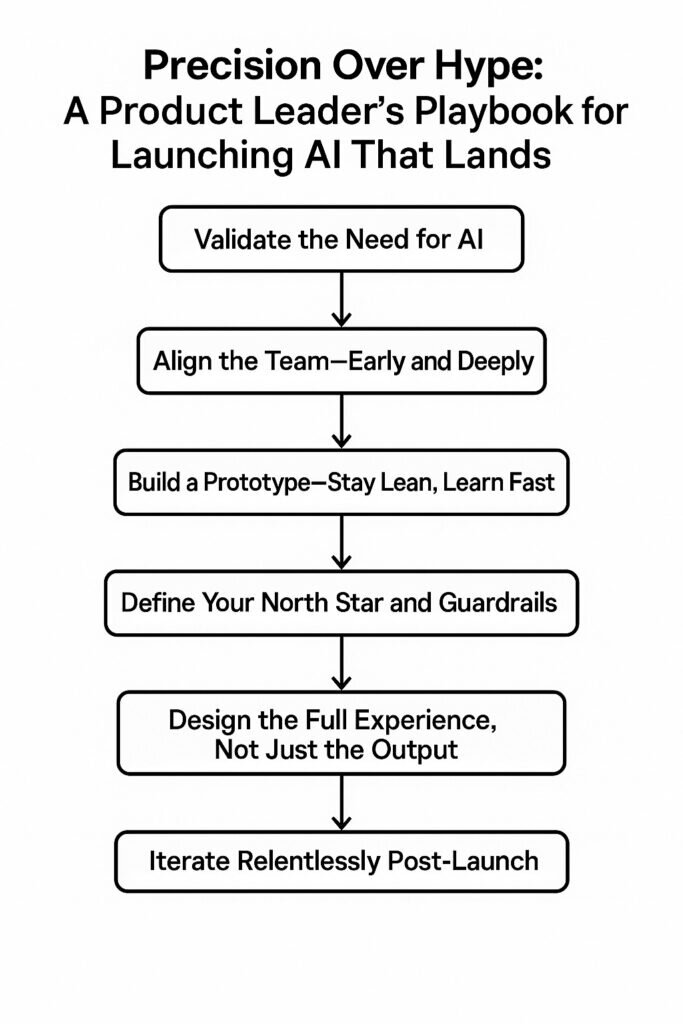
A Blueprint for confident AI launches
| Stage | Key Question | Execution Tip |
|---|---|---|
| Validate | Do we need AI at all? | Test heuristics first, prove the delta |
| Align | Are we solving the right problem? | Loop in all stakeholders, early and often |
| Prototype | Will users care? | Stay lean, test beyond the core circle |
| Define | What does success look like? | Pick one North Star, define acceptable tradeoffs |
| Design | Is this usable and delightful? | UX + ML together, design for failure |
| Iterate | Are we learning post-launch? | Plan retrains, collect signals, evolve features |
Closing thought: Don’t just ship. Steer.
The best AI launches I’ve seen didn’t just ship quickly—they shipped deliberately.
Not everything needs to be AI. But if you choose to go there, go in with purpose, alignment, and humility.
As the AI landscape continues to evolve at breakneck pace, teams that master this disciplined approach won't just survive the hype cycles—they'll thrive through them.
Because in the end, precision—not speed—is what makes your product unforgettable.

Keep reading
Wizard of Oz vs Concierge Testing: Behind the curtain or behind the desk
Designing safe conversational AI: The risks product managers overlook
What a 3-day hackathon taught me about product discovery
The brandbook MVP