


We’ve all felt the shift — AI has touched every part of our work as product managers. From rewriting emails to running large-scale evaluations, no team or function has remained untouched. Whether you're building for businesses or consumers, product managers who treat AI as a true execution partner are redefining what product success looks like today.
Part 1: AI’s impact on B2B product management
How AI is transforming day-to-day B2B product practices
Modern product managers are surrounded by AI tools that are rapidly becoming essential to how we work. Generative AI has been a breakthrough, helping us draft documents, analyze data, and brainstorm ideas in minutes. A 2024 McKinsey study even found that product managers using GenAI accelerated time-to-market by ~5% over a typical 6-month cycle.
But it goes far beyond this. AI-powered predictive models are starting to feel like a sixth sense for product managers. In B2B, tools can now analyze complex usage patterns, customer behavior, and feedback at scale, surfacing insights we might not catch on our own. For instance, product managers are using AI to forecast churn risk before it becomes obvious, helping them engage vulnerable accounts with the right feature nudges or support. Others are using it to flag upsell-ready customers by identifying power users or usage signals tied to higher-tier plans. This shift is elevating our analytical sense, especially around pattern recognition and probabilistic thinking.
Similarly, AI can track how features are performing in real time. If adoption is low or users are getting stuck, the system can alert the team instantly long before a complaint shows up in support tickets or NPS scores dip. In B2B platforms, where one confused admin can impact hundreds of end users, this kind of insight can be the difference between retention and churn. These kinds of insights help PMs not just react faster, but proactively shape their roadmap and make sharper prioritization decisions. Instead of guessing, we’re working off a rich, evolving layer of data. It’s a clear example of how AI enhances both product sense (by revealing unmet needs) and critical thinking (by encouraging fast, informed judgment).
AI is also transforming how we build. From automated testing that runs 24/7 to generating working code or UI mockups from simple prompts, product teams are saving time and boosting quality. Enterprise-grade tools now support AI-generated regression testing across sandbox environments, helping B2B teams meet compliance and uptime standards more efficiently. Even user research and product marketing are being reshaped with AI clustering feedback, drafting surveys, or generating copy at scale. All of this strengthens our execution sense, reducing time spent on grunt work and allowing us to focus on project flow, problem solving, and strategic alignment.
And the best part? Many of these tools don’t require deep ML expertise. Product managers are getting 2x the productivity boost from general-purpose tools like ChatGPT, Perplexity versus specialized ML platforms. The ecosystem is maturing fast with AI copilots emerging for everything from roadmap drafting to customer insights. These copilots even improve influential communication by helping product managers write clearer memos, persuasive internal updates, or polished customer messaging.
The bottom line: AI isn’t just a tool in the PM toolkit — it’s becoming the foundation. The next generation of product teams will be AI-native, using it intuitively at every step, from product vision and strategy to hands-on execution.
How AI is reshaping B2B organizational structure and team practices
AI is changing how product teams are structured and how they work together.
One shift is the rise of dedicated AI PM roles. These PMs focus specifically on AI-powered features and need to be fluent in topics like data science, model selection, and AI ethics. Over time, this may just become part of every PM’s skill set — but for now, it’s a valuable specialization, especially in complex B2B products.
We’re also seeing tighter integration between product and data teams. Data science is no longer a hand-off function. Product managers are staying in the loop throughout the AI lifecycle, from shaping training data and evaluating models to aligning outputs with customer needs. In many orgs, data scientists or ML engineers now work directly inside product squads, or at least in fast-moving workflows with PMs.
Another shift: AI is giving small teams a big advantage. With the right tools, a lean squad can move faster than a large one, so we’re seeing more autonomous pods forming, each led by a product manager who is augmented by AI. New roles are emerging too, like AI UX specialists or AI ethicists, who help ensure that AI-powered features are usable, ethical, and aligned with business goals.
Ultimately, orgs that treat AI as foundational, not just a bolt-on, are moving faster. Many companies are now building internal AI tools like ChatGPT-style assistants powered by proprietary data to give employees instant access to insights across functions. It’s a clear sign that AI is being embedded into day-to-day operations, not kept in isolated innovation labs.
In short: AI is pushing product organisations to become more experimental, cross-functional, and data-driven. Product managers are right at the center of that shift.
Part 2: AI’s impact on B2C product management
How AI is reshaping the B2C customer experience
In B2C product management, AI is not just a new tool. It is changing how we build, scale, and connect with customers. When you are operating at massive scale, personalization, speed, and adaptability are not nice-to-haves. They are expected. PMs who integrate AI into everyday decision-making are moving faster and building stronger customer relationships. In B2C, hyper-personalized experiences are directly linked to higher customer satisfaction, loyalty, and engagement, making AI not just an advantage but a necessity for sustained growth.
The most visible impact of AI in B2C is on the customer journey itself. AI powers personalized recommendations, dynamic user interfaces, tailored promotions, and contextual content that adapts in real time to individual preferences. These experiences are no longer seen as delightful extras. They are core to customer expectations.
Conversational AI is also expanding the customer journey. AI-powered shopping assistants can now answer product questions, recommend complementary items, and guide users through complex buying decisions without the need for human intervention. In the health and wellness space, AI-driven nutritional trainers are helping customers monitor dietary habits and set personalized fitness goals. These capabilities create deeper engagement, loyalty, and satisfaction well beyond a single transaction.
As the line between marketing, product, and service continues to blur, PMs are tasked with delivering experiences that are not only functional but emotionally resonant, at scale, and often in real time.
Building B2C products faster, smarter, and more responsibly
AI is reshaping how B2C products are built across every major step of the product development lifecycle.
In discovery, AI tools surface behavioral insights, emerging trends, and unmet needs much faster than traditional research. Product managers can validate ideas, identify new segments, and prioritize features in days instead of months.
During design, AI accelerates iteration by assisting with content generation, design variant creation, and persona-driven testing strategies. According to PwC’s 2025 report, adopting AI in product development can reduce time-to-market by up to 50% and lower costs by 30%. This competitive advantage is becoming increasingly important in fast-moving consumer markets.
In testing, AI-driven optimization methods like Multi-Armed Bandit testing allow teams to learn in real time, shifting live experiences based on actual engagement. AI-generated segmentation models improve targeting precision, making testing cycles sharper and more impactful.
Across all stages, ethical alignment is crucial. As AI drives deeper personalization, product managers must ensure transparency, fairness, and privacy protection. Collaboration with compliance, legal, and brand teams is no longer optional. These partnerships must be embedded early in the development cycle to ensure AI-driven products meet evolving customer expectations and regulatory standards.
The result is a product development process that moves faster, adapts better, and demands a deeper level of cross-functional collaboration to succeed in an AI-powered world.
Redefining how B2C teams work
AI is also redefining how B2C teams operate internally. Small, cross-functional squads are achieving more by leveraging AI tools that automate insights, streamline content workflows, and enable dynamic segmentation.
B2C organizations that embed AI across product, marketing, and operations are moving faster and serving customers better. The real differentiator is how these organizations are evolving their collaboration models. Product managers are expanding their working circles beyond the traditional trio of product, design, and engineering. Strong partnerships with compliance, legal, and brand teams are now foundational to shipping customer experiences that are innovative, compliant, and brand-aligned from day one.
In this new environment, Product managers are not just shipping features. They are balancing technological advancement, customer delight, and long-term trust — and doing it at a pace that sets them apart.
Bridging B2B and B2C: Cross-pollination and shared learnings
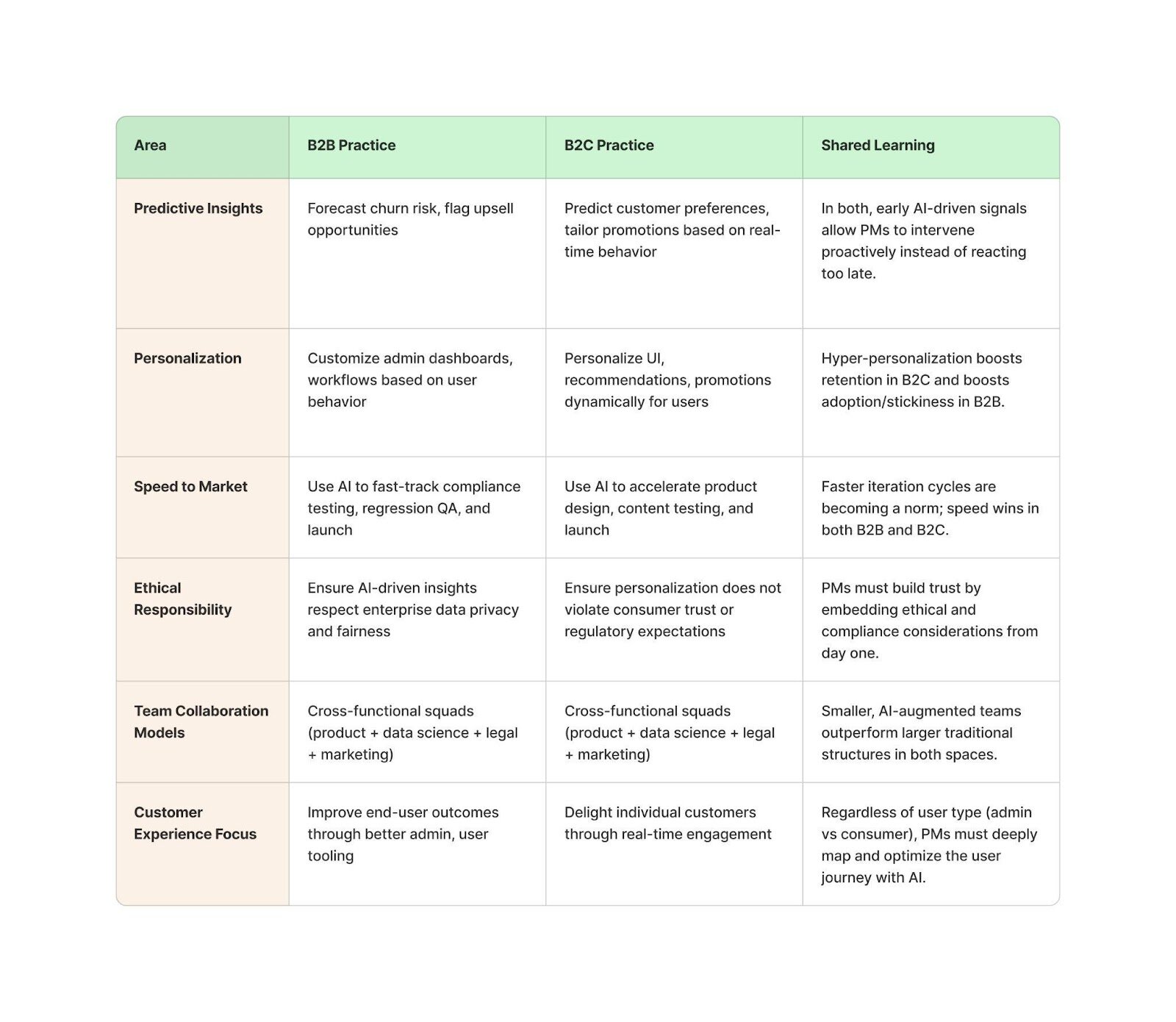
While the impact of AI on B2B and B2C product management looks different on the surface, many of the underlying lessons are transferable. The table below breaks down key takeaways across both domains and how product managers can apply these learnings to build smarter, faster, and more responsible products, regardless of audience.

Keep reading
Eight lessons from my transition from B2C to B2B Product Management
The hallmarks of good and poor B2B product teams
6 ways for product managers to drive GTM outcomes in B2B companies
What B2B companies can learn from Duolingo's growth strategy