

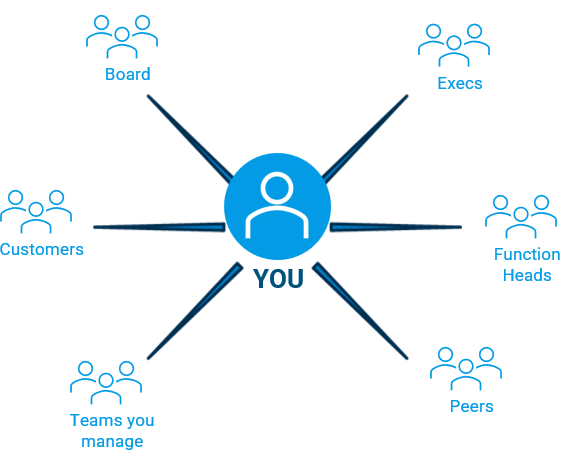
As you advance to more senior product leadership positions, your priorities increasingly align with business success. More than ever, it is essential to unite and influence individuals at all levels to achieve that goal. Over the last 20 years in product leadership, I’ve learned that success isn’t just about product knowledge—it’s about influence, business impact, and people. Here are six key lessons that will accelerate your leadership journey.
Your job is to drive performance
As you progress in your career, you get to manage a team, maybe multiple teams. You may be excited at that prospect. Perhaps a little scared! It’s natural that as a new leader, you want to be respected and liked… But your job isn’t to be liked—it’s to drive performance. Of course, that doesn’t mean being harsh or unfair, but it does mean making tough decisions, ensuring the right team is in place, and setting high standards. This is perhaps the first big hurdle of people leadership.
Don’t hire or keep people just because you like them. Because they have been there forever. Because you and them “do product” in a similar way. Instead, figure out what skills you have in the team, and which are lacking. Is it data fluency, voice of customer, discovery, or road mapping? There are plenty of tools out there that can help you in this assessment, such as the product competency toolkit by Ravi Mehta, or the PMwheel by Petra Wille.
Make it your job to train people in any missing skills so your team can handle the challenges ahead and deliver not just features but business impact. And yes, be ready to considerately let people go, sometimes.
Your peers are your team
As you become more senior, you will start to be responsible for multiple products, and then onto portfolios of products. More and more, you will interact with and rely on your peers. As in, other product leaders in the business.
In a previous role, I started a “Friday chat”. Every Friday, four of us dialled in from different cities, different countries, and would take 30 to 60 minutes out of our schedule for each other. Sometimes, it did feel like therapy! Venting… But other times, it was hands on. One of us would seek the others’ advice.
“Have you had trouble with XYZ?”
“What worked for you?”
“I tried this, but it wasn’t quite right.”
And we’d work through things together, being each other’s accountability partners. They were my team. The people who supported me, who motivated me, who had my back beyond our common boss. And vice-versa, I was there for them.
Speak cross-functional languages
Your world keeps evolving, you’re probably a director by now. The cross-functional collaboration that you’ve been practising for a while becomes more and more important and goes wider in the organisation. Across Tech, Sales, Marketing, Finance, Legal, Services, etc.
Now remember, we have our lingo in Product. So do other teams. Make an effort to learn theirs so you can really connect. Phil Hornby said it well – you have to “translate from each of these teams to each other”. It’s like learning a foreign language, and we need to practise. Do you speak “sales”?! Bookings, billings or even marketing SQLs.
Finance was the toughest language for me to learn, and I know I’m not alone. My advice? Start by learning to read a P&L, even if you don’t have P&L ownership yet. It’s a small step that makes a huge difference in strategic conversations.
Be a business ambassador
As you progress in your career, you start to interact with more senior people on the customer side. Their senior execs, even. Again, you must speak their language. For example, in what way does your team’s work, that latest release you’re all so proud of, how does that help the customer exec achieve their company goals?
When things go wrong—and they will—you will be on escalation calls, leading the calls. Many calls, possibly at random times of the day or the weekend. Remember… When you speak, you are an ambassador for your company. It’s We and Us. Never They, He, or She. Never throw colleagues under the bus, whatever happened! It’s “Us” who failed the customer. We are a united front, working on root causes, intent on resolving the customer’s issue, quickly and properly.
It’s not all dealing with issues. Rejoice when you step on stage to represent the company at an industry event, feel the excitement of an in-person bid defence, put your best foot forward at a customer governance meeting. Being a business ambassador will make you a more rounded professional and trusted product leader.
Drive and influence execs and the board
As a VP, you may interact with your CPO, other executives and the board. For example, with regular updates on your portfolio metrics or strategy, including asks you have for the C-suite and why. Go beyond that! Set up regular 1:1s with execs, not just your CPO, but the CRO, the CMO, the CEO. Ensure they know you, your motivation, your contribution to the company’s success. Ask for their input, for example on your product strategy. Establishing this rapport will pay many dividends and make for a collegial work environment.
As a CPO, you want to go a step beyond and drive cross-departmental initiatives. To influence other execs and the board about company direction, for example.
It doesn’t stop with you. Coach those more senior in your team to interact with execs, too, as part of their own career journey. When interacting with execs and the board, my advice is always: “Less is more”. I remember a time when we had a big roadmap review with the C-suite on a particular new product. There were some follow-up questions. Rather than getting those details and passing them on, I asked my PM to email the C-suite directly. I reminded her that less is more. Answer the questions succinctly, in business terms. As in, what does it mean for the company’s bottom line, their competitive edge? No fluff! If they want more details, they’ll ask.
Take control of your own career
Nobody will ever tell you to work less! Even the most supportive boss won’t manage your career for you. You have to own it—your growth, your well-being, and your path forward.
Here’s my take on what that entails.
- Find your tribe
Find your tribe, those who understand what you go through every day. Those who are a step or two ahead of you and happy to share their learnings. It could be your peers at work like the “Friday chat” story I mentioned earlier. Chances are, you will also meet like-minded people and potential mentors at product meetups, community events, or conferences; in person or online. For example, ProductTank meetups, or communities like MindTheProduct, CPO Track, or Sidebar. The important thing is to take those opportunities to make connections that last. Go for a coffee, for a chat. Share valuable insights. Allow yourselves to be vulnerable in your sharing.
- Keep relevant
Make sure that you keep relevant to a multitude of topics. Remember the comment before about us needing to be polyglots? Upskill in hard skills, with courses on Reforge, Hustle Badger, or Maven. Branch out to other topics of interest like business and AI, with folks like the Section School, and The Singularity University. And many more alike! Granted, most of these things come with a price tag. Call it an investment in You, in your career. But of course, be wise with your money! Choose what you need at the stage you are at in your career and can afford.
- Work on body and mind
What doesn’t have to cost you anything, or little money, is to work on your body and mind. Press-ups, meditation. At home, at a gym. But also, getting healthy routines. We often hear that it’s good to disconnect. I agree! But you don’t need to go to faraway places or climb Everest to find your inner peace. I try to go for a walk every day. Even if just for half an hour in between meetings. It clears my head! But even indoors—at the office or at home—force yourself to have a break every so often. I find that by just getting up and away from the computer for a few minutes, my mind relaxes and I see more clearly, and I’m better able to reply to that difficult email.
To sum up
Your ultimate goal is to drive business success. Dealing with people at all levels internally, as well as externally, is an essential skill for any aspiring or practising product leader to be successful. And it’s a skill that requires constant practice. In this article, I shared six tips to more efficiently deal with people including looking after yourself. Namely:
- Your job is to drive performance.
- Your peers are your team.
- Speak cross-functional languages.
- Be a business ambassador.
- Drive and influence execs and the board.
- Take control of your own career.
Which of these strategies have worked for you? And what would you add to the list? Let’s keep the conversation going—I’m always learning, too.

Keep reading
Wizard of Oz vs Concierge Testing: Behind the curtain or behind the desk
Designing safe conversational AI: The risks product managers overlook
What a 3-day hackathon taught me about product discovery
The brandbook MVP