

When product managers talk about decision-making, we often focus on frameworks to help us evaluate multiple options: prioritization matrices, RICE scores, or North Stars.
Over the years, I’ve learned that the real challenge in making effective decisions goes beyond prioritizing from a set of alternatives. The hardest part is having the conviction to choose a direction and move forward amid uncertainty.
What does it mean to be a decisive product manager?
Decisiveness means choosing a course of action confidently and backing it up with clear rationale. This doesn’t mean being reckless, it means moving forward with just enough certainty to unblock yourself and your team so you can accelerate your learning cycles.
As Jason Knight explains, “Product managers are constantly zooming in and out from up in the strategic clouds all the way down to excruciatingly specific details”. That constant context-switching makes hesitation easy and conviction hard. Your job is to simplify, prioritize, and communicate the why behind your choice.
Why decisiveness matters in product teams
Product managers are constantly balancing competing perspectives. Should we focus on strategic bets or devote more time to tactical wins? Should we prioritize quantitative insights over contradictory customer feedback?
Even experienced PMs fall into “analysis paralysis” believing that the more time we invest in framing a given problem, the more confident we will feel about the potential outcome of our decisions.
But indecision carries its own cost: slower learning, eroded team confidence, and stalled momentum. Great Product Managers accept the inherent unpredictability of the future and move forward regardless, knowing that any outcome (success or failure) is just another reference point for learning and improving future decisions.
When and how to be decisive
As a Product Manager, your frame of reference for making sound decisions is your stakeholder mix. Regardless of your industry (retail, fintech, hospitality) or business (B2C, B2B, B2G), the stakeholders impacted by your decisiveness are usually a combination of the following:
- Your immediate team: The group responsible for bringing your solutions to life (e.g. engineers, data analysts, product designers etc.)
- Your wider organisation: The group supporting your solutions (e.g. leadership, sales, operations, finance, etc.)
- Your target customers: The people who use and experience your solutions.
For each of these groups, let’s explore common scenarios of indecision and what you can do to become more decisive in practice:
1. With your immediate team:
Earlier in my career, I joined a new team and was shortly tasked with delivering one of the company’s biggest bets with a three-month deadline. I was still ramping up on the business and technical context of my team, and every decision my engineers brought to me felt loaded with risks I didn’t fully understand. My responses were often a variation of “Let me think about that”, as I was afraid of making seemingly stupid choices so early in my tenure.
Eventually, we missed the deadline. In our postmortem, the team was gracious to share responsibility, but our estimates showed that my indecision had contributed to roughly 60% of the total delay. That was a painful but significant learning moment and drove me towards making two important changes to how I approach decision-making:
a. Aim for clarity over perfection
A large part of my hesitation came from not having enough foundational understanding of the product to make confident calls. Instead of retreating to “think more”, I made a concerted effort to ask clarifying questions in real-time. Underpinning this change was the belief that my in-depth understanding would improve over time and so there wasn’t any need to pressure myself into making perfect decisions.
Consequently, the questions I asked were based on understanding three critical topics:
- To understand the fundamentals: What are the underlying assumptions for each option? Why are these options even valid in the first place? How do these options map to the core problems we’re trying to solve?
- To understand the technical risks: How much technical debt does each option expose us to? What is the risk of re-work for each option if we eventually need more flexibility in the future?
- To understand the product risks: Which option minimizes our time-to-market and maximizes learning for future iterations? How does each option negatively and/or positively impact the user experience?
While some of the questions were basic and occasionally repetitive, the effort paid off. Within a short period of time, I had built enough understanding of the risks and fundamentals that I was able to suggest alternate options the team had not previously considered. This helped improve my rapport with the team and gave me the confidence to defend my choices when required.
b. Timebox and commit
Another issue was that I had been operating against one large three-month deadline instead of smaller, actionable ones. Moreover, I had been treating each decision equally in time and effort.
To address this, I began to explicitly communicate and commit to time-boxed deadlines based on complexity:
- Low-complexity: Decide within 1hr.
- Mid-level complexity: Decide within 2hrs.
- High complexity: Decide within 4hrs.
Communicating these deadlines helped ensure better accountability for myself and built trust with my team. Additionally, time-boxing in this manner forced me to allocate my time proportionally, ask sharper questions and give the team timely direction without blocking execution.
The combination of these adjustments helped us recover quickly. We were able to successfully launch within the next month and we were able to ship most of our subsequent initiatives (some even more complex) within schedule.
Key takeaway: By providing your team with answers backed by clear justification and within your committed timeline, you build confidence in your methods, trust in your team and improve your joint ability to execute more efficiently in the future.
2. With your wider organization
On one occasion, I had just come out of a third successive meeting with non-technical leads across the business to help with launching a new feature. One of the main issues was a financial compliance risk that we failed to anticipate during the course of development and we were facing a two-month delay.
While it was clear to me that the meetings were becoming inefficient, I didn’t want to risk offending anyone that potentially felt differently. With three weeks left to launch and another expensive meeting on the horizon, I made the following changes:
a. Suspending inefficient meetings
I acknowledged the previous efforts to reach a consensus on the topic but clarified that we weren’t making any headway. To make progress, I proposed suspending the meeting and instead documenting the details of the risk on a document that we could comment on asynchronously.
The effect of the decision was immediate. Within a week, we had clarified important details and nuances to the risk that allowed us to launch the feature to a limited set of customers while buying us enough time to implement changes to support a wider launch.
b. Assigning ownership and deadlines
To support the “offline” alignment, I took the lead in delineating tasks to specific owners with clear deadlines. While the compliance team had previously been responsible for communicating the main risks and mitigation strategies, the team was severely short-staffed and their ability to support multiple product launches within the business was compromised.
With this in mind, I tasked leads from marketing, finance and operations with supporting the team in clarifying the details and implications for the rest of the business. This helped to make sure that there was a common understanding of the issues while maximizing the brainpower of multiple stakeholders to identify key solutions to the problem.
Both changes helped us launch the planned feature on-time, while inspiring the rest of the company to adopt similar approaches of leveraging documents and memos to address key issues without expensive meetings.
Key takeaway: By speaking up and taking ownership of key decisions, you provide leadership and foster better decision-making across your organization.
3. With your target customers
Later in my career, I crafted a compelling product strategy to improve adoption and engagement for a key product and I achieved buy-in from key stakeholders and sponsors. To build my hypotheses and opportunity sizing, I leveraged quantitative insights from internal product analytics as well as 3rd party industry research.
To get more context on the problems I had identified, I conducted interviews with target customers. However, the results from the qualitative research contradicted the quantitative insights. Where the quantitative insights indicated that there was friction in the user experience with the current product, the interviews suggested that our target users did not have any issue with the product and instead had personal circumstances that limited their usage of the product.
A few weeks passed and I was still stuck on deciding whether to prioritize the initiative or not as I did not want to risk investing time in a feature with little value.
To resolve, I did the following:
a. Frame a clear hypothesis
The main source of confusion wasn’t the contradictory insights, it was that I had combined multiple hypotheses and outcomes within the same initiative.
As Teresa Torres mentions in her book about continuous discovery habits, most teams make more progress when they focus on validating one key outcome at any given time. So, while my initiative included three to four features tackling different problems, the qualitative insights largely reflected insights from customers largely impacted by one of the features.
To address this, I crafted a problem/feature roadmap with a clear hypothesis to be tested for each solution:
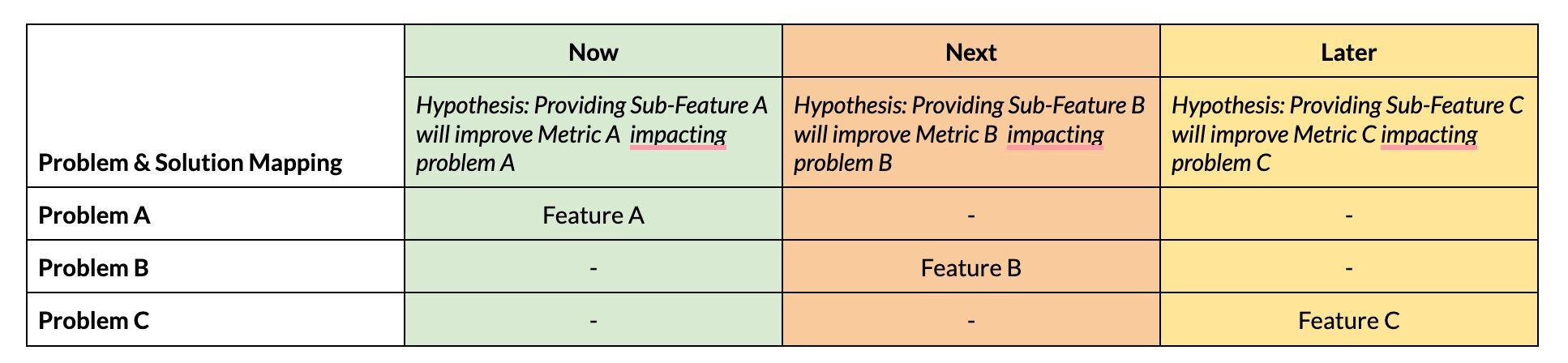
This helped with bringing more clarity to the product strategy and a method for quickly validating the most important hypotheses with more specific customer insights.
b. Time-box your prioritization decisions
In addition to not having a clear hypothesis, I did not sufficiently time-box my decision on prioritizing the initiative. To address this, I committed to making a decision within a week on whether to proceed with the initiative or de-prioritize for later.
Eventually, I de-prioritized the initial plan and used the same approach for hypothesis framing to prioritize another product and I provided supporting rationale that secured buy-in from other stakeholders. The alternate product was successful and I was able to adopt the learnings to inform future investment decisions.
Key takeaway: By framing a clear hypothesis and timeboxing your prioritization decisions, you can deliver value to customers faster, either through an initiative under consideration, or other more viable bets.
Final Thoughts
These scenarios show that decisiveness is a skill you can practice:
- Timebox: Commit to when you’ll decide and accept that you won’t be perfect.
- Communicate rationale: Share the reasoning behind your choices transparently.
- Learn and refine: Use your learnings to continuously inform future decisions and refine your methodology.
Decisiveness compounds. Each clear, timely choice you make builds trust, alignment and better judgment the next time around. When conviction becomes part of how you work, you help your team move faster with clarity instead of pressure. That’s how decisiveness turns from a personal habit into a product advantage.

Keep reading
Resetting product priorities with a strong UX vision
Why Friction Maxxing changes product strategy in 2026
The invisible middle — how mid-level bias distorts strategy
Prioritize with purpose: The product leader’s framework for data-driven roadmaps