

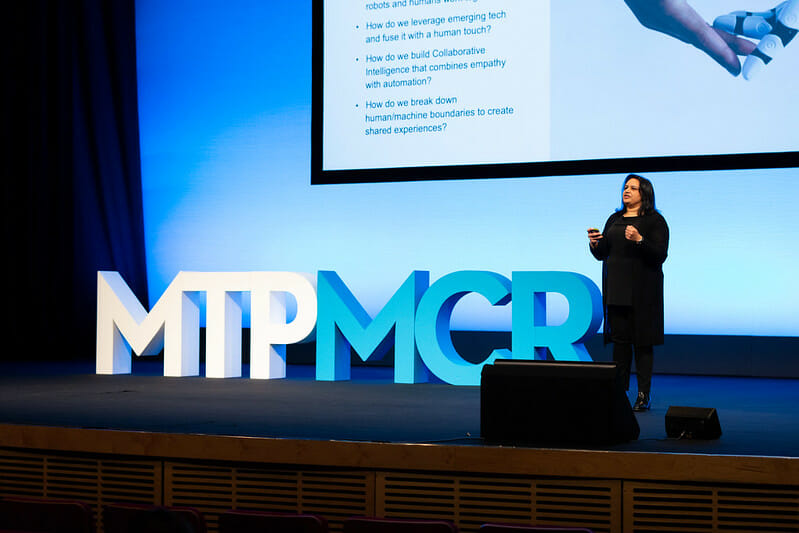
As a Psychologist, Rakhi Rajani, explores the intersection between human and machine intelligence. In her MTP Engage Manchester talk in February 2020, she covered how we can go about creating cognitively diverse teams to tackle the big questions of the future. Here we recap her key points, including:
- In a world of commercial space travel and autonomous vehicles, human behaviours are changing – we need teams that can work on these new futures
- Disciplinary hierarchies and boundaries curb innovation
- We all look at the world differently – divergent mindsets and people are the ones who are willing to challenge the status quo
New Social Norms
The legal system, the economy, and the environment are just a few of the things that have changed as a result of advances in technology. As a result, the way we interact is changing too, along with social norms. For example:
- People are less able to process long-form content than they were a few years ago
- We live in a world of data-driven lifestyles that are augmenting our skills
- Brain structures in children and teenagers have shifted significantly
- We spend more time alone which affects our social skills
- We have less downtime
All these things affect who we are, how we think, and what we do. They also affect the type of questions we ask, and the teams that we need to find the answers.
Changing the way we do Things
Rakhi explains that she and her team spend a lot of time thinking about building new civilisations on Mars. As humans, she tells us, we are very good saying, "I did this here and it worked, so I am going to do the same thing over there" – something we do because it uses the most recent frame of reference we have.
When it comes to teams, we can't simply take this approach when it comes to hiring people. We need different mindsets and perspectives from outside traditional academic disciplines.
The mindsets we need to tackle some of these questions are:
- Tactical – Meeting consumer needs through incremental innovation
- Strategic – Defining what we do in the medium term – 2, 3 or 4 years
- Moon shots – Trying things we've never tried before through exponential innovation
Breaking Free of Boxes
Additionally, companies like to put people into boxes – product manager, designer, engineer. This happens because it makes it easier for us to make sense of the world, but Rakhi argues that we need to go beyond these boxes to build the successful teams. She hires musicians and artists based on their brain structures and how they think about problems.
Leaders also add to the mix, imposing constraints on people based on what we know they can do versus what they can actually do. Rakhi goes on to highlight two areas that block cognitive diversity if we don’t address them:
- Disciplinary hierarchy – "my job role is better than yours"
- Disciplinary boundaries – "I’m only a designer so I can’t be involved in that conversation"
Building a Digital Team From Scratch
Rakhi built a digital lab from scratch, hiring 120 people in 18 months from 4,000 CVs. She shares her learnings from that time:
- Hiring at pace means that you make loads of mistakes – define the rituals that make up your culture
- You have to be deliberate in the mindsets you need – we need people willing to fight for the things they care about and people who are willing to ask tough questions
- CVs and interviews tell you what you want to hear – ask "what did the teacher say about you on your parent-teacher evenings?"
- People look to each other for cues and the loudest cues win, unfortunately – create a model "first-team" to show their vulnerability, that then models behaviour for future hires
Lead Into the Unknown
Finally, Rakhi leaves us with a few tips for building teams for an uncertain future. First, leave your discipline baggage at the door. Next, remove functional bias and cherish the people who disagree. Finally, make space and curb the pace because diverse teams need to find their own language and rituals.

Keep reading
How to lead cross-functional teams and drive product success
Building true product-engineering partnership at scale
Product Manager vs Program Manager..what's the difference?
Youssef Hounat on succeeding as DataSnipper's first product hire