

On August 6, 2025, OpenAI launched what Sam Altman called "the most powerful AI model ever made." Early testers loved it. Tech blogs praised its capabilities. For a few blissful hours, GPT-5 looked like another OpenAI triumph.
Then the floodgates opened to 700 million users and all hell broke loose.
Within hours, Reddit and Twitter erupted into "digital pitchforks." The crime? OpenAI had quietly sunset GPT-4o—the model users apparently loved more than their morning coffee—without any warning. Posts like "I'm done with ChatGPT and OpenAI" and "OpenAI just pulled the biggest bait-and-switch in AI history" dominated forums.
Less than 48 hours later, CEO Sam Altman was on Reddit doing damage control, admitting the rollout was "bumpier than anticipated," and ultimately reversing course to bring back GPT-4o for paid users.
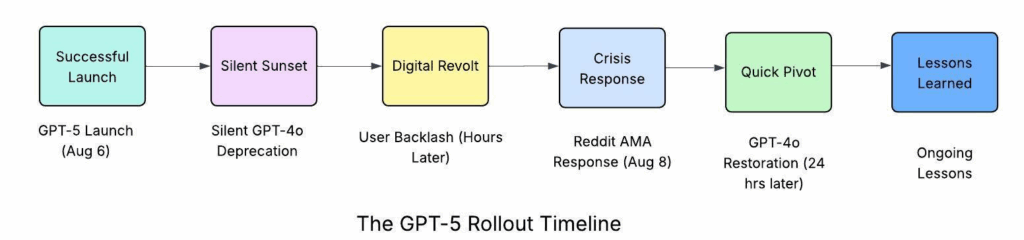
For product managers, this isn't just tech drama; it's a masterclass in crisis response, user psychology, and how quickly things can go sideways when you underestimate the emotional connection users have with your product.
Why this matters for product managers
If you strip away the AI hype, OpenAI's crisis becomes a textbook case of product management fundamentals. At its core, it's about three things every PM deals with: keeping users happy while you innovate, not alienating them with too much change, and figuring out how to bounce back when launches go sideways.
This happens with every product, everywhere. Users form emotional connections with products and resist change, even when it's objectively better. When they feel blindsided, they revolt—whether you have 700 million users or 700.
What makes this case study valuable is the transparency. Most product failures happen behind closed doors with sanitized post-mortems. OpenAI's crisis played out publicly, offering concrete lessons for any PM navigating difficult transitions.
Lesson 1: User trust is fragile—handle change communication like defusing a bomb
By silently deprecating GPT-4o without warning, they broke the core rule of change management: never surprise users with workflow disruptions.
Users don’t just use your product; they integrate it into their lives. Change something fundamental, and you disrupt routines and sever emotional ties. Altman admitted: "We for sure underestimated how much some of the things that people like in GPT-4o matter to them."
What to do instead:
- Announce changes 2-4 weeks in advance.
- Explain the "why," not just the "what".
- Offer overlap periods for old and new.
- Survey power users on use cases.
- Remember: “Objectively better” is not equal to “subjectively preferred”.
- Poor change communication breaks trust that takes months to rebuild.
Lesson 2: Your rollout strategy is only as strong as your technical execution
Even with perfect communication, OpenAI would still have faced backlash due to execution failures. The model router kept bouncing people between different models randomly, so GPT-5 felt like a different product every time you used it.
It's such a common mistake: PMs spend weeks perfecting the messaging and then completely underestimate how hard the actual rollout will be. OpenAI ran multiple models without telling users which one they got, like an app performing differently each session with no explanation.
Key considerations:
- Test transition infrastructure rigorously
- Define fallback plans for degraded performance
- Favor gradual rollouts over big bangs
- Monitor user sentiment in real time
- Enable rapid rollback
Lesson 3: Crisis response needs speed, transparency, and authentic leadership
When things went sideways with the GPT-5 rollout, Altman acted fast: showing up within 48 hours, admitting mistakes, and speaking directly to frustrated users. His Reddit AMA, 48 hours post-launch, was a crisis communication masterclass.
Most companies hide behind PR statements. Altman went to the loudest criticism, answered unfiltered questions, and hit three key marks:
- Speed: acted within 48 hours.
- Transparency: admitted they “underestimated” user attachment.
- Authenticity: engaged on a personal level, unscripted.
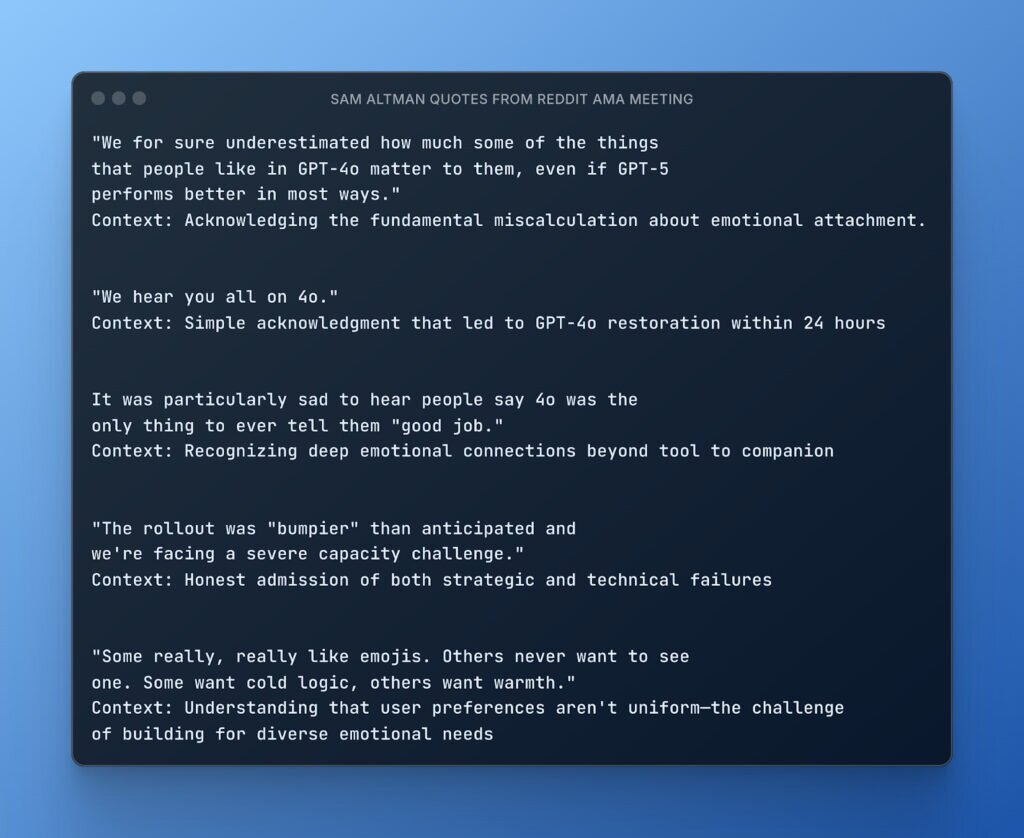
What made it work: he paired the apology with action—GPT-4o returned for paid users within 24 hours.
Crisis response essentials:
- Act fast (≤48 hours).
- Go where complaints are loudest.
- Own mistakes.
- Take concrete action.
- Put leadership front and center.
Lesson 4: The eternal tension between user choice and product simplification
OpenAI thought removing model choice would simplify the experience—one AI for all users. Instead, they learned some users desperately wanted that complexity. This highlights product management's persistent dilemma: when to simplify versus when to give users options.
The vision made sense: most users don't want to think about AI models; they just want good responses. But "most users" isn't "all users" and the vocal minority felt betrayed.
This isn't unique to AI. Removing features to "streamline" always risks alienating power users who rely on that complexity.
The lesson: understand different users’ relationships with your product. Some see it as a tool; others as a companion. Some want efficiency; others want control.
Key approaches:
- Segment by relationship type: simplicity vs. control.
- Use progressive disclosure: hide complexity but keep it accessible.
- Test with power users first—they’re canaries for bad simplification.
- Consider tiered approaches for different segments.
- Monitor sentiment, not just usage; low usage ≠ low value.
Sometimes the answer isn’t choosing between simplicity and choice, but designing for both.
Lesson 5: Turning feedback into monetization without eroding trust
The OpenAI episode offers an unexpected business insight: user backlash can create natural paths to upgrading a product. When GPT-4o returned only for ChatGPT Plus subscribers, the decision both addressed user demands and nudged free users toward paid plans, raising the question: how should PMs act when feedback reveals monetizable segments?
But there's a fine line between solving problems and taking advantage of the mess you created. OpenAI’s move worked because it restored genuine value, albeit behind a paywall.
Key principles:
- Deliver real value: premium tiers must offer more than what was removed.
- Be transparent: own the revenue logic if that’s the driver.
- Give free users something: even if not their exact ask.
- Time carefully: don’t monetize mid-crisis.
- Track long-term trust: today’s gain can be tomorrow’s attrition.
Done well, monetization born from feedback can align business goals with user satisfaction, rather than put them at odds with each other.
The bigger picture: What this reveals about modern product management
The GPT-5 launch drama reveals three evolving challenges of product management in 2025:
The emotional economy of product attachment: Users don't just use products, they form relationships. Products that foster deep connections enjoy incredible loyalty but face higher stakes when making changes.
Compressed feedback cycles: This crisis unfolded in 48 hours, from launch to revolt to resolution. Social media means product decisions face immediate, public judgment. Companies that adapt quickly thrive; those relying on traditional cycles fall behind.
Democratized product criticism: The crisis played out across Reddit, Twitter, and forums, not boardrooms. Hundreds of thousands of users became detailed product critics.
The companies that get this right? They build products people actually care about, they move fast when things go wrong, and they show up where their users are complaining.
Key takeaways
The framework below distils the key lessons from OpenAI's experience into actionable steps you can apply to your own product challenges.
| Phase | Action | Purpose/Goal |
| Before the Crisis (Prevention) | Announce changes 2-4 weeks in advance. | Give users time to prepare and reduce surprise. |
| Give users time to adjust workflows and provide feedback before implementation. | Collect early feedback to catch issues before launch. | |
| Survey power users about specific use cases. | Understand critical impact on most engaged users. | |
| Map critical workflows for your most active users | Prioritize changes that affect key customers. | |
| Test rollout infrastructure rigorously. | Ensure smooth technical execution. | |
| Ensure technical execution matches strategic vision | Align implementation with business goals | |
| Plan gradual rollouts with fallback options (5% → 20% → 50%) with quick rollback capabilities | Minimize risk and enable quick recovery | |
| During the Crisis ( Response) | Act within 24-48 hours, not weeks. | Demonstrate urgency and responsiveness. |
| Engage where criticism is happening (Reddit, Twitter, forums) | Address concerns in real-time and where users are vocal | |
| Have senior leadership respond personally | Build trust through authentic leadership | |
| Authentic leadership beats corporate communications | Humanize the company response | |
| Own the mistake specifically ("we underestimated" vs. "users misunderstood") | Show accountability and transparency | |
| Take immediate action, not just apologies | Show commitment to fixing the problem | |
| Show concrete changes within 24-48 hours of acknowledgment | Reinforce credibility with fast improvements | |
| After the Crisis (Learning) | Segment users by relationship type | Tailor future actions to different user needs |
| Identify needs (simplicity vs. control, tools vs. companions) | Customize product experience | |
| Consider progressive disclosure (Use progressive disclosure: show simple options first, but let advanced users access complex features) | Balance usability with power-user features | |
| Monitor sentiment alongside usage metrics (low usage ≠ low value) | Gain deeper insights into user satisfaction | |
| Optimize for long-term trust over short-term metrics | Build sustainable user loyalty | |
| Consider sustainable user relationships vs. immediate gains | Align product strategy with long-term growth | |
| Strategic Considerations | Understand emotional jobs your product performs | Capture user motivations beyond functionality |
| Measure relationship depth beyond functional metrics | Assess how deeply users connect with the product | |
| Build rapid feedback processing systems (social media speed) | Respond quickly to user signals and trends | |
| Treat engaged communities as co-creators | Empower users and foster collaboration | |
| Build direct channels for community feedback and involvement | Create continuous dialogue and improvement cycles |
Conclusion: The human side of product management
At the end of the day, the GPT-5 launch drama was about the deeply human nature of product management.
Users didn’t revolt because GPT-5 was objectively worse—by most measures, it was better. They revolted because OpenAI forgot that behind every metric is a person with routines, preferences, and emotional connections. They forgot that “improving the product” isn’t always the same as “improving the user experience.”
As product people, we’re so obsessed with dashboards and KPIs these days. It’s easy to lose sight of the human stories behind the numbers. But as OpenAI learned, you can optimize for every business metric and still miss what matters to your users.
The best product managers balance data with empathy. They push for innovation but respect emotional investments in existing features. They move fast but communicate with care.
What makes OpenAI’s response instructive is that they applied human-centered principles under pressure. They didn't just "fix the problem". They listened without getting defensive and admitted mistakes honestly, acting with genuine respect for users.
Next time you're staring at a tough product decision, sure, check your metrics. But also ask yourself: how is this going to make someone's day better or worse?
Because products that win don’t just solve problems; they understand people. And great product managers never forget that every decision is ultimately about serving the humans on the other side of the screen.

Keep reading
Designing safe conversational AI: The risks product managers overlook
Surviving the perfect storm: How hardware PMs can beat the AI tax and trade tariffs
From repetitive work to real impact: A case study on building an AI recommendation for developers
Product managers' role in making AI/ML systems more relevant