

Some products solve a single problem. Others – known as platforms – quietly build the scaffolding for entire industries. Yet despite their impact, platforms remain widely misunderstood. They aren’t just tools or infrastructure. At their best, they’re environments where teams and developers can co-create value far beyond any single feature.
This requires a shift in mindset. A feature-led product measures success by user growth; a platform lives or dies by integration rates, ecosystem health, and developer experience.
After nearly two decades leading platform initiatives in GenAI and data integration, one lesson stands out: platform PM isn’t about control – it’s about enabling others to thrive.
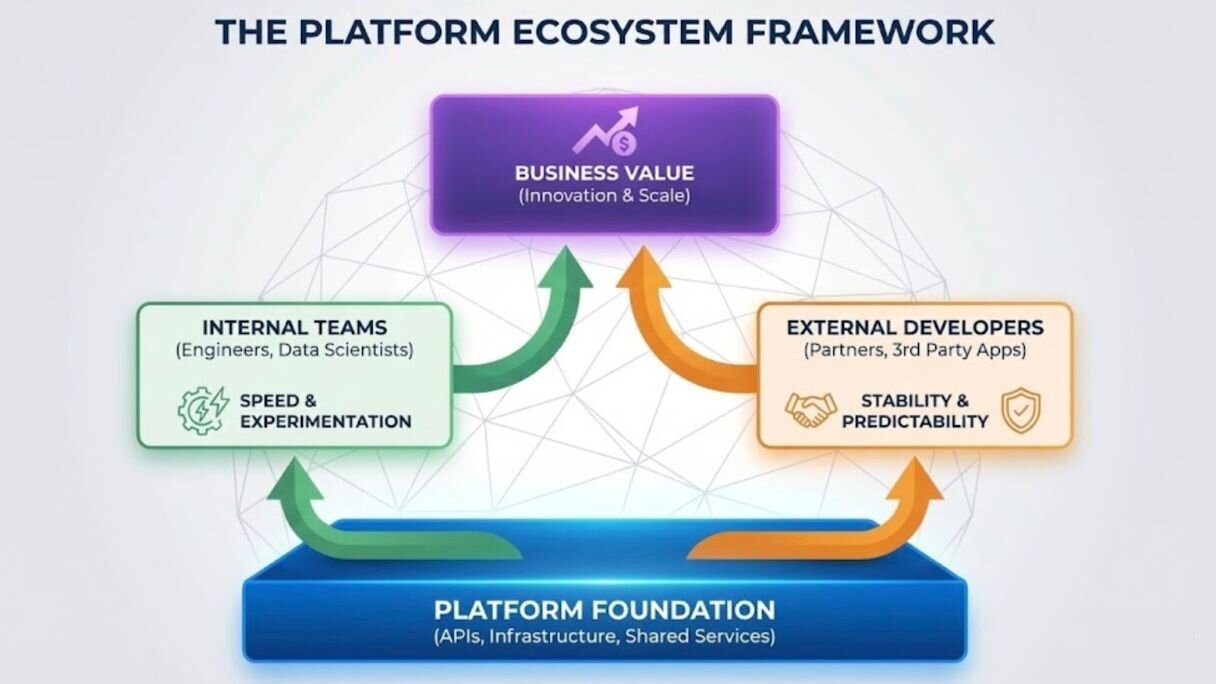
What makes platform product management different?
First, let’s clear up a common misconception: a platform is not just a product with an API bolted on.
In traditional product management, the focus is relatively contained: solve a specific user problem, build a coherent interface, iterate quickly. Platform product management, however, operates on a different plane of complexity. You’re building foundational capabilities that serve internal teams, external developers, and business stakeholders—all at once.
Consider the contrast:
- A product PM is obsessed with end-to-end user journeys.
- A platform PM must also obsess over how other teams’ products fit into and depend on yours.
That means thinking about:
- APIs as first-class citizens, not afterthoughts.
- Documentation and onboarding as part of the product experience.
- Stability and backward compatibility, sometimes above raw speed of delivery.
In my own work, particularly building GenAI infrastructure and integration layers, this complexity was front and center. Delivering an API that powers multiple internal data pipelines demands different rhythms than a classic SaaS launch. You have to consider who consumes your services, how they evolve over time, and what dependencies you’re quietly introducing across your organization.
Equally important, platform PMs often operate without the luxury of visible, direct metrics like daily active users or NPS. Instead, success might look like this:
- Other teams can integrate faster.
- External developers report fewer blockers.
- Critical systems stay reliable at scale.
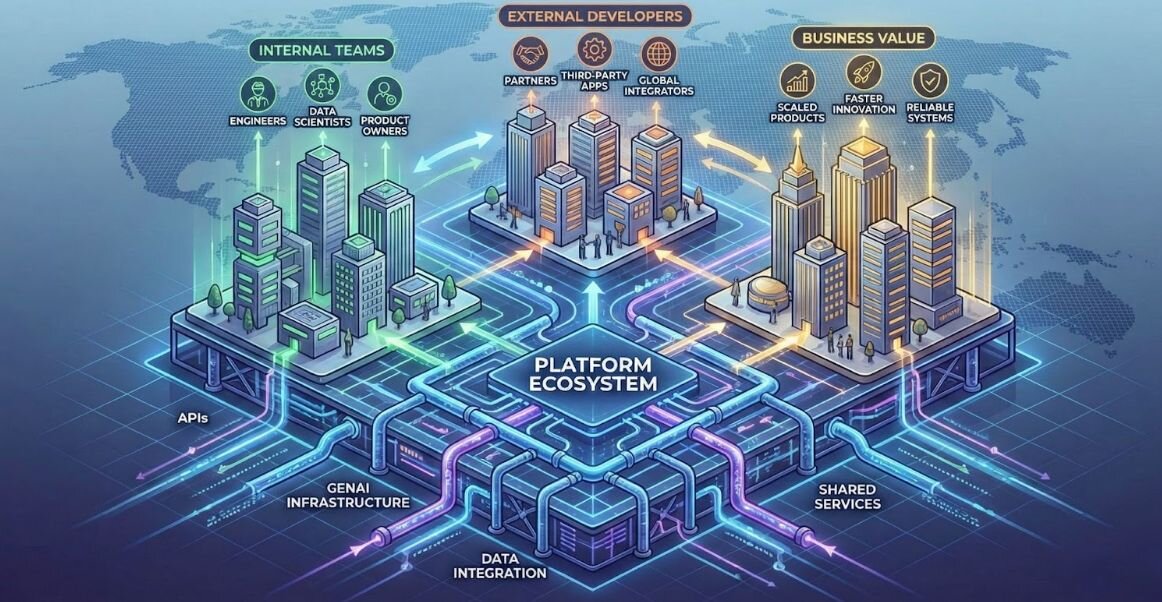
In a way, platform PM is closer to city planning than app design. You’re laying roads and utilities that enable countless others to build - and your true impact only becomes obvious over time.
Balancing internal needs and developer experience
One of the defining challenges in platform product management is learning to serve two masters. Internal teams–engineers, product owners, data scientists–rely on your platform to move faster and experiment freely. External developers, meanwhile, expect stability, clear documentation, and predictable interfaces. What feels like progress to one group can look like disruption to the other.
I’ve seen this firsthand. While leading a GenAI integration stack, internal teams needed rapid prototyping, but external partners demanded guarantees against unexpected changes. Balancing both required treating internal teams as real customers, with clear SLAs, versioning policies, and feedback loops.
Some practical strategies that helped:
- Service-level agreements (SLAs) for internal teams, spelling out reliability targets and escalation paths.
- Developer experience (DX) champions, whose sole job was to advocate for consistent documentation and onboarding flows.
- Clear versioning strategies, so teams could migrate at their own pace rather than endure abrupt changes.
Ultimately, success lies in seeing yourself not as a gatekeeper but as a steward. Your role is to balance competing needs without compromising trust on either side.
Redefining success metrics: Beyond classic KPIs
When I led platform initiatives supporting GenAI and large-scale SAP integrations, I quickly learned that tracking surface-level metrics wasn’t enough. It was never just about whether teams connected to our APIs – it was whether those connections turned into real, lasting adoption. Did new workflows get launched? Did partner products scale faster? Did internal teams reduce time-to-market?
If you measure a platform by the same KPIs you’d use for a standalone product, you’re likely missing the point. Traditional metrics like conversion rates or churn don’t capture whether a platform is genuinely enabling others to build and grow.
That’s why platform success demands its own numbers, often less visible but ultimately more telling. Some of the most valuable KPIs I’ve used include:
- Integration velocity: How long does it take a team to go from discovery to live integration?
- Ecosystem adoption: Are more teams and partners choosing the platform as their default?
- API reliability: What’s the uptime? How predictable is performance under load?
- Developer satisfaction: Are the people building on top of your platform actually happy with the experience?
Real impact shows up when teams rely on your services in production, developers advocate for your platform unprompted, and your capabilities become the backbone of other products.
Best practices in platform strategy and execution
Great platforms don’t happen by accident. They’re the product of deliberate choices about how to design, prioritize, and sustain the systems that everyone else depends on.
One of the most overlooked foundations is API strategy. It’s easy to treat APIs as a technical detail, but in practice, they’re often the most visible touchpoint between your platform and the outside world. That means consistency, clarity, and predictability matter as much as performance. A single undocumented change in an API could disrupt not only internal workflows but also partner commitments and commercial contracts.
Some non-negotiables for API excellence:
- Versioning and backward compatibility: Never assume everyone will upgrade on your timeline.
- Clear, accessible documentation: Treat docs as part of the product, not an afterthought.
- Governance standards: Establish principles early - naming conventions, error handling, security expectations - and enforce them ruthlessly.
Beyond APIs, platform PMs have a unique role in shaping system design. You’re often the one person bridging architecture discussions and business strategy. That means influencing big decisions: which capabilities to centralize, how much standardization to enforce, where to allow flexibility. In my experience leading cross-functional programs across the US, UK, EU, and India, this influence only works if you build trust with architects and engineers.
Roadmap planning also looks different on a platform. You’re not just prioritizing features; you’re sequencing dependencies across teams. You have to ask:
- What does this unlock for others?
- What breaks if we delay it?
- How does it fit into our long-term narrative?
One tactic I’ve relied on is visualizing roadmaps in layers: base infrastructure, core services, and enabling capabilities, so everyone sees how their work connects to the bigger picture.
If I had to sum it up, the best platform PMs do three things consistently:
- Design for clarity, even in complex systems.
- Advocate for the developer experience, internally and externally.
- Plan with ecosystem impact in mind, not just individual deliverables.
When you get these right, you create a platform people trust and want to build on.
Navigating cross-team complexity
For a Platform PM, one of the biggest complexities is the operating environment. Every decision affects multiple products, services, and teams that depend on the platform’s stability and evolution. Even in companies with mature product cultures, you’ll encounter competing priorities, hidden dependencies, and divergent incentives. One group might push for rapid delivery to meet quarterly goals, while another safeguards uptime for mission-critical systems. The Platform PM’s job is to align these worlds without eroding trust or reliability.
This was especially true during large-scale integration programs, where a single API change could ripple across continents. Coordinating five or more teams, each with unique roadmaps, tech stacks, and timelines, demanded the same rigor you’d apply to architecture design, only this time applied to people and processes.
A few principles that consistently help:
- Listen early: Understand each team's priorities, strategy, scope, expectations and what risks or dependencies they perceive.
- Co-create solutions: Invite stakeholders of the dependent teams into architecture and rollout planning so they share ownership.
- Over-communicate intent: Platform evolution often feels disruptive to consuming teams. Explaining the “why” behind roadmap shifts builds alignment and reduces resistance.
- Make dependencies visible: Use layered roadmaps and integration charts to show how changes cascade through the ecosystem. This prevents local optimizations from undermining global stability.
Ultimately, Platform PM is a discipline of orchestration: aligning teams, technology, and timelines so the entire ecosystem can evolve together. You can’t eliminate complexity, but you can replace confusion with context, and that’s what keeps the platform—and everyone who depends on it—moving forward in sync.
Conclusion
Platform product management isn’t glamorous in the traditional sense, but your impact is deeper and longer-lasting than almost any other kind of product work.
Because a great platform is an environment where others can build, adapt, and grow. It’s the quiet infrastructure that makes speed and innovation possible. And it’s the relationships across teams, companies, and entire industries that define whether your product is merely used or truly trusted.

Keep reading
How to build a bulletproof feedback loop in product ops
Why AI development demands product operating models
Leading product ops at Delivery Hero with Koen Dubelaar
Lessons from my first year as a Prod Ops Manager