By now, we all have a pretty clear view on the current state of product management and AI. A whole lot of uncertainty, transformation, and opinions on what lies in the future. The amount of AI information can often feel overwhelming, with an overload of tools, content, and advice available, making us all feel overwhelmed about what to prioritise when looking to upskill and find our way in this new space.
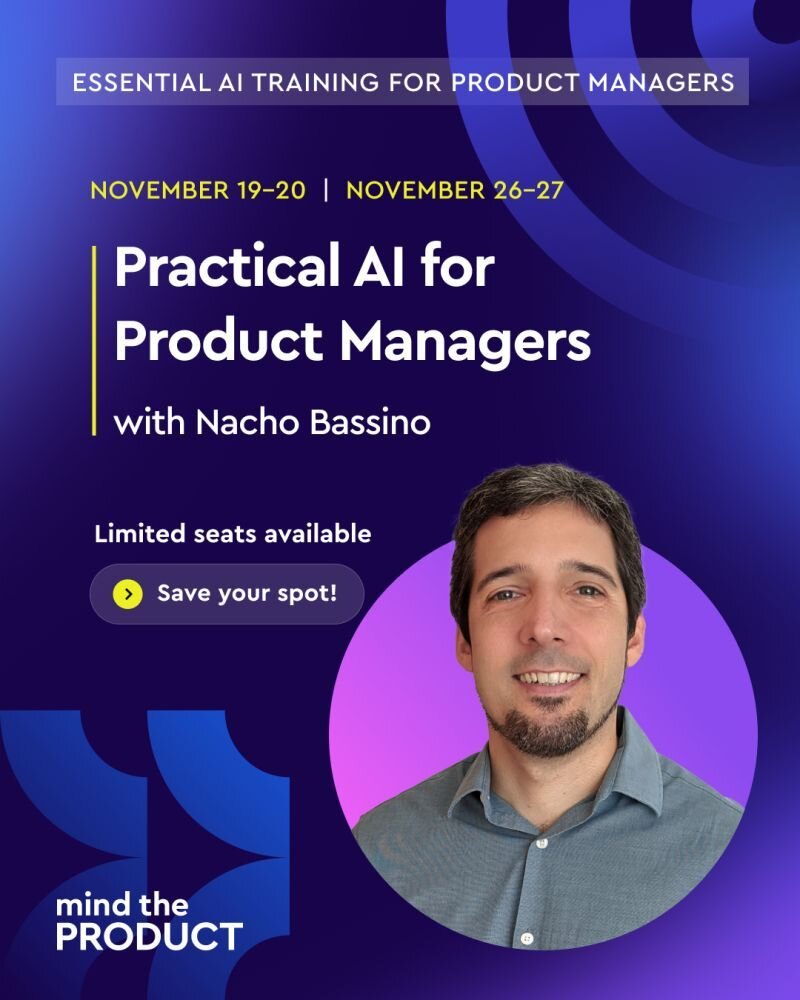
To help us on this journey, and make sense of what to focus on, we sat down with Nacho Bassino, VP of Product at dLocal and creator of our new "Practical AI for Product Managers" training class, to discuss what product managers need to do today to ride the AI wave effectively.
You recently took on the VP of Product role at dLocal leading product on the AI front. What drew you to this opportunity?
dLocal is a large Financial services company working on payments for emerging markets. It’s a public company, but still relatively young, and its impressive growth over the past few years has created a need for people who know how to scale product teams effectively. That was a natural fit for my background. At the same time, there’s a clear need to embed AI-driven practices, because, like almost every company, we’re pursuing maximum efficiency and looking for ways to deliver more with the same resources.
Being a young company means we can adopt new mechanisms quickly. Our engineering counterparts have already made significant strides, and now the product side is catching up. There is energy around experimentation, which makes it possible to try new operating models without getting stuck in legacy process debt.
I currently lead three teams: Core Services, AI, and Product Operations. The goal is to blend AI and product ops, implementing them together so that the operational fabric of the organisation is instrumented for automation, measurement, and continuous improvement. We’re looking at everything from how briefs are written to how knowledge circulates between teams, and we’re asking where AI can help us eliminate friction while keeping the bar high.
How is AI changing product management?
Beyond the obvious industry shifts, product managers have long faced a familiar problem: drowning in overhead. We spend time on Jira tickets, documentation, status chasing, and administrative follow-up. Over time, that drags us away from strategy and discovery and towards admin tasks. Marty Cagan has been especially vocal about this for years.
AI is unusually good at handling the administrative load. If we adopt these capabilities, we regain space for the strategic parts of the role, understanding the problem, defining the bet, and aligning the organisation. If we don’t adopt them, we risk becoming irrelevant as others streamline these tasks and move faster.
That’s why I talk about the PM “Orchestrator of AI” models, because it's where we can use this inflexion point to win.
There are overwhelming amounts of AI content available. How can product managers focus on the most impactful advice?
I feel it too, even as someone in charge of AI initiatives. I often feel drowned in all of the information out there. Here's my advice:
- First, curate your sources. Choose one or two quality sources to stay on top of news. I recommend the AI branch of Lenny's Podcast by Claire Vo, which features practitioners using AI. There's also AI Daily News, which runs daily updates via podcast or YouTube.
- Second, get your hands dirty. Beyond staying informed, you need to put things into practice. Start with prompting skills, then move to automating parts of your workflow. No one is an expert yet, we're all learning. Some of us may be more advanced, but we all gain knowledge by experimenting.
What are the most impactful AI tools for product managers?
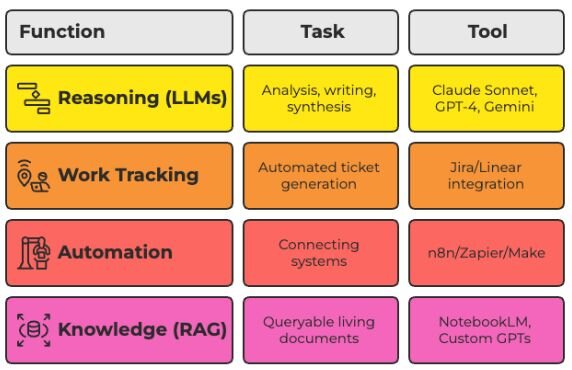
We have specialised tools for multiple tasks which can be incredibly productive, like, for example, tools for prototyping, like Loveable and then we have tools for user interviewing. So we have all these. Most people have ChatGPT, which can do many things, but there are special tools for certain activities that are important to experiment with.
Tools to experiment with:
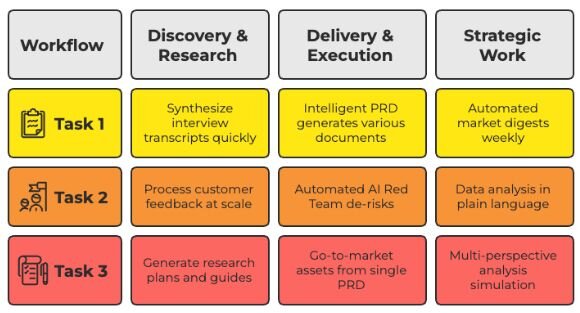
High impact workflows to experiment with:
What are the biggest misconceptions about AI in product management?
The first one is the most obvious one, that product management is dead. One thing that we are seeing is that one product manager can drive more impact than two years ago. The other thing is that as we learn to spin up agents or workflows to handle discrete tasks, a product manager who once focused on a single product may be able to oversee two or three without sacrificing quality. The scalability of ourselves as product managers is very powerful. And the same is being seen in the engineering world.
As we gain this productivity we will have a higher demand for building products, and our skill in understanding what a product needs to be successful will be invaluable. Over the next couple of years, it will be uncertain in terms of how many job openings there are, we’re seeing that now. However, when we move beyond that pace of uncertainty, the future looks optimistic for the profession.
The second misconception is around how we approach AI. Too many people think their “AI strategy” begins and ends with writing better prompts. That’s a very narrow view. Instead, we need to think about our work in a systemic way, how to use AI to automate workflows, connect processes, and build systems that meaningfully reduce repetitive tasks.
That also means being mindful of outputs. If the input or context you provide is poor, the results will be too. When you build AI-driven systems, you have to ensure the data and instructions are strong enough to deliver quality results.
And even then, the human-in-the-loop remains critical. We need to review and refine AI-generated output to make sure it meets the standards of our work. AI can automate execution, but humans still ensure direction, context, and quality.
The last one, is that AI is fad. If you are not adopting AI, someone who does will likely leave you out of a job. This is something that will radically change how we work. Every individual is responsible for taking this seriously and having some way to learn and adopt the tools.
Are you seeing organisational structures change due to AI?
Engineering is a bit further along the curve of adopting AI. So we are seeing now these teams that instead of having six to eight developers, have two, and they are as powerful as 16.
The speed of iteration is becoming much higher. Instead of writing a spec, having a UX person build a prototype, and then interviewing users separately, I can start with a prototype, get feedback in the same moment, build together, invite users immediately, iterate based on their feedback, all in real-time. We've been focusing on speed of iteration for 20 years since the lean startup movement began, and now we're really seeing the power of very short feedback loops.
Can you share some techniques that you can share to be more productive with AI?
Start with the basics of good prompting. We use a simple framework called RACER to make prompts reliable and repeatable. Here’s what it looks like in action:
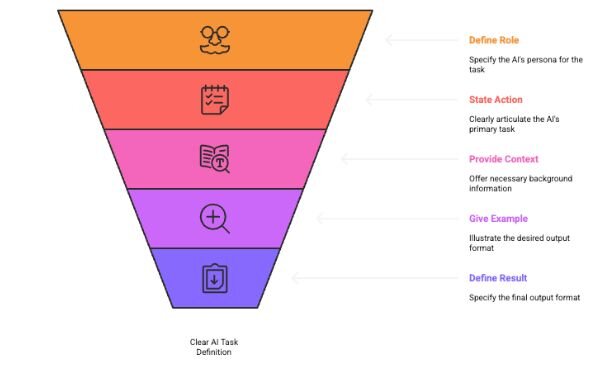
Then, you need to understand how automations works. For example, how will you work on having a system that can automatically confirm competitors' research or read your NPS survey.
Starting from a prompt and going through an automated system sits at the heart of the course that I’ll be delivering. We’ll explore how to apply AI across every part of the product lifecycle, from strategy and discovery to prioritisation and delivery.
What's your advice for product managers in heavily regulated industries who can't easily experiment with AI?
Start by building AI literacy. Understand how the systems work at a conceptual level and learn how to provide the right context about your product, customers, and constraints. Within stricter environments ,you may not have broad tool access, but you can still design processes that will function once tools are approved.
Focus on connecting the dots rather than isolated prompts. Don’t think of “a prompt for user research” as a one-off. Think of an interconnected workflow where research questions lead to structured notes, which lead to synthesis, which triggers a decision review. Even if parts of the chain are manual today, designing the system prepares you to automate safely when policy allows. Start with low-risk data, use sandboxed environments where possible, and document the guardrails you plan to use so that approvals are easier to obtain.
Ultimately, the goal is to reduce the time spent on small, repeatable tasks without weakening the quality controls your industry requires. That balance is achievable with the right design and oversight.
For those working in companies that are sceptical of AI, it’s becoming much, much better every day, which means that if you used AI four months ago and it didn't solve your problem, it probably will today. And if that today doesn't solve your problem, it probably will in three months' time.
So we need to change this fixed mindset of, Is this the right tool for this job to a mindset saying, Is the tool ready now, or should I wait a few more months? Because the speed of development is so huge that it will eventually get better at doing things that are impossible today.
Ready to upskill with AI? Attend one of Nacho Bassino's upcoming "Practical AI for Product Managers" public cohort sessions and learn how to build systems that amplify your impact and free you from administrative burden.