

The meeting that changed everything happened three months into what should have been a growth project. My client had brought me in to help their product management team scale after a successful acquisition — more people, bigger ambitions, booming business.
Then came the strategic pivot. Suddenly I wasn't helping them grow the team. I was helping them shrink it dramatically.
I found myself caught between two impossible roles: advising a CPO on layoff decisions while coaching the very people whose jobs were at risk. The team could sense something was up. They peppered me with questions about what I knew, while I struggled to maintain both leadership's confidence and the team's trust.
Being stuck between knowing layoffs are coming and when that shoe actually drops? It's one of the hardest positions any product leader can face.
Last month at Mind the Product's leadership forums in Cleveland, this exact challenge came up in every conversation I hosted. The wisdom that emerged was remarkable.
Here's what struck me most: even when there's no impending layoff, the industry's track record has everyone convinced the next one is coming for them. Product managers are freezing up, paralyzed by fear. It's making strong product leadership even harder to achieve.
From those conversations and my own experience caught in the middle, here's what I've learned about leading through both actual layoffs and the fear of them.
When you know more than you can say
The pressure on product leaders doubles during layoff season. You're worried about your own future while trying to protect your team. And if layoffs are actually coming, you're trapped in an impossible position.
You know it's happening. You probably know the names. But you can't tell anyone.
The leadership forum participants shared hard-won wisdom for navigating this ethical minefield:
Stay anchored in what's still true. As long as you're employed, the company's purpose and priorities remain valid. Your team's work still matters, and their contributions are still valued.
Avoid false reassurance. "Everything's fine" destroys trust when reality hits. Be honest about what you can't discuss: "I can't share details, but I know this uncertainty is hard."
Advocate behind closed doors. Push for clear, fair processes. Build your network now so you can help affected employees find their next roles quickly when the time comes.
Protect yourself too. Carrying secrets is emotionally expensive. Find safe peers or mentors for support — don't offload that burden onto your team.
Every conversation can feel two-faced when you're projecting confidence while bracing for bad news. The key is staying authentic within the constraints you're given. You can acknowledge uncertainty without breaking confidentiality.
But even when you're not privy to layoff plans — when there's no inside information to withhold — the industry's track record has created a different kind of leadership challenge.

The new normal: leading teams paralyzed by layoff fear
Whether your company is actually planning layoffs or not, fear of them has fundamentally changed how individuals on your team operate.
You've probably noticed it in meetings: "When will the next round hit?" has become the unspoken question behind every strategic discussion. Your product managers are struggling to think long-term when they're not sure they'll be around to see their roadmaps through.
As a leader, you're watching talented people operate in permanent fight-or-flight mode. Their decision-making suffers. Strategic thinking becomes nearly impossible. Even your strongest performers are starting to show signs of burnout.
The leadership challenge has evolved: it's no longer just "how do we handle an actual layoff?" but "how do we keep our teams effective when layoffs always feel imminent?"
When your team members are living in suspense
Over the past 18 months, I've coached quite a few product managers, and a troubling pattern has emerged that every leader needs to recognize. Nearly every conversation includes unprompted mentions of "the next layoff" – even when there's no rumor, no indication, nothing concrete to point to.
Your team members are making decisions based on one question: will this action make me more or less likely to survive the next round?
As their manager, you need to coach them into a more stable mental state. Because otherwise they’re going to make choices that hurt themselves, the company, and you.
I've watched product managers stop pushing back on executive requests, afraid that disagreement signals disloyalty. They've stopped advocating for customer needs because saying "yes" to leadership feels safer. They're choosing visibility over impact, politics over product sense.
The irony? These choices reduce the likelihood of great products getting built. It instead increases the chances that the company will need to cut costs because of underperformance.
Here's the coaching framework that cuts through the fear: Whether your team members stay or go, their best move is the same — do great work that matters.
If they stay, driving real outcomes makes them valuable. If they go, that's exactly the work that makes them marketable.
Your job as a leader is to redirect their energy from survival politics to meaningful impact. Here's how: Help them focus on projects that build real value, coach them to document their wins as they go, and shift team metrics to measure success by contribution rather than visibility.
This coaching approach serves a dual purpose. Product managers doing their best work give you the strongest case for keeping them if budget cuts come.
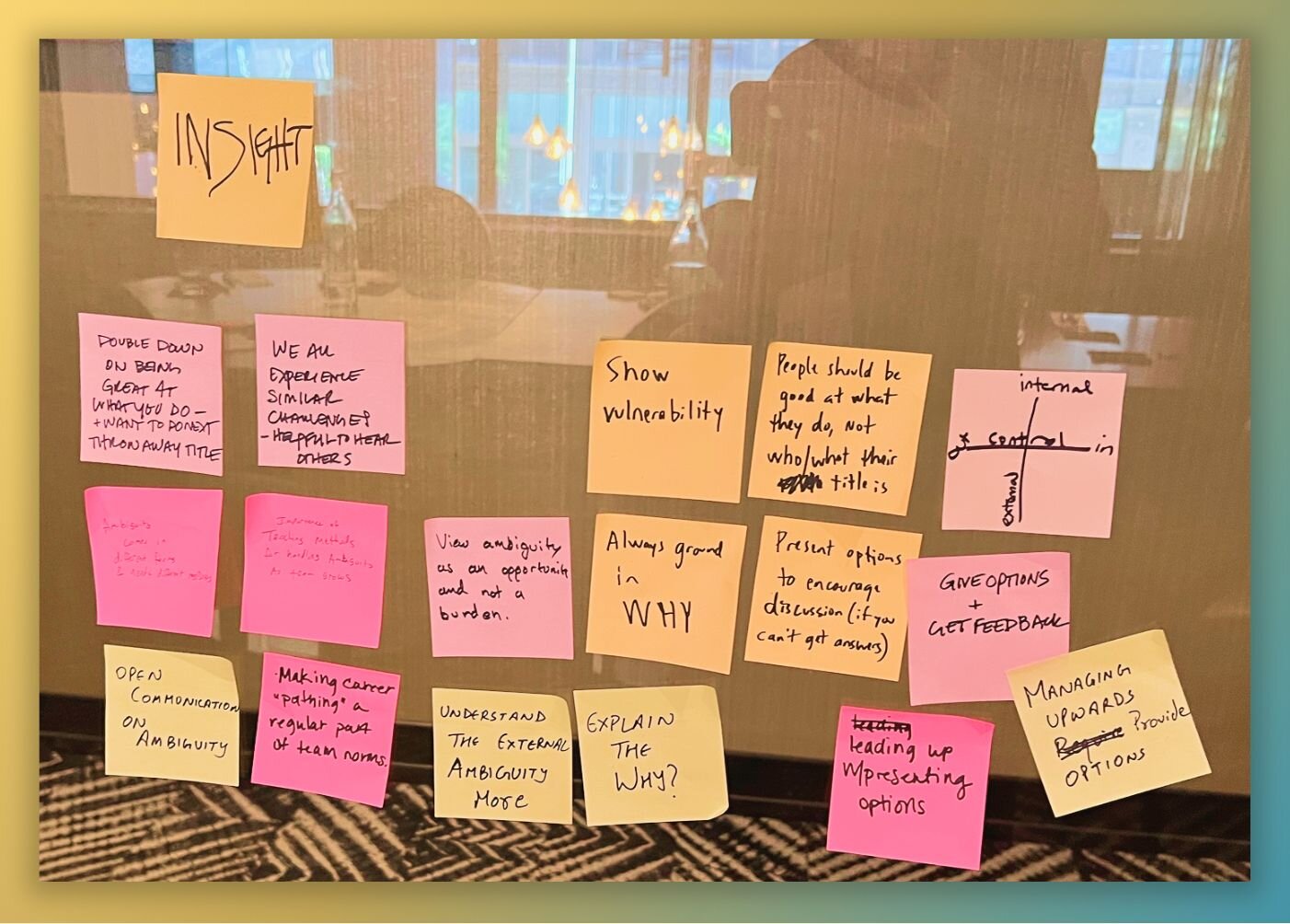
A practical exercise for managing fear
Fear thrives in ambiguity. Both you and your team can regain control by getting crystal clear about what's actually within your influence.
Here's a framework we covered specifically for navigating layoff anxiety with leadership teams:
Draw a simple 2×2 grid with these axes:
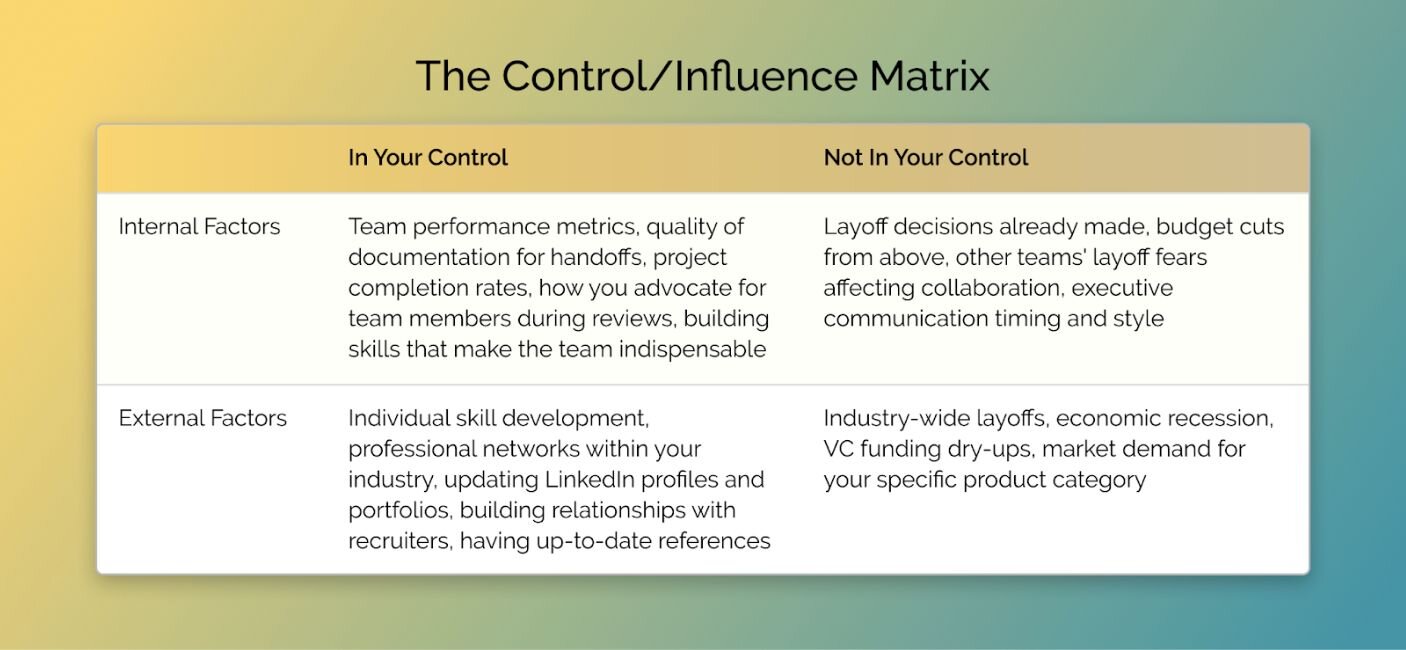
How to use this:
Fill it out honestly for your layoff fears. What specific actions can you take to protect your team or improve their prospects? What layoff-related anxieties are you spending energy on that you can't actually influence?
Focus your energy on the "controllable" quadrants. Instead of obsessing over potential layoff lists, direct your efforts toward demonstrable outcomes, building stronger stakeholder relationships, and ensuring your team's work is visible and valuable.
Use it to guide your crisis leadership. The "internal factors you control" become your layoff-season priorities - how you communicate uncertainty honestly, how you advocate for your people in leadership meetings, how you help them prepare professionally without creating panic.
Revisit during layoff rumors. When the next round of industry layoffs hits the news, return to this matrix. It's a reminder that even when you can't control hiring freezes, you can control how prepared and resilient your team is.
This isn't about false optimism - it's about strategic focus. Leaders who concentrate their efforts where they can actually make a difference consistently outperform those paralyzed by factors beyond their control.
Leading through the fear, not around it
Remember my impossible position from the opening — caught between a CPO planning layoffs and a team sensing something was wrong? I learned something crucial: you can't eliminate the fear, but you can lead through it.
The most effective leaders I've worked with during layoff seasons don't pretend everything is fine. They acknowledge the uncertainty while redirecting energy toward what actually matters. They coach their teams to do great work instead of survival theater. They focus their own efforts on the decisions they can influence rather than spinning on executive choices they can't control.
Here's what I wish I'd known during that gut-wrenching engagement: your team doesn't need you to have all the answers. They need you to be the steady presence that helps them focus on what they can control.
When everything feels uncertain, you become their anchor point. Not because you can guarantee their jobs — no leader can do that — but because you can guarantee that under your leadership, they'll do work that matters, build skills that transfer, and maintain their professional integrity regardless of what happens next.
The leaders who master this don't just survive layoff seasons. They emerge with stronger, more resilient teams that trust them to navigate whatever comes next. In an industry where layoffs have become the new normal, that trust is your most valuable currency.

Keep reading
Product thinking is the key skill behind the fastest-growing jobs in 2026
How PMs can make imposter syndrome their friend
How much were product managers paid in 2025?
Feeling lost in Product? Emma Mulholland on burnout, resilience and finding your way back