

How we got internal teams onboard with using AI through a simple workshop
There’s a lot of noise about how AI is going to revolutionise work. Bold mandates like Shopify’s “use AI in everything you do” make the headlines. But the reality is that most people don’t know where to start, and they’re too busy to figure it out.
For a while, myself and the product team had been mulling over the idea of running service design blueprint workshops to explore how different teams at Elsewhen might approach AI. But things accelerated when someone messaged me asking for help: “Our team has loads of problems to solve, but no idea what AI tool could help — or if AI is even the right thing.” That, combined with dedicated AI tooling budget and an internal push to experiment, helped us refocus and quickly get something up and running.
So I built a workshop.
The workshop format: light, purposeful, and action-focused
The goal isn’t to learn AI. It’s to help people identify where in their actual day-to-day AI could save time, reduce friction, or support better outcomes. Applying product-first principles: start with the problem, not the tooling.
Here’s the structure:
- Context & warm-up (10 mins): set expectations of the session
- Team workflow deep dive (45 mins): reflect on team goals, where time goes, and where frustrations lie
- Ideation & action (60 mins): use your imagination and ideation
Use a structured template board to guide the session
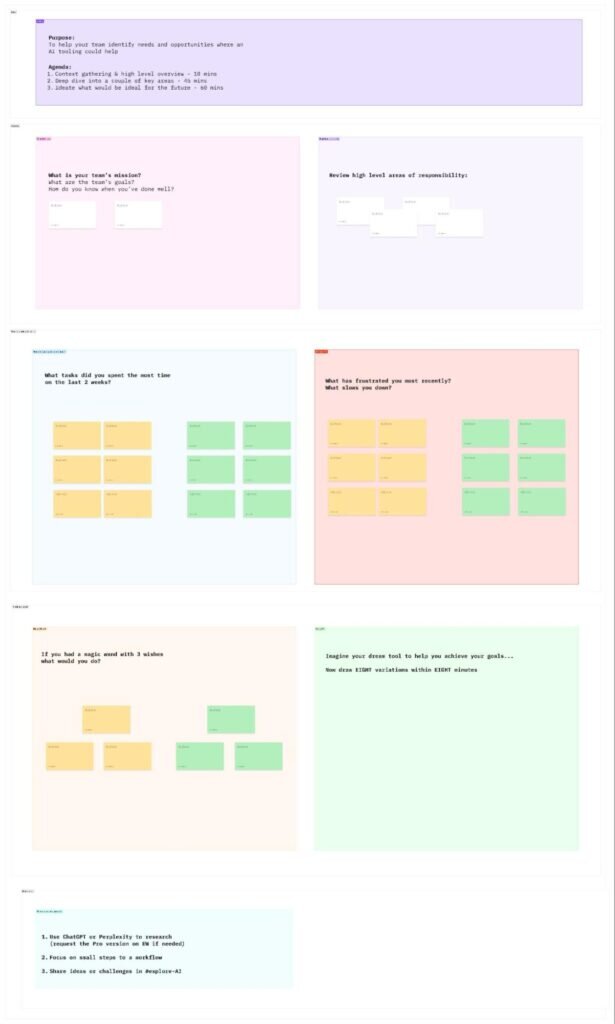
Here’s the real board I’ve been using to help teams across a range of departments from Talent, Ops, Business Development & Engineers. I’ve loved speaking to individuals to draw out insights and watching their realisation on what they spend the most time on, what frustrates them and how that aligns with their overarching goals.There’s sometimes a disconnect between where people spend the most time and what their actual focus is. Naturally the cadence of different activities can change throughout the year, for example, around financial year-end or during performance review cycles.
One person reflected, “I really enjoyed this. I rarely stop to think about how I work. This gave me space to reflect on how much I cover—even if it doesn’t always show up as tangible outputs every day.”
Sometimes we all need to have a bit of a rant and a moan and that’s ok – we are all human after all! And there’s nothing like a round of Crazy 8s to push people out of their comfort zone and let their imagination run wild. You’re not going to have your best ideas in the two-minute pause between back-to-back meetings.
Insights
I found that most people fall into one of three groups:
- Early adopters – building custom GPTs and using no-code tools like Cursor for side projects, and have been for a while.
- Dabblers – familiar with key concepts but still most of their AI usage is limited to using ChatGPT for content writing
- Overwhelmed – unclear on what qualifies as AI versus automation, stretched by existing workloads, and anxious about being left behind
This group is usually the largest but also the most overlooked, because people often hesitate to admit gaps in their AI knowledge, particularly if they feel others are more advanced.
I also found it interesting how many common frustrations and synergies exist across departments, such as the lack of documentation or the time spent writing up meeting notes. So I’ve been helping by connecting people with similar use cases to try tools and share insights, especially when they work in teams that have minimal overlap otherwise.
3 takeaways if you want to run this yourself
1. Start with goals, not tools
Teams don’t need a list of AI platforms—they need clarity on where they’re stuck. Begin by exploring what the team is trying to achieve, and what’s getting in the way. That unlocks more relevant and grounded opportunities to apply AI.
2. Design for tiny wins
People won’t adopt AI in big, sweeping transformations. They’ll adopt it when it saves them 15 minutes a day on something annoying. Encourage experiments like summarising Slack threads, rewriting messy notes, generating draft comms, or tone-checking stakeholder emails. Small steps in the right direction are better than nothing.
3. Make the first step simple
Every workshop ends with this advice:
- Ask ChatGPT or Perplexity to help dive deeper into your use cases
- Focus on a small improvement to a specific workflow that’s within your control (or mostly!)
- Share what you’re doing with others (we have a dedicated slack channel for AI experimentation)
Once people know they’re not alone in feeling daunted by the prospect of AI, then they are far more likely to be open to try something, learn fast, and keep iterating.
It’s not about hype. It’s about headspace.
AI will change how teams work, but only if they’re given support to figure out how. Mandates don’t do that. Workshops like these can. These exercises are simple by design, and while they’re not a silver bullet, they’re often just enough to get people unstuck.
So block two hours, pick a team, and start. You don’t need perfection—you just need momentum.

Keep reading
Designing safe conversational AI: The risks product managers overlook
Surviving the perfect storm: How hardware PMs can beat the AI tax and trade tariffs
From repetitive work to real impact: A case study on building an AI recommendation for developers
Product managers' role in making AI/ML systems more relevant