

For me, as it also is for many product people, the idea of applying a scientific approach to product management came from Eric Ries in Lean Startup – put simply, his approach outlines the way companies can successfully build and launch new products by learning what their customers really want and by testing continuously. In many ways, the concept was a game-changer in how to approach validating product ideas and getting to product-market fit.
Over the last few years, the idea of using hypotheses that are tested and measured has become accepted in organisations of all sizes, from startups to global corporates. However, from what I’ve seen through various consulting projects, the application of Ries’ approach has become so formally structured that many organisations are missing out on the true initial intent – a framework for quick learning and continuous innovation.
Instead of encouraging experimentation and entrepreneurship, I’ve noticed that people hesitate even to make and share their hypothesis. The reasons are varied.
Some don’t feel they truly understand the approach, so they just don’t do it. For them, there are questions around “what really is a hypothesis?”, “have I written it correctly?”, and “how do I know if it’s ‘right?’”
Others feel that in stating a hypothesis and sharing it publicly, they’re sticking their necks out and risking their reputation. After all, what if they’re wrong?! Others simply don’t feel like jumping through the hoops that their companies have established as part of their formalised approach to experimentation.
This is not to say that there shouldn’t be some level of rigour in testing hypotheses, but in many organisations, hypotheses have become overwhelming.
And that word is "bet"
This is where bets come in. I started encouraging teams to use the word “bets” instead of “hypothesis” a few years ago. It may seem like a just a wording change, but it actually creates a change in mindset that has a noticeable impact on the product organisations I’ve worked with.
Bets are simple to make, easy to talk about and addictive. Their informality makes them contagious (in a good way).
Planning a Product Experiment With Bets
Planning an experiment with bets is as easy as asking a simple question that is measurable and coming up with answers in the form of bets.
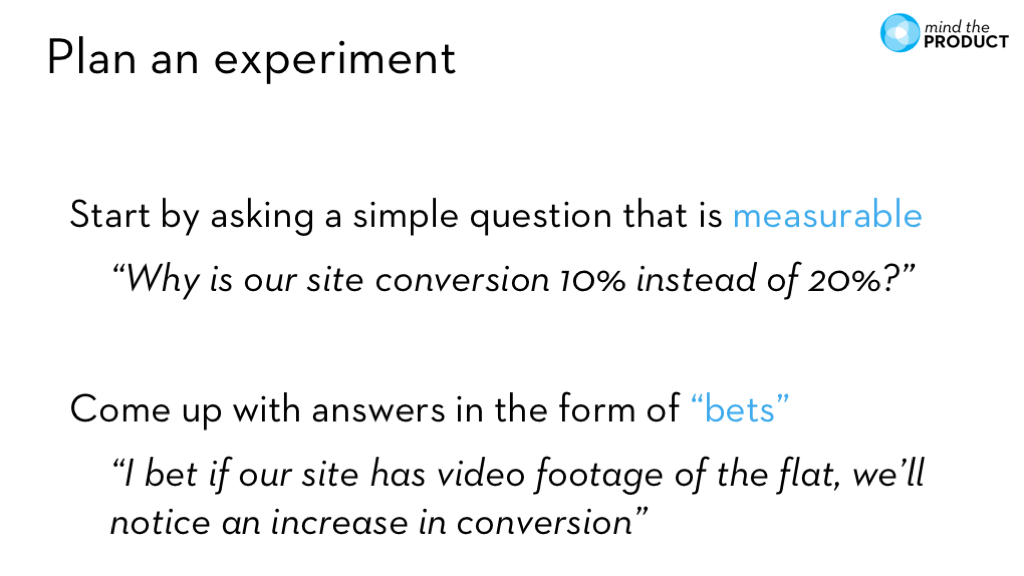
I’ve adapted a basic matrix used for hypothesis creation to pull it all together:
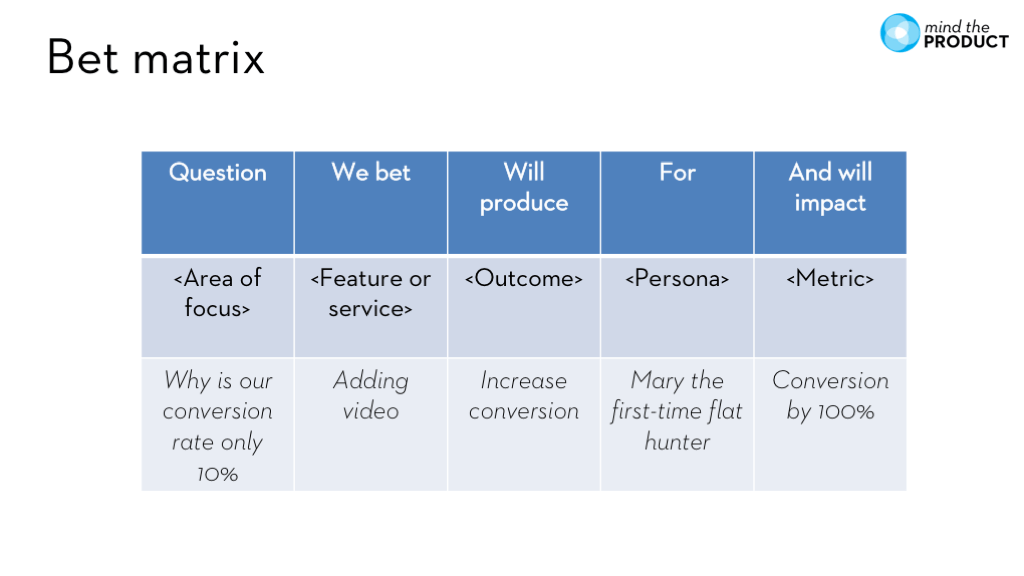
Each item in this matrix is essential, as it helps you ensure your bets are aligned with actual user needs (through personas) and organisational goals (through KPIs and metrics). If your bet doesn’t fit with an existing target customer or make an impact that your company needs, there’s no point in doing it. So if nothing else, use this matrix as a way to filter the bets you create.
It’s More Than a Bet, it’s a Mind Shift
Next time you get bogged down with hypotheses, try using bets. If your bet is wrong, you might feel bad, but it was a bet – nothing more. Using this nice three-letter word (vs four-syllable hypothesis) lightens the mood of creating and sharing ideas.
Plus, “bets” works into people’s vocabulary much easier than "hypothesis". With a bit of guidance, the next thing you know people across the organisation are saying, “I bet X. I bet Y.” It’s a great step towards actually building a culture that encourages effective product experimentation and continuous innovation that Ries was advocating.
Try it. I bet you’ll like it.

Keep reading
SUNDAY REWIND: The playbook for achieving product-market fit by Dan Olsen
SUNDAY REWIND: Dual-Track Agile: Why messy leads to innovation
Experimentation for product teams: Part 1
SUNDAY REWIND: How high-performance organisations innovate at scale by Barry O'Reilly