

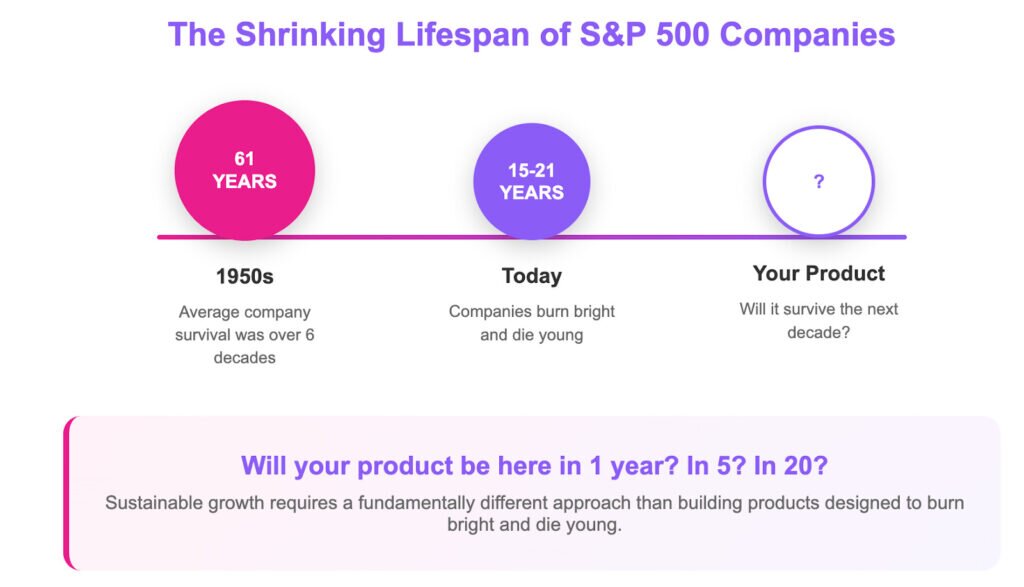
The average S&P 500 company now survives just 15-21 years, down from 61 years in the 1950s. We build products designed to burn bright and die young, yet sustainable growth requires a fundamentally different approach.
Product managers should ask: Will my product be here in a year? In five? In twenty? What can I do today to make this happen? This might sound counterintuitive in a world where investors expect 10x returns, but it's more aligned with creating lasting value and securing your product for decades.
From my experience facilitating growth strategies across B2B tech companies, I've identified five actionable questions that drive long-term product sustainability. This coaching-driven questioning approach helps product teams develop self-awareness, identify blind spots, and maintain focus on what actually drives future growth.
1. Where does our value and revenue come from?
While some product managers may be disconnected from financial data and actual revenue streams, there's a growing need for Product Managers to act as mini-CEOs for their products, covering a wide range of business and tech-related issues.
Whether it's a service-based business or startup, I see the same problem repeatedly: products created for C-level executives, founders, or engineers, reflecting their vision and past pain points without considering the real users. Customers won't pay for this.
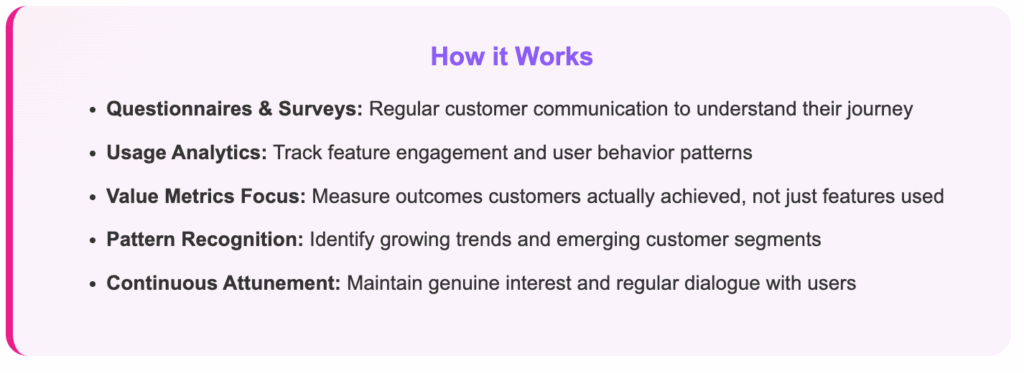
Understanding the key value drivers of your customer base requires regular communication, attunement, and genuine interest. Focus on value metrics—the product outcomes your customers have actually used—and feature stickiness.
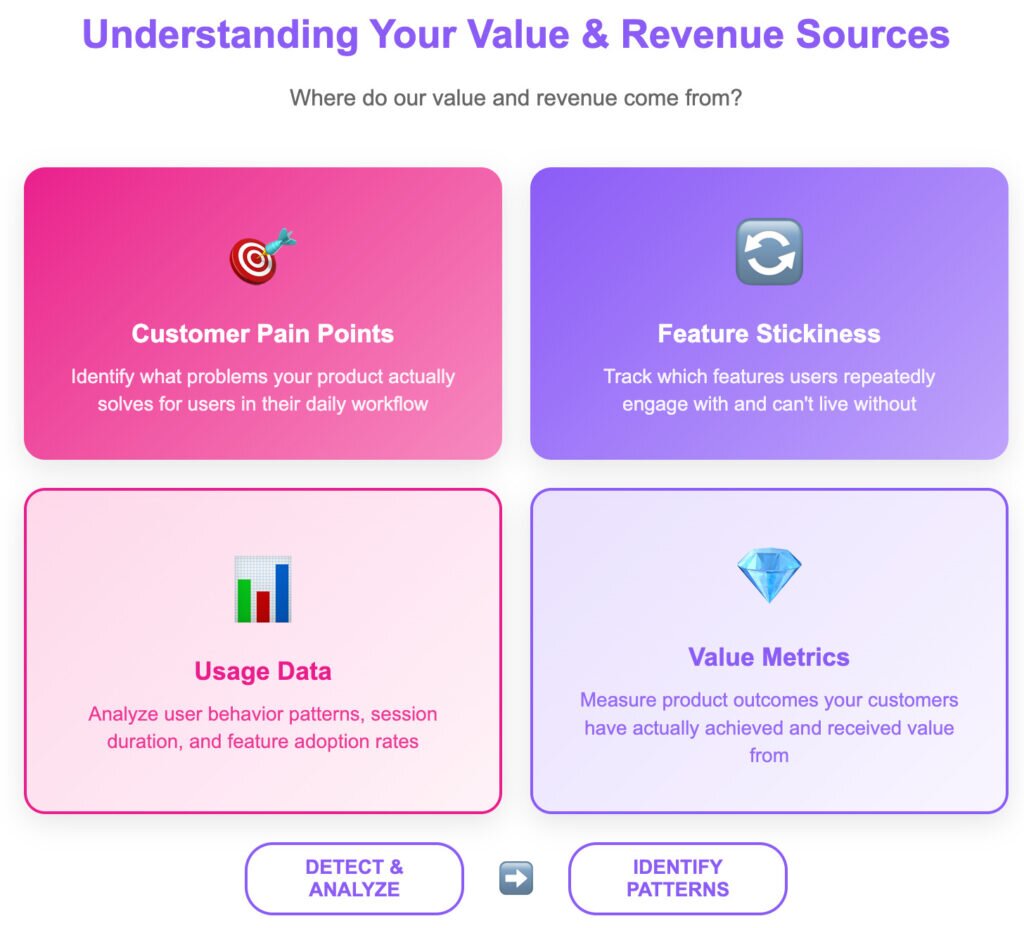
How it works: Detect what features and scenarios users implement with your product through questionnaires and usage data. Focus on value metrics (product outcomes your customer has actually used), feature stickiness. Identify growing and changing patterns, and spot emerging customer groups.
Why you should try this: To stay current and build a product customers genuinely need.
2. What emerging customer trends do we see?
There's a persistent belief that you need to launch new products and features regularly to stay current. Most industries operate in cycles of agile incremental improvements, daily bug fixes, and major releases each quarter or half-year. Gartner confirms that by 2028, an estimated 15% of day-to-day work decisions will be made autonomously through agentic AI.
Trend identification requires a systematic approach using multiple data sources: owned data from CRM and analytics, industry data from competitors and LinkedIn client updates, major research reports from Gartner or industry associations, and conference agenda analysis to identify both evergreen and emerging pain points.
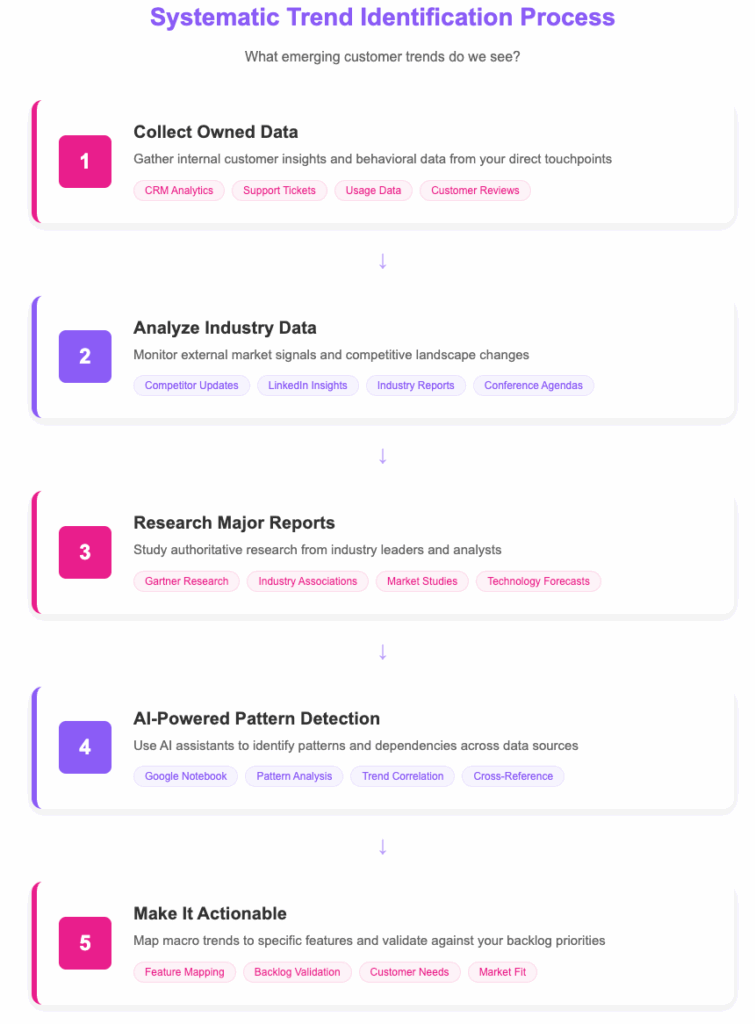
Use research AI assistants like Google Notebook to identify key patterns and dependencies in the ocean of available data. Upload your last 50-200 support tickets and reviews securely to identify explicit and implicit customer pain points, then cross-check with your marketing team regarding competition and search inquiries to estimate hidden potential.
How it works: The trickiest part of research is making it actionable. Map macro trends (like those from Gartner) with your latest support tickets and customer reviews. Use GenAI to detect patterns and overlap with features you're working on to improve what your customers need.

Why you should try this: To manage your backlog with features the market and customers actually need.
3. Do we support long-term goals or work on short-term fixes?
Reviewing your current sprint backlog is challenging. The tendency to store every idea, feature request, and stakeholder suggestion makes backlogs unmanageable dumping grounds, leading to frustration and decision-making fatigue.
Use your long-term vision as a decision-making tool to balance short-term gains with maintaining your market position for years. Ask yourself what percentage of your current sprint backlog contributes to your two-year long-term vision.
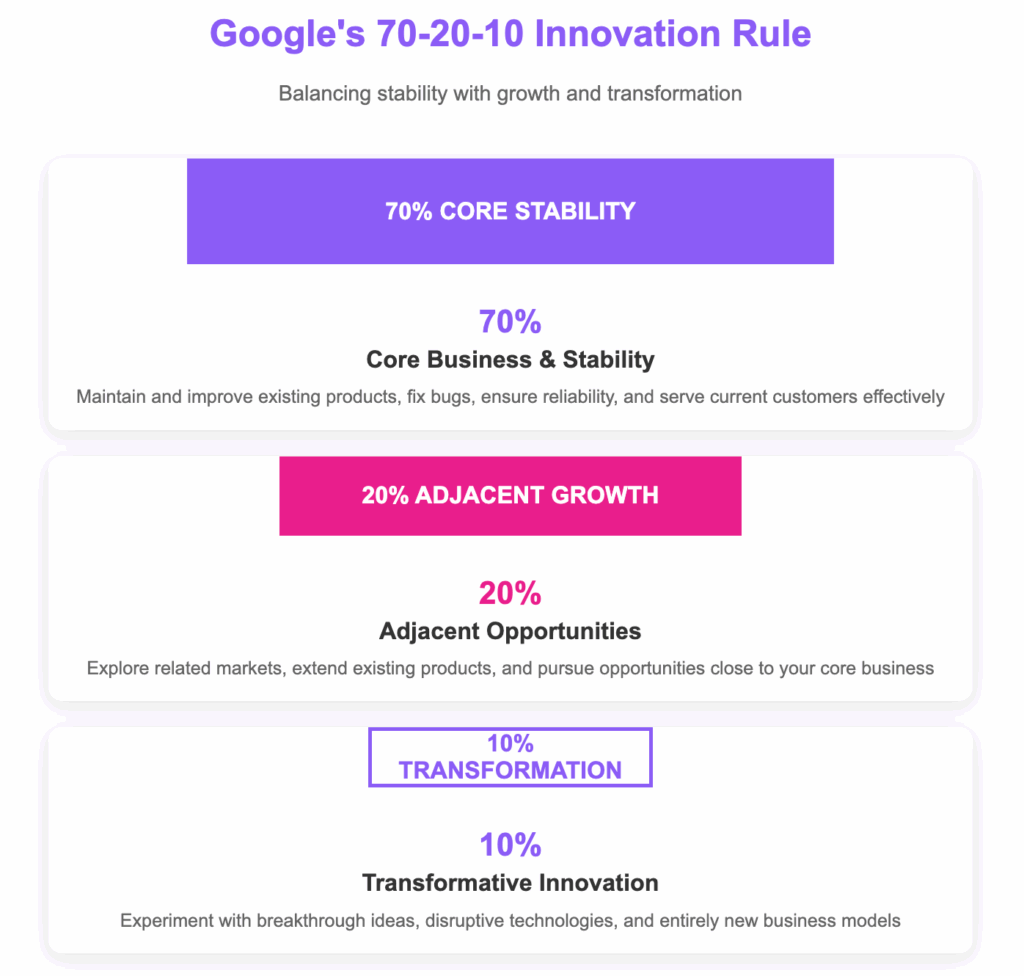
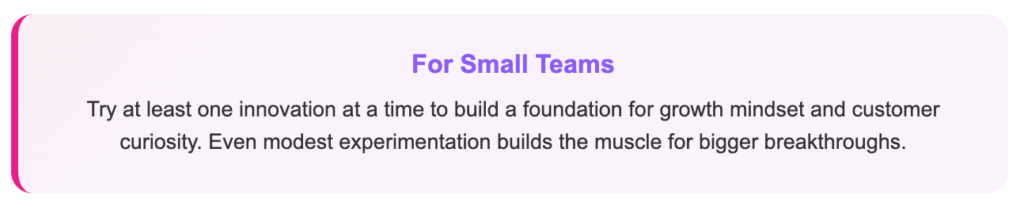
Google suggests investing 70% of effort in core stability, 20% in adjacent growth, and leaving 10% for transformative innovations. Amazon's famous "Day 1" approach splits effort between long-term innovations and agile teams focused on internal transformations and short-term fixes. For small teams, I encourage trying at least one innovation at a time to build a foundation for a growth mindset and customer curiosity.
How it works: Make your strategy a decision-making tool. Each time you want to add a new feature request to your backlog, validate its alignment with your core strategy. Keep the balance between long-term product benefits (at least 10%) and short-term fixes.
Why you should try this: Backlog burden is real. Agreeing on priorities and managing stakeholder expectations when they conflict is hard. Long-term vision can become a decision-making tool. It's not you versus them anymore—it's a team serving customers for your shared goal.
4. What can you say goodbye to this month?
This question consistently generates the most valuable discussions in strategic sessions. Product teams accumulate features, processes, and initiatives that no longer serve their core mission. The challenge isn't identifying what to add—it's recognising what to remove.
I apply a systematic approach to elimination: review features by usage and impact data, assess processes for time versus value contribution, and evaluate initiatives against current strategic priorities. During one session, a colleague pointed out a truth I didn't want to see: "When we take on too many projects, we lose ideas." Growth requires focus.
The most effective product managers I've worked with dedicate 5-20% of their time to redesigning and improving existing solutions rather than building new ones.
How it works: Conduct monthly audits of features, processes, and initiatives. Use data to identify low-impact elements. Create a "stop doing" list alongside your "start doing" list. Track 2-3 metrics to simplify decisions.
Why you should try this: Simplicity scales better than complexity. Removing unnecessary elements improves user experience, reduces maintenance costs, and allows your team to focus on high-impact work that drives real growth.
5. What experiment can we run this upcoming month?
This is my favourite question because teams get to share dreams and ideas. During one session, we brainstormed improvements for our LinkedIn presence. Three months later, we doubled our visibility among potential customers.
The key is asking each team member for their ideas to find commonalities, hidden gems, and bottlenecks. Each friction point acts as a limitation; each pattern could be simplified to enable success at scale.
Frame experiments as learning opportunities, not success requirements. Set clear success metrics and timelines. Start small with rapid iteration cycles. When you connect the dots between action taken and result achieved, you see what actually works and how. This leads to personal growth for each team member and the product in general.
How it works: Dedicate time each month for team brainstorming. Set up small, time-boxed experiments with clear metrics. Create a culture where "failed" experiments are celebrated as learning opportunities everyone can learn from.
Why you should try this: Innovation comes from experimentation. Regular small experiments build team confidence, generate insights about your market, and often lead to breakthrough discoveries that drive sustainable growth.
In summary…
These five questions transform monthly product reviews from status meetings into strategic coaching sessions. They help teams develop the self-awareness, resilience, and confidence needed to build products that don't just grow fast but grow sustainably.
The goal isn't finding the perfect answer, but building questioning skills that keep your product aligned with both current reality and future vision. Start using these questions in your next monthly session and watch how they change not just what your team builds, but how they think about building it.
Author BIO
Iryna Manukovska, Sustainable growth strategist, VP of Innovation at XME.digital, where she compressed strategic decision-making from 9 to 3 months and delivered 22% revenue growth through systematic questioning frameworks. With a background spanning enterprise B2B software, telecommunications, and FMCG at Ogilvy, she specializes in translating complex innovations into sustainable growth systems.
She has guided product teams across seed to Series B companies in AI enterprise software, b2b products and cleantech, focusing on market validation acceleration and strategic clarity. Her four-question framework for monthly strategic sessions increased innovation output by 60% across multiple organizations.
Iryna hosts the #makeyourinnovationswork podcast, has presented at 20+ conferences across 11 countries, and mentors startups expanding from Ukraine to UK markets. She holds ICF coaching certification and a Global Executive Leadership Program credential from the Swedish Institute. Currently based in Cyprus, she combines systematic thinking with practical frameworks to help product teams build for long-term sustainability rather than short-term growth.

Keep reading
Designing safe conversational AI: The risks product managers overlook
What a 3-day hackathon taught me about product discovery
The brandbook MVP
Resetting product priorities with a strong UX vision