

Product management has recently become a highly coveted role to drive growth while sitting at the intersection of customers, business, and technology. So it becomes important to understand not only what it takes to become a product manager, but also how your past experiences can uniquely position you to drive business value.
There are many paths to becoming a product manager, with people starting out in backgrounds including design, research, engineering, marketing, consulting, and more. A product manager is versatile in general with specific skill set needs based on the team or company, so all these experiences carry great value in adding a unique style of product management to that individual.
In this article, I’m going to explore my journey in transitioning from an engineering background into product management. I will also share what I believe are the advantages, disadvantages, and nuances of having an engineering background, influencing the transition and growth as a product manager.
Why I chose product
First, let’s start with the question “why.” In a way, the question is also the answer—product managers always have to ask why they should do something in their product (and answer it as well).
To answer why product management—usually it is a personal choice, but one driven by awareness and market research. Let me answer it with my own scenario.
I was a Software Development Engineer at Amazon Ads in India, building global-scale services and infrastructure for a multi-billion dollar annual revenue earning ads business. From the first day till my last day in the team, it was a challenging and exhilarating journey full of growth and learning. It was also a great team with an amazing manager.
And yet, something was missing for me: I didn’t know why we were building many of these great features. I also had more questions along that line, such as how did we know what customers wanted, how did we ensure they were aware of the new features, and did these features actually improve the customer’s experience and contribute to the overall business?
Naturally, like anyone who is curious, I started researching what these questions meant and connected with product managers in my team and outside to learn that they knew many of these answers. It all started to fit together like puzzle pieces—that a product manager had the information from all these partners, the process to collect data and refine it into features, and the ability to influence and drive feature creation and adoption.
That’s when it clicked—I wanted to be a product manager. To understand customer needs, influence the features that need to be built, and track them throughout the lifecycle to understand the value they contribute to both customers and business. In the long term, some of this knowledge and skill set can also help me build my own startup with a zero-to-one product.
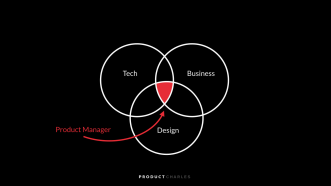
(Source: productcharles “What is Product Management?”)
Transitioning into product management
Now comes the interesting and slightly more challenging part—how. I understood why I wanted to be a product manager, but not yet how to become one.
With more research, I had a few paths to transition from my current role as a Software Development Engineer at Amazon. One option was to do a lot of internal networking, showcase my product skills, and potentially transition into a rarely created mid-level product manager opening at Amazon. Another option was to look for startups that would be more willing to hire someone with engineering experience but not much product experience. And lastly, pursuing higher studies in either India or abroad—especially pursuing a business degree—seemed like a promising path to switch to a product role.
With my own dream of working in the US, at the heart of technology innovation and many big companies’ HQs, I chose the Master of Science in Software Management (focused on product management) at Carnegie Mellon University. While this course was less heard of than MS CS or an MBA, it was offered in the heart of Silicon Valley and provided a syllabus with a good mix of business, product, and technology courses. The alums had also secured good product-based roles, and I personally knew some seniors who had taken this path.
While the professors, academics, and learning alongside peers were great, the job market was very difficult. As I had just come out of an engineering role, my resume and mindset were still that of an engineer (e.g., services, testing), and it took time to shift both to a product-mindset (e.g., users, revenue).
Securing a product internship was a little easier with my engineering background and individual product preparation. I had the opportunity to work at Splunk on a recently launched customer-facing product. It was highly technical and challenging at the beginning, but I quickly grasped the domain knowledge in a few weeks and was also able to share that knowledge with other product managers. I worked on some interesting go-to-market demos and new feature explorations to improve customer adoption and also solved a high-priority customer escalation issue.
The truly challenging part came after graduation. While I was confident in my performance as a product intern at Splunk, conversions are always subjective and unpredictable, and I ended up not getting a full-time offer. Although it was disappointing and saddening to hear that, there was no time to wait around, as international students' timelines are strict and I needed a full-time job as soon as possible.
With more aggressive networking and job applications, I was finally able to get an offer as a Product Manager at JPMorgan Chase. So, it was definitely a journey with challenges, iteration, growth, and finally an entry point into the world of product. And I understood that this needs not only skills and intelligence but a lot of networking and effective communication.

(Source: Adobe Stock)
Beginning a career in product
Starting my dream role at a new company, I had all the enthusiasm to learn and grow. I worked with my manager to craft a customized plan—to first learn the product and domain in the first month, then deliver some low-hanging fruits in the next month, and later drive the key initiatives planned for the year.
While there are many aspects to stepping into a product manager’s shoes, here I want to focus on the specific advantages and disadvantages I had with my engineering background.
Advantages of having an engineering background
Some of the key advantages I was fortunate to have were:
- Data: Having a data-oriented background (like SQL) was very helpful in quickly understanding and exploring first-hand the data available for our product. Access to data meant more of my hypotheses were data-driven.
- Tech partnership: Quickly building a strong partnership with the engineering team, being able to speak their language and understand more context. https://www.mindtheproduct.com/data-driven-product-management-by-matt-lemay/
- Problem solving: When faced with a user issue or a complex problem, I had the engineering mindset of investigating, understanding, and breaking down possible routes to solve it. This greatly helps in tackling broader pain points in our product and treating them as problems to solve.
- Attention to detail: Closely related to problem-solving is paying attention to detail—deep diving on things like data quality, active users, session times, and more helps support and validate key assumptions made in products and features.
- Timeline estimations & delivery: With a strong partnership with the tech team, it helped me understand and influence the path to deliver new features with well-estimated timelines, including buffers that could be communicated with leadership.
- Product lifecycle familiarity: A bonus was the familiarity with the development process, including local testing, test environments, and production environments. I also understood tools like Jira and agile methodologies to manage technical requirements and write clear criteria for user stories.
Disadvantages of having an engineering background
- Stakeholder communications: One of the biggest challenges I faced was creating effective materials for presentations and communication tailored to leadership and non-technical audiences. From an engineering background, it was not a common skill and it continues to take a lot of practice to write brief but impactful messages with suitable visuals.
- Potential micro-managing engineering: In developing the tech partnership, I also got overly absorbed in determining some of the approaches. While it made sense to use my skills to help accelerate feature delivery, it missed the broader picture of where I could have the most impact. It's important to delegate and trust the engineers with the technical work.
- Limited team influence: Experienced engineers are often autonomous, and I too had a bit of that mindset earlier. It limited my ability to drive knowledge sharing and mentorship actively in the team, as I was focused on my own deliverables.
- Jumping to solutions: One of the biggest issues with an engineering background is jumping to solutions when we come across problems. It’s something I’ve worked to curb, especially during my master’s. This didn’t affect me too much as I stuck to rigorous user research and feasibility analysis with my tech team. I did learn over time what my tech team finds complex versus straightforward.
Overall, with any background, there are some advantages and disadvantages. The best we can do in our initial days as product managers is to leverage our strengths, and work on improving the other areas over time.

(Source: Freepik)
Long-term growth and partnership
Beyond the initial transition into product management, for long-term growth I’ve observed a few key areas to invest in to become a full-fledged and well-balanced product manager:
- Deep user research & design thinking: Working closely with UX researchers and designers to conduct rounds of user research, gather open-ended feedback, understand key pain points, go broad to ideate, and converge on prioritized features to build and deliver.
- Business strategy: Understanding the product portfolio in the organization, the overall user experience we want to deliver, and market signals. This helps in developing broader, more strategic initiatives to best address business needs.
- Setting vision and narrative: Framing inspiring vision statements that are ambitious but achievable helps rally and influence partners toward common goals. This requires highly effective communication with the right keywords to convey intent and drive alignment.
- Stakeholder and cross-functional partnership: Beyond direct partners in design and tech, it’s important to grow relationships with cross-functional teams like marketing, customer ops, and more. It also helps to maintain strong stakeholder visibility with leadership and key customers.
- Mentorship and team influence: Being more aware of the moving parts across the team and proactively helping to drive best practices is key. Sharing knowledge and mentoring those new to the role or team also strengthens the product culture.

(Source: Shutterstock)

Keep reading
Surviving the perfect storm: How hardware PMs can beat the AI tax and trade tariffs
January's top product management reads on Mind the Product
How to start a sustainable product business: CEO Laura Crawford on growing her brand from scratch
What the GPT-5 launch teaches product managers