

Every product discovery starts with a signal, be it a problem, an opportunity, or a risk - actually, it's mostly a mix of all three. But what you do next is critical. Discovery tests the truth behind signals, and this is a story of how we saved a large consumer-facing organisation building on belief.
Signals arrive in many different forms, it might be a shift in the market, a tech enabler like GenAI, a compliance deadline, or a customer pain point. Sometimes a signal is raised by a customer. Sometimes it emerges from data. And sometimes, it comes from the conviction of a senior leader, a situation I found myself in. Whichever way it shows up, what really matters is what you do next. Because if you dive straight into delivery, you risk building on half-baked truths and beliefs.
In this instance, a senior commercial leader was certain the quality of some of our products were letting customers down, damaging trust, and costing the business. Returns were an operational inefficiency and a symptom of deeper disappointment. Feedback was difficult to capture which meant the business struggled to hold external partners to account or learn how to improve. The belief was that material value was at stake through lost efficiencies, lost loyalty, and lost sales.
It was a complex, end-to-end challenge, which I was asked to lead, and my first step was to create space for rigorous discovery.
Discovery is the work of turning these signals into actionable chunks, testing them until confidence replaces assumption. And we needed this because even our initial sizing of the prize was based on data extrapolation. Discovery would enable us to deepen our understanding, break the challenge down and, crucially, find out whether the value really existed.
The excitement of exploration
We began with an exploration workshop. The opportunity touched multiple value streams, from supply chain, back office, through to customer experience. We engaged stakeholders across the whole system, including external parties.
When organising workshops on this scale, my advice is simple: don't be afraid to do it.
Don't be tempted to split people into functional areas. Bringing everyone together is where the magic happens. It promotes collaboration but also creates moments of discomfort, places of disagreement, where the most deeply buried assumptions, issues, and risks are unearthed.
That unearthing also comes through holding the space to hear one another's perspectives, but most importantly, bringing everyone together creates a single shared experience. Everyone leaves the room with the same context, the same 'aha' moments, and a sense of joint ownership. Split sessions dilute energy, create more work, and lose the unique value that only a larger group can bring.
Handling pushback
Pushback was inevitable, and I urge you to spend time on how you will manage yours, too. We met three main types:
- Stonewallers who were silent. Disengaged.
- Challengers who stalled progress with endless ‘why’ questions.
- Guarded who were outwardly supportive but resisted sharing their real thoughts.
We worked hard to position and sell the kick-off workshop. We used what was at stake, securing a galvanising call-to-action from our most senior sponsor, and using it as a catalyst to bring people together. We made it a session people didn’t want to miss, a chance to hear every perspective in the same room.
But, we knew not every topic felt relevant to every person. So when the inevitable pushback came, we acknowledged it. We were prepared: we’d already mapped drivers, priorities, fears. We held 1:1s with detractors to explore their world and build rapport. We positioned the value of their unique perspective and the power it could have in surfacing key hidden assumptions or risks.
At the same time, we found and activated our champions. Their ripples of support reverberated around the business.
On the practical side, we secured a date with senior stakeholders eight weeks in advance. We avoided clashes with school holidays, tracked RSVPs closely, and always requested an empowered delegate for anyone who declined.
The workshop
The workshop itself had enough structure to keep us on track but contained fluidity to enable impromptu exploration of unanticipated topics. The semi-structured prompts gave just enough shape to keep momentum without shutting down creativity. And when someone from customer service, a digital lead, and an external partner all spotted the same issue from different angles, you could feel the excitement and the ownership shift; everyone had their part to play in solving the problem.
People were encouraged to jot down their ideas as they came to them, and soon, we had a wall full of Post-its. One by one, everyone walked through their thinking, building an encyclopedia of knowledge.
By the end of the session, we had co-created a hypothesis, not polished or word-smithed, but a statement we could all point to and say: "Yes, this is where we'll start."
From big idea to testable chunks
Of course, one high-level hypothesis was too broad to test directly, so we used a hypothesis tree to uncover the riskiest assumptions, and break them down into testable chunks.

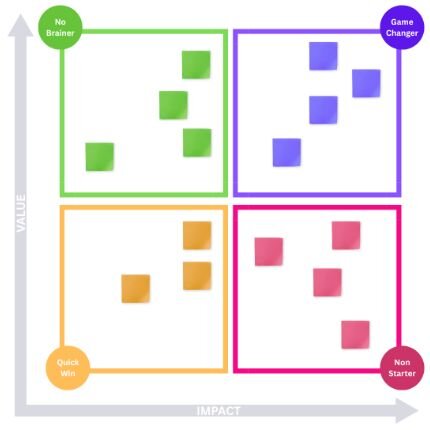
We drew on qualitative and quantitative data to help us identify the pain points across multiple value streams. Ideation drew out multiple options which we mapped onto a simple classification quadrant:
- No-brainers: easy to do with high impact
- Quick wins: fast to deliver, moderate impact
- Non-starters: Harder and low value
- Game-changers: Harder and more complex, transformational and high value
Ironically, the solution workshops didn’t just surface ideas; they refined our hypothesis tree. By this stage, we still hadn't proved the size of the opportunity, or even whether the customer problem was really happening at the scale we had assumed.
That’s the thing about discovery, it’s rarely linear.
Searching for the truth
So we took a step back and tested the assumptions that had arisen thus far. Without doing this, we could have easily slipped into flawed validation and ended up proving what we already believed instead of uncovering what was actually true.
So, we went looking for evidence. We spoke to colleagues and customers. We analysed contact centre data. We pulled more data from systems across multiple channels.
The picture was mixed. While customer service gave us quotes to substantiate the problem, we didn’t witness the problem for ourselves. And the sales transaction data didn't evidence it either.
And yet, all of us working on the initiative couldn't shake the sense that the problem was real, that perhaps customers were absorbing it with silent dissatisfaction. So, we explored this too.
We looked for proxy signals, and checked for repeat purchase patterns. But the evidence wasn't stacking up. The handful of anecdotes we gathered wasn't enough to prove a statistically significant pattern.
Eventually, we asked ourselves whether we should keep chasing the hunch and risk burning time and money or stop and divert our attention to something else.
That's when we were honest with ourselves; we saw how we had been rationalising poor results, excusing the data because we wanted the story to be true. We had been seduced by its potential for impact, and our exuberance, our humanity, had clouded our judgement. In the end, we had to admit that the problem simply wasn't there.
Delivering difficult news
Disappointment was inevitable. Some stakeholders even showed disbelief. But because I'd kept the most senior leaders closely updated throughout (short personal updates and one-to-one conversations), there were no nasty surprises. I was giving the commercial leader, in particular, near-real-time updates, which built trust, strengthened our relationship, and secured their support and air-cover.
I set aside time with the team to probe the findings from every angle before shaping the playback. We acknowledged each person's contribution, emphasising the value of what had been uncovered.
The story we played back crystallised. It was classic 'fail fast', except it wasn't a failure at all. Discovery had spared us months of wasted work and given us the clarity to move on. And while debunking beliefs can (and did) sting, we reframed the narrative around three positives: the smaller opportunity we had uncovered, the upside that the feared problem wasn't real, and the chance to redirect focus on to the next high-value initiative.
Saying "no" freed us to say "yes" to something better.
Reflections
Over the course of my career, discovery has taught me a lot:
- Beliefs aren't facts; test every assumption. In product, you test with data, surfacing what's hidden.
- Tech products don't exist in a vacuum. Bring the whole system into the room; without input from across the value streams, you miss the whole picture.
- Manage the message, bad news travels better when people are prepared for it.
- Reframe and refocus. Even when the big prize disappears, there's usually something smaller and real worth holding onto.
- Data matters, but so do people. Value relationships, whether it's standing down a team with care or supporting a stakeholder through a tough realisation, relationships are what make the hard work possible.
Discovery isn't about proving someone right (or wrong), it's about finding what's true. It's about unearthing and testing assumptions with rigour, curiosity, and collaboration, to discover what truly creates value for customers and the business.

Keep reading
Sunday Rewind: Going from 0 to 1 in product discovery by Merci Grace
From product to entrepreneurship: My journey with co-founding Rove
Sunday Rewind: How to avoid product discovery pitfalls, by Navin Nair
How to use continuous discovery habits in your job search