

KPIs are the key to motivation, aren’t they? Well... it depends on what kind of person you're trying to motivate.
I once worked at a company where product revenue was the only performance metric for the product management team. We went through all the stages, denial, anger, bargaining, and eventually some strange form of acceptance.
And now? I actually believe that it works. But only in very specific cases.
In this article, I’ll explain how behavioral typology, product maturity, and team dynamics can help you figure out when revenue is a useful KPI for product managers — and when it’s not.
Product Maturity and Behavior Model as Pre-Conditions for Setting KPIs
Let’s rewind. At that company, a massive shift happened: Revenue and Revenue Growth became the single KPI for the entire product team. That was it.
The result? Over time, 150% of the product managers were replaced. Yes, you read that right: everyone was replaced once. Then about half of the replacements were replaced again.
Was it the right move? From a business perspective — yes. Revenue went up. From a team perspective — still a question mark. The transformation wasn’t smooth. It wasn’t pretty. But it was revealing.
Let me explain why.
Not Every Product Manager Is the Same
And they shouldn’t be. Different products — depending on where they are in their lifecycle — need very different kinds of PMs.
- A brand new product launch needs energy, guts, and vision.
- A mature product needs care, consistency, and structure.
- A declining product needs someone who can either restart or gently sunset.
This is where behavioral models like DISC (by William Moulton Marston) or even Adizes PAEI come into play. Let’s stick with DISC — it’s what we used at the company.
Quick breakdown:
- D – Dominance: assertive, goal-driven, challenge-oriented
- I – Influence: outgoing, persuasive, emotionally intuitive
- S – Steadiness: stable, patient, team-first
- C – Conscientiousness: analytical, detailed, structured
Everyone has all four, but in different ratios. In a professional context, most people lead with two. That combination influences what drives them — and how they respond to KPIs.
Matching PM Types to Product Maturity
So... who’s the best fit for what kind of product stage?
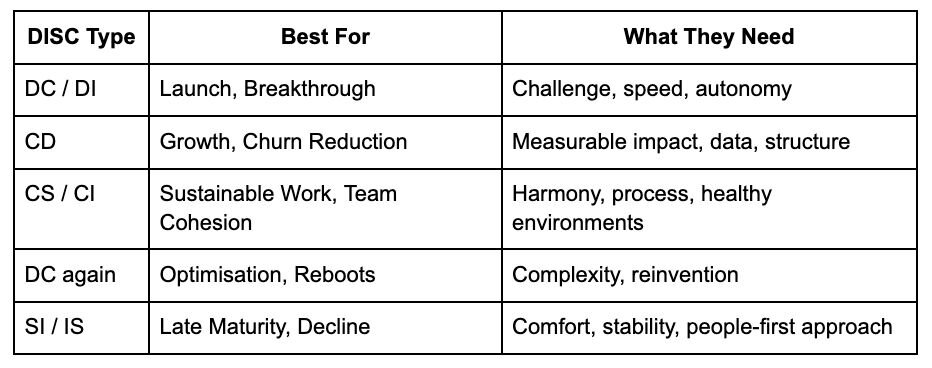
Now here's the kicker: Every type of product manager requires a different kind of motivation. Not all of them care about numbers. Some care about the process. Others care about people. Some need short-term wins; others live for long-term goals.
Break it down:
- Ss - Hate vague metrics. They're about people and balance.
- Is - Need appreciation and fast feedback loops.
- Cs - Can’t stand ambiguity or fuzzy targets.
- Ds - Love goals, but if the metric is rigid and blocks them from being social or strategic, they’ll rebel.
So... is revenue a good KPI for all of them? Not even close.
What’s Special About Revenue as a KPI for Product?
If we’re talking about software revenue, it looks deceptively simple on paper.
For SaaS, it’s usually: Revenue = Active Subscriptions × Price per Period
For non-SaaS — like one-time licenses, downloadable tools, or perpetual software — it’s more like: Revenue = Purchases × Unit Price
But real life? It’s never that clean.
While these formulas might work for finance or sales, revenue for product teams is never just about multiplying a price by a user count.
Here’s what makes revenue a tricky KPI:
- Revenue is multi-factored. It depends on dozens of processes: lead generation, sales conversion, onboarding, implementation, feature adoption, TCO, customer satisfaction...
- Revenue is multi-dependent. Each factor involves its own team with different skillsets and performance levels.
- Revenue is externally influenced. Market demand, economics, politics, competition — all impact it.
Still, revenue is one of the core indicators of company success. Someone has to be responsible for balancing all the inputs that drive it. And while product managers aren’t traditionally the ones held accountable for revenue, maybe they should be.
They’re the ones who can shift the vision, adapt the roadmap, and influence the GTM.
Not by chasing static KPIs, but by continuously improving the product’s value and market fit.
So...What About Sales? Shouldn’t They Own Revenue?
Great question. We asked it too.
Isn’t revenue a sales job? After all, they close the deals, right?
Yes. But what if there are no leads? Or if churn is growing because the product has bugs or poor UX? How can sales teams bring in revenue if the product isn’t competitive?
Eventually, we realized something: Sales is far more dependent on Product than the other way around.
Even more importantly, we discovered this: Alignment only happens when the sales team has KPIs tied to a specific product revenue, not just any revenue.
That shift forced collaboration. It stopped the habit of hitting sales targets with old products while ignoring new ones that needed support.
The more mature the product, the less sales depend on product management decisions. But at launch or in fast-moving markets? Product is everything.
And What About Marketing?
Marketing owns lead generation, right? So why would product managers be responsible for their work?
Because product vision is the root of every good marketing initiative. If the vision is outdated or vague, there’s no way to build a proper GTM or messaging strategy.
In dynamic markets or early-stage products, marketing becomes heavily dependent on product decisions. When revenue became our single KPI, we had to completely reconsider collaboration between Product, Sales, and Marketing. It was the only way forward.
The Revenue KPI Mind Shift
What if the product revenue plan isn’t hit? Even if you did your best? Even if the dev team worked hard? It’s demotivating.
The thing is, you can’t work with revenue directly. It’s not a task. It’s not a feature. It’s not a sprint goal. Revenue needs decomposition.
Unlike retention or onboarding KPIs, revenue isn’t tied to a single system or moment. Sometimes it’s about lead gen. Sometimes churn. Sometimes bugs. The real work starts with asking: “What’s blocking revenue now?” And that answer can, and should, change over time.
You don’t reanalyze revenue every 6 months just because a calendar says so. You reanalyze it because your environment changed. Because suddenly usage matters more than monetization.
Because acquisition got too expensive, or churn suddenly spiked. You need to define the right supporting metrics dynamically, based on what’s affecting revenue now.
That’s what makes it such a hard KPI. And why it forces product teams to stay strategic, cross-functional, and honest.
Yes, metrics like churn reduction or onboarding conversion are easier to digest. But they can also narrow the PM’s vision, keeping them away from fast-changing market realities.
And here’s the painful truth: Effort this month doesn’t lead to revenue this month. That’s brutal for I-first-type professionals who thrive on fast feedback.
For PMs, revenue is a lagging indicator. They work today and maybe see the impact in 3-6-12 months — if everything else goes right.
Bargaining for the Right Product Metrics
So what’s the right set of product KPIs? It depends on:
- Product maturity
- Market dynamics
- Personality traits of your PMs
In complex platforms with many sub-products, negotiating metrics became a mess because each domain has its own: Personality fit, Maturity level and Market speed.
Trying to set up the right product metrics for all domains we discussed everything: ticket counts, bug rates, customer satisfaction. Want to guess what we ended up with? - Revenue.
Not because it was perfect, but because it gave the most freedom. It pushed PMs to build vision, make bets, and take ownership.
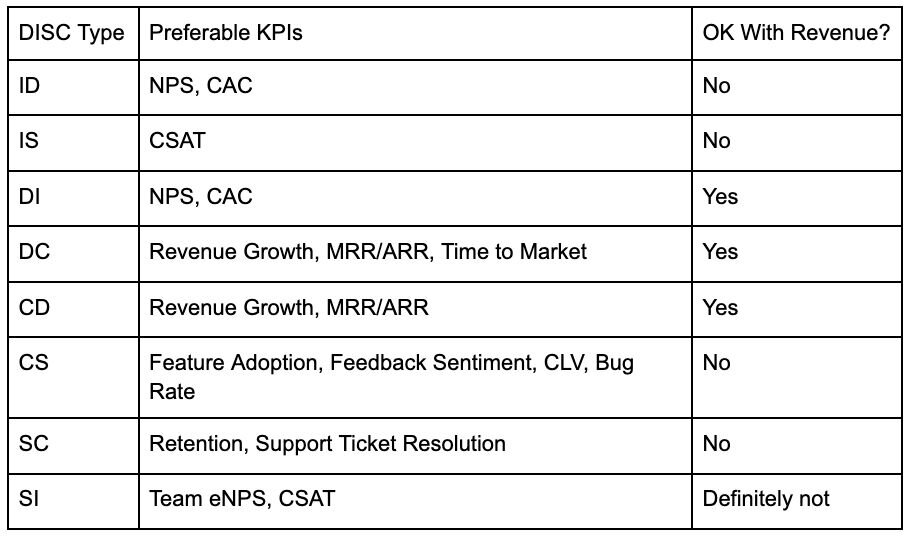
Of course, not everyone could accept that. Revenue as a KPI tends to reward D and C types, and it can demotivate others or simply doesn’t bring any value with other PMs.
So if you pick revenue as your main PM KPI, you need to be very aware of personalities and product context.
So, When Does Revenue Work as a KPI?
Final Thought
If you’re going to use revenue as a KPI, you need to understand who you’re giving it to.
It’s not just a number. It’s a mindset shift. Some people will love it. Some will burn out. Others will quietly disengage.
Revenue can be a powerful, strategic KPI. But only when it’s connected to personality, product maturity, and business context.
That’s when it works. And when it doesn’t? You’ll know quickly.

Keep reading
The 3 financial metrics every PM needs on their scorecard
Products on average retain 30% of customers after 3 months: Product benchmark findings
From conception to clarity: Navigating the KPI journey for product managers
Measuring the user experience by Tomer Sharon