

After months of AI exuberance, and companies telling the workforce that AI will create new jobs while eliminating old ones, a new tone has emerged - those new jobs can also be replaced by AI. Now that companies have had enough time to experiment with the different tools and capabilities, there is optimism that this can lead to “smarter” workforce reduction. In a July 27 article in the Wall Street Journal, Chip Cutter writes, “The careful, coded corporate language executives once used in describing staff cuts is giving way to blunt boasts about ever-shrinking workforces. Gone are the days when trimming head count signaled retrenchment or trouble. Bosses are showing off to Wall Street that they are embracing artificial intelligence and serious about becoming lean.”
Software teams are already feeling this change as tools now write code, build prototypes and synthesize customer feedback. In James Gunaca’s July Product Management Jobs Report, he shares that Product Manager jobs worldwide are down 5.9%, compared to June 2025, when they were up 5.1%. Although teams have been reduced, the importance of the smart, resourceful and communicative product manager has never been more important – there are just fewer of them, with fewer layers between them and the CPO.
In the ‘90s, the commercial internet created enormous new opportunities for content, commerce and communications, and with that, the software Product Manager went through its first seismic change. The PM no longer had to lead efforts to ship software versions on physical discs or CD-ROMs - a very expensive and time-consuming process. PMs had to learn how to strategically launch smaller, more iterative releases while adopting new KPIs such as impressions, click-throughs and bounce rate. The barrier to create a website was pretty low, and as the internet exploded in the 90s, so did the demand for product managers.
As the role matured, and organizations made it standard alongside engineering and user experience, new career paths merged. It began with the Associate Product Manager, typically entry-level, then moving to Sr/Product Manager > Sr/Director > VP > Chief Product Officer. There was a pretty clear track and plenty of opportunities all buoyed by a series of high impact changes to the industry (see below). That brings us to today, where generative AI tooling can automate and articulate so much of what the PM had done within their organization - it’s the first time in 31 years we see a retraction of the human skills necessary to advance and grow products:
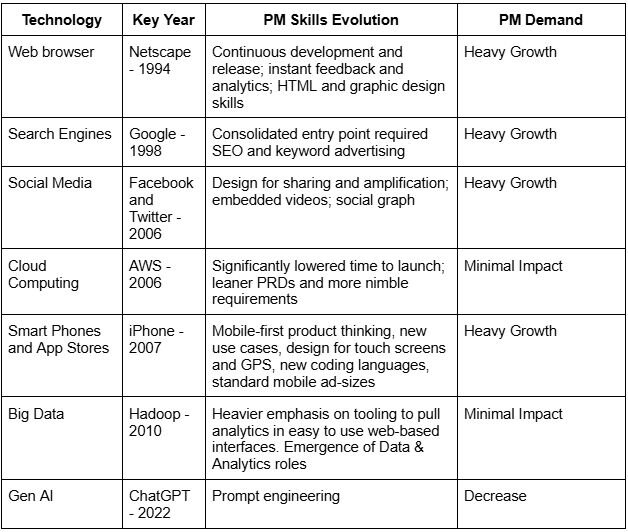
I’ve started to see a shift with clients towards leaner product teams, where the individual contributor is now front and center. In small to mid-sized companies, product organizations have flattened, with all product managers reporting directly to the CPO.

PMs continue to have wide compensation ranges - from Principal Product Managers, who can earn as much as team VPs, to more junior Product Managers compensated at the associate or manager level. The key differentiators are the individual’s experience, expertise, and product scope. For example, a Principal PM leading a $500M product with 50% annual growth expectations will earn significantly more than a PM managing a $10M product growing at 10%.
This isn’t entirely new. Companies like Atlassian, Stripe and others have followed this model for years. As Chip Cutter’s article points out, companies are going to be more confident to follow this path now. As the product team layers thin out, there will also be a change in the supporting roles to the product organization.
In my previous head of product roles, my first hire was often an analyst - someone who pulled data, tracked KPIs, spotted trends, and supported prioritization and experimentation. They used tools like Pendo, FullStory, SQL, or Excel to quickly show what was working and where we hit snags.
Today, AI-driven tools like Seek, MindStudio, and Delve can deliver these insights on a recurring basis. While messy data still limits full automation, capabilities will improve as tools mature. Similarly, UX research is shifting - customer interviews can be transcribed and analyzed in tools like NotebookLM to answer questions such as, “What did customers find most confusing about step A?” or “What experiments could improve this flow?” PMs can now navigate data faster than ever.
Product teams will continue to need an operations-driven person to help with the set-up and optimization of these tools, as well as other supporting needs like cost management, governance, privacy, and GTM coordination. Dan Shipper, co-founder and CEO at Every, recently shared on Lenny’s Podcast that he has a head of AI Operations who creates continuous efficiencies for the team using AI tools and prompts which has created “a big unlock” for the company.
There is a scramble right now for PMs to seek and understand every tool out there - FOMO is a real thing. There is also heavy top-down pressure for product teams to “just use more AI” - both for internal efficiencies and to improve their product’s capabilities. I have recently started to teach a course at General Assembly on this very topic to help guide product teams to a manageable set of tools which fit their set of business needs. Although tooling is still emerging, it’s amazing to see how many product managers are incorporating this into their day-to-day. Not everything is ready for mass adoption. Here’s my go-to list at the moment:

It is natural for product managers to feel a little panicked. For the past 30 years product managers and leaders have seen consistent growth – both in terms of job opportunities and the skills an individual can learn. Although the quantity of roles is shrinking, their importance will continue to drive a product’s growth and innovation. The fundamentals will continue to be critical for a product’s success, and the PM will continue to turn to tools, data and people to get the answers they need to lead. Jobs will be more competitive, and people remaining in this field will need to enjoy being individual contributors rather than people managers. Listed below are the top 3 skills product managers should strengthen to be successful in this ever-changing role:
- Have a stable of go-to tools. Experiment with the above set of tools in your current job to get a feel for what helps. Some tasks may still be easier and better without the tools - that’s OK, but have an informed and strong point of view of what you like to use, even if your company has different standardized tools.
- Improve financial literacy. Product managers will need to become more business-driven leaders, and with this comes financial planning and decision-making. Establish strong working relationships with your finance team to get in the weeds on investment cases, resource allocation and levers to accelerate or decelerate work. Work closely with your commercial team to understand revenue forecasts and pipelines so you are an active partner to steer the business forward. It’s not just about knowing your market and customers, it’s knowing how to steer business growth and the different levers at your disposal.
- Hone your interpersonal and storytelling skills. Ongoing communication with your teams will continue to be critical. Think about how you can continue to tell the story of your customers, their problems and how your product is solving their challenges. Share honest learnings and issues you face and ask for help. Continue to generate excitement and support for your product so that it gets the resources needed for success.
Times of big change always present windows of opportunity to those who seek it - good luck and please continue to share stories back to the community.

Keep reading
Allyship in UX & product: Eight ways to improve your influence across teams
Your AI problems might actually be team problems
Why team alignment starts with incentives: Org design lessons from B2B SaaS
Precision over hype: A product manager’s playbook for launching AI that lands