

There is a counterintuitive operational principle: to make the greatest impact, do as few things as possible. It’s useful in day-to-day product development, but especially during planning. Here's the thinking behind it – and how to put it into practice.
If you take all the possible opportunities your team has, ideas, or projects you can work on, assess their expected impact, and draw on the chart, you will get some form of a power law. The below charts show the typical view you will get. On the X-axes, the project's impact is divided by effort; on the Y-axes, the number of projects in a bucket by impact is divided.
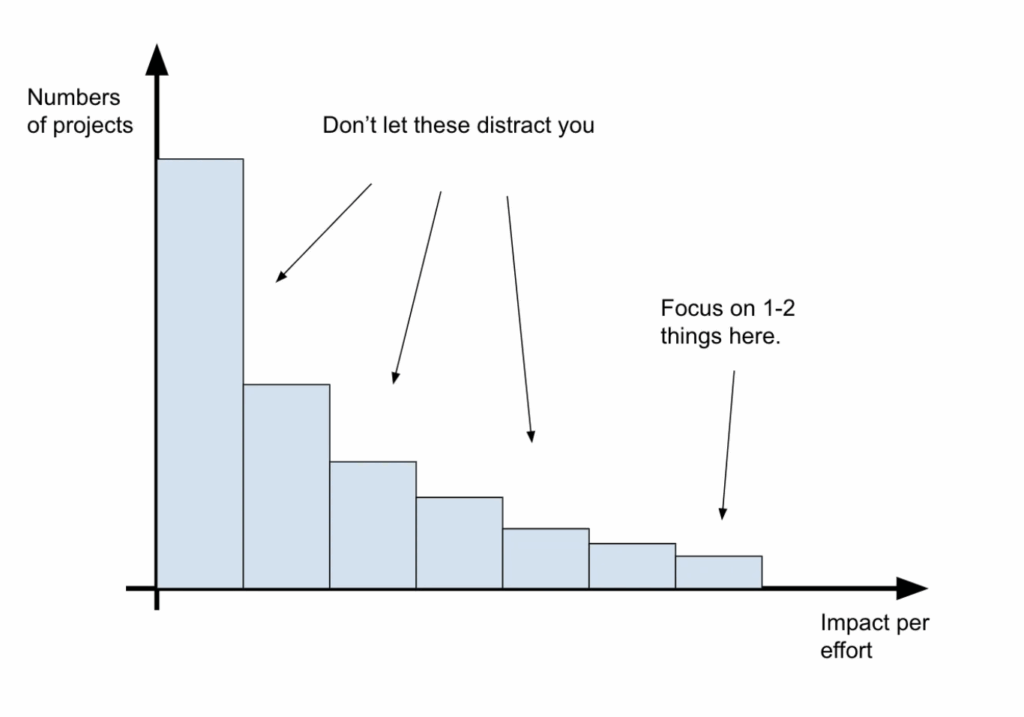
Most things don’t matter (as much)
You’ll likely see that most of the projects will have a low impact. A few will be of high value. But only a tiny number – maybe just one – promises outsized impact. The top is likely to be more valuable than the second. The second one will be much better than the third, and so on. This common observation is often called the Pareto principle or the 80/20 rule and is observed in various domains, from economics to software performance to time management.
In short, most of your results will come from a minority of your efforts. Your job is to figure out which efforts those are.
How to apply this in practice
You need to identify your top projects and focus as much effort as possible on them. Here’s a simple framework for prioritizing work using this principle:
1. Gather all the opportunities
Make a list of all the potential projects, ideas, or experiments your team could work on – it can be a very simple list, fitting on one page or spreadsheet. Use the self-explanatory names so your colleagues can understand them without your help, at a glance. If your list takes more than a minute to scan, it’s too long or too complex.
2. Assess the impact of each every idea or project
If you don’t know the impact, write down your expectation or best guess. You should have some intuition as something made you put this project on the list in the first place. Even if you’re unsure of the numbers, don’t be worried about missing the estimation.
In fact, you can easily be 50% off without a negative impact on the prioritization outcome. Remember the difference between the top project is more than “multiple times” so a 50% error rate is ok. The trick is to have a common measure for all the projects on your list. To make your estimates more consistent, use a shared Key Performance Indicator (KPI) tree. This is a secret sauce that makes this thing work.
3. Sort the list by impact
Once you’ve added rough impact estimates, sort your list. Ideally, you want to use impact divided by effort as your sorting metric. That way, you prioritize not just high-value work but work that’s also realistically achievable in a given timeframe.
4. Focus deeply on the top item
Now comes the hard part: do less.
Allocate as many resources to the first project on the list. Until you get to the level of diminishing returns when you can not invest more time or resources into it productively.
Only then should you start working on the next item on the list.
5. Repeat – within reason
Allocate as much of the remaining resources and time into the next project by impact. Repeat.
If you do it right, you will likely have the capacity for two or three projects running simultaneously. That’s the point. If you’re juggling four or more major initiatives at once, there is a very high probability that you’ve not prioritized well.
You’re likely diluting your effort across lower-impact work, wasting precious time and resources on something that is an order of magnitude less important than what you could have been doing. And even worse, you’re adding complexity, making it harder to track what’s going on, respond to change, or finish anything well. As a side effect, you can also experience a lack of understanding of what’s happening.
This same approach applies to managing your personal to-do list, a product squad, or an entire company. The focus is fractal.
Signs you’re doing too much
If you’re unsure whether you’ve overcommitted, here are some warning signs:
- You’re unclear about the team’s primary goal right now.
- Progress feels slow across the board.
- People keep switching between tasks or meetings without visible outcomes.
- You’re maintaining lots of parallel efforts, but none are getting finished.
- You’re getting lots of feedback, but it’s scattered and hard to act on.
All of these symptoms indicate a lack of priorities and, often, an unwillingness to say no. But influence comes from choosing — and sticking to — what matters most.
Focus brings clarity
It is worth repeating: doing fewer things well leads to better results, both operationally and culturally.
A roadmap with clear priorities:
- Reduces coordination costs
- Boosts morale (as teams can see their impact)
- Enables better communication with stakeholders
Allows for faster learning and iterationYou’ll also better understand what not to work on – at least not now. That clarity is a competitive advantage.
The art of simplicity
“Doing as few things as possible” is not just a productivity hack. It's a discipline. It requires resisting the urge to play it safe or to please every stakeholder. It asks you to say no to 'good' ideas so that you can say yes to the best ones.
In the long run, this mindset will enable your team to deliver meaningful, measurable results that align with your product vision.
Start with a spreadsheet. Shorten the list. Choose the most important things. Then, develop a habit of focus. This is how great products are created.
Do as few things as possible.

Keep reading
January's top product management reads on Mind the Product
How to start a sustainable product business: CEO Laura Crawford on growing her brand from scratch
What the GPT-5 launch teaches product managers
Eight skills, one journey: How mastering product management transformed my career