

When we talk about product management, it’s easy to picture it in the world of fast-paced tech startups or large corporations – launching new apps, scaling platforms, chasing KPIs. Many of us are familiar with this traditional, business-driven version of the role. But product management exists beyond the walls of Silicon Valley – and it’s quietly transforming how nonprofits operate, deliver services, and create impact.
Nonprofit organizations – whether advancing cancer research, supporting new mothers, sheltering children, promoting sustainability, or building stronger communities – are united by a mission to serve, not to sell. Yet behind the scenes, they all have something else in common: they build and manage products. These might not always be digital, but they’re intentional solutions designed to meet real-world needs.
Product managers in this space take on a unique challenge. Their north star isn’t revenue or user growth – it’s impact. They must translate mission into action, navigate tight budgets, balance donor expectations with beneficiary needs, and still bring structure, strategy, and vision to the table. While the core skills – stakeholder collaboration, prioritization, problem-solving – remain the same, the context is entirely different.
In this paper, we draw on our own experiences as nonprofit product managers to explore how product principles are being redefined in mission-driven spaces. We delve into the theoretical foundations that underpin this work, identify key gaps in research, and offer real-world strategies and methodologies that reflect the realities of nonprofit environments. Through comparative analysis and a case study, we highlight how product thinking, when applied with empathy and purpose, can unlock powerful outcomes in communities where the need is greatest – and where every product decision carries the potential for real-world change.
Introduction
When most people think of product management, their mind usually goes straight to tech companies, consumer apps, or fast-growing startups. It’s a role often associated with building market-driven products, scaling user growth, and driving revenue. But over the last few years, product management has quietly found its place in an entirely different world – the nonprofit sector.
Nonprofits, whether working in healthcare, education, climate action, or community development, may not always call it “product management.” Yet they are building products every day – from digital tools and learning platforms to services and programs that touch real lives. The difference? Their measure of success isn’t profit margins or customer acquisition – it’s impact.
In this paper, we explore how product management is evolving within nonprofits. We draw from our own experiences working at the intersection of technology, mission-driven strategy, and social good. Managing products in nonprofits is not just about applying best practices from the corporate world – it’s about adapting them to environments where resources are limited, stakeholder needs are complex, and impact matters more than anything else.
This paper unpacks those nuances – the challenges, the lessons learned, and the opportunities ahead for product managers working in or with nonprofits. Because while the tools might look familiar, the mindset, the goals, and the definition of success in nonprofit product management are entirely different – and deeply human at their core.
Literature review
This literature on product management predominantly focuses on for-profit contexts, emphasizing market competition, customer acquisition, and revenue growth. However, recent studies and industry reports have begun to shed light on the application of product management principles in the nonprofit sector.
For instance, the NTEN report "The State of Product Management in the Nonprofit Sector" highlights that many nonprofits are not just consumers of technology but also creators, developing tailored solutions to meet their unique needs. Similarly, Forbes emphasizes the growing importance of hiring product managers in nonprofits to drive strategic initiatives and enhance service delivery.
Despite these insights, there remains a paucity of empirical research and case studies focusing specifically on product management practices within nonprofits, indicating a significant gap in the literature.
Theoretical Foundations
Modern product development heavily relies on methodologies like Agile, Lean, and Design Thinking. Nonprofits historically operated with more traditional project management approaches (e.g. waterfall projects tied to grant timelines), but this is changing. Today, many nonprofits are experimenting with Agile and human-centered design to increase their effectiveness.
- Agile and Lean: Nonprofits are finding value in Agile methodologies to manage projects under conditions of uncertainty and resource constraints. A 2022 study found that applying Agile and Lean in nonprofit projects helps with continuous progress tracking and adapting to change, which is critical as nonprofit projects often face evolving community needs or external conditions. Agile’s emphasis on iterative development and feedback loops aligns well with mission-driven work: it encourages trying small interventions, measuring results, and refining the approach – rather than spending a year building something that might not fit the beneficiaries’ needs. For example, an environmental nonprofit developing a new tool for farmers might use Scrum sprints to quickly prototype features, test them in the field with a small user group, and iterate based on feedback, rather than rolling out a fully-formed solution to all regions at once.
However, adopting Agile in nonprofits requires cultural and managerial adjustments. Some challenges include: limited tech expertise among staff to run sprints or use tools like Jira, difficulty committing a cross-functional team exclusively to one product (since team members often juggle multiple duties), and stakeholder expectations for detailed upfront plans (e.g. a grantor might want a fixed scope and timeline, which clashes with Agile’s embrace of change). Despite these hurdles, there is a clear trend of nonprofits embracing hybrid approaches – combining Agile with traditional planning to meet funder requirements. Researchers note that a hybrid strategy may be necessary, blending Agile’s flexibility with the reporting needs of nonprofit projects. Additionally, Lean principles (eliminating waste, focusing on value) resonate strongly in resource-limited environments. Nonprofits have been quick to adopt Lean startup ideas like running pilot programs (MVPs), validating assumptions early, and scaling only once impact is proven.
- Design thinking and human-centered design: Arguably even more than Agile, design thinking has taken hold in the social sector as a way to ensure solutions are well-tailored to the people they serve. Nonprofits work on “wicked” social problems where a deep understanding of human behavior and context is critical. Design thinking’s process – empathize, define, ideate, prototype, test – is naturally suited to nonprofit innovation because it centers on the users/beneficiaries. A Stanford Social Innovation Review article pointed out that too often social initiatives falter because they “are not based on the client’s or customer’s needs”. Approaches that are imposed top-down (what design thinkers call “outsider solutions”) often miss the mark in local contexts. By contrast, design thinking encourages going into the field without preconceived notions, co-creating solutions with the community, and rapid prototyping to get feedback.
Nonprofits have started to use human-centered design (HCD) not just for product interfaces, but for designing programs and services. For example, the global design firm IDEO.org is a nonprofit consultancy that helps NGOs design solutions alongside the communities they serve. The process ensures that the end-users’ voices are heard early and often. A key mindset here is captured by the social impact product principle: “Build with users, not just for users”. This aligns with what Joni Cooper highlighted as co-design: successful social impact products involve the target community in the design process to create trust and better outcomes. In practice, this might mean a nonprofit PM spends time conducting user interviews in a low-income neighborhood to inform an app for accessing social services, or runs participatory design workshops with frontline staff to prototype a new data collection tool.
Design thinking in nonprofits often crosses sector boundaries. Cross-sector collaboration is common, where businesses, nonprofits, and governments co-create solutions (for example, a city government and a civic tech nonprofit jointly designing a public service app). The optimism and creativity of design thinking help break down the “we’ve always done it this way” mentality. As the SSIR article noted, “Nonprofits are beginning to use design thinking as well to develop better solutions to social problems… by working closely with clients and consumers, design thinking allows high-impact solutions to bubble up from below rather than being imposed from the top.”.
- Methodological adaptations: In applying these methodologies, nonprofit product managers sometimes need to adapt the language and tools to fit their context. For instance, rather than speaking about “customers” and “market fit,” they might speak of “community members” and “mission fit.” Instead of revenue-focused OKRs, they set impact-focused OKRs. But the underlying techniques – user research, prototyping, backlog prioritization, iterative improvement – are very much the same and equally effective. An Agile sprint review in a nonprofit might include not just the team and management, but also a funder representative or a field volunteer to gather their feedback. Similarly, success in an iteration might be measured by qualitative feedback from beneficiaries (“Did this new feature help you?”) alongside any quantitative metrics.
One practical methodology gaining traction is Service Design, which complements product design by mapping the entire service journey (important for nonprofits delivering services, not just self-service products). Also, frameworks like Theory of Change often guide nonprofit projects – essentially a backward design from desired outcomes to activities. A savvy nonprofit PM will integrate Theory of Change with agile roadmapping: ensure each feature or release can be traced to an outcome in the theory of change, thereby aligning agile execution with long-term impact goals.
- Service delivery vs. product mindset: Nonprofits traditionally think in terms of programs and services rather than “products.” An emerging theoretical conversation is how applying a product mindset (iterative development, user feedback loops, lifecycle management) to service delivery can improve effectiveness. Concepts like Product-Market Fit morph into Problem-Solution Fit in the nonprofit space: ensuring that the solution (product) truly fits the social problem and the community context. Frameworks like the Double Diamond (discover, define, develop, deliver) are being used in social innovation, which marry well with design thinking and agile cycles.
In summary, nonprofits are increasingly borrowing the best practices from tech (Agile/Lean) and human-centered innovation (Design Thinking/HCD) and molding them to mission-driven work. The result is a more inclusive, iterative product development approach that can tackle social problems in innovative ways. As evidence of this trend, a KPMG project management survey in Australia noted that 68% of organizations (including nonprofits) have adopted Agile in some form, and Forbes has featured how nonprofits can adapt Agile for resilience and impact. This methodological evolution is equipping nonprofit product teams to deliver better results despite uncertainty – to “build the right thing” (through design thinking) and “build the thing right” (through agile execution).
Challenges in non-profit product management
Nonprofits face distinct challenges in product management, some of them also as detailed in the NTEN report: (https://www.nten.org/)
- Resource constraints: Limited budgets and staff capacity hinder investment in research, development, and iteration, with 81% citing budget issues for expansion and 62% for hiring.
- Stakeholder complexity: Balancing the needs of beneficiaries, donors, and regulators complicates prioritization and decision-making.
- Mission tension: Aligning product goals with organizational missions can conflict with operational feasibility or donor expectations.
- Measurement difficulty: Quantifying social impact, as opposed to financial metrics, poses evaluation challenges.
- Financial constraints: Unlike for-profit companies, nonprofits rely on grants, donations, and public funding, making budget allocation a persistent challenge.
- Technology adoption: Many nonprofits struggle to implement digital tools effectively due to resource limitations and resistance to change.
- Scalability issues: Expanding a non-profit initiative requires strategic planning to ensure sustainability without diluting its mission.
- Willingness to sell: One of side of the Business Strategy’s value stick is WTS which is the willingness of sellers to provide their services, usually getting impacted by microeconomy, salary or incentives etc, In case of non profits however the product building is mostly done by volunteers both at product dev and operational side. Since such services cannot be incentivised, it becomes a challenge for such firms to encourage volunteers to retain.
Comparative analysis: Traditional vs. non-profit product management
| Aspect | Traditional | Non-profit |
| Primary goal | Profit and growth | Mission and impact |
| Target audience | Customers/market segments | Beneficiaries, donors, stakeholders |
| Resource availability | Abundant capital and talent | Limited funding and staff |
| Product innovation | Market driven | Mission driven |
| Primary KPI | Revenue and growth | Social impact metrics |
| Funding | Sales and investor | Grants and donations |
| Budgeting | Strategic cycles | Grant based |
| Decisions | Market driven | Stakeholder balanced |
| Scope | Proft focus | Mission focus |
| Methodogies | Agile, lean | Agile, hybrid |
| Risk | High, tolerated | Lowm managed |
Challenges and future direction
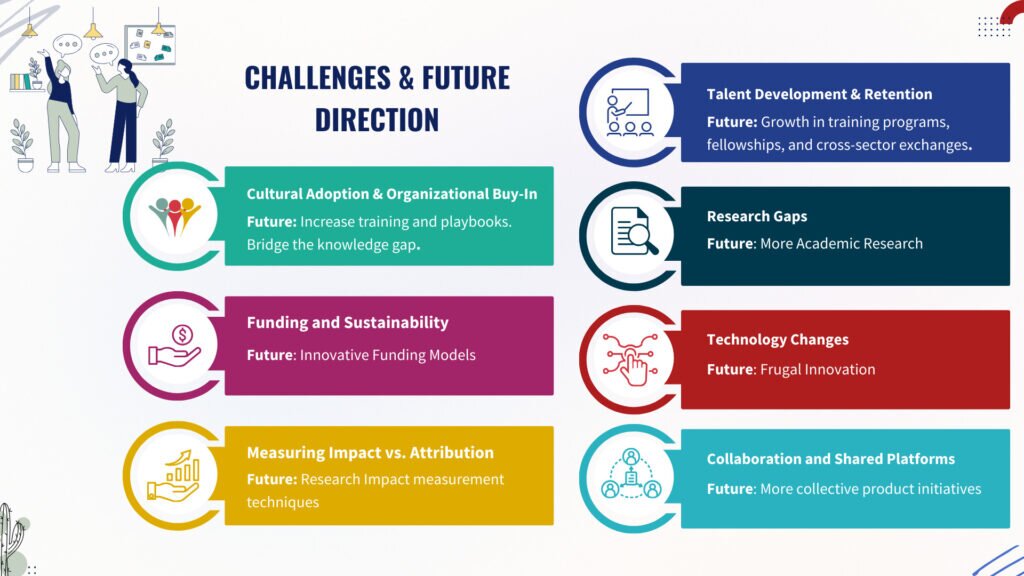
The field of nonprofit product management is still emerging and faces numerous practical challenges and research gaps. Here we outline some of these challenges and discuss future directions for the discipline:
| Challenges | Description | Future direction |
| Cultural adoption & buy-In | Convincing leadership to embrace product mindset; limited familiarity with Agile/Design Thinking. | More nonprofit-specific training, playbooks, and growing communities of practice. |
| Funding & Sustainability | Restricted funding for product roles/tools; need for flexible or shared cost models. | Innovative funding (e.g., social impact bonds), open-source platforms, earned income models. |
| Measuring impact vs. attribution | Difficult to attribute long-term social impact to specific products. | Better impact metrics, academic research integration, agile + evaluation convergence. |
| Talent development & retention | Hard to attract/retain product managers due to lower nonprofit salaries; skill gaps on both sides. | Training, fellowships, cross-sector exchanges, social product manager career paths. |
| Research gaps | Sparse academic literature on nonprofit product management as a field. | New research exploring frameworks, ethics, and product governance in mission-driven contexts. |
| Technology changes | Keeping up with rapid tech (AI, mobile) while ensuring accessibility and ethical use. | Frugal innovation, strong data ethics, ICT4D-inspired product frameworks. |
| Collaboration & shared platforms | Need for cross-org product initiatives to reduce duplication and align roadmaps. | Shared infrastructure, ecosystem product managers, sector-wide product certifications. |
Conclusion
Product management in the nonprofit sector isn’t just a professional discipline it’s a deeply human one. At its core, it’s about aligning innovation with empathy, and strategy with service. While traditional product roles often chase revenue, nonprofit product managers pursue something less measurable but far more meaningful: impact.
The road is not without its hurdles. From limited funding and complex stakeholder environments to the constant pressure of proving value, nonprofit product managers face a unique set of challenges. Yet, it’s precisely these constraints that spark creativity and purpose-driven problem-solving.
As the field matures, we see a growing recognition that nonprofits deserve the same strategic tools and product thinking that fuel innovation elsewhere but with adaptations that honor their mission. Whether through agile pilots, community co-design, or frugal tech, nonprofit product management is carving its own identity one that values progress over perfection and people over profits.
The future will require more cross-sector learning, better funding models, and frameworks built with impact in mind. But perhaps most importantly, it will require more people like you who are willing to ask: How can we build better, not just bigger? And how can we serve with strategy, without ever losing sight of the soul behind the solution?
Because in the end, great products don’t just change user behavior, they change lives.

Keep reading
Your product community is in the wrong place: Why in-app integration matters
Why ClimateTech products fail at deployment
How Mastercard turned Token Connect into a $3bn scalable growth engine
The 2026 AI product strategy guide: How to plan, budget, and build without buying into the hype