

It is a well-known adage in the tech industry that "hardware is hard" - a warning every founder or product manager dreads when building atoms and not just bits. Well, in 2026, hardware is getting even harder.
We are living through the AI summer, but for hardware product managers like me, it feels a lot like winter. While software teams celebrate the capabilities of on-device AI, hardware teams are staring at the bill. The hardware industry is in a crisis and the threat is two-pronged:
First is the AI tax. Running AI models locally on devices requires massive jumps in NPU performance, DRAM, and thermal headroom. Simultaneously, the explosion of AI hyperscaler demand has squeezed the global supply of DRAM and other silicon chips. DDR5 DRAM prices, for instance, have shot up by 4X or more in just the last 6 months. We are already seeing the casualties - Nintendo’s stock nosedived recently, while Dell, HP, and Lenovo are raising prices - all due to spiking memory costs.
Second is the trade tax on finished products i.e. Tariffs. For decades, we relied on manufacturing hubs in China, Taiwan, and Vietnam to build products at a lower cost. But recent trade tariffs are destroying the arbitrage and crushing margins. iRobot filed for bankruptcy recently, explicitly citing the high tariffs on Vietnam imports as the final blow that made their debt unmanageable.
The result? Component inflation and tariffs have made it impossible to build the same product at the same cost. The old playbook – negotiating harder with suppliers or simply cutting features – won't work this time. AI use cases demand more compute, while consumers expect improved performance year-over-year without a price hike. To protect margins in the AI era, we need to look beyond the usual cost-cutting measures and start looking at the product development model itself.
The build vs. buy trap
Traditionally, both consumer devices (B2C) and enterprise hardware (B2B) companies have oscillated between two extremes - OEM (Original Equipment Manufacturer) and ODM (Original Design Manufacturer).
- OEM model (build it all). You design every circuit and line of code in-house and pay full price for Silicon Valley engineering hours. You do use a contract manufacturer to manufacture the product at scale. This vertical integration has worked well for giants like Apple or Samsung due to economies of scale. For smaller players however, the high development costs - labor, tooling, non-recurring engineering (NRE) - can kill a product before it launches.
- ODM model (buy off-the-shelf). You simply buy a manufacturer’s white-label device, put your logo on it, and ship. This is standard practice for store brands like Amazon Basics. It’s cheap and efficient, but your product has zero differentiation; it is indistinguishable from your competitor's.
In the AI era, the OEM route erodes your margin, and the ODM route kills innovation and devalues your brand. The solution lies somewhere in the middle – the "Goldilocks" zone that takes the best of these two approaches, allowing you to own the innovation while leveraging the manufacturing partner for the execution.
This approach is the Joint Development Model (JDM).
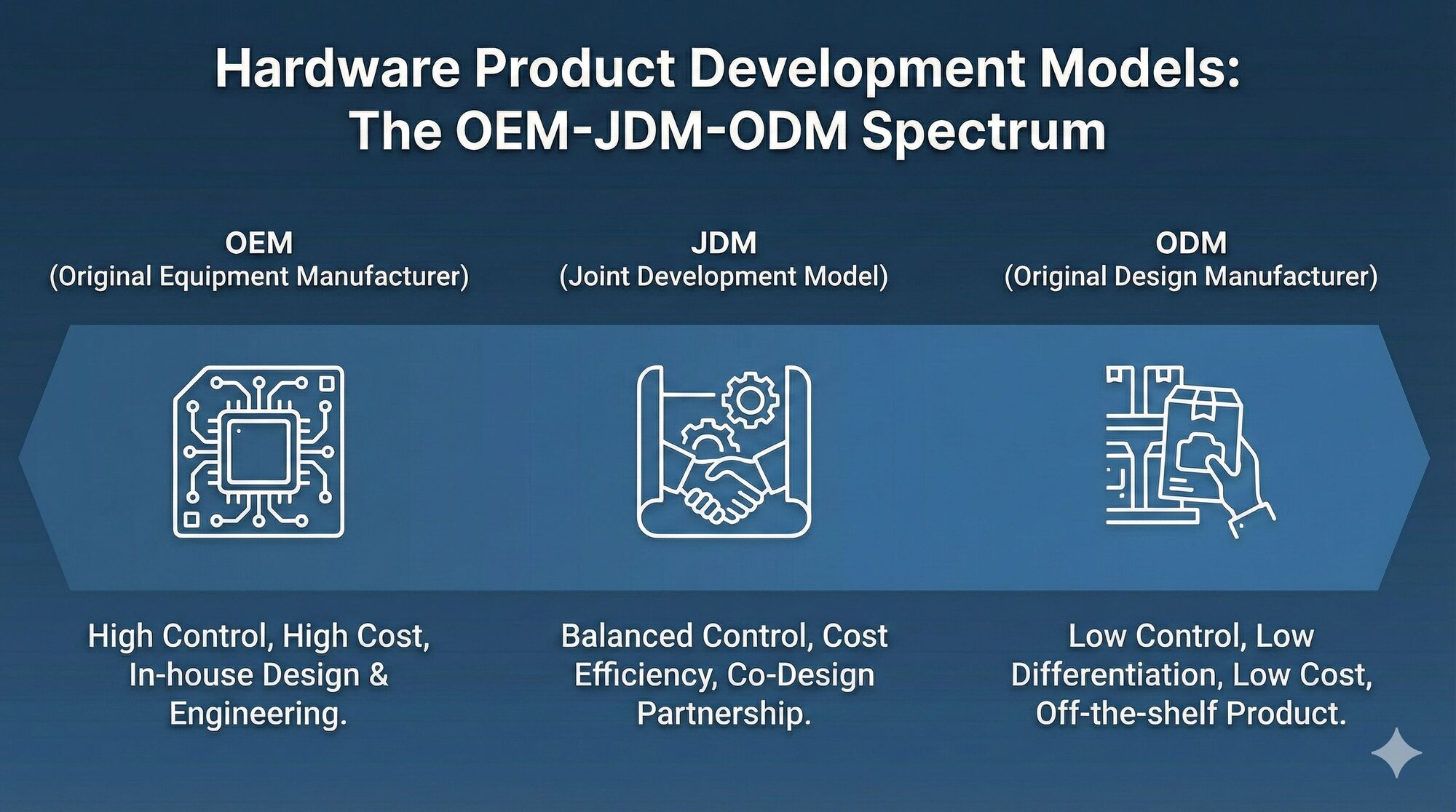
Unlike OEM or ODM, JDM is a co-design partnership. You define the product vision, design specifications, and critical IP, while the partner handles the detailed engineering, sourcing, and manufacturing. With the right partner, contract structure, and organizational mindset, this model allows you to focus on building an innovative product, while the JDM partner solves how to build and ship. It is not an outsourcing tactic; it is a precision instrument that balances a hardware company's strengths and weaknesses.
Let me be clear - JDM is not a radical new concept. Mature products like PC, laptops, and networking gear have relied on JDM for years to maintain profitability. However, many hardware leaders have been hesitant to adopt it, primarily due to a “trust gap”. Shifting an organization’s mindset to rely more on an external partner is a huge challenge. Contract manufacturers (CMs) are still seen as mere assemblers who require heavy oversight and training to execute a premium product vision. Apple, after all, spent billions of dollars over decades training CMs in Taiwan and China to build world-class products.
However, the tables have turned. Top-tier CMs in these Asian hubs have come a long way, transforming into engineering powerhouses with deep expertise in cutting-edge technologies and manufacturing. A prime example is Asus. This Taiwanese giant started as a motherboard manufacturer for companies like IBM in the 90s. As they grew their expertise, they eventually split the business into two entities: Asus (the first-party consumer devices brand) and Pegatron (the CM that notably manufactures iPhones).
JDM’s goal is to leverage these matured partner capabilities to unlock two massive advantages:
- Engineering arbitrage - You should not be paying Silicon Valley rates for standardized PCB layout or firmware development. By shifting "execution engineering" to partners in Asia, you leverage significantly lower labor costs without sacrificing quality. This frees up your expensive in-house teams to focus solely on the crown jewels - the product vision, features, design, and the novel algorithms - that actually drive differentiation.
- Economics of Scale - A JDM partner buys components for multiple clients. They gain volume discounts and allocation priority that a single product line could never achieve. With DRAM prices skyrocketing, drafting off a partner's purchasing leverage is a defensive moat for your margin.
The impact - In my experience transitioning product lines from OEM model to JDM, I have seen development costs drop by upwards of one-third. Such savings can make or break the product. They create the necessary buffer to fully or partially offset the AI and trade taxes, without punishing the consumer or destroying your margins.
How to JDM
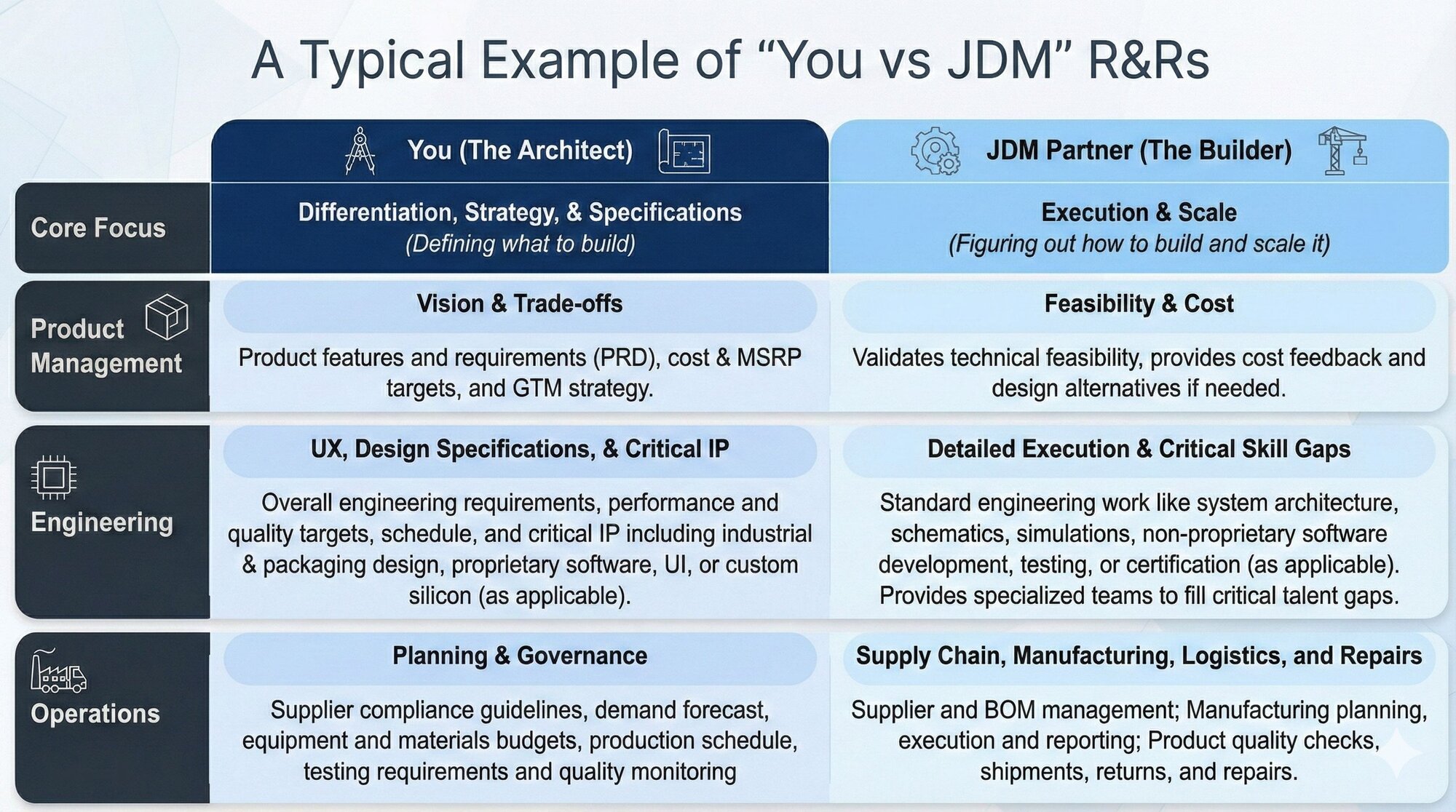
Drawing on my decade-plus experience building hardware products, I recommend approaching JDM as a strategic partnership similar to that between an Architect and a Builder. You then separate your product development into two buckets:
- The Architect (keep in-house) - You own the Soul of the product. These are critical, unique, or differentiating elements – like the product definition, industrial design, camera tuning, the AI software layer or quality standards. These preserve your product vision and brand equity, so you must retain strict control here.
- The Builder (offload to JDM) - You leverage the partner to do the Heavy Lifting. This goes beyond standard execution – product manufacturing, testing, certification, or supply chain management – it is also about filling your capability gaps. If your team lacks the internal resources or expertise to execute complex tasks, like RF design or thermal simulation, you can leverage the JDM's specialized engineering teams to fill those voids seamlessly.
Note: There is no set formula for where to draw this “you vs. JDM” line. It is up to every company to decide what level of offloading is practical based on their unique in-house capabilities, product complexity, and business priorities. Below is a typical example of what the roles and responsibilities (R&R) split might look like:
Admittedly, moving to JDM directly for a flagship device can feel daunting. If you are building a first-generation or a highly complex product where you cannot yet risk relying more on a partner, you can still leverage JDM by employing a portfolio-level strategy.
In this strategy, a company might keep its flagship device 100% in-house (OEM) to ensure perfection, but aggressively move less complex ecosystem products to a JDM model. For example, mature categories like power accessories or standard peripherals often benefit most from this shift. These lower-complexity, higher-margin add-ons create a profit buffer to absorb the taxes on your main device. This allows you to protect your business margins without exposing your flagship product to external execution risk.
Managing the risks
JDM is not a silver bullet. While the financial benefits are compelling, JDM comes with risks that must be managed proactively.
Typically contract manufacturers operate on thin margins and are not built for exploration. If you change your requirements halfway through development, you will likely end up with substantial cost increases and schedule delays. So it's critical that detailed product requirements and R&Rs between you and JDM are well-documented early-on, ideally when the contract is signed.
To manage these risks and the organizational mindset shift, the move to JDM doesn't have to be immediate. I recommend a phased, long-term adoption approach:
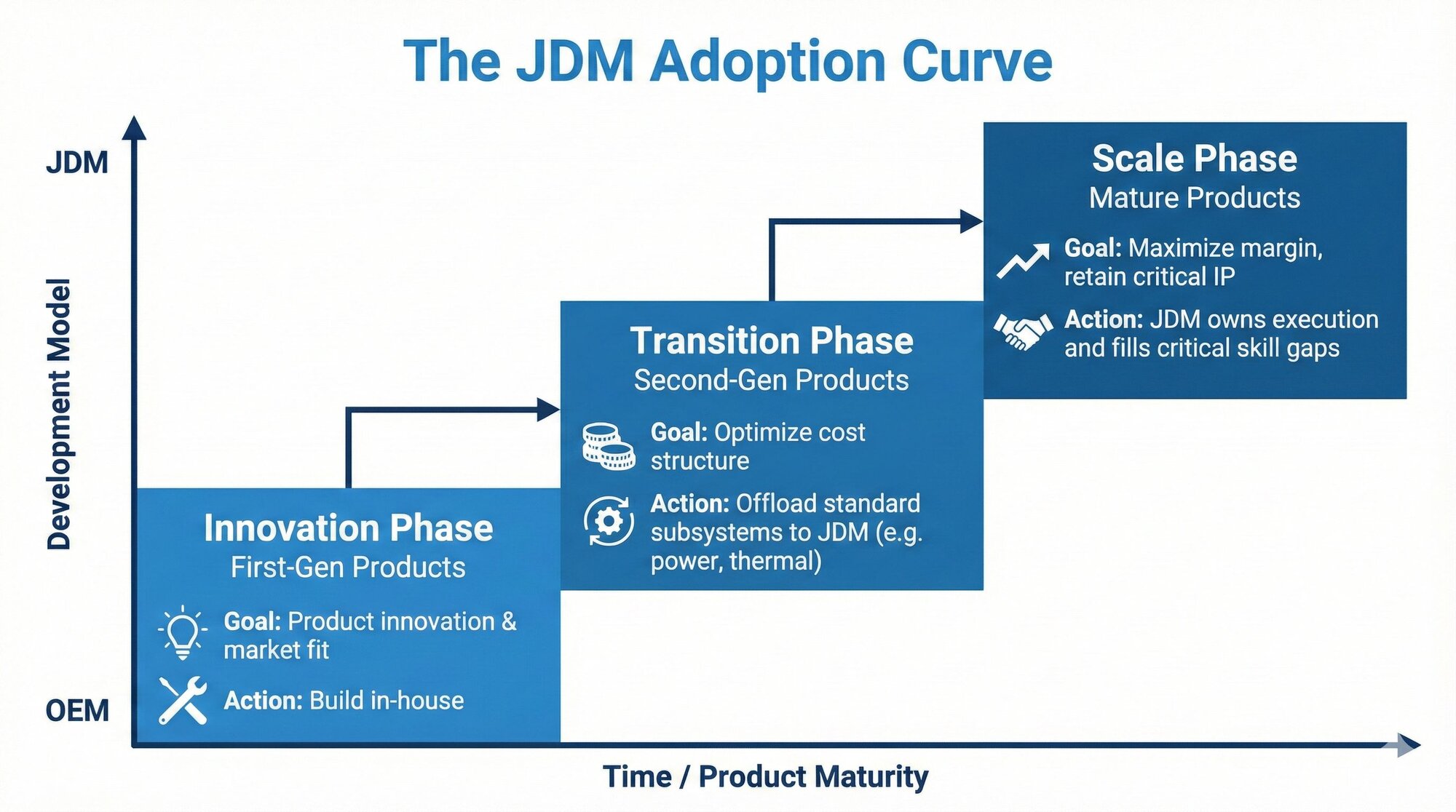
- First-generation products (Innovation Phase) - Build these in-house (OEM). When complexity is high and you are still discovering product-market fit, you need the agility to change direction daily without contract penalties.
- Second-generation products (Transition Phase) - Move the stable, standard subsystems to JDM to start optimizing your cost structure.
- Mature products (Scale Phase) - Move the majority of the execution to the JDM partner.
From product owner to business architect
As tech industry visionaries predict, the future lies in agentic systems and AI-native products, including new consumer devices.
As we tackle the challenges to building this future, the definition of "product management" is expanding. It is no longer enough to be the voice of the user. You must also be the architect of the business. If your product roadmap requires high-performance specs but your cost structure cannot support it, you don't have a product - you have an expensive hobby.
Strategically deploying JDM offers a path to build the AI hardware of the future without bankrupting the present.
Disclaimer: The views and opinions expressed in this article are purely the author's and do not necessarily reflect the official policy or position of Google or its affiliates.

Keep reading
January's top product management reads on Mind the Product
How to start a sustainable product business: CEO Laura Crawford on growing her brand from scratch
What the GPT-5 launch teaches product managers
Eight skills, one journey: How mastering product management transformed my career