
At #mtpcon London 2025, Matt LeMay, a veteran product leader and coach with a wealth of experience across major tech companies, captivated the audience with a talk about the importance of aligning product work with business impact.
In a session filled with humour and actionable advice, Matt emphasised that product teams must prioritise impact over perfection if they want to thrive in today’s business environment. Watch the video in full, or read on for his key points!
Why product teams must focus on business impact
Matt opened by acknowledging the challenges that product teams face, noting that the product management world has been tough in recent years. Yet, he pointed out a shift in product management. While once dominated by rigid frameworks and rules, the conversation is slowly evolving towards a deeper understanding of business realities and the importance of tailoring approaches to each company's specific needs.
“The reality is that product teams often find themselves stuck in low-impact work,” Matt stressed. He referred to what he calls the Low Impact Death Spiral—a cycle where product teams deliver features that don’t move the needle for the business. These features often complicate the product, adding layers of complexity with no tangible results in terms of revenue or user growth.
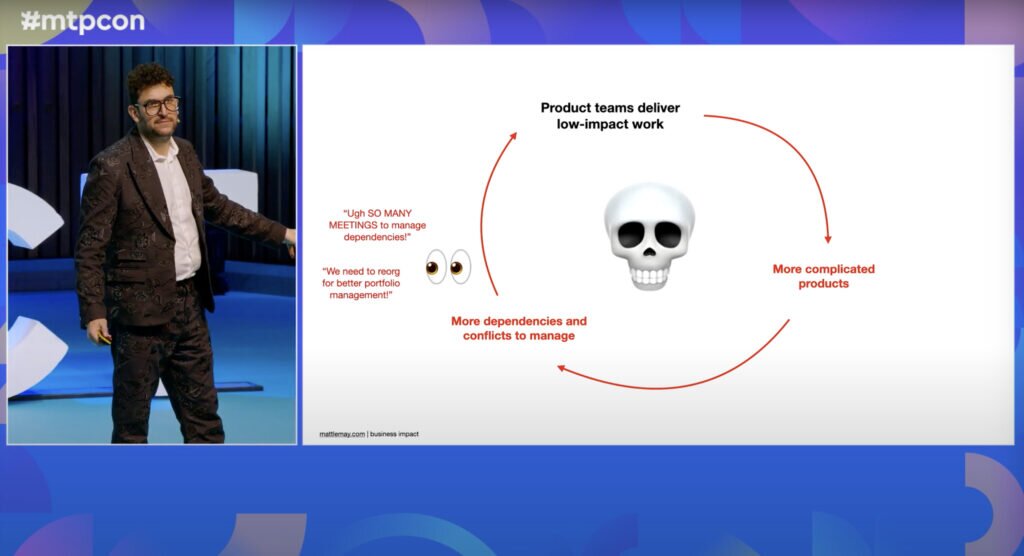
The low-impact death spiral
He discussed how low-impact work often stems from the path of least resistance. It’s easier to build small, fiddly features than to tackle the bigger challenges that could have a real impact on key business metrics. But this mindset creates unnecessary complications and slows down progress. As product teams look at dependencies and conflicts, they tend to choose the easier, less impactful work, which results in a product that’s more difficult to use, with no meaningful improvement in user experience or business results.
Matt made it clear that the problem doesn’t lie with the product teams directly. It’s often the organisational structure that perpetuates low-impact work. Teams are asked to deliver work that doesn’t align with the company’s broader goals, and this misalignment leads to frustration, inefficiency, and ultimately, stagnation.
How to break the cycle
Matt shared three steps that every product team can take to break out of the low-impact cycle and focus on the work that truly matters to the business:
- Connect product team goals to company goals
One of the biggest issues Matt observed in organisations is that teams often don’t align their goals with the company’s broader objectives. This misalignment leads to teams working on projects that don’t contribute meaningfully to the business. Matt notes the importance of setting team goals that are no more than one step away from the company’s goals. This ensures that product teams are always working towards outcomes that directly impact the business, rather than getting lost in a maze of disconnected tasks. - Understand your contribution
Matt stressed that every product team must understand how their work contributes to the company’s success. When asked to build something, product managers should ask themselves, "How does this contribute to the business?" This question forces teams to focus on outcomes, not just output. He shared an example from his own experience where a team working on a fintech product realised they were accountable for increasing customer lifetime value by upgrading users from single-product to multi-product. Once they understood this business goal, their work became much more focused and impactful. - Connect everything back to business impact
The final step is to consistently tie the work being done back to its impact on the business. He explained that the more removed a team is from impact, the more likely they are to get trapped in low-impact work. By constantly asking how every feature or task aligns with business goals, product teams can avoid getting bogged down in unnecessary work and stay focused on what truly matters.
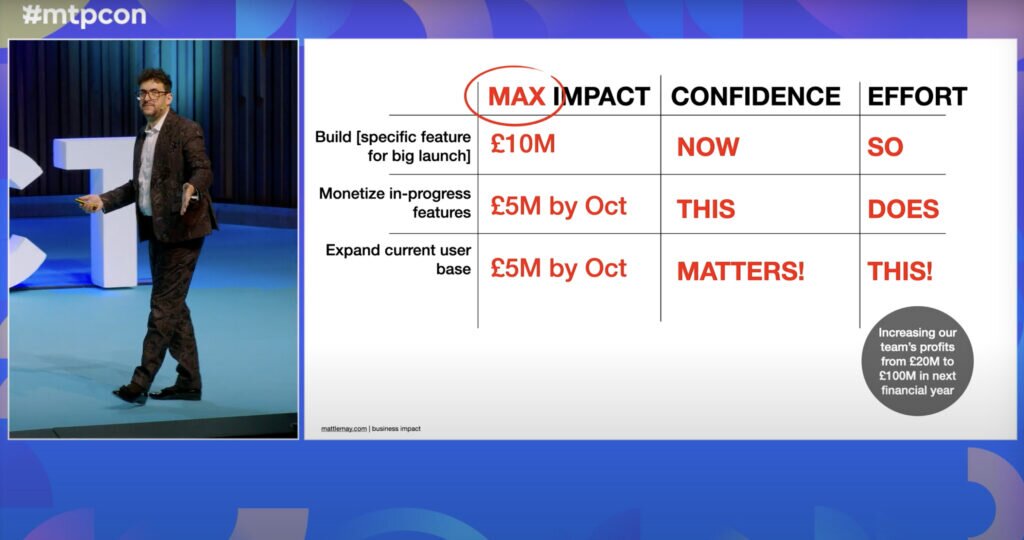
Product teams must align with business realities
Matt closed his talk by reinforcing the idea that product managers should stop fighting to do things ‘the right way’ according to frameworks they’ve read about online. Instead, they should focus on what works for their specific business and align their work with the company’s goals. This doesn’t mean sacrificing product excellence or user experience, but it does mean that product teams need to be commercially aware and accountable for the impact their work has on the business.
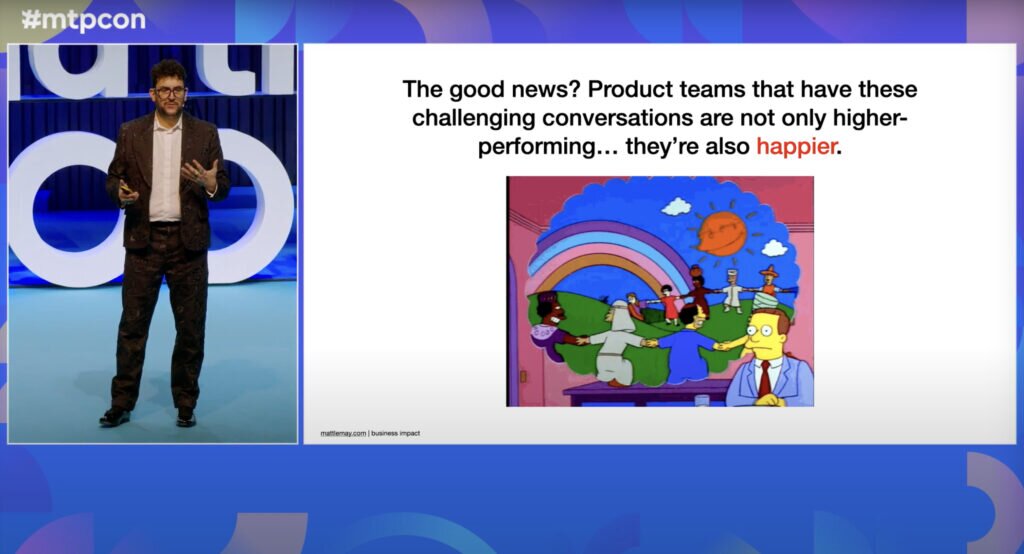
Finally, he encouraged product teams to take charge of the conversation and proactively define their contribution to the business. This approach, he argued, will not only help product teams happier but also make their work more meaningful and impactful.
For those who want to learn more about prioritising business impact, Matt's new book Impact First Product Teams offers further insights into how product managers can create value while staying aligned with company goals.
Catch up on all #mtpcon London 2025 talks on our recap page!

Keep reading
Surviving the perfect storm: How hardware PMs can beat the AI tax and trade tariffs
January's top product management reads on Mind the Product
How to start a sustainable product business: CEO Laura Crawford on growing her brand from scratch
What the GPT-5 launch teaches product managers