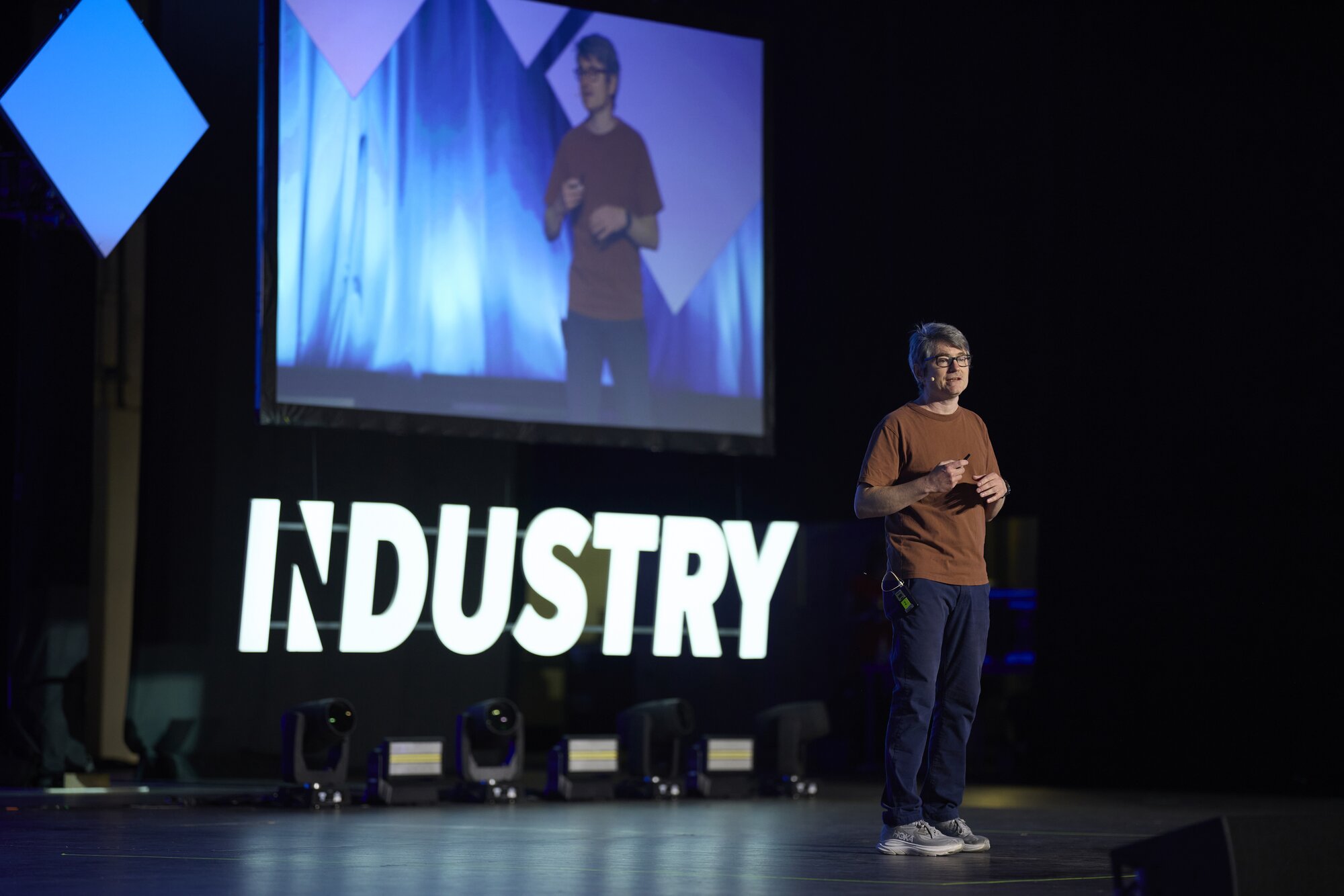
In this Industry keynote, author John Cutler, now Head of Product at Dotwork, takes an in-depth look at the way product managers and leaders work and how they generally don’t design and use internal processes to the best effect. Some companies, however, can treat how they work as a product and reap huge benefits. It means thinking about internal company processes as a game, he says, so he starts by asking the audience to think about the best game they’ve ever played.
In Product, John observes, we bring so much intention, creativity and curiosity to the customer experience and the customer environment but the reality is that this perspective isn’t reflected internally. “We’re systems thinkers and complexity thinkers when it comes to our customers but if you’re a systems thinker internally you’re an over-thinker,” he says.
He says that, to product managers, most process feels reactive, low-leverage and gets in the way - in fact process is what you do when things are going wrong in the company. It’s even worse for leaders. Many of them have been burned by worrying about frameworks and ways of working, so are happy to accept what John calls “a mediocre approach”. In addition, these are challenging times to be intentional. And yet, some teams work out how to design and play a better game internally. “Some companies figure out how to treat how they work as a product and it’s a force multiplier in the company,” he says.
What makes a good game?
John says that the list below shows the elements of a good game and also describes a place where he would like to work.
- Clear attainable goals
- Balanced difficulty
- Timely feedback and rewards
- Engaging mechanics
- Signs of progress
- Meaningful choices
- Compelling environment or story
- Progression and mastery
- Variety
- Social interaction
- Accessibility
- Playability
What gets in the way of behaviour change that is unrelated to skill?
John highly recommends Julie Dirkson’s book on behaviour design, Talk to the Elephant. The list below shows what gets in the way of behaviour change. Leaders, then, are game designers, because they’re designing games that their teams play and designing - with other company functions - the game the company plays.
- Lack of feedback
- Unclear goals
- Unlearning
- Lack of big-picture understanding
- No environmental/process support
- Fear or discomfort
- Low confidence
- Mistrust
- Social proof missing
- Lack of autonomy
- Misaligned incentives
- No identity alignment
He points out that very often we think of playing the game in a company as understanding the political dynamics in an organisation - but this is different. It’s shaping the environment, the systems, norms and constraints that you have, and thinking intentionally about tactics and rituals.
John then suggests a few tactics to help you to think about internal processes as a game.
Focus on behaviours/interactions
John gives an example of a team that wanted to be more data-driven.This is how they broke down their focus.
- Behaviour: Regularly review and analyse key performance metrics.
- Who: Product teams
- Will do what: Conduct regular in-depth reviews and analyses of key performance metrics.
- To what extent: Dedicate time in weekly meeting to discuss trend patterns and metric shifts, identifying both routine and special variation.
- In what context: Use a shared data dashboard with Process Behaviour Charts (PBC) and SPC methods, accessible to all team members.
- For what outcome: Drive continuous improvement, inform product decisions with real signals, and align actions with business goals.
Minimally viable consistency
Most companies at a global level have only a handful of rules and mechanisms, says John. There aren’t countless frameworks at a global level, but maybe five to 10 ideas. He gives The Legend of Zelda: Breath of the Wild as an example. There are essentially three rules in this game - fire burns grass, metal conducts electricity, and cold slows you down - and you can use these core rules in many different and interesting ways. “Most games that you enjoy are the function of a core set of rituals and ideas at a global level that most people can latch onto,” says John. There’s an opportunity to decide on a few core ideas that really carry weight and drive the company forward, says John, so don’t phone that in.
Enabling constraints
Most games have a checkpoint to focus attention on the game, look at the score, connect with others and so on. It’s a powerful tool, says John, but many companies have no constraints, they have nothing that everyone agrees to that also closes the loop. He gives an example of constraints in one of his clients - for example, there’s only one roadmap, and there are no pre-booked meetings on Thursdays. “These are well-designed interventions," says John.
Community co-design
The real game emerges through co-design, says John, and the best games are co-designed: “We are playful creatures,” he adds.
He gives an example of a company that treats any process proposal as a product - looking at them as a job, an anti-job, and an FAQ.
For milestones:
- The job: to encourage frequent integration of ideas, risks, code and parallel efforts.
- The anti-job: not to split big projects into arbitrary phases that do not actually reduce risk.
- The FAQ: Isn’t this just OKRs with a different hat on?
John concludes: “Look at something like mega projects in Minecraft. Hundreds if not thousands of people get together. There’s no winner, no scoreboard. They contribute their time, resources, design, creativity… It's shared but they bring their own flair, they bring the constraints. They bring curiosity because the game emerges over time. It’s incredible. Imagine if you could harness that within your company through basic game design mechanisms.”
If this resonated, catch up on the complete INDUSTRY 2025 recap for more talks, slides, and recaps.
