


At the INDUSTRY Leadership Forum this year, Vidya Dinamani, Founder & Partner at Product Rebels, led an engaging and practical opening keynote session assessing your product leadership work. Product Leaders from across industries gathered to reflect on the principles, challenges, and opportunities that the role brings. Read on for a recap of her talk:
Vidya opened by explaining that most of us know what good product leadership looks like by now: delivering customer and business value, prioritising sustainable growth, ensuring success metrics are tied to real impact, and working with empowered teams.
So if we know what good looks like, then why is it so hard to be product-led?
To understand this paradox, Vidya went through the biggest challenges that product leaders face today which is preventing them from leading successful products and teams, based on a survey that she commenced 4-5 years ago, based on a sample size of 500 product managers across several industries from mid-sized to large companies.
She asked product managers what the biggest issue they are facing at the moment is:
- Prioritisation: The majority of product leaders find it difficult to identify and focus on the right initiatives.
- Saying no: Just under half of product leaders struggle to decline feature requests from customers and stakeholders.
- Debates over opinion vs. data: Many face too many subjective arguments, slowing progress.
- Team alignment: Many face confusion about direction and priorities across teams. That sense of frustration and the sense that they’re not working on the most important thing continues to exacerbate.
The Product Leadership Diagnostic Framework
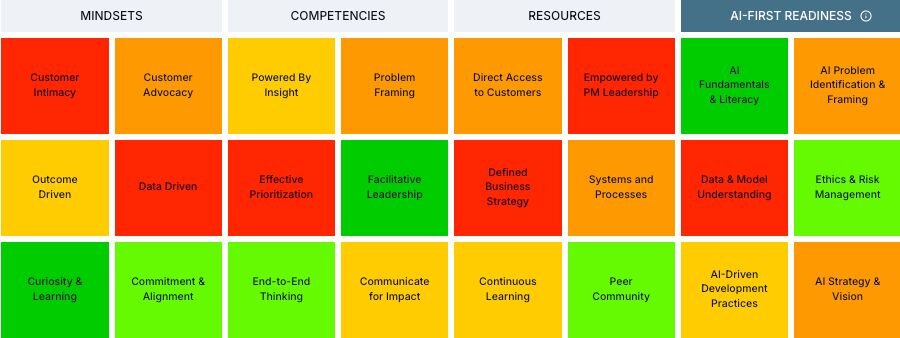
In light of these findings, Vidya and her team created a diagnostic framework (a 10-minute assessment) that locates starting points across three domains: Mindsets, Competencies, and Resources.
1. Mindsets
- Customer intimacy
- Customer advocacy
- Outcome-driven
- Data-informed
- Curiosity and learning
- Commitment and alignment
2. Competencies
- Powered by insight
- Problem framing
- Effective prioritisation
- Facilitative leadership
- End-to-end thinking
- Communication for impact
3. Resources
- Direct access to customers
- Empowered by product leadership
- Defined business strategy
- Systems and processes
- Continuous learning
- Peer community
"Surprisingly," Vidya notes, "a lot of product teams work without clarity, systems, processes, continuous learning, or a peer community.” She stressed how all of these fundamentals are key to making product managers PMs successful.
Case study: Etsy's product learning journey
Vidya illustrated the framework with Etsy’s strategy pivot. Initially, the objective was to increase the number of merchants opening shops to increase revenue. The product team looked to speed up the onboarding experience, making it easier to set up a store. This led to a surge in new shops, but many failed to generate sales and unhappy merchants.
The takeaway? Focusing on the wrong problem leads to vanity success metrics.
Vidya noted that Etsy took a step back and analysed its customers. The product team discovered that the real drivers of value were high-quality product images and clear descriptions.
Following this insight, the team shifted their key metric to "the number of shops with at least one sale." The onboarding experience completely changed. Now, it took longer and was more complex but focused on helping merchants create the right number of quality pictures and descriptions, and in doing so, making more money. So although it took longer for merchants to set up a new shop, meaning fewer shops overall, the quality of these shops were higher quality, resulting in happier merchants, happier shops, and increased revenue.
Following on from this and over a year, Etsy’s product team built a consistent problem-first approach, established continuous customer learning sessions, and created communities of practice across hundreds of PMs.
Case study: Global Fintech transformation
In a second example, Vidya described work with a global fintech whose CEO had mandated customer-centricity across the organisation. Vidya explained that before working with them, the CEO mandated that every employee in the organisation needs to be customer-driven.
"The product executives reached out to us because, though they were happy with their front-facing product teams being customer-centric, they revealed that almost 70% of the hundreds of product managers were internal platform-situated."
The assessment that Vidya sent to the product team revealed a plethora of yellow and red. “Where do you begin?” she said. The organisation prided itself on delivery, which meant there was little pushback on whether the team was solving the right problems.
The solution: Starting with the Right Questions
Vidya's team delivered a simple framework and reusable tool focused on product teams asking the right questions. "We started there because we wanted them to have the tool before we went to customer intimacy", she added.
They started watching how their internal customers were using their products, meaning that they started to deeply understand customer behaviours, unlocking key decisions on driving value.
"It wasn't simple", Vidya reminded the audience, "But focusing on these areas allowed us to have a starting point. It's all about focus"
The results
After a year, Vidya and the team developed a framework in which every product manager consistently thought about the problem first. The rest of the organisation then started getting used to it. From then onwards, they introduced continuous learning sessions that teams could pop into, sharing videos, screenshots, meaning that the whole mandate of being customer-centric started to feel real.
Preparing for the present and future
Vidya then tackled the emerging challenge of AI readiness for product leaders. “We're all in this together; this is a brave new world.”, she said. To prepare product teams for AI, Vidya developed a way for product teams to be AI-ready,
With every leader now asked to articulate their organisation's AI strategy, participants explored what this truly means for product leadership.
Core AI readiness areas:
- AI fundamentals and literacy
- AI problem identification and framing
- Data and model understanding
- Ethics and risk management
- AI-driven development practices
- AI strategy and vision
On AI strategy for product leaders, Vidya offered crucial advice: "The biggest advice that I'm giving right now to our clients is thinking about your unique advantage. There's lots of different areas, and I think the push and the urge is to try and develop a broad AI strategy."
"But if you instead turn the tables and you think about your unique advantage, which is really your data, it's your understanding of your customers. It's your deep knowledge of the information that you have about your industry, with your customers. What would it look like if you started there and then you built around that?"
This creates "a different lens to put on the way to think about AI strategy and vision. And I think it's more powerful and it's more ownable. And you can build a moat around that particular advantage in a way that I think is really hard to do if you step back and try to do this top down."
"We're really encouraging more of a bottom-up approach to thinking about how you can create your roadmap around AI."
What's next for product leaders?
For those who don't know where to start when you have a few issues, orange and red areas, Vidya encourages to just pick a place. It doesn’t matter where you start, it's all about focus, there are so many different areas that we have to focus on, but it's important to just focus on one and improving, lifting the bar as an organisation.
And secondly, for those with mostly green assessments, Vidya asked: "Does everyone else in your organisation feel the same?" She encouraged seeking feedback from:
- Leadership teams: How does senior leadership view the product org?
- Product teams: Are priorities and strategy clear internally?
- Engineering partners: Do developers see you as a strong collaborator?
- Sales, marketing, and customer success: Are you viewed as a true partner in driving outcomes?
Vidya concluded the session by saying, "There's way too much on us as product leaders. Pick a specific area of focus." The journey to becoming truly product-led is one step at a time in the right direction.

Keep reading
Mastering the art of communication as a PM: Sahil Jain at INDUSTRY 2025
Disrupt or be disrupted — how to navigate product stagnation: Stephanie Musat at INDUSTRY 2025
Excel at managing product managers: Mariah Craddick at INDUSTRY 2025
How to use Jobs-to-be-done to recruit and retain great product teams by Bobby Moesta at INDUSTRY 2025