
At INDUSTRY 2025, Stephanie Musat, Director of Product, Content Discovery, offered an effective solution to a common challenge that many products face, product stagnation. Sometimes, the best way to grow your product is actually to replace it, she opened with.
Watch the video in full, or read on for some of her key takeaways.
"Most of you won't do this, shouldn't do, couldn't do, depending on the nature of your product." Stephanie explains. However for many products, the only path forward is to leave the path you're currently on.
Why products grow stagnant
Like many product teams, Stephanie explains how we might have experienced early momentum. Early adopters flocked to your product, health metrics climbed, everything pointed up and to the right. Then came the plateau. "There's naturally a plateau in most products as you try to evolve past the stage of early adopters into more mainstream consumers," Stephanie explains. "What happens in a world where that jump into the mainstream isn't working as you had expected?" she explains.
She grounds the discussion in what she calls a product philosophy, borrowed from Laura Klene's work in the agile handbook. Product development has two sides of the same coin: building the right thing and building the thing right. The ideal state sees us understanding user problems so deeply that we architect powerful, beautiful solutions.
Sometimes in the product we understand the problem, but we don't nail the execution. Other times, we build something cool that nobody asked for. And perhaps most commonly, we end up in that uncomfortable middle ground where neither the problem nor the solution quite lands, "because your boss's boss's boss says, 'LLMs have finally advanced so we can finally get our chatbot.'" she says.
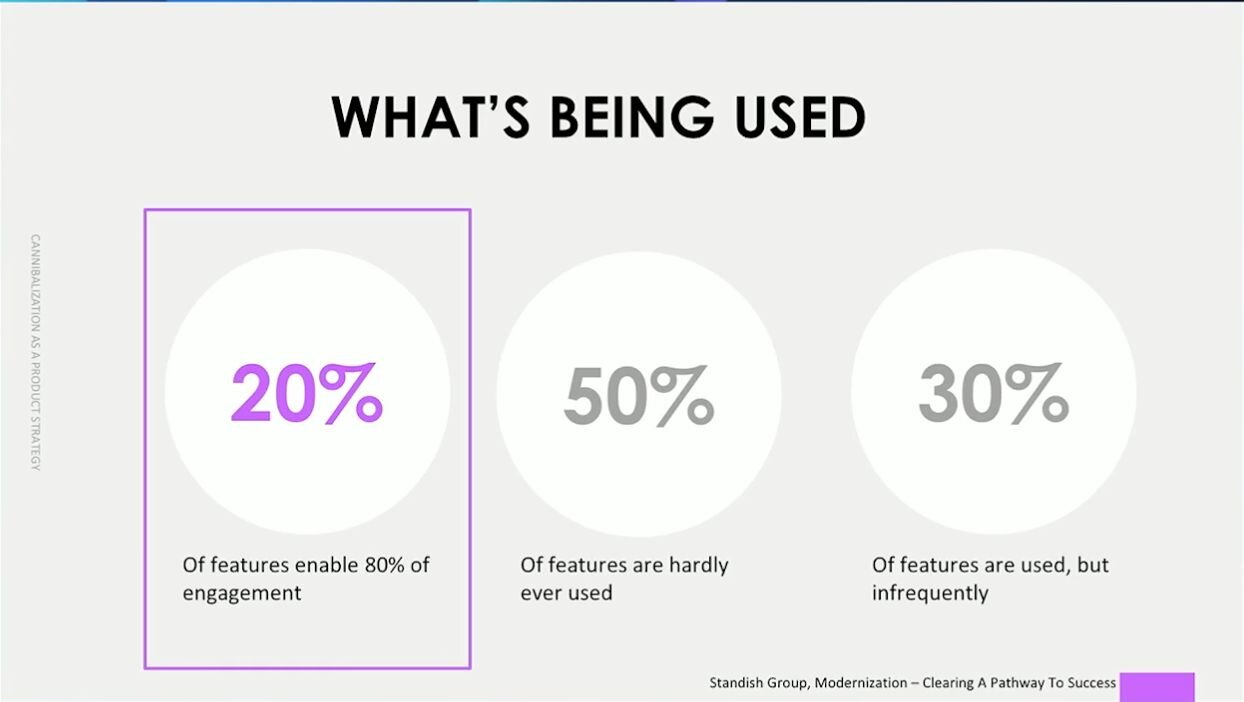
Stephanie cites The Standish Group study, which quantified that 20% of features drive 80% of engagement. Additionally, 50% of product features in your product do absolutely nothing.
What cannibalisation actually means
Stephanie encourages product cannibalisation: the intentional creation of new products or features that replace ones that exist today.
This is controlled disruption, she adds. "You are in the driver's seat. You have the reins. And you're saying in my product, I see something. It worked a little bit, but it's not getting to the results I need. I'm going to change that before somebody else changes it for me."
When your product hits that plateau, Stephanie presents three diagnostic paths.
At the top of the pyramid sits cannibalisation, for when you have a problem, tried to solve it, saw some traction, but need to push further.
Bottom left is deprecation, when the solution simply didn't work and needs removing.
Bottom right is pivoting, when your product is doing well but solving a different problem than you anticipated. Slack's evolution from gaming tool to messaging platform exemplifies this path.

Stephanie outlines three scenarios that might lead you to cannibalise your own product.
- Market saturation: when your current solution can't integrate well with mainstream consumers. The feature might be too limited, or there may be a better way to solve the problem. "You have to evaluate what you need to do to get more people to use your product."
- Customer misalignment: customers won't wait for you to address their concerns. Things shift. What worked yesterday may not work today. She shares the story of Mother Soda, a vinegar-based drink addressing the market need for healthier alternatives. When regional penetration stalled, the company cannibalised itself, re-emerging as Poppy, which sold to Pepsi for $2 billion.
- Internal innovation inertia: Pivoting or trying something different feels like admitting failure. That fear leads to endless cycles of optimisation, AB testing, tweaking to achieve minimal gains. "This is a moment for you to think about what you have on your plate, something that you need to fix. Is it better to spend your time, your energy, on small iterations or a big bet on something else?"
The diagnoses are clear. "If you don't eat your lunch, somebody else will." Stephanie explains. When growth is below expectations, the riskiest move is to stay put. Customers won't wait for you to get it right. And if you can't convince people that small iterations are costing you speed, that becomes a problem as you scale.
The risk-reward calculation
Stephanie points to familiar examples. Apple cannibalised the iPod in favour of the iPhone, while Microsoft constantly upgrades operating systems. Moving users from Windows 7 to Windows 11: maintaining loyalty while driving change.
When you're sitting with something that's not quite working, you run a risk-reward calculation across four areas. Are you consistently missing growth targets? Is there a mismatch between what users need and what you've built? Are competitors gaining traction on problems you thought you'd addressed? Does your value proposition align with what people actually perceive?
Three questions cut through the noise: If we don't do this, will a competitor? Are we making this change too early or too late? Will people see this as abandonment or improvement?
"Have that conversation," Stephanie urges. "You ask these questions, and you say, 'Can we do this better? Should we do this better?"
Making the move
Once you've made the decision to cannibalise, three steps follow on from this. Design a clear migration path so users feel upgraded. Align internal teams by incentivising sales on the new offering, helping finance see beyond the short-term hit, and preparing customer support to evangelise the change. Finally, communicate with transparency, framing this as an opportunity rather than abandonment, circulating learnings, and tying everything back to your OKRs.
Take this slide with you
Stephanie wraps up with four reminders. Cannibalisation is strategic self-disruption. Products plateau for predictable reasons, and mainstream adoption is difficult. Healthy cannibalisation is a strategic lever for longer-term growth. And it's all about asking the right questions.
"If you sit and you just continue to tweak and iterate and design, iterate and AB test your way, you're making small incremental improvements to something, you're not going to be able to open up the entire business opportunity here."
"So ask the questions you need to ask. Have those honest conversations with your teams. Think about it critically. See if there's space to bring this into your products." she closes.
Want more practical product insights? Access the full INDUSTRY 2025 recap to discover more talks.

Keep reading
Mastering the art of communication as a PM: Sahil Jain at INDUSTRY 2025
Excel at managing product managers: Mariah Craddick at INDUSTRY 2025
How to use Jobs-to-be-done to recruit and retain great product teams by Bobby Moesta at INDUSTRY 2025
Execution won’t stop. Strategy will unless you have a system: Jenny Wanger at INDUSTRY 2025