
Prerna Singh is CPTO at Avaaz, where she has a wealth of experience heading up design and product teams to create better digital experiences. At INDUSTRY 2025 she delivered an engaging session on using AI to build at speed without losing the most important part of the process, which she emphasised, is “you”.
Watch the video in full, or read on for some of her key takeaways!
Finding the foundation: product sense, judgement, values
Prerna opened by asking the audience how many PMs had been asked to bring AI into their product organisations and how they felt about it. Responses ranged from dread to excitement, a spectrum she admitted she herself had experienced. She reassured PMs that getting started with AI does not require a specific degree or new knowledge.
“As product managers you have everything you need to get started with AI and that’s your product sense, your judgement and your values.”
She describes these three components as the “foundation.” When paired with AI, this foundation “supercharges one of the best ways we can make impact as PMs and that’s through AI prototyping.”
Prerna highlights the human centric nature of product work.
“The hardest thing about building a product isn’t the code or the tools, it's about understanding people well enough to know what to build in the first place.”
This principle underscores why AI prototyping matters; it's not about perfect code or tools, but about learning faster from humans, testing with humans, and building for humans.
“That’s something that AI hasn’t been able to crack just yet.” she explained. Leading her on to explain a new concept which could not only save PMs time, but can facilitate a more effective way of building products of value.
The old way vs the supercharged way
Prerna reflected on the traditional 2024 approach: define, design, develop and deploy.
“What I really want to focus on is what’s happening between each of these stages.” She explained that every handoff, design to engineering, engineering to QA, PMs to everybody, introduces the risk of miscommunication, competing priorities and delays.
Every delay pushes back the human part of this process and that’s getting feedback from your users. She warned that when PMs take weeks or even months to gather the feedback they need can be like a “death sentence” for a product. Decisions then lag behind reality and what customers truly want. Instead, Prerna says that the supercharged way of building products in 2025 is set to be through AI prototyping using a more thorough system that works for you.
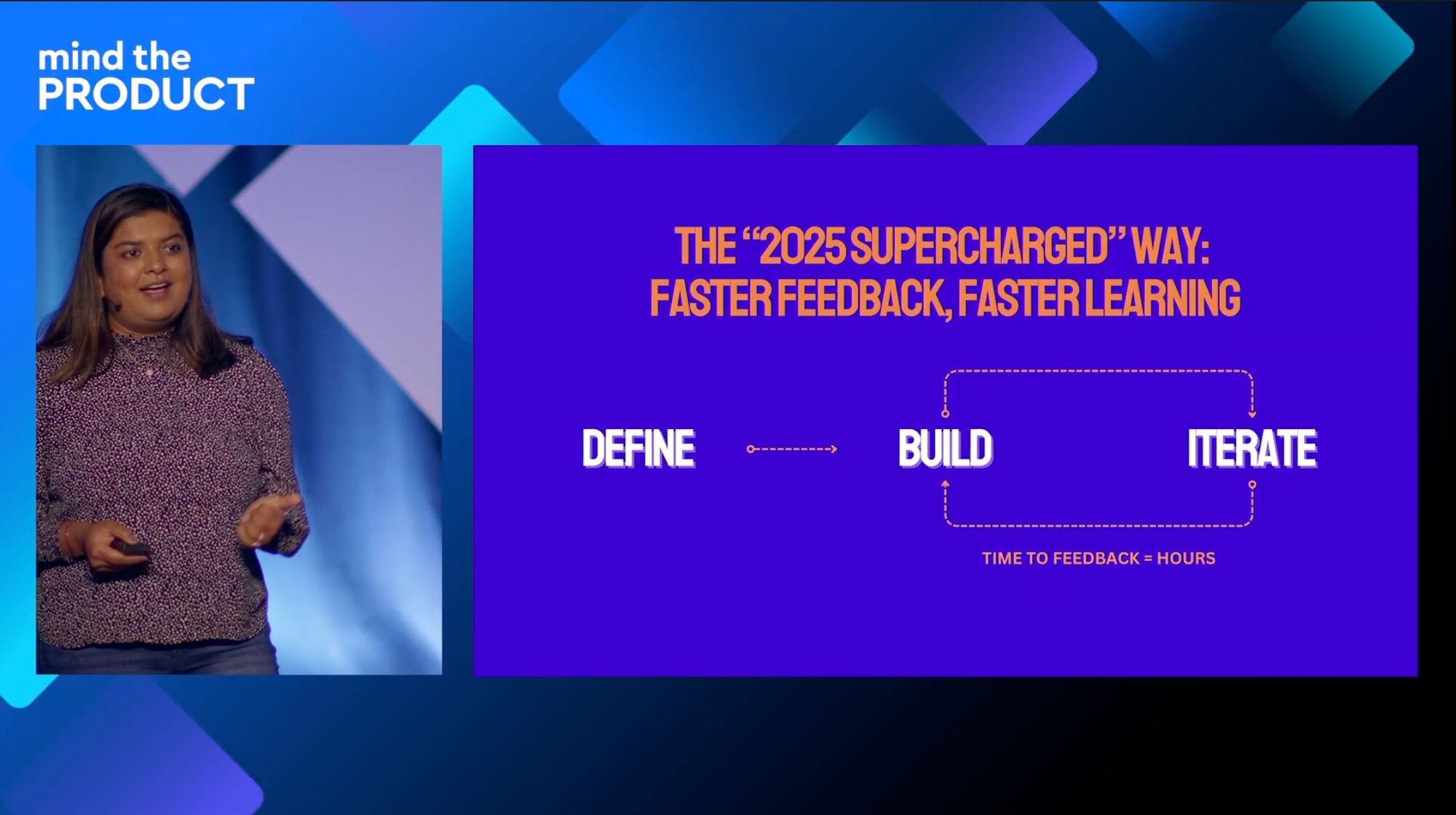
“What we now get with AI prototyping is the much tighter feedback loop. No more waiting around for design polish or engineering bandwidth.”
She describes this process as having three parts:
- Define - clarifying problems, users and boundaries before building
- Build- use AI to build prototypes that bring your ideas to life
- Iterate - test with real users quickly and gather feedback to refine a solution
AI collapses the process, allowing the human centred parts which involve judgement, creativity and product sense to happen sooner and faster. PMs can go from chasing tasks to actually driving impact.
Real-life example: Meetup community tool
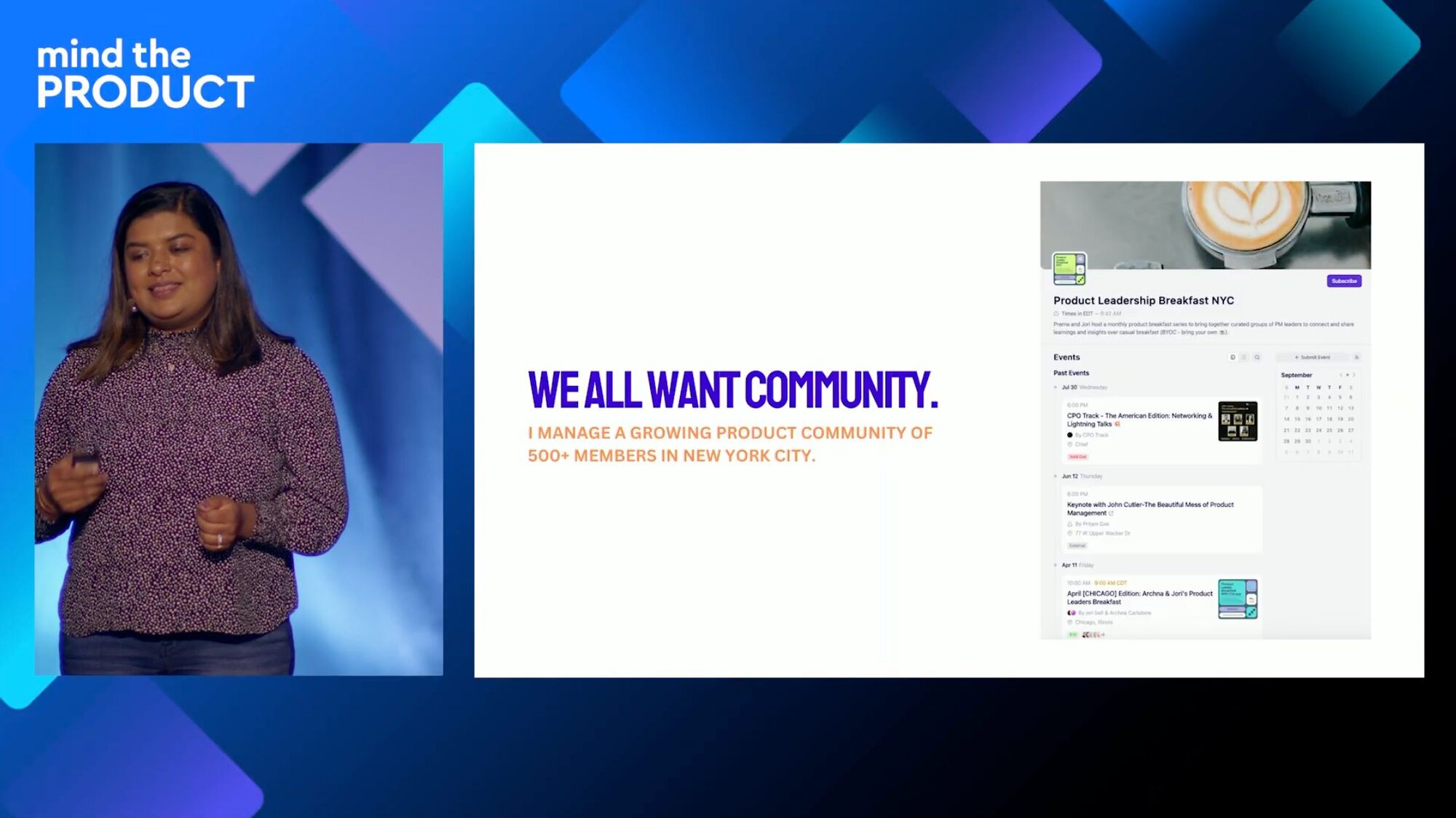
Prerna shared a personal example of growing her Meetup product community in New York to 500 members, hosting a monthly PM breakfast. While the community thrived, manually connecting members was a logistical nightmare, with ten person meetups requiring her to juggle Luma events, Google Docs, and a flood of emails.
She identified there was a human problem of managing her time to help members find meaningful connections. AI, she realised, could help to accelerate the solution and save time.
Prerna approached the challenge using her tried and tested framework: define, build, iterate. She chose ChatGPT and Lovable as her tools, but stressed that the specific technology isn’t what matters most. What counts is how the tools support your process, enabling faster experimentation and better learning from users.
She began by defining the problem through AI:
“It pressed me on things like: Who are you really building for? Is this for yourself or members of your community? And things like what happens if the user doesn’t take the action you think they are going to take?”
This approach forced Prerna to clarify the problem, define user personas, and outline the boundaries of her solution before moving into the build phase. She emphasised that this upfront work is critical, “Defining what you are going to build before you actually build it mattered a lot in 2024, it matters even more in 2025 because it’s your compass.”
Only once the problem was clearly defined did she start building. Using Lovable, she rapidly created a homepage, a member directory, and a member profile page for her community tool. The speed of this phase highlighted how AI can accelerate prototyping, but Prerna warned against relying on AI blindly. She noted, “What’s really challenging about AI is that it doesn’t have that product sense and it doesn’t know what exactly you are trying to build. It will only do exactly what you tell it to do.”
To mitigate this, she guided the AI through her logic and mapped out user journeys, ensuring that the solution solved the right problem in the right way. “Building isn’t just about building features, it’s actually about solving the right problem and solving the problem right,” she said.
Stick to your product guns
Prerna went further by asking AI to reflect on its own output. “Once the prototype had the basics, I asked AI to do two more things: actually have it reflect, knowing what we built together, how would you approach it differently?”
By stepping AI out of “obedient builder mode” and into “alternative thinker mode,” she uncovered blind spots and alternative approaches. “It’s not about letting AI have the last word, it’s about using it to surface blind spots and to help your learning.” This process also increased her empathy for the kinds of conversations she should be having with designers and engineers when building real products.
Iterate faster and gather feedback
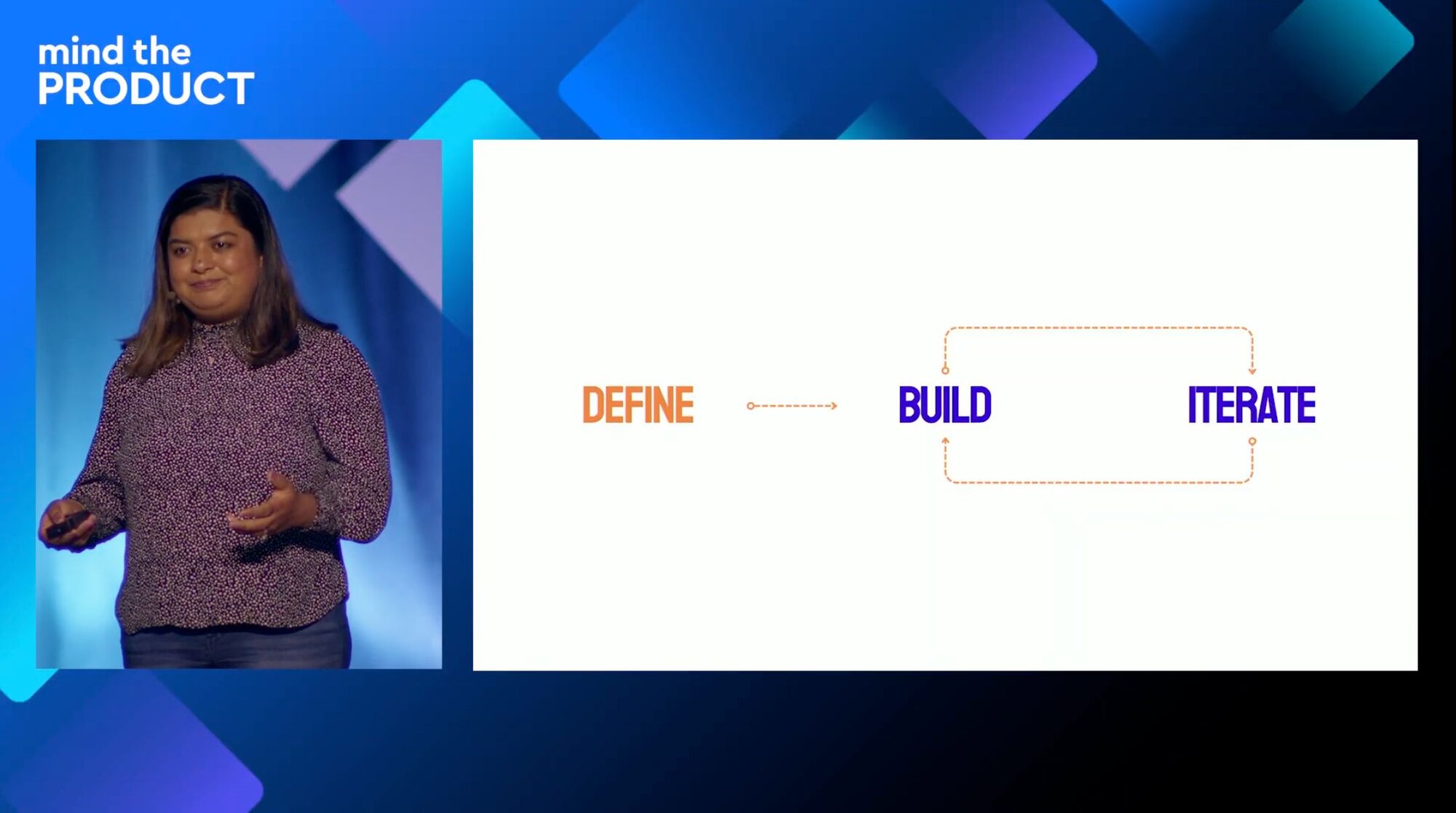
Prerna stressed that a prototype sitting on a machine is essentially useless; it must reach users. In just two hours, she had the first version of her prototype in front of a user. AI also sped up customer research, summarising transcripts, highlighting key quotes, and surfacing insights quickly. This accelerated feedback enabled faster iteration and more efficient documentation.
Reflecting on her process, Prerna noted the value of starting over with AI tools as projects evolve: “It might be frustrating to feel that you have to start over from scratch but for me that’s where the real learning has been. To continue learning new frontiers of my problem and then my solution.”
Scaling AI culture across teams
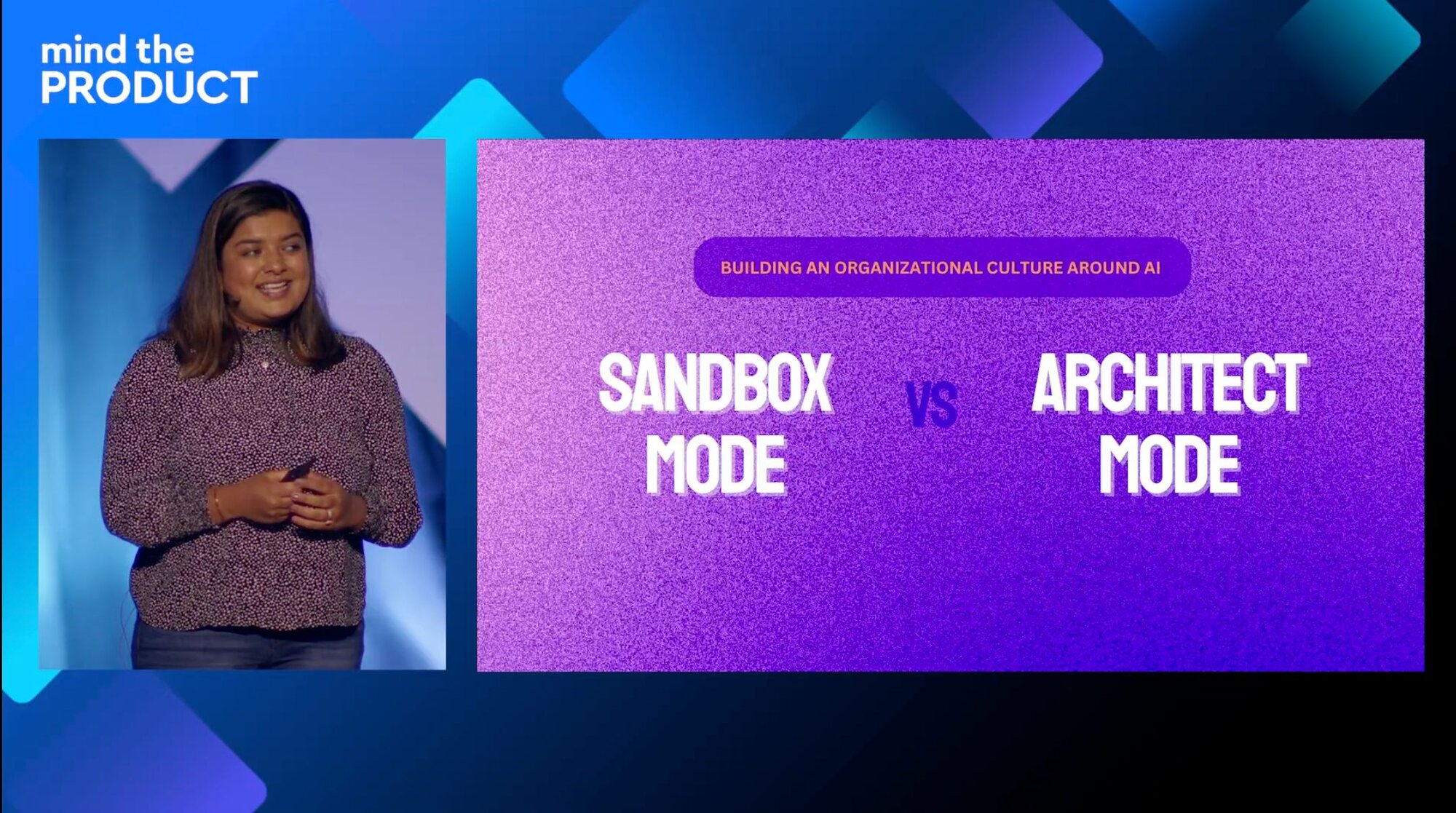
Prerna addressed how to bring AI experimentation into larger teams. Simply adding AI tasks to OKRs doesn’t create a culture. Instead, she recommended separating experimentation into two modes:
- Sandbox Mode: a safe space for teams to explore tools, experiment, and learn without the pressure of delivering on business KPIs.
- Architect Mode: a structured approach focused on scaling solutions, driving results, and delivering business impact.
“The only way to get to architect mode is through sandbox mode, you have to give teams permission to play to make products that last,” she said.
She emphasised that excitement and curiosity are critical to fostering effective AI use and innovation.
“To learn by doing, give people permission to play and you’ll be surprised about what not only they create for themselves but what they create for your business and that’s the bigger point here,” she added.
Prerna closed the session by reinforcing that while AI is a powerful tool, human creativity, judgement, and product sense remain at the heart of building great products. “The best part about building with AI isn’t the tools themselves or the tech, the best part about building products is the human side and that means that the best part about building products is all of you, it’s your judgement, your creativity and your product sense.”
Key takeaways
- Leverage your foundation: product sense, judgement, and values are your starting point, AI enhances them, it doesn’t replace them.
- Use AI for prototyping: collapse feedback loops, iterate quickly, and learn from humans faster.
- Define problems clearly: clarify your problem, user personas, and boundaries before building.
- Guide AI, don’t follow blindly: challenge AI, make it reflect, and surface blind spots.
- Iterate and test rapidly: get prototypes in front of users as quickly as possible.
- Scale culture intentionally: start with sandbox mode, then transition to architect mode for structured, impactful AI use.
- Humans remain central: AI is leverage, but creativity, judgement, and product sense drive innovation.

Keep reading
Mastering the art of communication as a PM: Sahil Jain at INDUSTRY 2025
Disrupt or be disrupted — how to navigate product stagnation: Stephanie Musat at INDUSTRY 2025
Excel at managing product managers: Mariah Craddick at INDUSTRY 2025
How to use Jobs-to-be-done to recruit and retain great product teams by Bobby Moesta at INDUSTRY 2025