
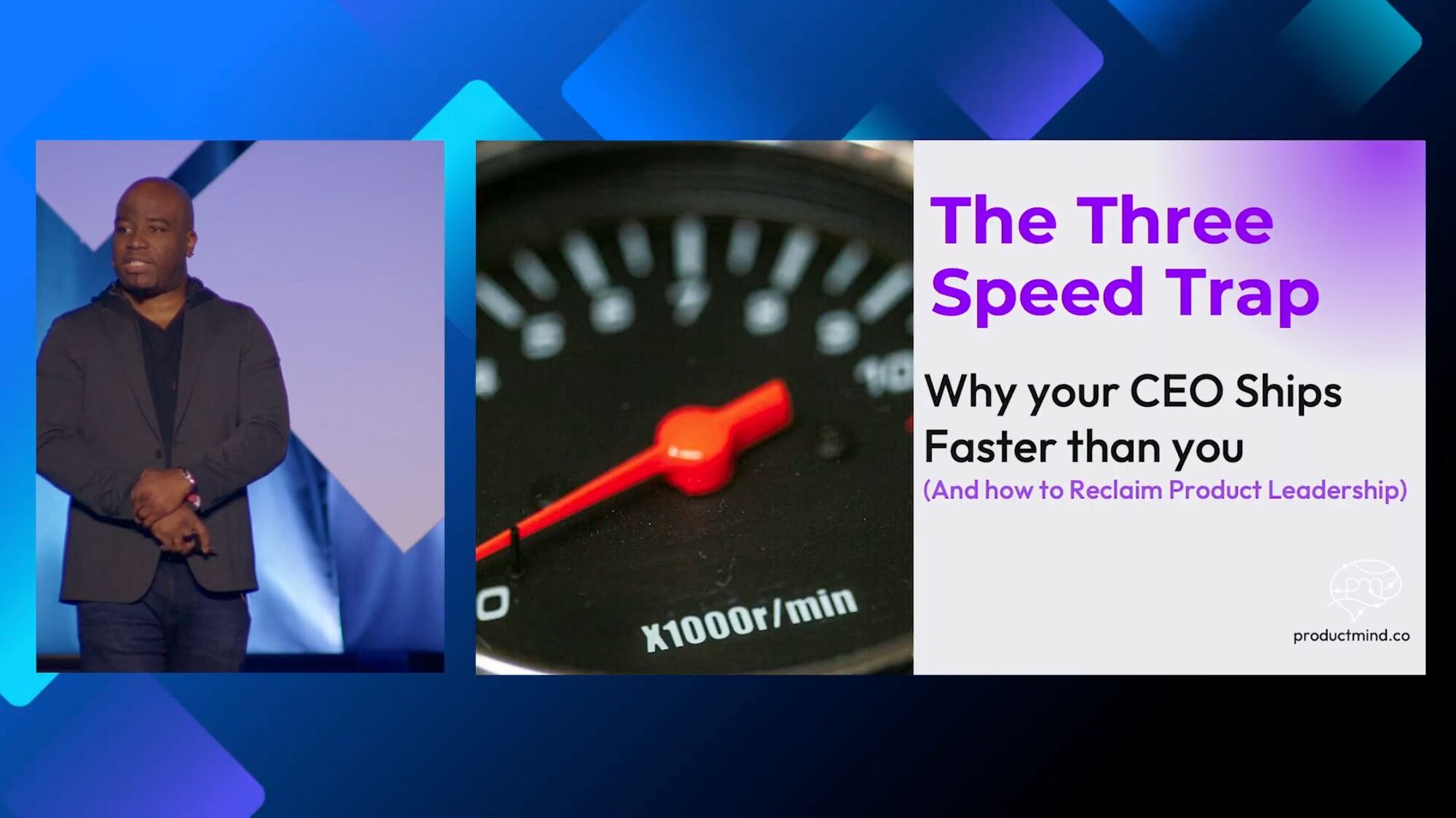
At INDUSTRY 2025 in the opening keynote, product veteran Oji Udezue, former Chief Product Officer at Atlassian and now partner at ProductMind, delivered an engaging talk on how AI is reshaping the speed of product development and what that means for product managers. Watch the video in full or read on for our key takeaways from Oji's session.
His core message was clear: unless product leaders adapt, they risk being outpaced by their own CEOs, who now have the tools to bypass traditional product processes.
“We are realising that we are in a period of really great change. Building AI-native products means rewriting how people build over the next decade.”
The Three-Speed problem
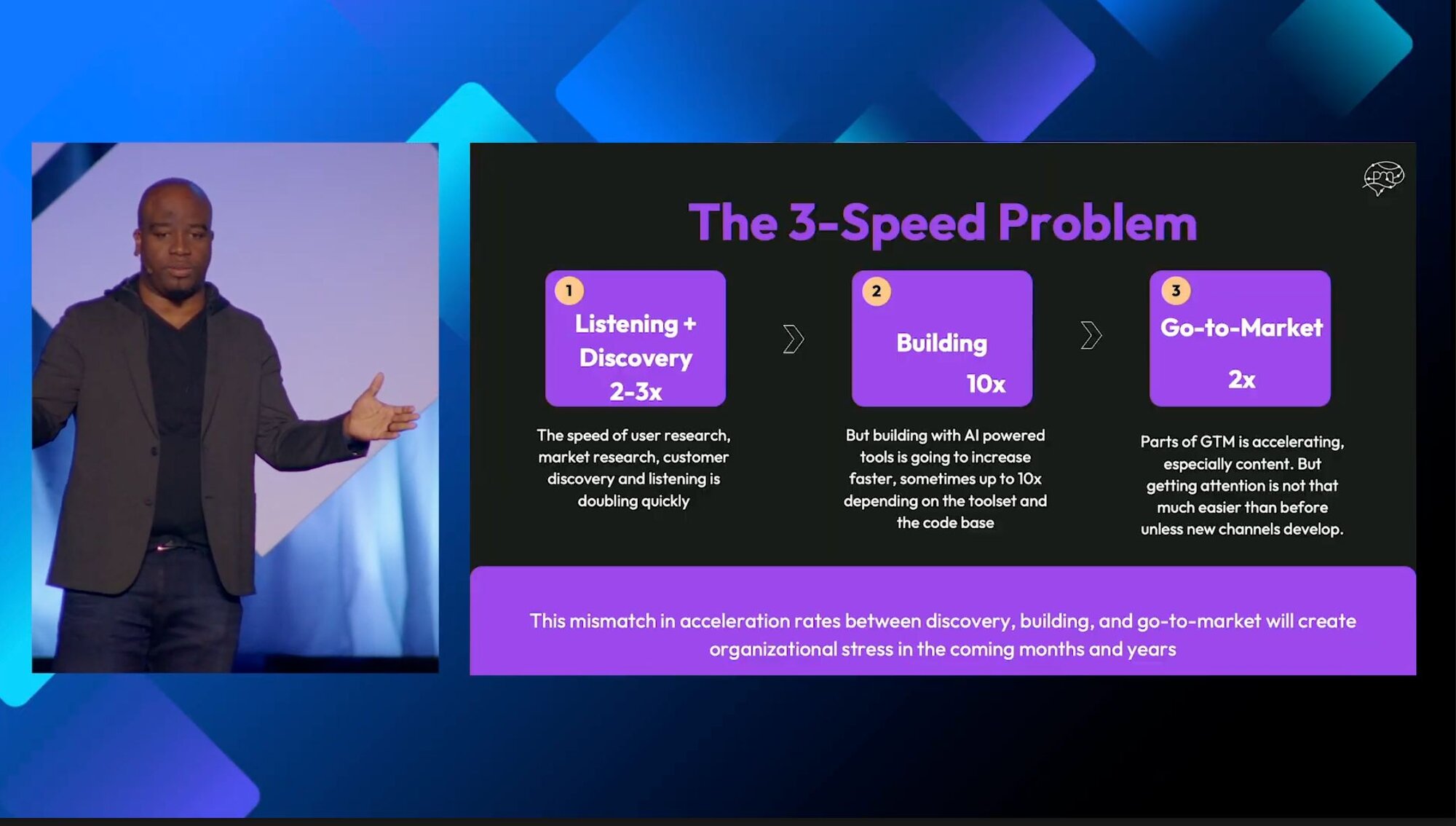
Oji framed his talk around what he calls the three-speed problem, a tension created as different parts of product development accelerate at different rates. Thanks to AI, the build process is speeding up dramatically, while customer discovery and go-to-market execution still depend on external factors and remain comparatively slow.
He illustrated this with a striking example: at a staffing company in Eastern Europe, engineers were able to prototype a new product in just four hours using AI tools.
“Every product practice you go through is constructed around the bottleneck resource of engineering. But what happens when engineering is no longer the bottleneck?”
This imbalance creates risks of gridlock, organisational conflict, and wasted output if companies don’t rethink how product teams work. If discovery and GTM don’t catch up, the build engine will overwhelm both customers and internal systems.
Oji explained that “If AI isn’t creating some tension in your organisation already, you’re probably behind the curve.”
When your CEO codes
Perhaps the most provocative moment of Oji’s talk came when he addressed a growing reality: CEOs bypassing product teams by coding and shipping features themselves.
“I saw a PM panic because his CEO coded a feature, pre-sold it with the CRO, and bypassed the entire product team. This lack of trust and inflexibility is causing chaos, and it will only grow as tools make building accessible to everyone.”
The rise of “vibe coding”, where leaders or non-engineers use AI tools to create quick solutions, presents both opportunities and risks. While the pace of building increases, without careful product leadership, organisations risk flooding customers with poorly conceived, unvalidated features.
Oji warned that this isn’t a future scenario, it's already here. When the ability to build prototypes is altered, leadership must set up guardrails to prevent chaos.
“When your CEO says you’re too slow and starts vibe coding features, what do you do?”
Redesigning the product system
So how should product managers respond? Oji argued that this shift requires a fundamental re-architecture of product systems and operations, not just "tinkering at the edges".
The goal is to balance the three speeds: accelerate customer listening and discovery, while learning to “build different” in the middle.
Accelerating customer listening
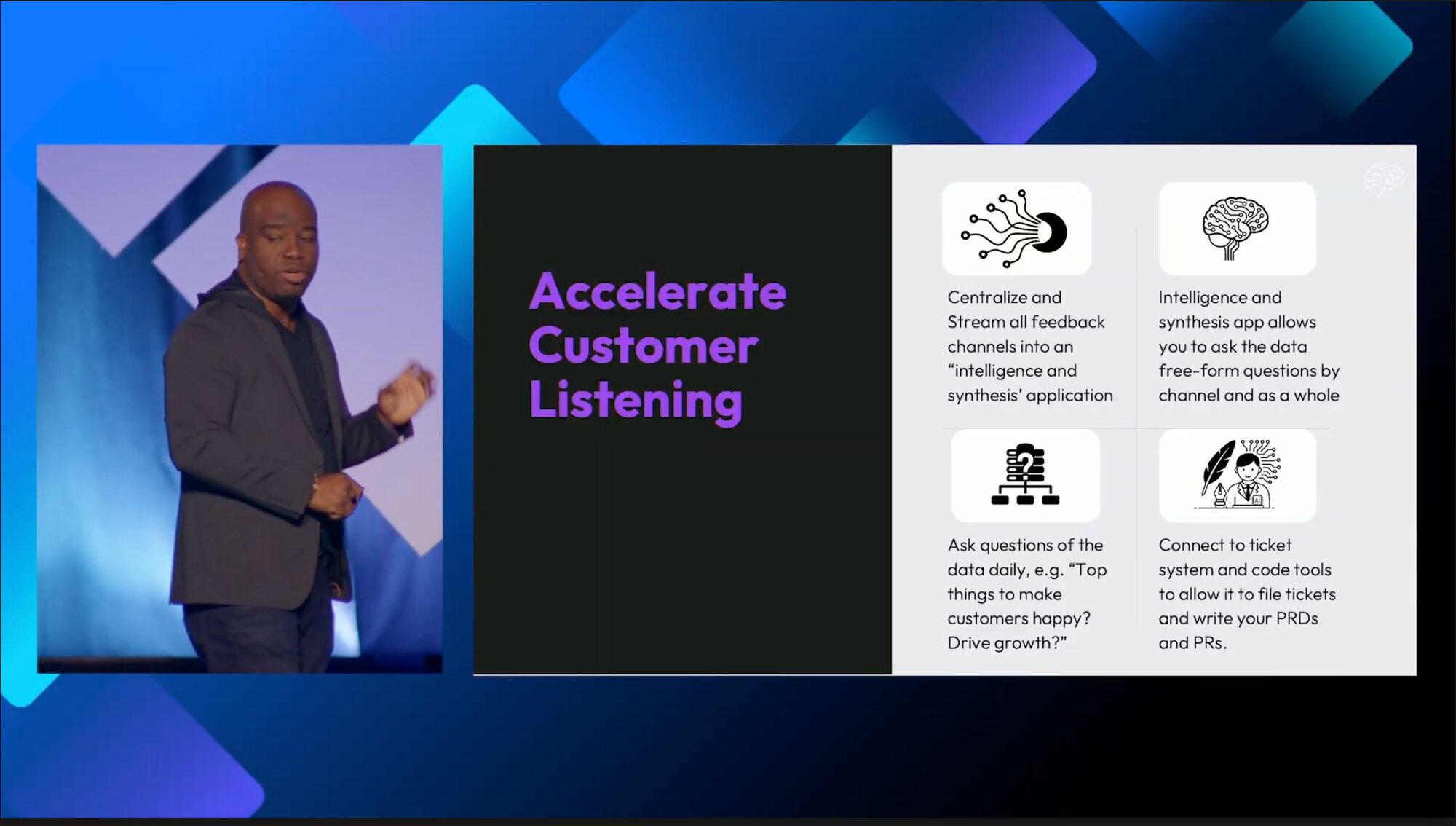
Oji suggested using AI-powered systems to turn customer feedback into a turnkey process:
- Aggregate all feedback channels, community, sales, support, bugs, account management into one pool.
- Use AI to synthesise and analyse insights.
- Integrate directly into ticketing systems, enabling PRDs and even PRs to be auto-generated.
Oji explained that “What we need to do is make customer feedback so turnkey that we are drowning not only in feedback but in synthesis of what it means.”
By embedding AI into these processes, PMs can turn a traditionally slow practice into one that keeps pace with faster build cycles.
Smarter discovery
Discovery, Oji stressed, should be constant and embedded across products and communities. He pointed to community-powered discovery during his time at X, formerly Twitter and encouraged PMs to leverage AI for customer research.
He outlined practical steps:
- Run lightweight experiments within features themselves.
- Embed discovery prompts into user flows.
- Use AI research assistants to summarize patterns of behaviour.
- Always validate AI insights with human conversations.
“Talk to real humans. Listen for what they’re saying—and what they’re not. Watch their behaviours. Then synthesise.”
By fusing human insight with AI scale, PMs can maintain discovery quality while accelerating pace.
Build different
On the build side, Oji urged PMs to adopt a more hands-on approach:
“If we have anything to explain to developers, I write the prototype myself. My PRD has become code with annotations. We need to get to code much faster.”
Whether using tools like Cursor, writing prototypes directly, or experimenting at scale, PMs must learn to move beyond static documents and embrace ambition and velocity.
He argued that PMs must develop new skills: API design, rapid prototyping, and understanding how to evaluate AI systems. The days of PMs writing lengthy PRDs detached from the build process are numbered.
Fusion of product and GTM
Another key theme was the blurring of boundaries between product and go-to-market functions. Oji challenged PMs to lean into GTM, helping shape marketing messages and working directly with sales.
“Your job doesn’t stop when you ship. Your job stops when customers are happy.”
This “Product and GTM fusion” creates new opportunities for PMs to deliver value as the build speed accelerates. Instead of passively handing products over, PMs should co-create the launch narrative and actively support adoption.
The shipyard model: Expanding the core team
Oji argued that the traditional triad of product, design, and engineering is no longer sufficient. He proposed the Shipyard Model, where small autonomous teams also include data/AI, research, and product marketing.
This expanded skill set reflects the evolving role of PMs in the age of AI. Beyond customer empathy and strategy, today’s PMs need fluency in API design, prototyping, evaluation, and community management.
“ The core triad is no longer enough. Think of your team as a shipyard complete with design, engineering, AI, data, research, and marketing all working together to launch.”
The Proto-Cycle: Rethinking time management
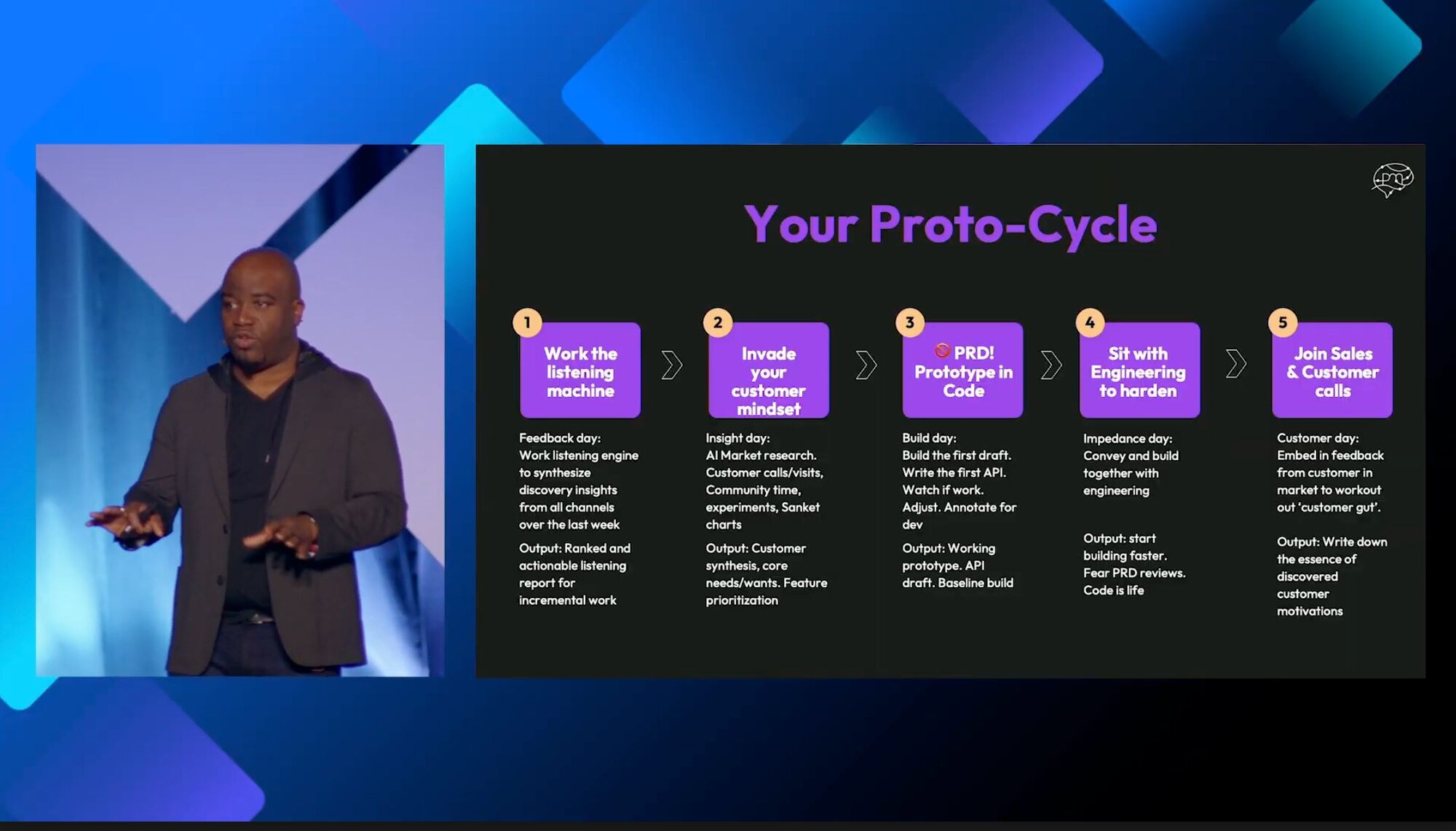
A practical framework Oji shared was the Proto Cycle, a five-day rhythm for PMs:
- Day 1: Feedback day—work the listening machine.
- Day 2: Insight day—synthesise customer patterns.
- Day 3: Build day—prototype and build first drafts.
- Day 4: Impendence day—collaborate with engineering.
- Day 5: Customer day—join sales calls, embed market feedback.
This system forces PMs to continuously rotate through discovery, build, and customer connection instead of getting stuck in one lane.
“How a PM spends their time is by far the most important thing they can do to succeed. Spend too much in a narrow lane and you won’t succeed long term.”
Leading with AI
Oji closed with a challenge: don’t just keep up with AI, lead with it.
“You can become the PM who moves faster than your CEO. Re-orchestrate the three speeds so you deliver continuous value. When you master this, you don’t just keep up with AI, you lead with it.”
His final challenge to the audience was bold:
“By next Monday, map out how you’ll harness new speed. Run your first continuous discovery experiment with AI. Within this month, write your first prototype application. Be the person who says, ‘Screw it, I’m shipping it.’ The tools are there, the question is, will you use them?”
Key takeaways
AI is changing the speed of product development—building is accelerating 10x, but discovery and GTM still lag.
- PMs risk being bypassed if they don’t adapt to new ways of working.
- Customer listening must be automated with AI synthesis, turning feedback into actionable insights.
- PMs need to prototype directly, and this helps with a better understanding of the product.
- The PM skill set is evolving to include coding, API design, AI evaluation, and community engagement.
- The future of the product involves: shipyards of PM, design, engineering, AI, research, and marketing working as one.
Oji’s talk was both a wake-up call for PMs, we learned that if we can implement more effective systems as PMs then we can work better with the CEO and lead great products with speed.

Keep reading
Mastering the art of communication as a PM: Sahil Jain at INDUSTRY 2025
Disrupt or be disrupted — how to navigate product stagnation: Stephanie Musat at INDUSTRY 2025
Excel at managing product managers: Mariah Craddick at INDUSTRY 2025
How to use Jobs-to-be-done to recruit and retain great product teams by Bobby Moesta at INDUSTRY 2025