
Since 2022, the product community has been overwhelmed with questions and claims about how AI is disrupting the craft. What the data currently shows is a bit more nuanced: structural reorganisation of how product teams are built and how they operate.
A few things happened in close succession in late 2022, early 2023 that together changed product: the world pushing for normality after the Covid-19 pandemic, a wave of technology layoffs that impacted over 200,000 roles across the sector, and the public release of ChatGPT in November 2022.
None of these events alone would have produced what the data now shows. The Covid-19 pandemic gave organisations the incentive to overhire and then eventually have to cut headcount. Meanwhile, AI gave organisations a practical argument for why smaller teams could sustain the same output. Together, they set the conditions for a restructuring that is felt across the whole workforce.
With that bit of context out of the way, I’ll explore how AI specifically is changing product teams, backed up by data from Live Data Technologies and Mind the Product community polls. Hopefully this will help to provide a clearer picture of what’s actually changing, and what isn’t.
The tenure signal
Let’s start with what’s easiest to explain away. Across every seniority level, median PM tenure has actually gone up since 2022. At the individual contributor level, median completed tenure now sits at around 25 months, up from 22 months for roles that ended in 2019.
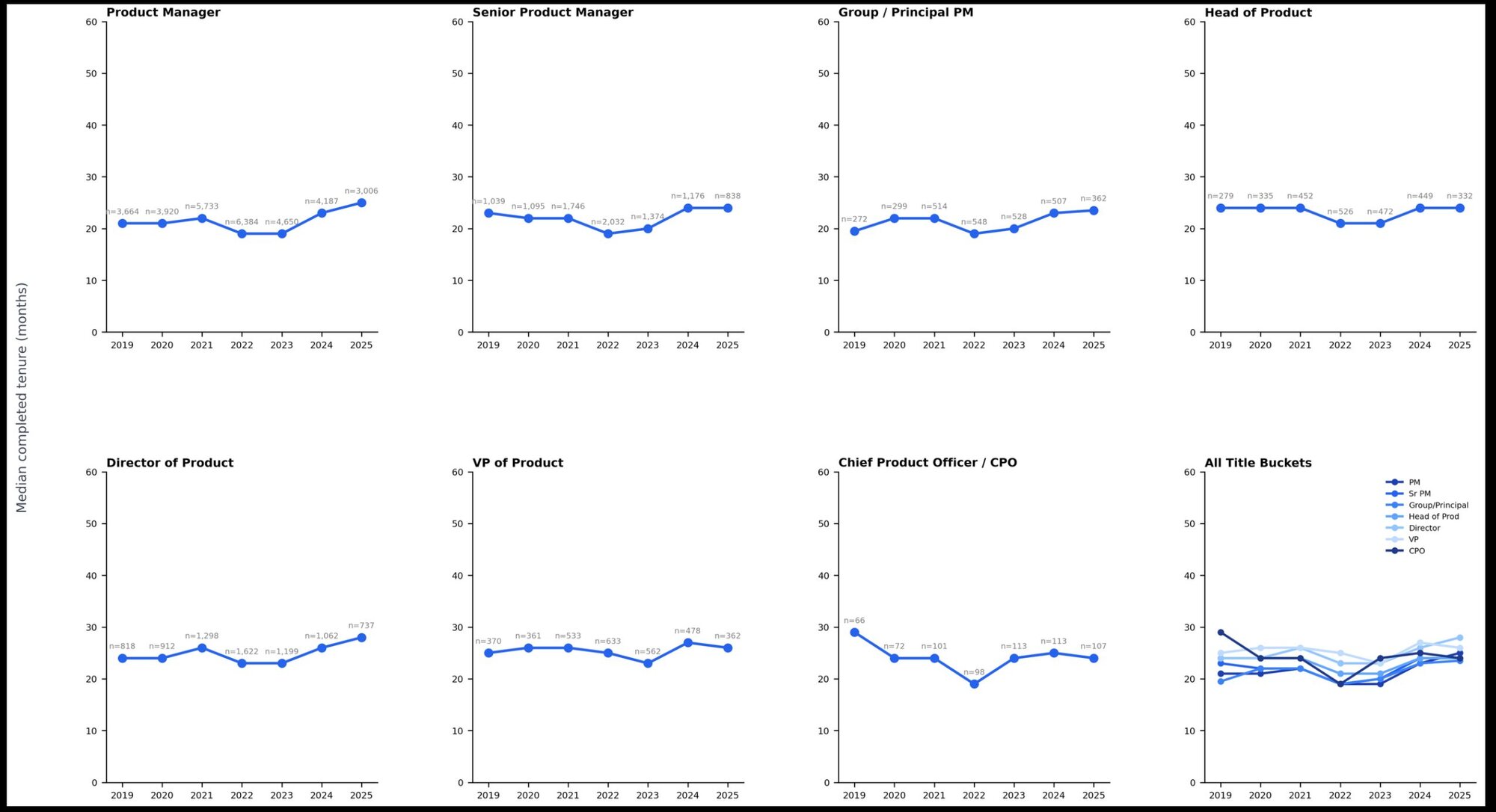
At the leadership tier, VP of Product is the stickiest title in the data, at 31 months median. This is longer than Director (29 months) and CPO (24 months), which declined from 29 months in 2019.
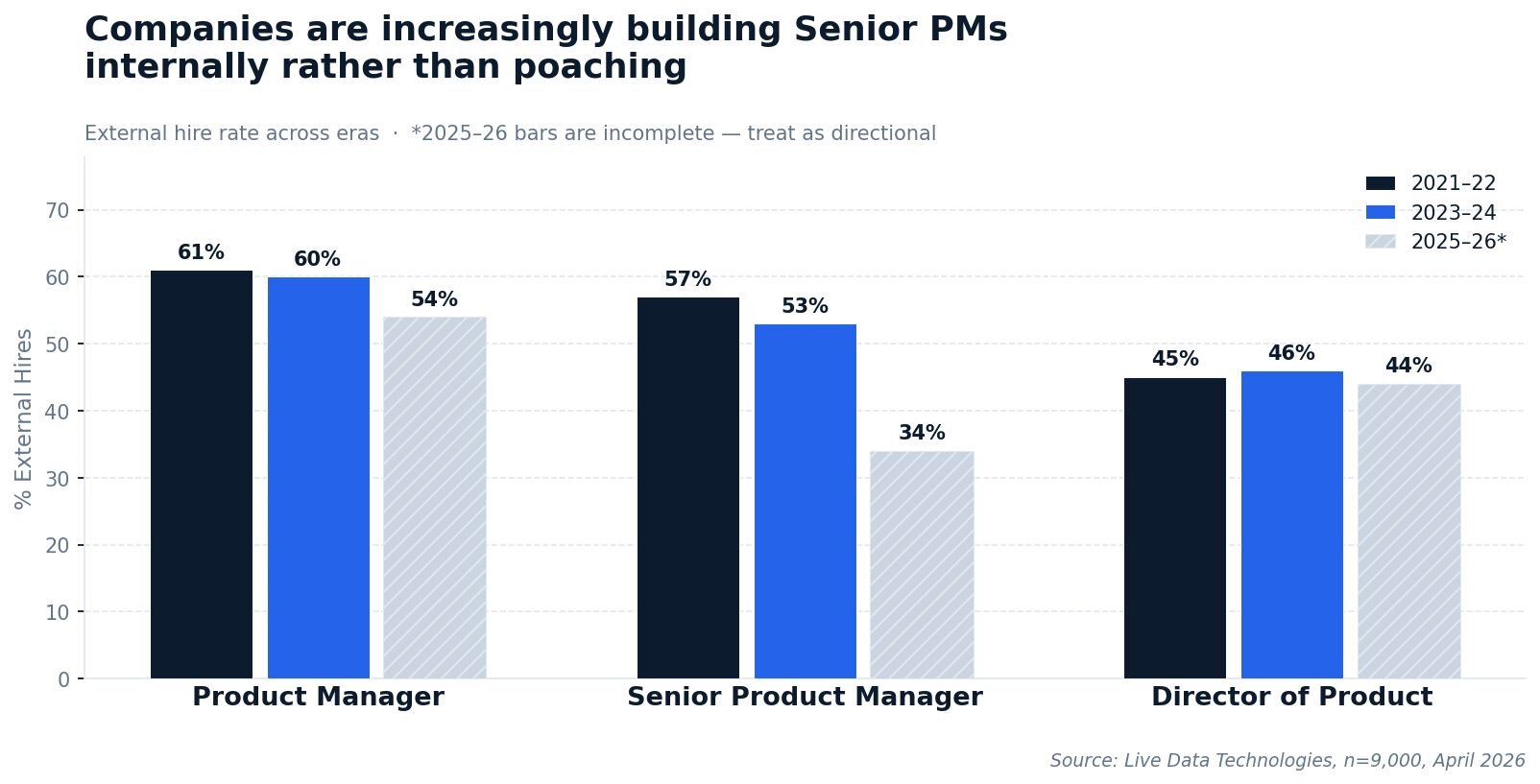
There are two explanations for this. One, there’s a lot of uncertainty at the moment—according to Layoffs.fyi, 92,272 tech employees have been laid off since the start of 2026. People are staying put because they have to, and tenure is rising because exiting is now riskier. Second, companies are looking to consolidate by hiring and promoting internally.
This could explain why, while the job market shows positive growth on the surface, job seekers’ experiences don’t echo that. For the moment, internal hires seem to be the priority for companies .
Team structure is changing
More findings by Live Data Technologies show that the seniority mix inside product teams is changing. 61% are product managers, 18% at Director, and 14% at VP. That means there are roughly three to four Managers for every Director, seven to eight for every VP, and approximately 35 PMs for every CPO.
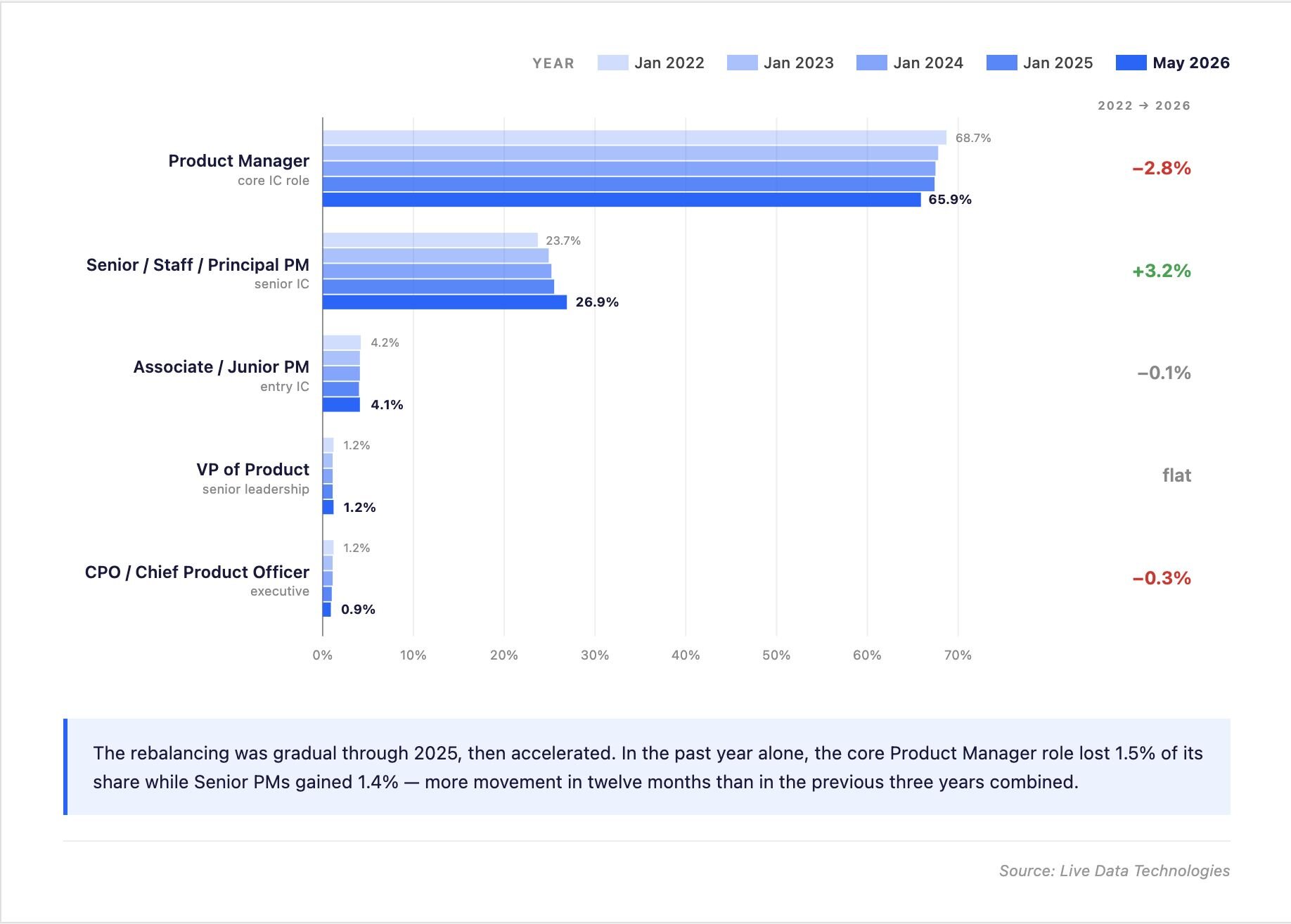
What the data shows is a compression from both ends of the seniority pyramid simultaneously. At the top, Director and above levels are being stripped back slight as leadership layers get consolidated. The Senior level PM tier for now remains protected: it handles cross-functional coordination, delivery oversight, and the translation of strategy into day-to-day execution, work that has so far proven harder to compress.
We spoke to a few individuals who have been directly affected by these changes to the industry. Frank Rodriguez, an AI UX Diagnostics Practitioner at Lightwell said: “Toward the end of my time at Intuit, I started using PRDs to vibe-code ideas directly in Figma Make, then taught the rest of the design team how to do it. What changed was the distance between a brief and something testable. That gap closed fast. Work that used to require a longer handoff cycle was suddenly something one person could move through in an afternoon.”
Enrico Teotti, a product consultant, experienced similar changes. Over the past year, he’s been part of an eight-developer team in charge of maintaining three separate apps. By the end of the project , the team was down to just three members. “The AI removed the buffer that let some developers avoid engaging with the product,” he explained. The developers who remained, he added, were the ones who understood the product, asked questions of both the stakeholders and the tools, and knew when to push back on what the AI produced.
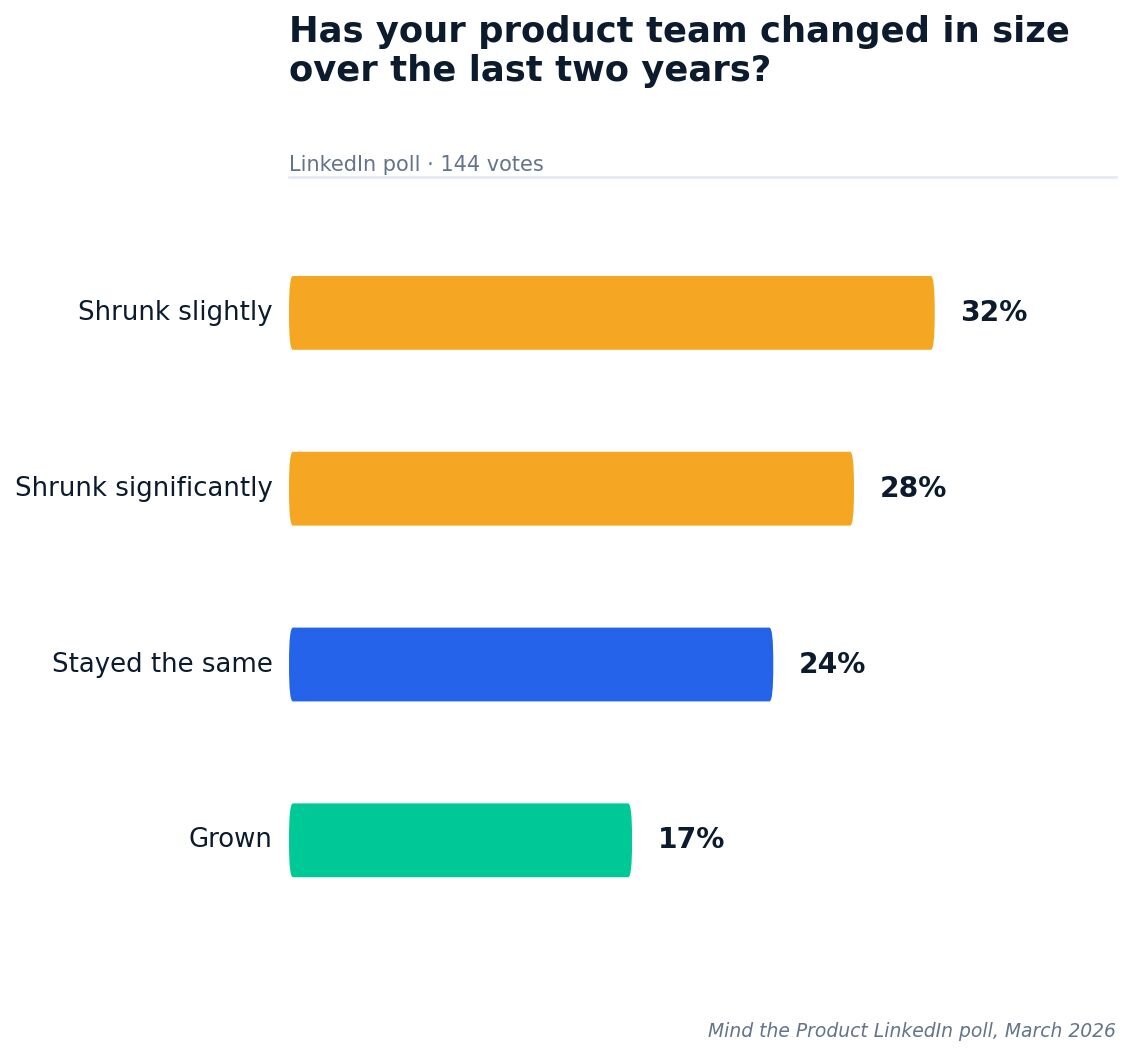
Data from the community backs up these experiences. Our community poll reveals that two-thirds (60%) of respondents have experienced some level of shrinkage in their orgs, with almost one in three (28%) seeing a significant reduction in headcount. This puts the onus on leadership to invest in their existing employees within leaner org structures.
Still, one question the current restructuring narrative sidesteps is what happens to the pipeline of talent just entering product. “If we’re not hiring juniors, I don’t know how the next generation develops,” Product Leadership Coach and Co-host of The Product Experience podcast, Randy Silver, says. “All the data I’m seeing shows it’s not looking good across the board. You need people like that coming into the workforce.”
How AI is changing team dynamics
AI is also affecting how teams work from the inside. Jocca Torres, a product consultant who has worked with multiple companies through this transition, points to a shift in where the tension lies. He says: “Faster execution with AI is making decision-making more visible inside teams. In several companies I’ve spoken with, engineering can now prototype or implement options faster than product and leadership can decide which problems are worth solving.”
In light of this, Randy has seen teams confused over who does what. The question is, whose job is this? The answer is it’s a little bit of everybody. If you hook up your design system to an MCP, now everyone can produce code that's 'production ready'. Product Managers, Designers, and Developers all can do each other's job, at least up to a point.”
He points to a proposal reportedly circulating at Amazon, aiming to collapse job roles across two units under the title of Builder. This can have unforeseen implications for future work and team structures. “If you’re putting a house together, you don’t just get builders. You still have architects. That works great if you already have the blueprints. But most of what we’re doing doesn’t have blueprints,” says Randy.
According to Randy, leadership teams are growing impatient in this new climate. “Expectations are proceeding even faster than the realities,” he says. “We can do stuff way faster. It may not take six months anymore — but it might still take a few weeks, and that few weeks feels like forever now.”
He often needs to push back and explain: “it’s not actually done.”
His response to teams navigating this is to use it as a point of engagement. Come back within days. Show where you are and say, let’s refine together now.
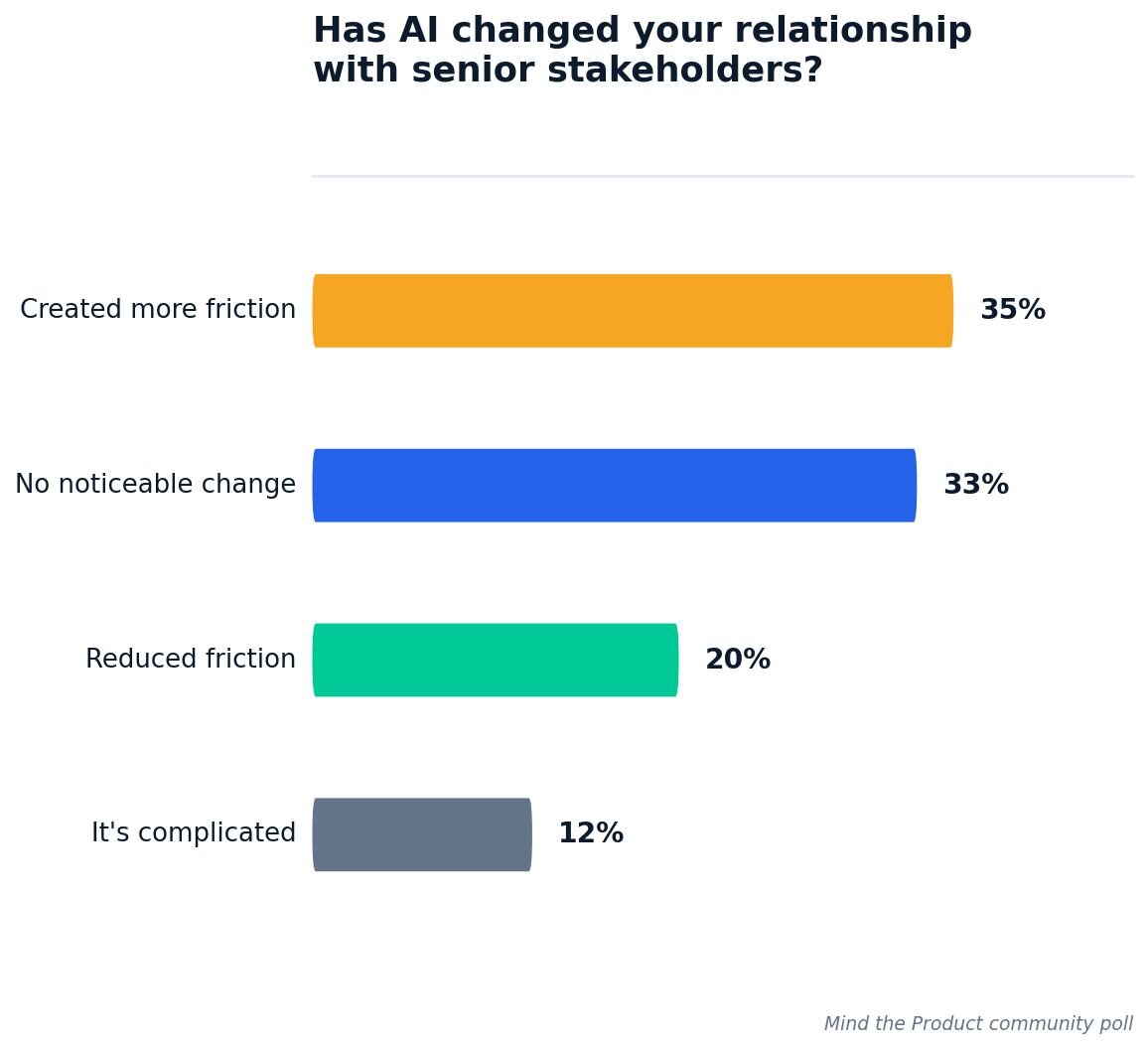
Poll data backs up his points. 35% of respondents claimed they experienced more friction with senior stakeholders, while 12% said “it’s complicated”.
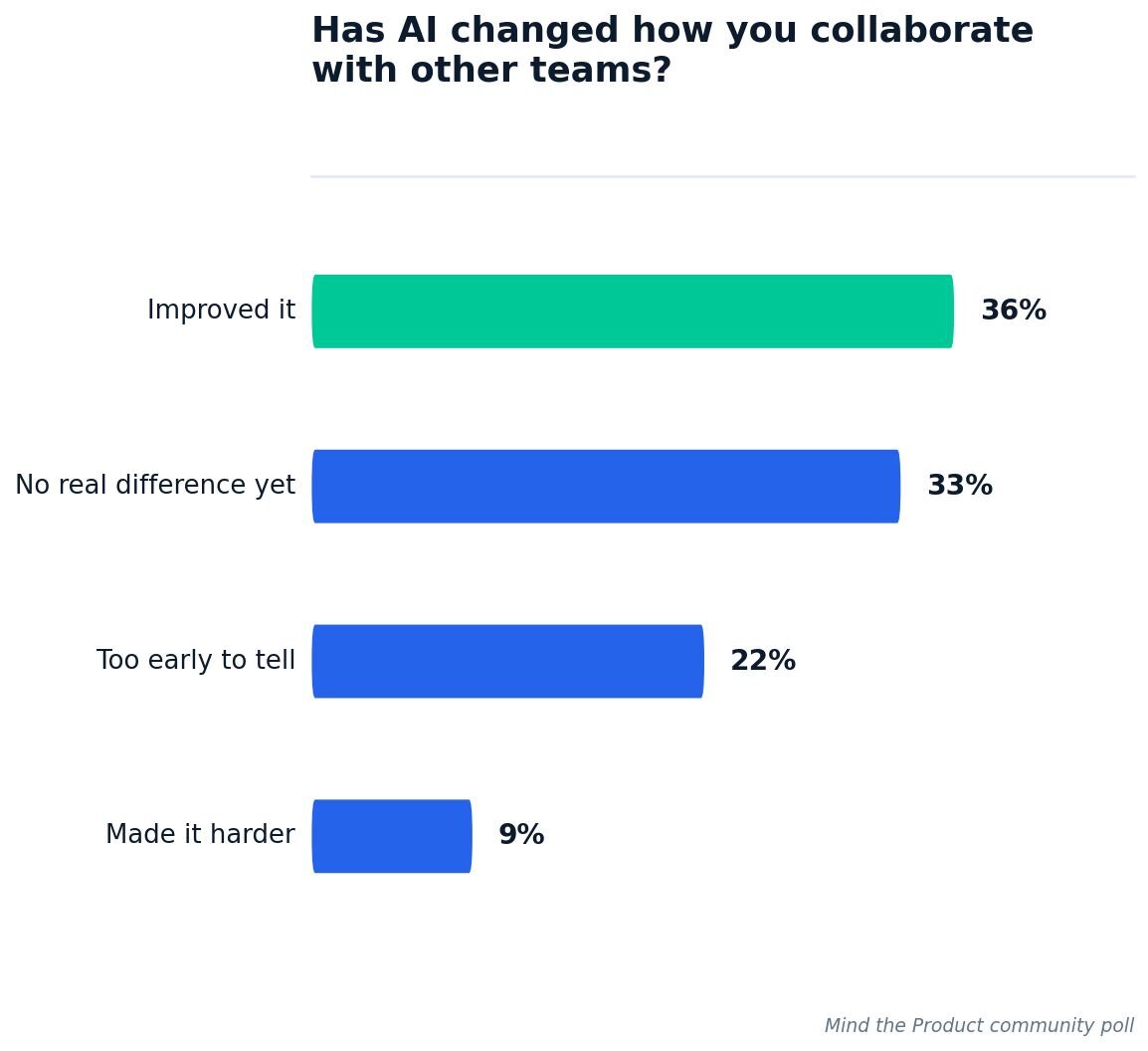
We also asked the Mind the Product community if AI changed the way they collaborate with other teams. One in three (36%) said AI actually improved collaboration, while 33% and 22% reported no real difference, or stated it’s too early to tell.
How AI is transforming the PM role
Technical demand is now on the rise as teams get leaner and more reliant on AI tools. Our poll data reveals that almost half (45%) of Product Managers have experienced the technical bar rising in the past three years.
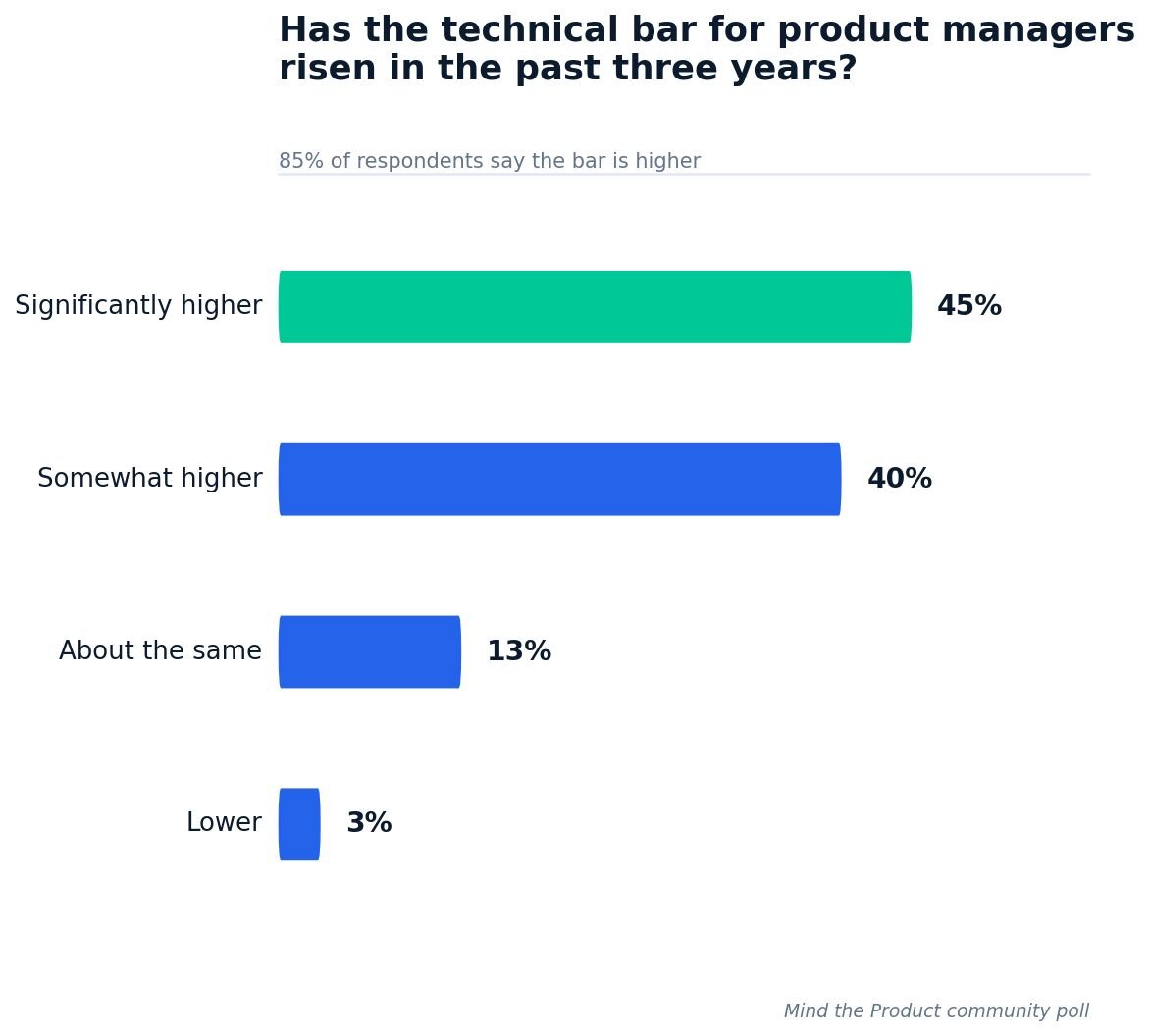
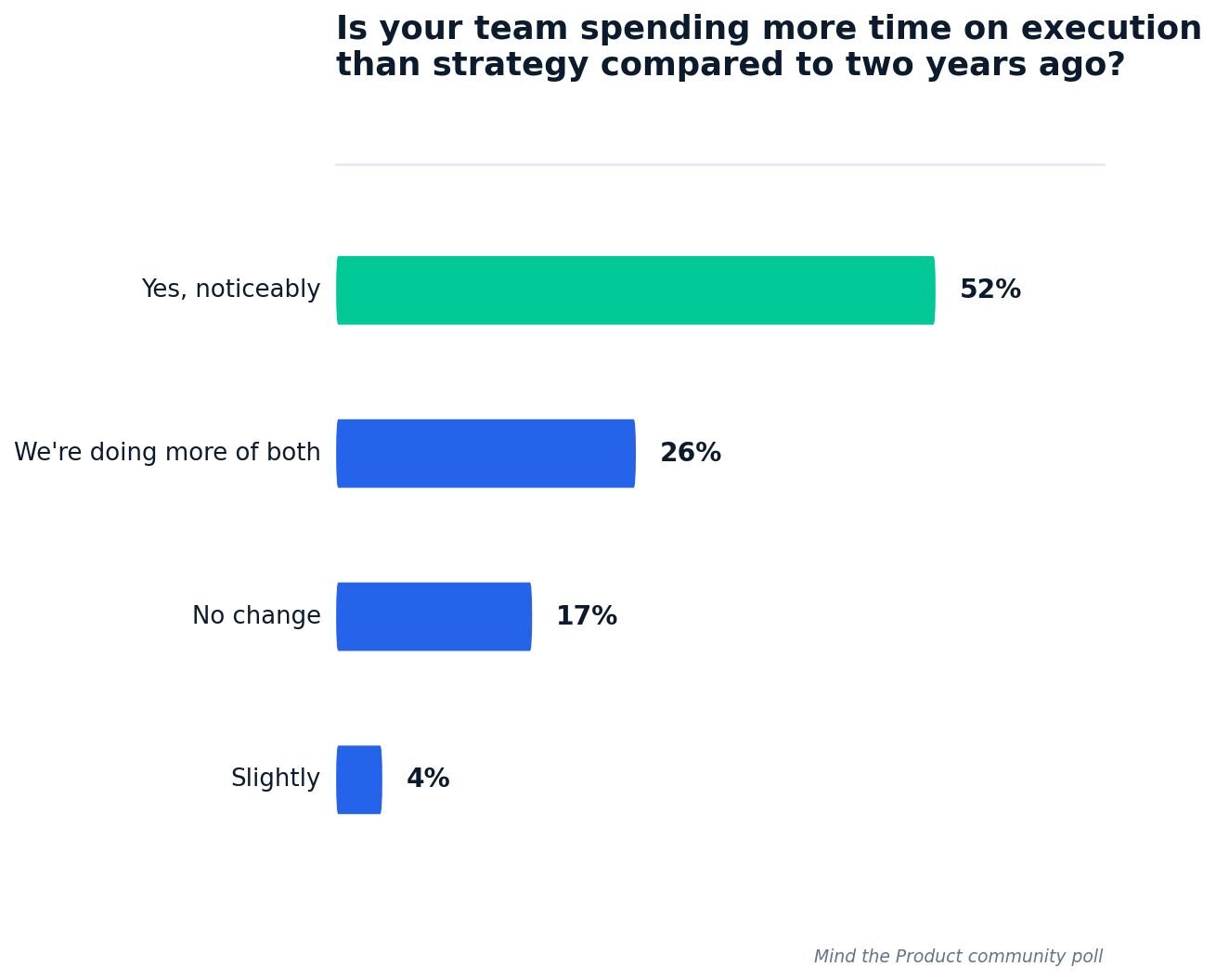
The majority of PMs understand that the technical expectations on them are higher, compounded by an increased demand to ship products and features faster. Over half (52%) of the community have experienced more pressure to spend time on execution. Only 17% reported seeing no change in this regard.
Product Leadership Coach Kate Leto in a Fireside Chat, hosted by Female Product Lead, says how the same pressure comes out in her coaching sessions. She often works with product leaders who know what they’re capable of but find that the acceleration of execution has outpaced the guidance on what to actually do with that.
The self-awareness required to navigate that gap is, in Kate’s view, the crucial meta skill of the profession. “Knowing yourself, knowing how you impact others, the impact you’re having on your community, your workplace, your relationships,” she says. “That’s the meta.” In a period when the tools can run faster than the thinking, it becomes critical for practitioners to build strong self-awareness.
What the role of PM should look like, in the view of most practitioners working through this transition, is a function that has moved firmly toward:
- Problem definition
- Prioritisation
- Architectural judgment
However, even with the best of intentions from product coaches and leaders alike, the world is simply moving too fast. Kate hears this tension in almost every client conversation right now. “There’s no playbook,” she says. “There’s no rulebook for how product should work and how you should work with AI.” What she sees in her clients’ experiences is something she calls being “off script”: knowing you have the capabilities, but feeling a gap open up between what you know you can do and what you are actually doing.
So where does this leave us?
Teams are smaller and flatter, and the expectations sitting above them are higher than they have ever been. "I think the strong conclusion is that it is chaos," Randy says. "No matter what answer you give, it will be different in every organisation today. In each of those organisations, a year from now. Don't pretend that anyone has the answer. You just have an answer along the way."
Despite the chaos, there are three things you can do:
- First, treat self-awareness as the actual work. Knowing yourself and how you impact others Is key.
- Two, come back to what you actually understand rather than reacting to what everyone else is doing. Knowing your own strengths is key here: the customer you understand more deeply than anyone, the problem you have spent years on, the data or insight or market knowledge that no general-purpose model has. Use the enhanced speed to do that differently.
- Three, get technical. Senior Product Leader Cris Valerio, writing on Mind the Product made the point plainly: you never really learn something unless you get your hands dirty and raise the stakes. That framing applies even more directly now than when her article was written. AI has compressed the distance between an idea and a working prototype to a matter of hours. Pick something you actually care about solving and build a working version of it.
Closing out, Randy lands on a more optimistic note: “The people who can work their way through the chaos are going to win , and win big,” he says. “It may not be a product role in the long term. But you’ll still be doing all the product things. You might just be sitting in a business chair. And that would be a massive win.”
