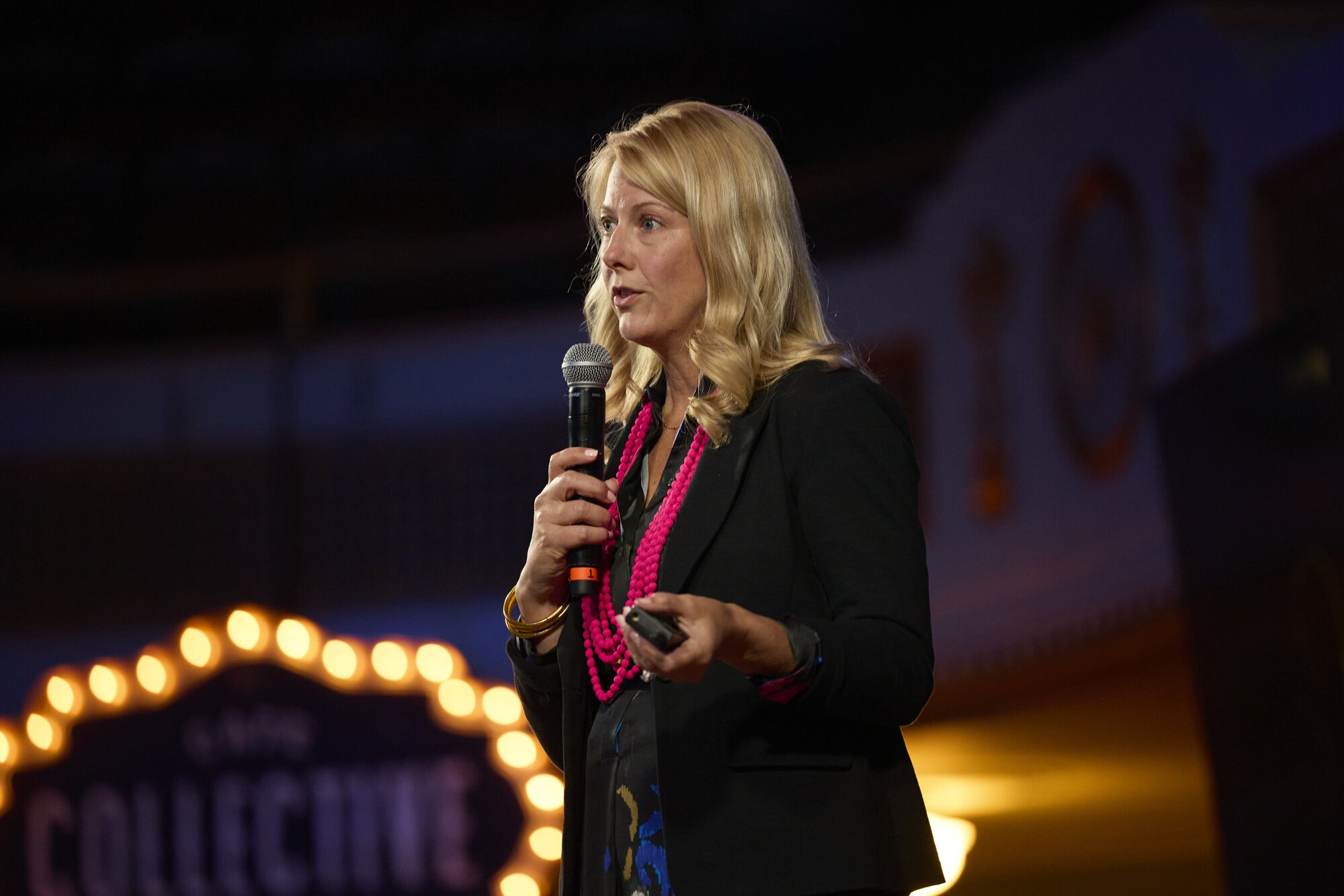
(Sponsored post) In this spotlight session Nichole Mace, SVP, Product and UX at Pendo, took to the stage at INDUSTRY to share a lesson on how product people can use AI in onboarding. Watch the video in full or read on for Nichole’s key points.
Where are we going?
Nichole explains how we’re entering a world where AI agents will run onboarding. These agents will guide users, automate setup tasks, and continually drive experimentation and optimisation.
Eventually, she states that many of today’s onboarding steps will disappear, replaced by autonomous AI experiences that accelerate time to value.
Getting to the 'Aha moment
So, what exactly is an “aha” moment? Nichole defines it as the point in a user’s journey when they first feel the product’s value.

She offered examples such as the delight of a personalised Spotify playlist, the ease of speaking a few sentences in Duolingo, and the relief of splitting a bill on Venmo.
The numbers back it up: Companies that actively measure their aha moments see 3x the growth of their peers. Nichole noted that HubSpot found that 75% of users churn if they don’t find value immediately.

What’s the difference between Onboarding vs Aha?
Onboarding and aha are not interchangeable, and Nichole highlighted the differences. Onboarding teaches the user how to use a product, while aha moments convince them why it’s worth their time.
The challenge is sequencing the two, Nichole explains. For example, going too heavy on onboarding could mean users drop out before reaching value. On the other hand, leading with aha may cause users to struggle with using the product afterwards.
Nichole highlights that there’s no one right path. Some companies sprinkle aha moments throughout, others front-load them. But in every case, the goal is to optimise that journey. AI, said Nichole, can help resolve this tension.
AI’s Four Superpowers: Understand, Personalise, Guide, Accelerate
She shares a four-part framework to help us understand how best to use AI to get users to the ‘Aha’ moment.
Understand your users better
Traditional onboarding often asks users to provide their role, goals, and company upfront, creating friction. But AI changes the game, Nichole says. We now have better behavioural and contextual data. AI can aggregate and analyse this data, which enables more intelligent onboarding without asking the user to repeat themselves.
Personalise onboarding
Nichole reflects on her time at LastPass, where she worked on two distinct onboarding paths: one for users who wanted convenience, and another for those seeking security. Each had different motivations, language, and goals, and creating them took time and resources.
Today, AI can power hundreds of tailored journeys, drawing from real-time signals to deliver relevant flows and messaging.
Guide with in-product help leveraging prompt data
With AI agents and chat interfaces, Nichole explains how users don’t need static walkthroughs. They can ask questions in the moment and receive live guidance. AI can even detect frustration in user behaviour and adjust the tone or complexity of guidance accordingly.
Eliminate onboarding steps
Nichole explains how the most powerful application of AI is removing unnecessary steps. At Pendo, tagging events used to be manual and time-consuming. Now, LLMs automate tagging, accelerate installation via GitHub integrations, and even pre-build segments from metadata. Reducing cognitive load at these moments dramatically improves conversion.
Putting it all together
With AI, Nichole explains that the principles of product management have remained the same, but the way we achieve them has changed. She urges the audience to identify their metric benchmarks and measure what matters.
Nichole stresses the importance of starting small. Identify a single pain point in your onboarding experience and test one AI-powered improvement. Look to peers, mimic great ideas, and keep the aha moment front and centre, she explains.
Final thought
AI is all about acceleration, Nichole shares as a final thought. For product teams, it’s a lever to drive growth, reduce churn, and create more meaningful user experiences.
Learn more about onboarding software by Pendo here.
