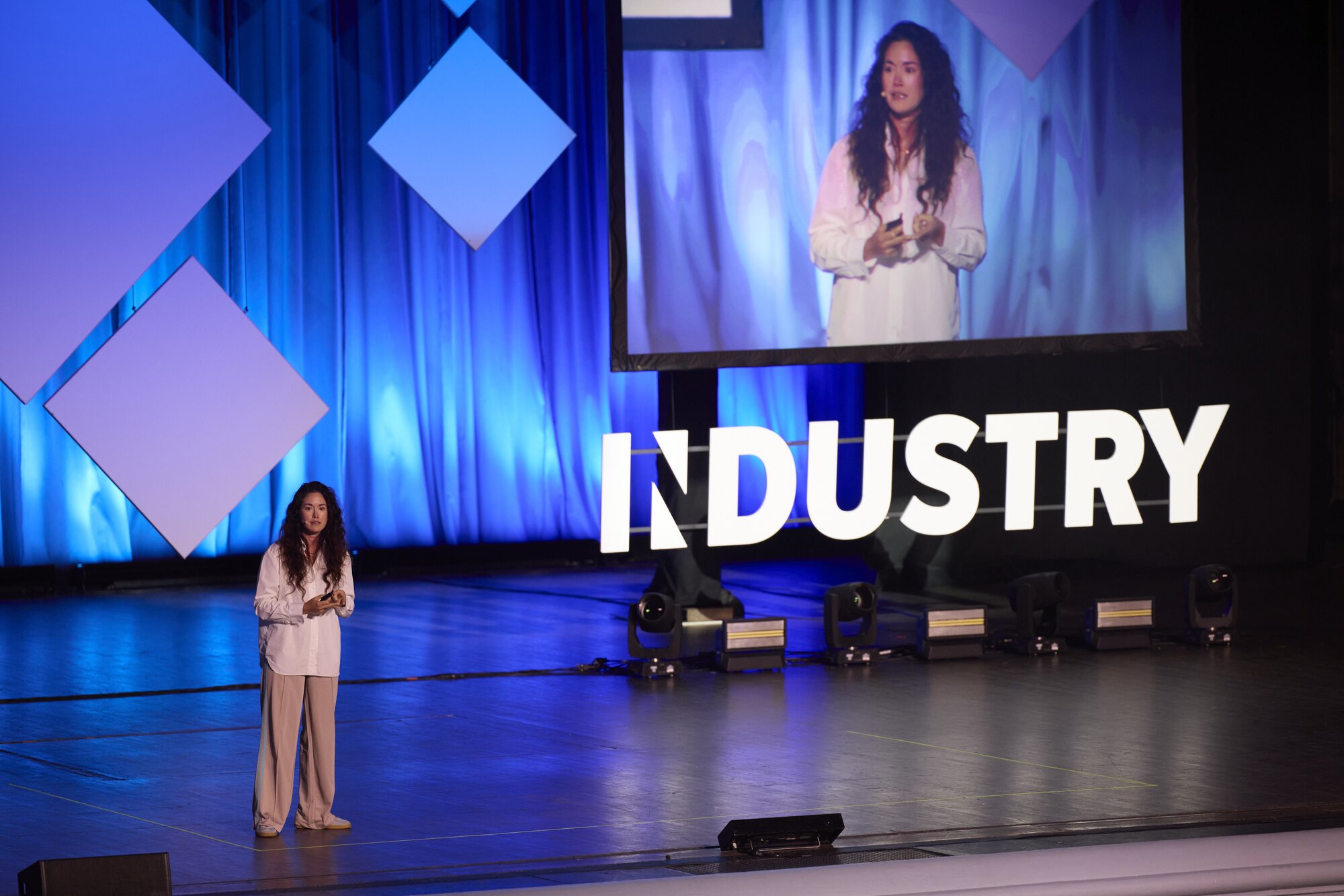
Taking big bets in product management refers to the high-risk, high-reward items that can fundamentally change a product experience, or even industry, if implemented well. At this year’s INDUSTRY: The Product Conference, CPO and Co-founder of Lex, Michelle Parsons explains how product teams can de-risk these big-ticket items and drive growth.
Formerly a product lead at big companies like Netflix, Kayak, Hinge, and Spotify, Michelle draws on her experience as Netflix’s Global Kids and Family Product Lead for a practical and detailed case study. Watch the video in full, or read on for our key takeaways from her session.
A solid foundation
Michelle starts off by asking for a show of hands: how many product people have put time, effort, and resources into a strategy only to find themselves executing against it? Teams get sidetracked for any number of reasons: listening to the loudest (but maybe not the rightest) voice in the room, underestimating the resources needed for a high-impact item, or simply losing track of their goal.
Great product strategy means nothing without great execution, she explains, as that’s where we get to actually enjoy the fruits of our intensive planning labour. On the other hand, great execution doesn’t have a leg to stand on without great strategy.
So, where do we go from here? How do we sequence our roadmap to focus on the highest-impact items? And how do we de-risk them along the way?
Because, as Michelle explains, high-risk bets can measurably improve your company’s ability to influence in the future, build up credibility and gain trust with execs and stakeholders, and even drive the industry forward. There’s a lot riding on them going right.
But they’re also riddled with unknowns and potentially difficult trade-offs. Is this big bet finally going to solve the problem or are we, in betting on it, allocating resources away from a safer option? How long will it take to find that out?
As a solution, Michelle introduces a concept that she’s used throughout her career, both at big tech companies like Netflix and Kayak and at Lex: the balanced portfolio framework.

The balanced portfolio approach
This came in especially handy at Netflix, when Michelle’s Kids and Family team needed to prove the ideas they wanted to bet on were worth going after.
The framework breaks down your roadmap into three key categories:
Quick hits
- The so-called “easy wins”
- Quick to test and rich in learning opportunities
- Low-cost, potentially high bang-for-buck customer features and changes
Small bets
- Getting the most out of current investments
- Lower resource costs, leveraging existing features, improving craft
- Optimisations, customer enhancements
Big bets
- Creating a competitive advantage, inspiring the company
- High user impact, product enhancing features and changes
Michelle recommends an 80-20 split between the first two categories and the last one: the quick hits and small bets provide learnings that shore up your changemaking big bets.
In other words, you allocate enough resources to learning opportunities, enhancing customer experience, and leveraging features you’ve already shipped, in order to balance out the remaining 20% of big bets and investments. An added way to de-risk is to pair these with quick-hit optimisations that ladder into your final product goal and bring valuable lessons, even if they don’t make it into the final product.
Case study: Netflix Kids
For a practical example, Michelle draws on her experience building out Netflix Kids during her time as Global Kids and Family Product Lead at Netflix. When Michelle took over the team, it was under-resourced and lacking a product strategy of its own.
After weeks of diligently researching their viewer base, the team came up with a strategy meant to set Netflix Kids apart from the service’s broader user base. They focused on:
- Trust: gaining the trust of parents and guardians through increased understanding and control
- Empowering kids: letting them lead their own viewing experience
- User-led discovery: facilitating kids’ discovery of new favourites after they’ve had their fill of the classics (like Cocomelon)
The team used the playful visual metaphor of a castle to advocate for their (as yet unproven) strategy: the foundation would be parents’ trust, followed by empowering young viewers. Then the two towers of user experience would be familiar content (the safe bet, to which 80% of resources would be allocated) and immersive discovery (the bigger bet or the other 20% of resources).

The user journey was going to be different from the rest of Netflix, too. The team understood that kids start out by wanting to watch a particular show, or connect with a specific character, and that their job was to make that quick and easy to find. Afterwards, they could move on to helping them discover something new, but still familiar.
The first step was to greet young viewers with their favourites on the Netflix homepage. Michelle’s team wanted to have a user’s top five favourites appear right away on the homepage and then seamlessly move to the player state with one-click access.
The big challenge here was understanding what a kid’s favourites were and when that changed because they had grown out of it. So the team experimented with ways to encourage kids to provide explicit input that would help personalise their recommendations.
While good ideas, at this stage, these were some big bets that would need months and entire teams across the organisation—the trust, device, algorithm teams and more—to implement. Michelle’s team had to find a way to de-risk them first and prove they were worth pursuing.
The first big breakthrough was realising that kids tend to rewatch content twice as much as adult audiences and 66% of these views were coming from search. But, in the broader framework of Netflix, the search experience was a multi-step one that actually removed already-watched content. So it would have to be overhauled for smoother access to a kid’s favourite.
The solution was to devise a test that leveraged existing features and insights.
- 66% of kids’ views happened from search
- Search pre-query form that served discovery titles
- The “Watch Again” row of Netflix recommendations
Instead of implementing costly new experiences, the team focussed on using these insights and features to try and achieve their goal metric of increased watch time.
The main changes tested:
- Instead of placing a user on the search box, they would instead land on the first title of the pre-query screen.
- They recommended Watch Again titles instead of discovery titles.

This resulted in a threefold increase in their key metrics and enabled them to consider the next steps: what it would take to place a user’s favourites on the Netflix Kids homepage.
This meant creating a new kids’ algorithm, character art, homepage UI, and click-to-play experiences. With the success of the previous small bet tests in their pocket, the team got the green light for a high-risk, high-impact overhaul. And it paid off.

Michelle’s team saw an increase of 5% in their core metrics, which, she adds, in an organisation the size of Netflix “is a really hard number to move.”
The next challenge was improving discovery metrics, so the team moved on to that with another quick hit test: reframing discovery as unboxing. As kids began ageing out of a favourite show, the algorithm would suggest a new one that appeared alongside familiar recommendations, making it less intimidating for a kid to engage with.
This proved successful and allowed Michelle and her team to reap the learnings from their previous tests, phase out lesson-rich features that had run their course, and ultimately drive change to Netflix Kids and the wider company.
Closing takeaways
Michelle’s case study shows how, in the balanced portfolio approach to product management, the big, high-risk, high-impact bets are anchored by smaller, quick-hit tests that allow you to learn and de-risk the unknowns within your strategy.
The key lessons:
- Develop a clear strategy informed by research and data
- Understand the features and insights already at your disposal and what you can learn by experimenting with them
- Use these to test your key hypotheses quickly
- Leverage the results of these tests to prove your big bets are worth it
- Get buy-in using storytelling through data
- Treat learning from quick hits and big bets as a cycle on which you continuously iterate

