
Vrushali Paunikar is CPO at Carta who has a wealth of experience in building great product teams. She has been responsible for developing products and providing solutions which help businesses scale. . At INDUSTRY 2025 she delivered an engaging keynote, laying out her philosophy for building “problem-oriented” teams and why it matters now more than ever.
“Building great product teams isn’t about the biggest budget. Focus on problems not jobs, aim fewer arrows with more wood, embrace constraints with creativity, and above all build to learn, because learning is compounding. The faster you learn the more value you create.”
Watch the video in full, or read on for some of her key takeaways!
The bigger mission
Vrushali began by grounding her talk in Carta’s mission. She described the company’s work as building the ERP system for private capital, a $24 trillion industry that underpins much of the world’s wealth creation.
Today, she argued that the system is in disarray. Private capital operations are “broken” and in many cases, completely inaccessible to those outside a small inner circle. Carta’s mission is to change that by building the platform that private capital runs on, they hope to create transparency, efficiency, and access at a scale that could reshape the financial landscape.
“We hope that we can open it up for the masses. We hope to bend the arc of this industry. With 50,000 companies, 3,000 investment funds and 150,000 LPs we are well on our way.”
For Vrushali, this isn’t just about business outcomes. It’s about creating what she calls “state change.” That philosophy, of identifying the problems that, once solved, unlock a new reality and is the same approach Carta applies internally when it comes to how they hire, organise, and empower their product teams.
Problems, not jobs
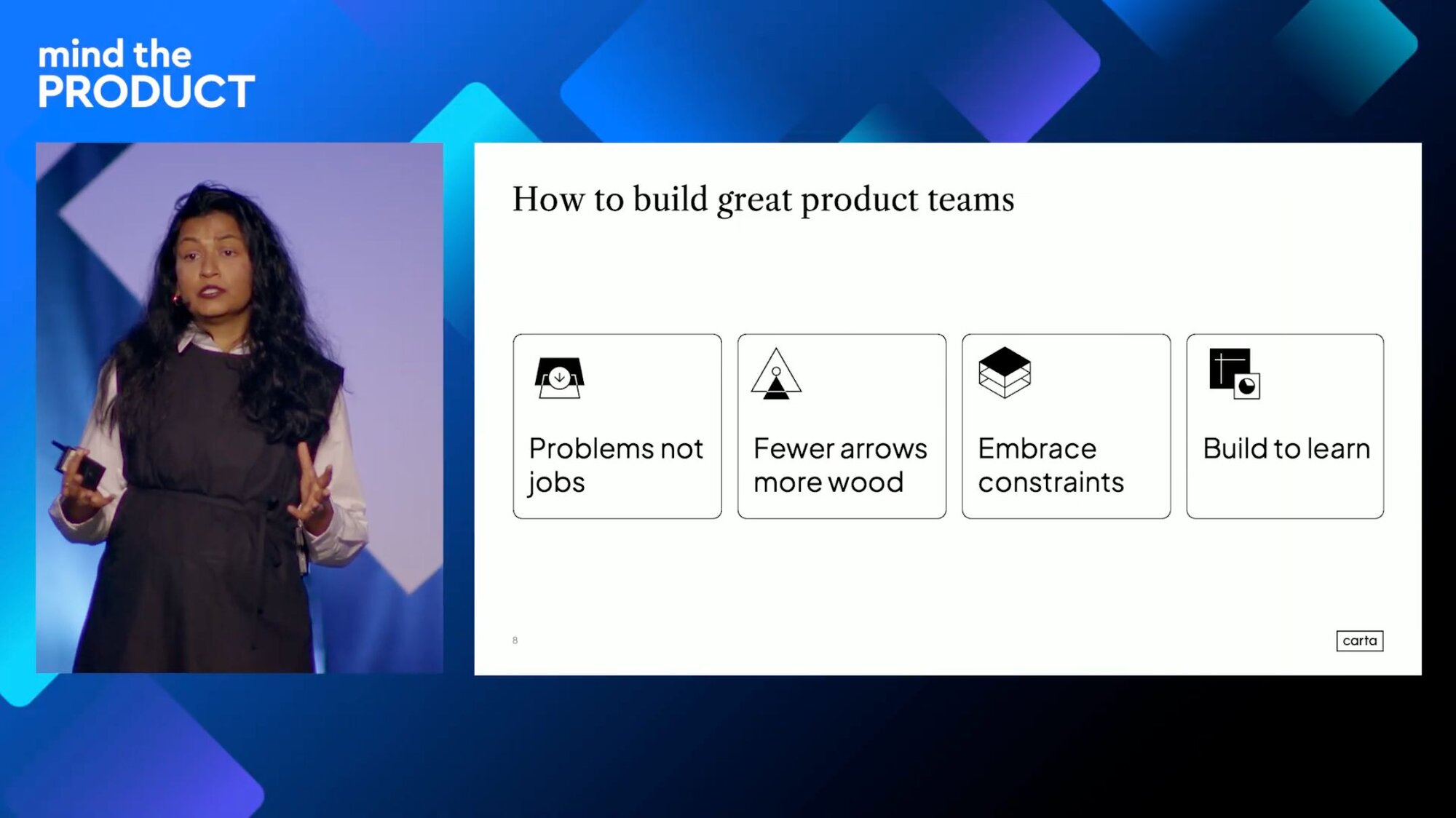
One of Vrushali’s most striking points was that strong product teams are not organised around roles and responsibilities, but around problems.
“At Carta we orient around problems. A problem when solved creates state change in the world and we exist to create state change.”
Traditional job descriptions, she argued, can often do more harm than good. They list tasks, skills, and responsibilities, but rarely capture the essence of what actually needs to be achieved. Worse, they can inadvertently create barriers for candidates from underrepresented backgrounds who don’t see themselves fitting neatly into the language of those descriptions.
She linked this to what economists call the “principal-agent problem.” As she explained it: “Employees are the agents, the company is the principal.” The tension arises when the incentives of the employee (the agent) are misaligned with those of the company (the principal).
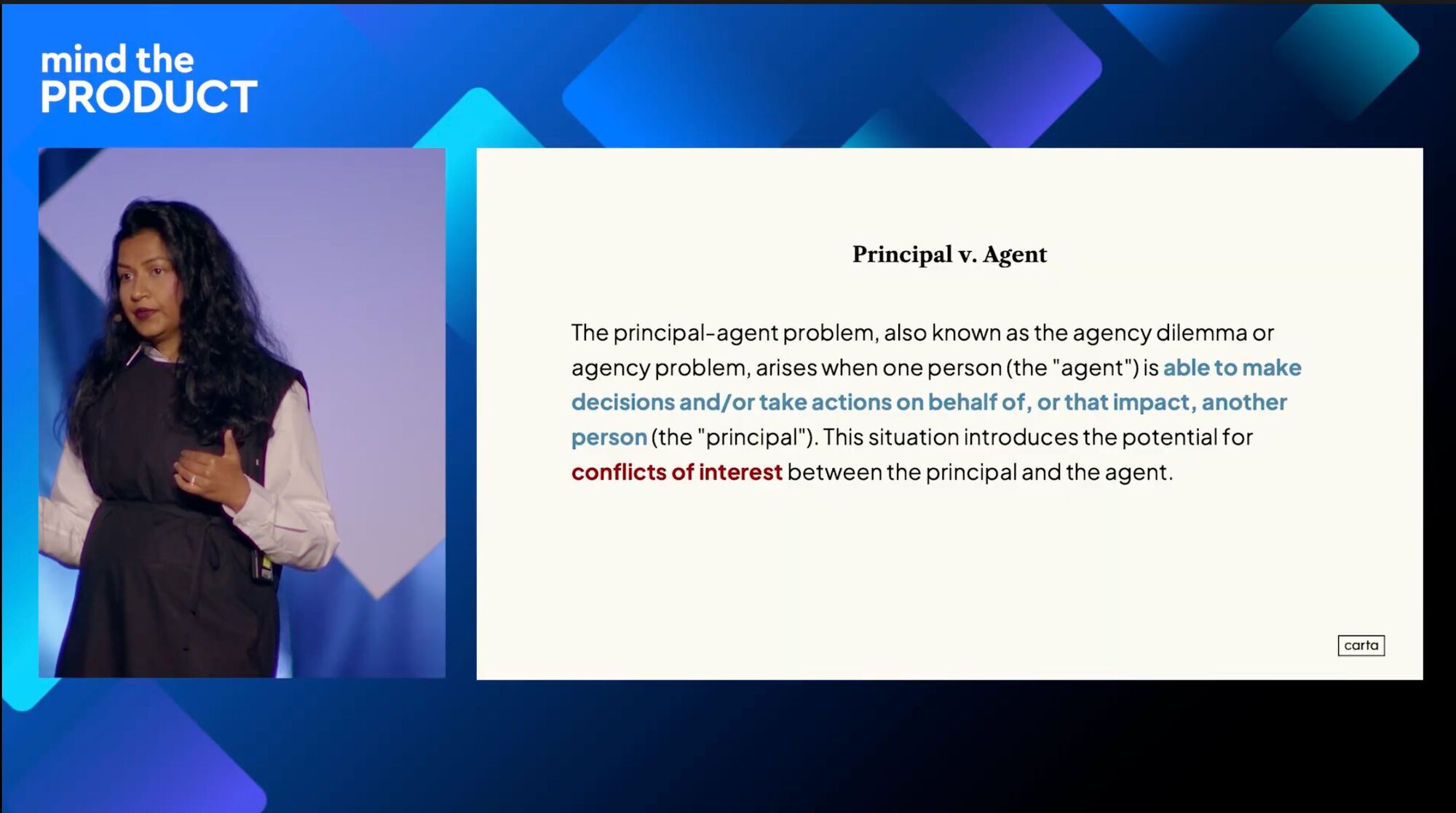
A list of tasks does nothing to resolve that misalignment, in fact, it can reinforce it, reducing complex problems to checkboxes and robbing people of the autonomy to think creatively about solutions. The alternative at Carta is simple but powerful: problem descriptions. “One of the simple ways we put this into practice is that we don’t have job descriptions, we have problem descriptions.”
By framing roles in terms of the problems that need solving, Carta makes it clear what the real work is and who might be best suited to take it on. It also widens the funnel. Vrushali emphasised that when you strip away exclusionary language and focus on the problem itself, you invite a more diverse range of candidates to see themselves in the role.
Making success problem-oriented
Reorienting around problems doesn’t stop at hiring. Vrushali described a simple but powerful framework for what success looks like once teams are in place:
- Find the right problem to solve
- Use your time, energy, and craft to relentlessly pursue solving that problem
- Tell people how you solved it, and what you learned by trying
“Our weekly product reviews are oriented around problems,” she explained. “We engage our stakeholders by solving this with us.”
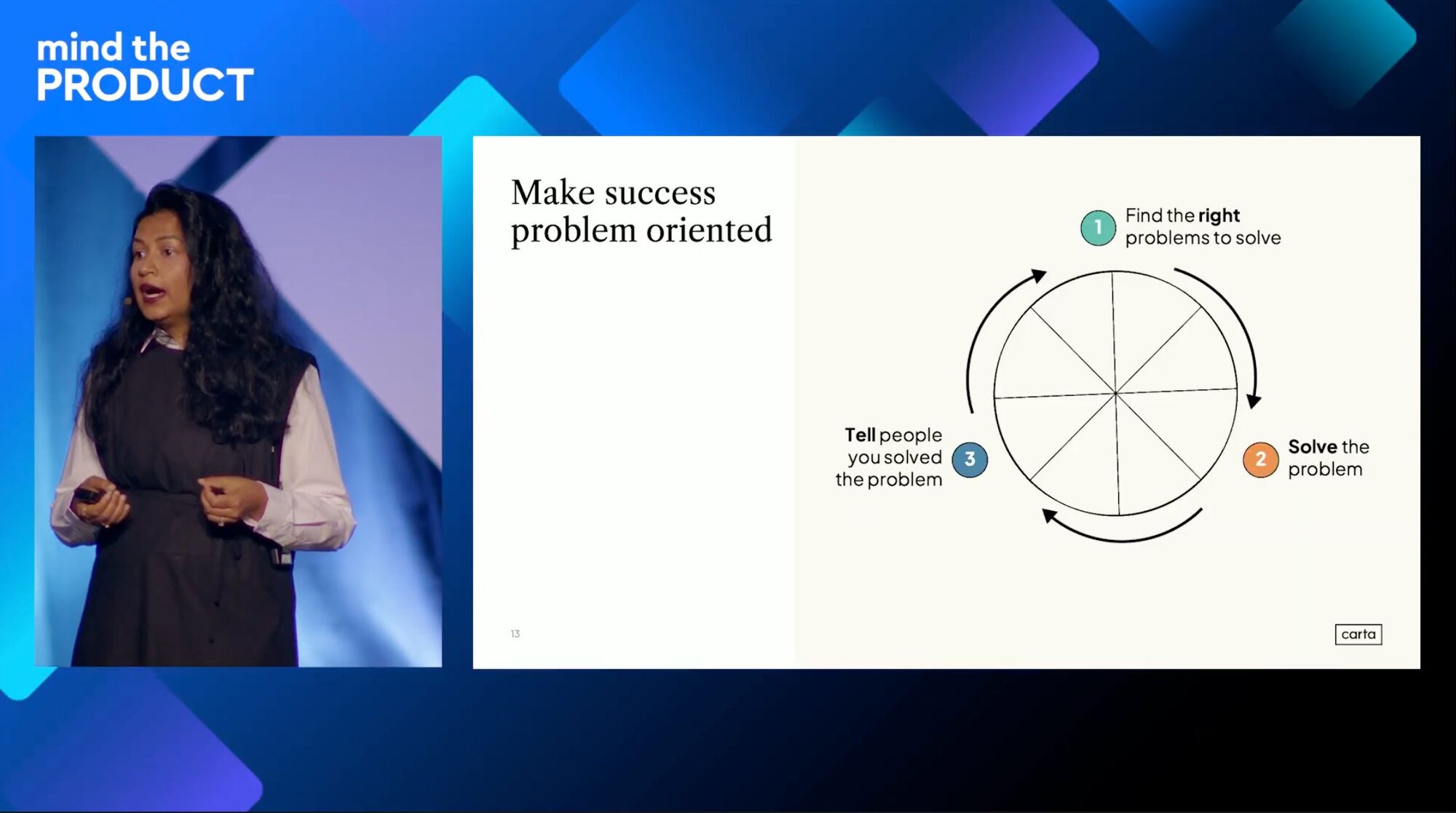
That focus extends to how Carta approaches planning. Rather than maintaining traditional feature roadmaps, they use problem roadmaps. Each quarter, teams identify the three problems they will dedicate themselves to solving. This clarity, Vrushali argued, creates sharper alignment across the company and avoids the trap of bloated roadmaps filled with low-priority features.
The shift also reframes the role of communication. Teams aren’t just delivering solutions; they’re expected to tell the story of what they tried, what worked, and what didn’t. The act of sharing becomes part of the learning cycle, a way of ensuring that progress compounds across the organisation.
Generalists, specialists and teams
From there, Vrushali turned to a debate that’s shaping the future of product management: in a world transformed by AI, are generalists or specialists more valuable?
She argued that the most innovative teams don’t choose one or the other; they combine both. “We pair our craftspeople, the product managers and designers with subject matter experts so we have teams that have both the best generalists and the best specialists.”
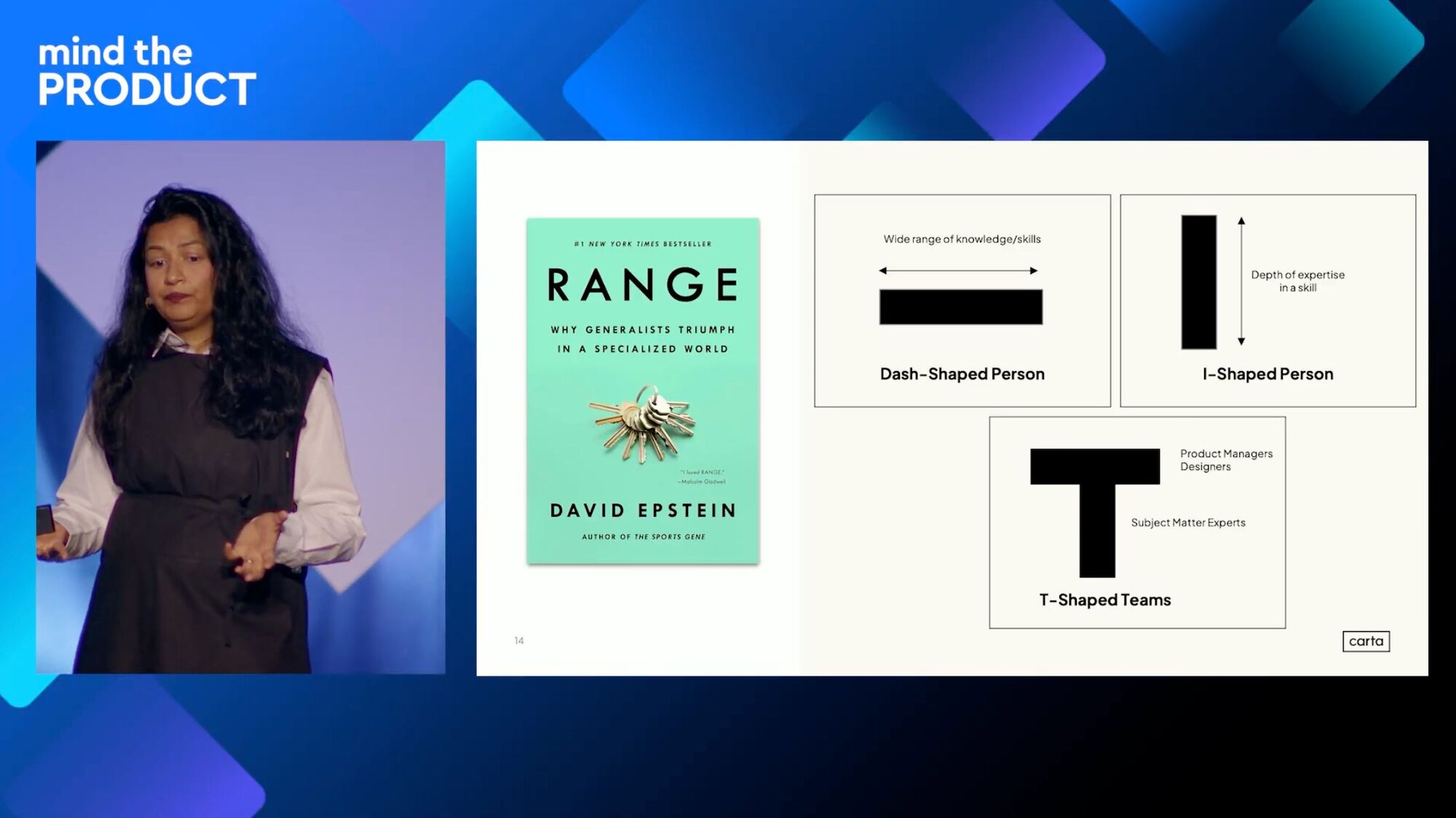
This balance, she said, is the essence of a T-shaped team. The breadth of generalists enables adaptability, context, and systems thinking, while the depth of specialists brings expertise, and domain insight. At Carta, this model has been so effective that around 50% of her product team originally came from non-product roles. That diversity of backgrounds has created a culture of curiosity, flexibility, and resilience.
Building culture intentionally
Once you’ve shaped the right mix of skills, Vrushali argued, the real work begins: building a culture that allows those teams to thrive. She shared a set of practices that Carta uses to create consistency and reinforce its values:
- Starting all offices at 8:30 sharp, creating a shared rhythm across locations
- Expecting product leaders to spend one day a week in a different Carta office to stay connected
- Reviewing every data model with the CEO and founder, reinforcing accountability
- Hosting an annual “Carta Business School,” where top performers are invited to learn, reflect, and recommit to the company’s principles
Each of these practices may look small in isolation, but together they create a culture of connection and shared responsibility. Vrushali also emphasised how these principles also “set guardrails against one of the biggest threats to product organisations, politics”
“The faster you get product into the hands of users, the faster you cut through the politics,” Vrushali said. For her, speed is not just about efficiency, it's a cultural safeguard.
Embracing constraints
A recurring theme throughout her talk was the importance of constraints. Rather than seeing them as blockers, Vrushali framed constraints as levers.
- Minimise effort for a fixed outcome
- Maximise outcome for a fixed effort
“Product managers create leverage. They deeply understand their domains, they recognise patterns, they apply insights, and they orchestrate all in service of creating maximum customer value.”
For her, constraints are not just conditions to work around, they are the very things that spark creativity. They force prioritisation, sharpen decision-making, and push teams to do more with less. In an age where resources are rarely unlimited, this mindset can be the difference between teams that stagnate and those that thrive.
The role of AI
Vrushali was clear-eyed about both the promise of AI and its pressure.
“With AI, the upside is truly unfounded. You can synthesise vast amounts of data in minutes, you can write documents, create videos, even report broadcasts and get your message to every audience.”
But she also cautioned product managers not to be complacent. “As a product manager, the best way for you to create leverage is to master your craft and 10x your offerings with AI.”
Her point was not that AI will replace PMs, but that it will amplify the gap between those who know how to use it effectively and those who don’t. The winners are the ones who figure out how to combine AI’s scale with human judgement, creativity, and product sense.
Build to learn
Vrushali closed her keynote with the concept of “build to learn”. She argued that delivering user value is only half the story. The other half is the speed of learning. At Carta, one of the ways they institutionalise this is through weekly “show and tells,” where anyone can sign up to share what they’re working on and, more importantly, what they’ve learned. “Show and tell is the best MBA class.”
These sessions make experimentation visible, normalise risk-taking, and ensure that learning compounds across teams. Mistakes aren’t hidden; they’re shared, analysed, and used to accelerate progress.
She also offered a reminder that execution is what ultimately drives strategy: “Product managers, product leaders and founders spend 90 per cent of your time on execution and the strategy will come.”
Raising the stakes
As she wrapped up, Vrushali left the audience with both a warning and a challenge.
“AI is raising the stakes; it's do or be irrelevant. Speed of learning is survival.”
Her goal was not to hand people a fixed playbook, but to spark conviction to build teams that are problem-oriented, to embrace constraints rather than fear them, and to learn faster than anyone else.
Because, as she put it, that is how you don’t just change the trajectory of your company, but the trajectory of your industry and “maybe even the world”.
