
I spent years in charge of product at an online marketplace that bought game items from users for cash and resold them. We were a team of about 20 people, full-time and part-time, and we handled millions in inventory. And almost nothing about it worked the way I expected a marketplace to work.
People assume a marketplace connects buyers and sellers and never touches the asset itself. Ours didn't work like that, since we were the sole buyer. A user brings in a CS2 skin (a cosmetic in-game item), we pay them on the spot from our own money, and then it’s ours. We hold it until we resell it, and we deal with whatever happens to the price in between.
So the user leaves happy and we’re left holding an item that might be worth less by the time we sell it.
That mechanic meant we were underwriting risk on every item we bought. Every instant price we show is a bet with our own cash on two questions: what can we resell this for, and how long until we do?
Then the platform kept making "how long" worse
At the start, "how long" was basically zero. We would buy it, sell it within minutes or days, done. The money never sat still, so the risk felt theoretical and we mostly ignored it. Unfortunately, this didn’t last.
To explain what happened next, I first need to explain the main vulnerability of this process. The skins we sold didn’t sit on our servers, but in a user's Steam inventory on Steam. From the point of view of the gaming platform, a trade is just a change of ownership recorded on Steam's side: the skin stops being theirs and becomes ours, then later stops being ours and becomes the buyer's.
Think Google Drive: your files live in your account and you reach them through your Google login. The Steam account is the key, the inventory is the drive, and the whole thing runs on Steam's infrastructure, not ours. We owned the skins, but not the inventory they were kept in. Every trade went through Steam and lived at the mercy of its bugs, delays, new features, and whatever got updated that week.
At first this worked smoothly. The flow was cheap and instant, and hosting the skins cost us nothing.
Then, Steam added a holding period, and an item we bought now had to sit in our inventory for seven days before we could even list it for sale. We thought it might be the end of us. Our entire model was about speed; seven days of forced waiting on every item meant their value could drop hard before we were even allowed to sell. It felt like the floor was falling out.
It kept on falling. A couple of years later it was not seven days but ten before a skin we bought could go up for sale, with no way to opt out. A couple of years after that, Steam shipped a feature where a seller can reverse a completed trade within seven days and pull the item back. That meant we paid for a skin, the user got the cash, and a week later they could yank the item out of our hands. That was a hole opening under every trade we made.
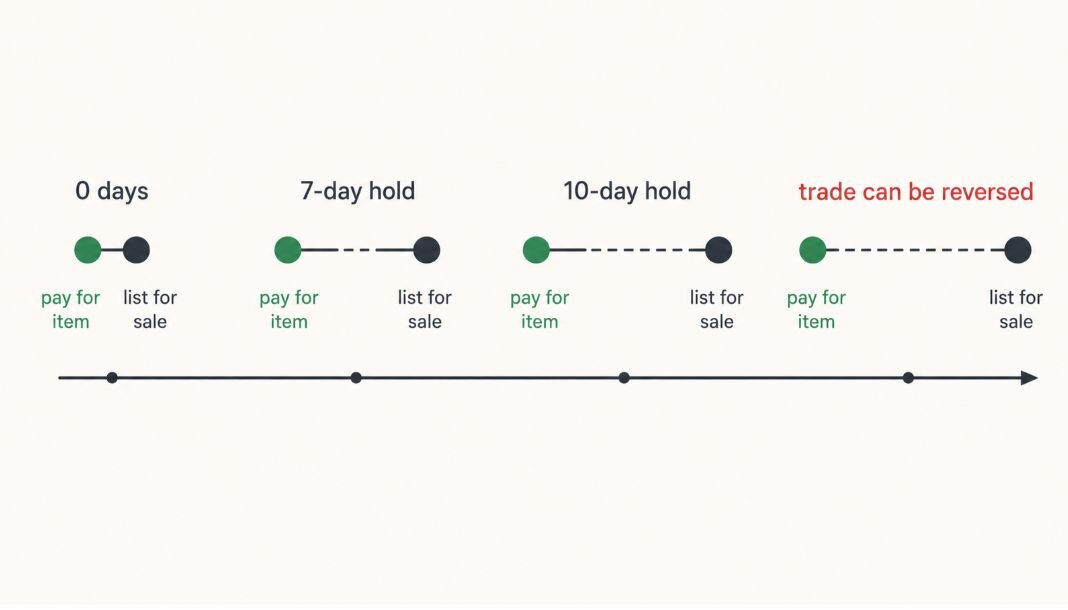
Every change pushed the same way: a longer gap between paying for an item and selling it. And that gap is the whole risk, because a skin's price can fluctuate wildly over ten days. So we were left with one question: how do you price something when you can't fully control how long you'll be holding it?
Why does one good pricing rule keep losing money?
Every price we quoted was a trade-off: offer too much and we lose when we resell; offer too little and the user sells to a competitor instead. The right offer was somewhere in between, and it kept changing along with the level of risk involved.
This is why a flat margin rule can cost you money. For example, on a volatile item, a fixed spread is too thin, the price blows past it before you can even list, and you’ve underpriced your own risk without noticing. On a stable item the same spread is too fat, you are charging for danger that does not exist, and the user just goes to a competitor and never comes back. The same fixed spread can’t both protect you on the items that move fast and stay competitive on the ones that don't. And the items that do move fast are the ones that bring you the most money.
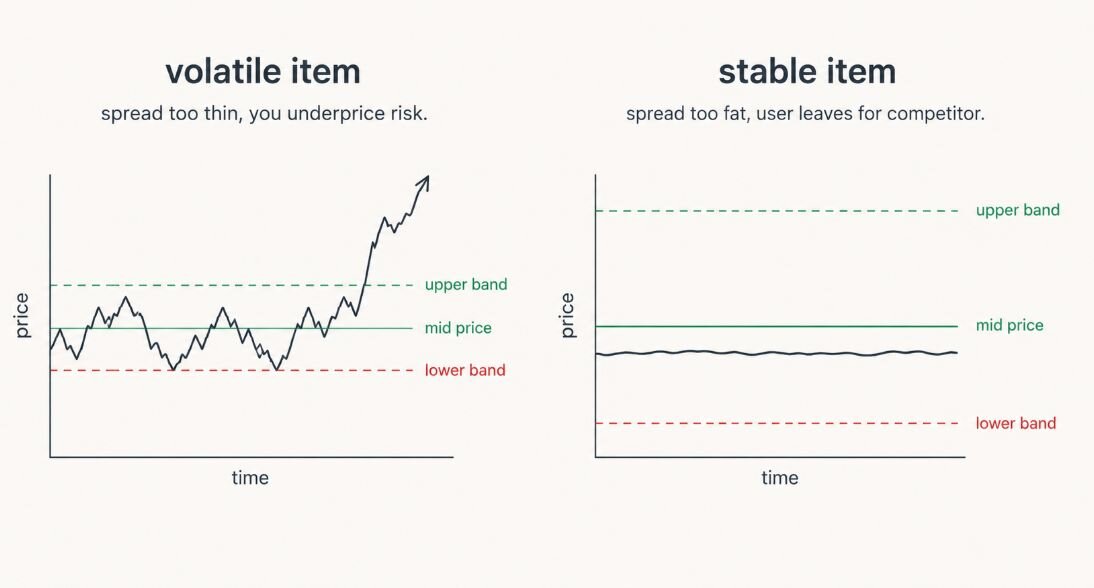
Somewhere in there I started picturing us as a trading desk instead of a store. A desk reprices constantly against live conditions and is obsessed with one thing: how long risk spends on the book before clearing.
So, what should the model optimize?
Margin per trade is the obvious thing to chase, but it’s also the wrong thing. We needed to clear inventory fast and still make money on it, which is a different problem.
I led the product and directed the team that built the answer: an ML dynamic-pricing engine that repriced every item, continuously. We tracked competitors' public sales, every price and how many of each skin actually sold, and that was our read on real demand. We knew our own side too: how much of each skin we were holding, how much we had sold in the last days and weeks, and where we thought the trend was heading. From all of that the engine predicted where each skin was heading and priced it accordingly, in real time, item by item. It took a team of four engineers, one data scientist and two PMs five months to build, and it paid for itself in less than a few months. No fixed rule could ever keep up with that.
The harder part was pricing against a holding window we could not control, and hitting our turnover target without giving away the margin to do it. There is always an easy way to sell faster: drop the price and sell everything in seconds. But that hits the turnover number and kills what you make on each item. The real job was to clear fast and stay profitable across the book at the same time, which is a much narrower target.
Sometimes, however, the right move was to take a loss on purpose. If the price of an item was sliding, holding on to protect our margin just meant watching the loss grow, so we sold into the fall and got out.
So the number we focused on the most was turnover time, from the second we bought an item to the second we sold it. The shorter this window, the better our odds of selling at a profit. The pricing engine cut this window by 53%: half the holding time means the same money works twice as fast, and it also halves the opportunity for a bad price swing to negatively affect our trade.
The day our thesis got tested
October 23, 2025. Steam pushed an update that let players manufacture the rarest items in the game instead of waiting to find them. Overnight, these items stopped being rare: knives and gloves fell as much as 70% in a day. The total game skin market cap dropped around $2 billion. An M9 Bayonet Doppler that used to be worth $2,053 was now down to $780:
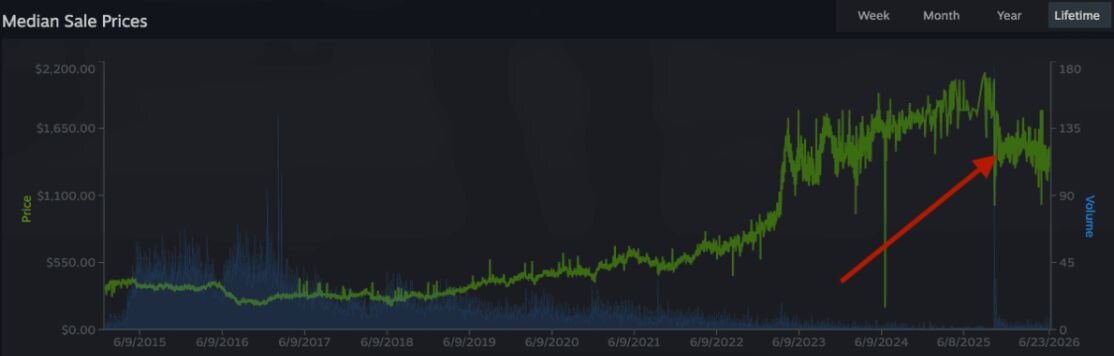
Whoever was holding the most expensive inventory was hit the hardest by this change. The pricier the item, the more money you have tied up per unit, and the harder the fall. This is the exact nightmare a buyout platform is built to avoid. The longer your money sits in an expensive item, the more time a surprise update has to wipe it out. Years of squeezing turnover came down to surviving a day like this.
Because our skins sold within days instead of sitting for weeks, we had very little expensive stock when the update hit. We took a loss, but a small one, while platforms that held inventory longer took the full fall.
When is growth actually just risk?
On most marketplaces, GMV (gross merchandise value, the total value of everything traded through the platform) going up is good news, but on ours it could be a trap. GMV you can’t turn over is just risk stacking up on your book, waiting for the market to turn while your holding window ticks closed. We could have "grown" by buying harder and holding more, and all we would have built is a balance sheet full of items we couldn’t sell fast enough to be safe. The job was to grow and turn over at the same time, and to prioritise velocity in the process.
That is what stayed with me. When your platform eats the risk instead of brokering it, pricing is not a feature of the product, but the product itself.
My recommendation to product teams is to design with the bad days in mind. This paid off for us, because Steam kept doling out bad days. It’s important to get the balance right because, otherwise, "growth" could only dig the hole deeper, with every trade adding another item you can't sell fast enough. But if you get it right, the same money, moving faster, does far more than its size suggests.
