
Product teams track velocity, cycle time, and feature throughput obsessively. Almost nobody tracks the sprints lost to privacy rework created six months earlier, in a planning meeting where nobody asked the data question.
Here is the failure mode nobody names as a product failure. A feature ships on time. Velocity looks great. Then, two quarters later, a compliance review finds that the feature has been collecting more data than it needs, retaining it longer than it should, and sending it to a third-party integration that privacy never signed off on. Everything else on the roadmap stops. Engineers are pulled off new features to unpick architecture that should never have existed. The next two sprints belong to a problem that was created in a planning session half a year ago, when nobody asked what would happen to the data.
This is Privacy Debt. Unlike technical debt, which product teams have learned to measure, name, and consciously defer, Privacy Debt tends to arrive as a surprise bill. It does not accumulate visibly in the backlog. It hides in the gap between what your compliance document says and what your Definition of Done requires.
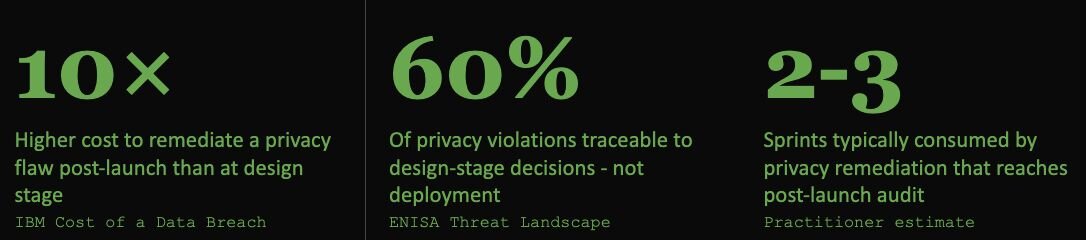
The velocity implication is unambiguous. Privacy debt is not a legal risk managed at the end of a quarter. It is a roadmap risk created at the start of every sprint. Which means it belongs in the product manager's problem set, not delegated wholesale to security.
Why product teams keep exporting this problem
The default mental model is that privacy is a security concern, a legal concern, or a compliance concern but not a product concern. This makes life simpler in the near term. It makes roadmap planning a nightmare six months later.
The handoff pattern is consistent: a feature is scoped and built. Somewhere in the process, the security or legal team is asked to 'review' it. They raise issues. The issues are resolved under pressure, creating shortcuts or deferred to a future sprint that never quite arrives. The team ships with known privacy gaps and labels it acceptable risk— until it is not.
"Privacy debt is not a security problem that escapes detection. It is a product problem that was never given a Definition of Done."
Robert Ouko Ogendo - Technology Programme & Product Leader
The structural cause is a mismatch of artefacts. Privacy requirements live in a compliance document. Delivery decisions live in the backlog. When those two things never meet, privacy is not being managed, it is being hoped about.
Three product decisions that close the gap
Closing this gap does not require a privacy engineer, a new toolchain, or a reorganisation. It requires three product decisions that any PM with ownership of their backlog and Definition of Done can make this week.
- Translate privacy requirements into user stories
Privacy requirements written in compliance language are, by design, comprehensive and imprecise. That makes them useless for sprint planning. You cannot ensure data is processed in accordance with applicable legislation. You cannot assign it. You cannot write a test for it.
The moment you translate a compliance obligation into a user story, with a specific user need, a specific data constraint, and specific acceptance criteria, it becomes plannable, assignable, and verifiable. The story has the same requirement. The format is what makes it actionable.


2. Put privacy in the Definition of Done
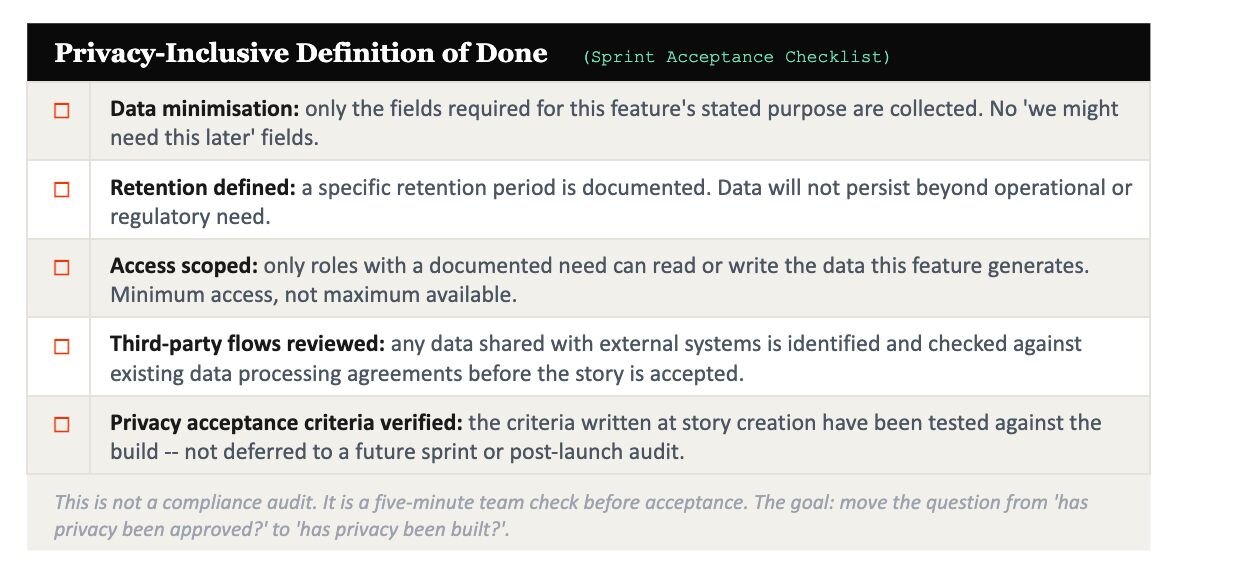
The Definition of Done is the most powerful instrument a product team controls. What is inside it is non-negotiable before a feature ships. What is absent from it is, in practice, optional. And optional requirements are the first casualty of sprint pressure.
Adding privacy acceptance criteria to the Definition of Done converts privacy from a compliance activity—something that happens to your product—into a quality standard, something your product meets before it ships. The checklist below takes under five minutes per story to verify.
3. Move privacy into discovery, not just review
Privacy issues found in a post-launch audit cost sprints to fix. Issues found in a design review cost hours. Issues surfaced in discovery cost minutes. The value of moving the conversation upstream is directly measurable in developer time reclaimed.
This does not require a privacy specialist in every kickoff. It requires one question added to every feature kickoff: “What data will this generate, collect, or process and have we defined what happens to it?”.Teams that ask this consistently, before a line of code is written, eliminate the majority of the privacy debt that would otherwise reach production.
What product managers own vs. what security owns
One reason privacy gets fully exported to security teams is genuine confusion about the ownership line. The table below is the clearest breakdown in practice. Both columns matter. When PMs treat the left column as someone else's job, both columns go unowned.
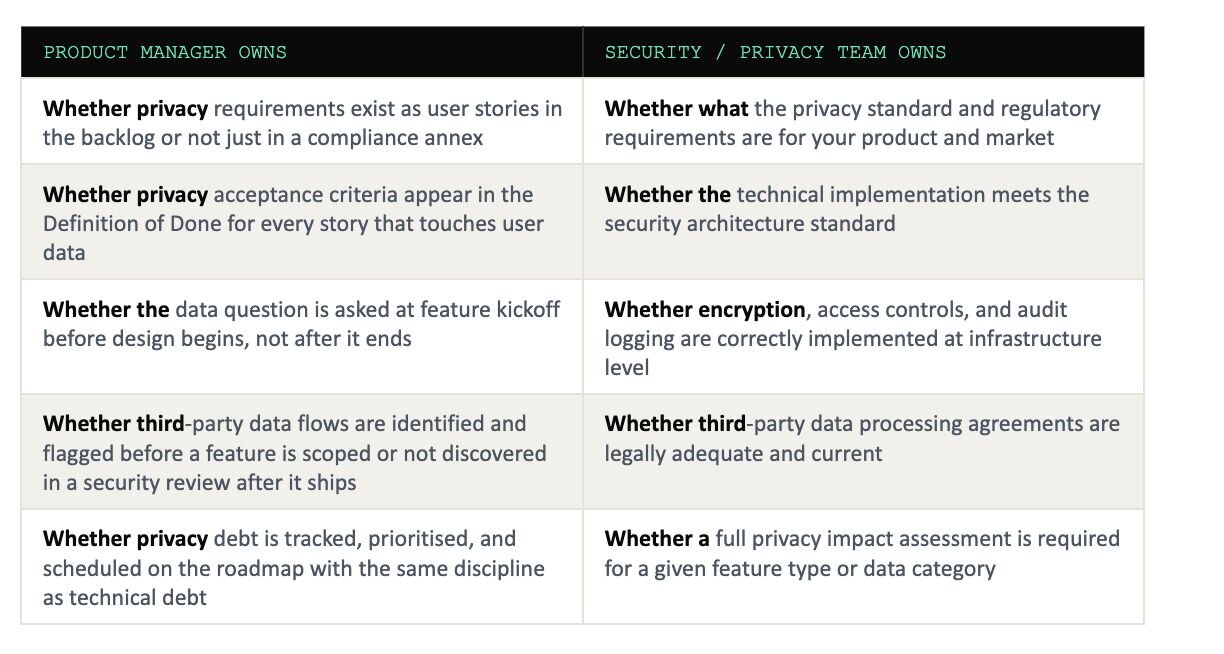
The pattern is consistent across every row: product managers own the process decisions whether privacy is visible, plannable, and verified in the delivery workflow. Security teams own the technical and legal standard decisions, what the bar is, and whether the implementation clears it. These are complementary, not competing. Both fail when the left column is treated as optional.
Privacy by design is a product discipline
The framing of privacy by design as a security principle has always been a misattribution. Ann Cavoukian's original formulation was specifically about embedding privacy into the design and architecture of systems—the moment product teams control, not security teams. The fact that regulators worldwide have since codified it into law (GDPR, Kenya's DPA 2019, POPIA, CCPA) makes it a compliance obligation. But its natural home was always the product backlog.
The teams that deliver sustained velocity without late-stage privacy surprises share one characteristic: they treat privacy as a design constraint to be worked around at the start, not a gate to be navigated at the end. That reframe is a product leadership decision. The tools to make it are already in your hands—the backlog, the Definition of Done, the kickoff agenda, and the roadmap. None of them require a security engineer to change.

