
As the AI gold rush continues, product leaders are racing to embed AI into everything, including apps, workflows, and increasingly, consumer hardware. New AI gadgets promise more natural, agentic, and ambient ways to interact with intelligence.
But beneath the excitement, many of these products are failing not because of poor execution, but because they should never have been built in the first place.
In the rush to capture the next AI wave, teams are skipping a critical step: rigorous product filtering at the concept stage. Significant capital is being invested with the hope that something sticks, rather than disciplined judgment about what deserves to exist.
That approach might work in software, but the hardware world is unforgiving.
In software, you can often iterate your way out of a bad idea while developing the product. In hardware, that is simply not possible. I’ve seen this play out multiple times in hardware programs. By the time product leaders realize an idea lacks product-market fit or is too expensive, they’ve already spent months in development, locked in suppliers, ordered materials, and committed millions to production. At that point you’re deciding how much loss to take.
The 4C viability test (a stage 0 filter)
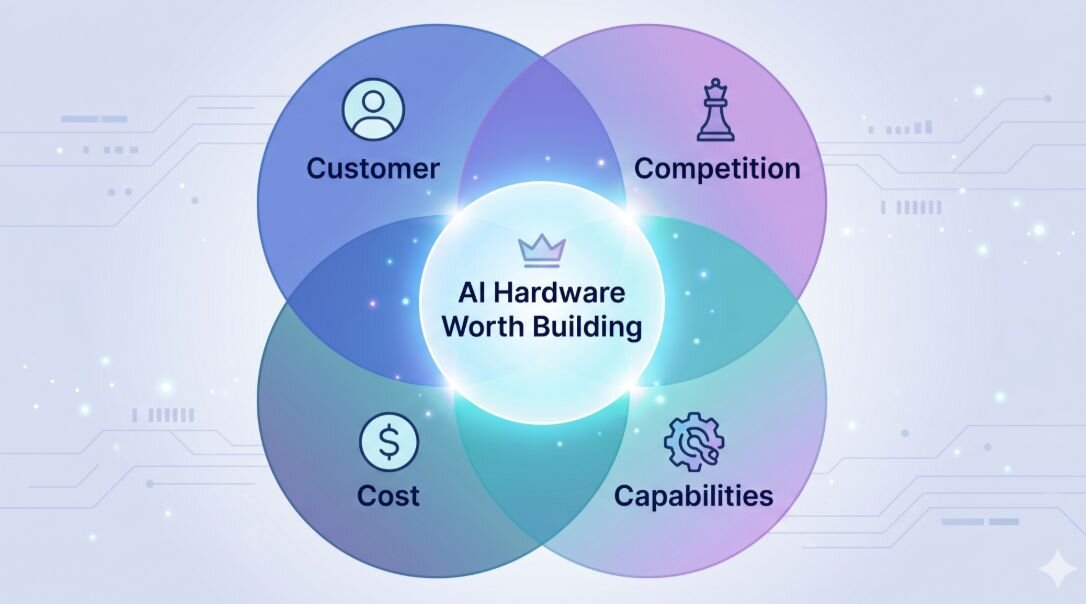
Over time, I’ve found that most bad hardware ideas show cracks very early, if you look for them. A viable product sits at the intersection of consumer need, market realities, product economics, and execution capabilities.
In practice, I use a simple four-part Stage 0 filter (Customer, Competition, Cost, and Capabilities) to pressure-test whether a product should exist at all. It’s not perfect, but it’s good enough to surface early gaps in your product-market fit. If a product fails even one of these, that’s usually a signal to rethink, pivot, or simply walk away.
1. Customer (the habit filter)
Users don’t just buy devices; they adopt habits. And habits are incredibly hard to change. In a world already inundated with devices, ask yourself: why will a consumer actually remember to charge, carry, and use this new product every day? What is the visceral payoff for changing their behavior?
You can’t rely purely on focus groups to answer this. In hardware, user research has limits. Consumers usually don’t have the vocabulary to predict how they will interact with a completely new physical paradigm until they actually use it. They don’t know they need a new form factor until they experience how it eliminates a problem and fits seamlessly into their lives.
Therefore, the burden is on us as product leaders to be confident that users will actually change their behavior. Unless your product requires a unique physical capability, such as AR glasses or a new sensor, the behavioral gravity of the smartphone, iPad, smartwatch, or laptop will eventually pull users back.
When to walk away:
- The product requires replacing an entrenched behavior (like pulling out their phone) without delivering a massive improvement in speed or friction or quality of life.
- The value is novelty-driven or episodic. Gimmicky products may attract pre-orders and media attention, but they inevitably end up dead in a desk drawer as the excitement fades.
2. Competition (the two-front war)
When building any consumer product, you are fighting a two-front war. Your competitive threats are twofold: existing substitutes and direct competitors.
First, the existing substitute. The smartphone is the apex predator of devices, constantly aggregating new capabilities into a single interface. If your hardware is essentially a physical wrapper around a cloud API, your primary threat is a new app or OS update that makes your device entirely redundant.
Second, the direct competitor: whether nimble startups or incumbents. If the category already exists, you need a clear and compelling reason for users to switch. Incremental improvements rarely survive in a market with strong, entrenched incumbents. And if you do prove that a new form factor works, you immediately paint a target on your product’s back. To survive the inevitable wave of fast-followers, your product must possess a durable competitive advantage that competitors cannot easily replicate. You need a structural moat, whether that is a proprietary architecture, an exclusive distribution advantage, or deep ecosystem lock-in.
When to walk away:
- The core value can be served by an existing substitute like an app or an OS update.
- The product has zero or marginal differentiation against existing incumbents.
- The product has no defensible moat against competitors cloning the product
3. Cost (the margin squeeze)
The brutal math of fully loaded unit economics makes or breaks a hardware product. It is easy to look at a Bill of Materials (BOM) margin on a spreadsheet and assume the product is viable.
I’ve seen this mistake happen in the ideation phase, especially for first-generation products. Teams are usually estimating component costs alone this early, so the target price and margins can look attractive based on the initial BOM estimate. But the picture changes quickly once they account for tooling, logistics, warranty, retail margins, and ongoing software or cloud costs. That is often the moment when an exciting concept starts to look much less viable.
True hardware unit economics must account for three distinct layers of costs:
- First, BOM costs. Running AI models locally or even via a hybrid architecture demands serious NPU performance, expanded memory, and thermal management. In addition to standard components and modules, context-aware agentic AI experiences may require specialized sensors, which immediately inflate BOM costs.
- Second, non-BOM costs. Moving from prototype to mass production requires accounting for tooling and equipment capex, logistics, customer support, warranty, and inventory management costs. These costs are especially hard to estimate for first-generation hardware because there is no direct product history to reference. Warranty is a good example. Teams have to estimate expected return rates, replacement costs, and shipping costs using past products, comparable categories, or industry benchmarks. Getting this wrong can later erode margins that looked healthy on paper during early planning.
- Third, structural and recurring costs. You have to fund development, marketing, promotions, and distribution channel margins. Crucially, in the agentic AI era, you must also account for continuous cloud compute. Hardware yields a one-time revenue spike, but you may pay a recurring cloud API bill for every user interaction. If engagement goes up and your costs scale with it, success becomes a liability. This creates a fatal margin vs. MSRP struggle. You either absorb the recurring cloud bills and structural overhead, meaning high engagement bankrupts your bottom line, or you pass these costs to the consumer. That may force a retail price so high the product only appeals to a tiny niche.
When to walk away:
- The unit economics are negative or structurally unsustainable, both at launch and as usage scales, with no realistic path to improvement over time.
- Losses are justified as a growth strategy, but there is no credible path to long-term profitability through scale.
- The fully loaded cost structure forces a retail price beyond market viability.
- Projected sales volumes are too low to justify the investment.
4. Capabilities (execution reality)
Winning in consumer hardware requires excellence in hardware and software execution across design, engineering, manufacturing, supply chain scale, and go-to-market strategy. Without it, you ship products that promise capability but fail in real-world use.
When strategizing how to execute, hardware leaders face the classic “build, borrow, buy” dilemma. Each path carries real risks for AI devices.
You can build deep hardware capabilities and custom components in-house, which gives you maximum differentiation, but it is expensive and slow. You can buy off-the-shelf from a supplier to move quickly, but that usually means little to no product differentiation. A software team cannot simply buy a white-label box, run an LLM on it, and expect to win. Or you can borrow by partnering or outsourcing, which introduces dependencies you do not fully control.
The fundamental question is simple: Do we actually have the capabilities to build, scale, and bring a high-quality, differentiated product to market?
When to walk away:
- The team lacks critical engineering, supply chain, manufacturing, or distribution expertise, with no realistic path to acquire it.
- The product relies on off-the-shelf hardware with little to no differentiation.
- Success depends heavily on capabilities, ecosystems, or partners the company does not control.
Lessons from the hardware graveyard: Humane AI & Rabbit
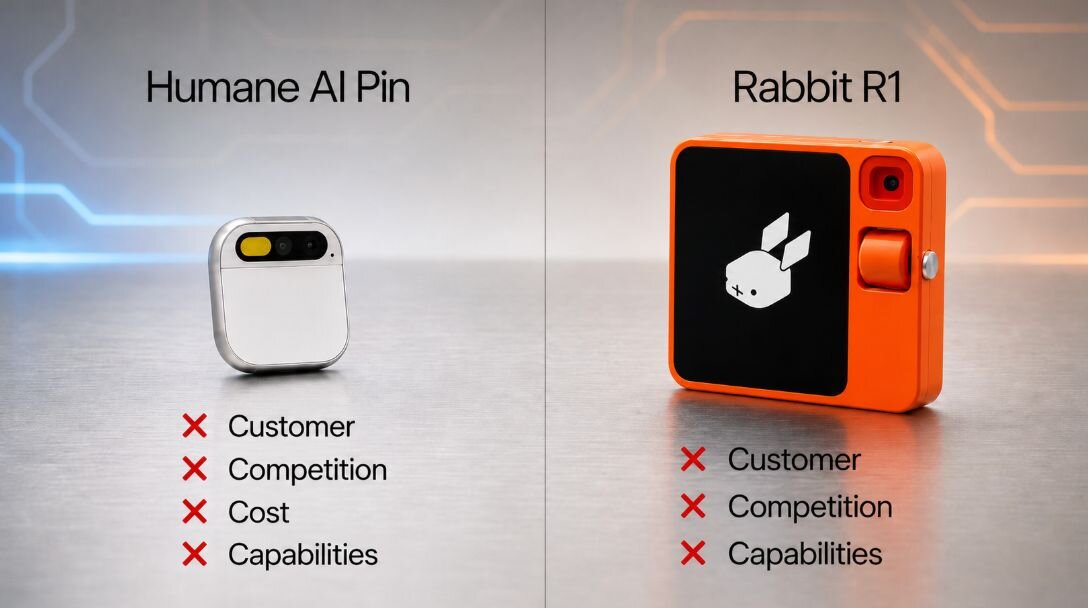
The consumer electronics graveyard is littered with products that prioritized what could be built over what should be built. The Humane AI Pin and Rabbit R1 are useful case studies for the 4C framework. Both of these AI devices dominated the news cycle, only to struggle at launch. The 4C test explains why:
Humane AI Pin
- Customer + Competition: Asked users to adopt a new interaction model without a meaningful advantage over the smartphone, making common tasks slower and more cumbersome.
- Cost: High upfront price ($699) and mandatory subscription ($24/month) created a weak value equation for users.
- Capabilities: Struggled on basic execution. Reviews consistently pointed to slow response times, overheating, unreliable interactions, and core features that did not work as expected. The product felt unfinished and impractical for everyday use.
Rabbit R1
- Customer + Competition: Offered little reason to change user behavior. Most use cases were already better served by a smartphone, making the device redundant.
- Capabilities: Shipped as an incomplete product with missing or unreliable features. It relied on “half-baked” third-party integrations and workarounds for its core functionality. This made the experience brittle and exposed a lack of control over the product’s own value chain.
The power of the veto
The AI gold rush has created a surplus of ideas and a deficit of focus and discipline. Hardware product leaders are under pressure to act fast, but speed cuts both ways. Move too slowly and you risk missing a real market shift. Move too quickly and you risk committing millions to the wrong idea.
Steve Jobs famously noted that focus means saying no to a hundred other good ideas. In the unforgiving world of physical products, saying no isn’t just about focus; it’s a survival strategy.
Exploring innovative concepts is essential, but one true test of product leadership is making hard calls early, before the organization commits millions in capital. The most effective way to train that muscle is through Stage 0 pre-mortems. Before the team falls in love with a concept, assume the product has already failed in the market and work backward using the 4C filters. What user behavior didn’t change? What competitor or substitute won? Where did the economics break? Which execution capability was missing? This shifts the discussion from subjective enthusiasm to objective evidence, and gives teams permission to kill weak ideas before they become expensive programs.
Walking away from an exciting idea can feel like a failure of vision. In reality, the Stage 0 Veto is the highest-leverage decision you can make. The teams that win this AI era are the ones that apply ruthless discipline to build only what deserves to exist.
Disclaimer: The views and opinions expressed in this article are purely the author's and do not necessarily reflect the official policy or position of Google or its affiliates.
