
In 2022, I worked on an AI product that seemed inevitable. Customers loved the demos. Leadership was excited. The problem was real. By 2025, the standalone product was dead.
What I learned: in B2B, a product can solve a real problem and still fail if the buyer has no incentive to act, if the packaging is not right, or if the channel cannot reach them. Product-market fit is actually product-market-buyer-channel fit.
What we built
The insight: the best way to find weaknesses in an Anti-Money Laundering (AML) transaction monitoring system is to expose it to an ethical money launderer — an AI agent trained to evade the system. The agent’s tactics would reveal exactly where an institution’s controls broke down and what countermeasures would close the gaps.
It felt category-creating. By building an AI-powered simulator, we could synthesize and study criminal behavior that is exceedingly rare in the real world. We could test an institution’s full set of controls holistically rather than piece by piece. It was a way to genuinely prevent financial crime, not just react to it.
What we mistook for validation
After bingeing on a lot of product management content, I was acutely aware of the risk of building something people did not want. This idea, however, seemed to have several proof points.
It had clear parallels in cybersecurity, where red teaming is standard practice. Another company had built a viable business solving the same problem without AI — their existence proved the need and the willingness to pay.
Further, demos evoked a lot of engagement from prospects, while leadership was fully bought in and supportive. In fact, leadership was so enthusiastic that I made myself the skeptic, ran pre-mortems, and actively solicited dissenting views. The idea kept holding up.
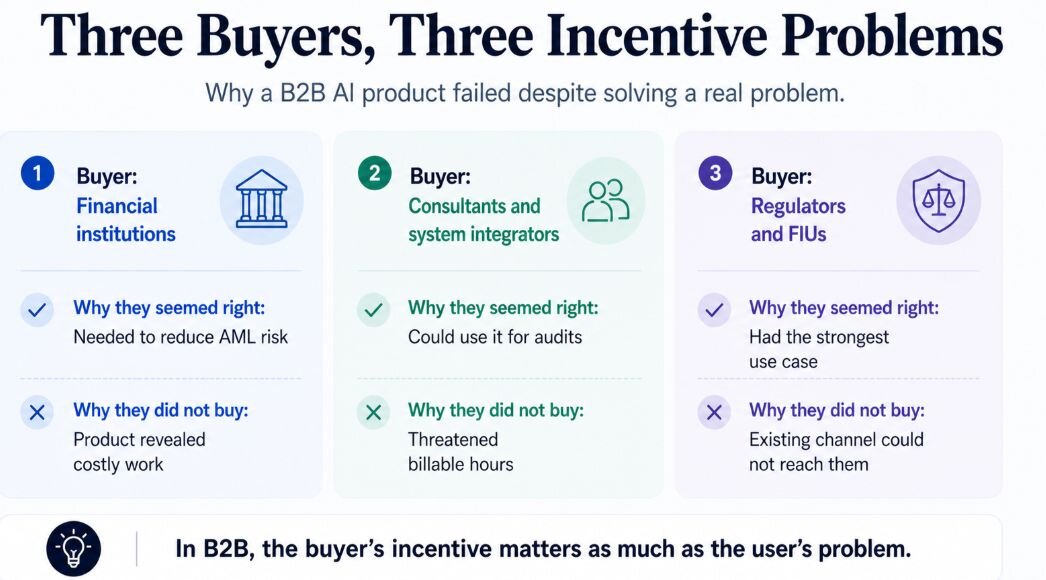
Three buyers, three incentive problems
Financial institutions
Financial institutions were our primary market. A tool that reduced the risk of future fines and regulatory action seemed like an obvious sell. The market was large. Our channels already reached it.
What we missed: at that moment, banks were not trying to reduce risk. They were trying to reduce costs. And the regulatory regime — specifically Model Risk Management (SR 11-7) — punished mistakes more than it rewarded innovation. Our tool would reveal gaps that institutions were then obligated to fix, at significant expense. Why volunteer for that when no regulator was demanding it and your CFO was asking you to cut budget?
The problem was that the product did not just reveal risk; it created work.
Consultants and system integrators
Consulting firms looked promising. They ran independent audits for financial institutions, and the tool would have made them better at it.
But the tool also eliminated billable hours and, in the long run, threatened to replace those audits entirely. The incentives were inverted. The product threatened their existing service model unless it was packaged as leverage for them, not as a replacement for them.
This is going to be a recurring problem for AI adoption: you cannot sell a tool to someone whose long-term interests it threatens — not without a top-down mandate. Relying on the agency of users who are being automated is a mistake.
Regulators and FIUs
Regulators and Financial Intelligence Units (FIUs) conduct exams of financial institutions. The tool would have been perfect for them. The problem was reach — our channels were built for financial institutions, not their supervisors.
The non-AI competitor I mentioned earlier — the one whose existence we had read as validation — had succeeded by reaching regulators directly and being adopted via a top-down mandate. We read their existence as proof of demand. We did not read it as a clue about which buyer actually buys.
We never got to product-market-buyer-channel fit. In B2B, it is not enough that your product solves a real user problem. The buyer’s incentives have to align with the solution, given the regulatory environment. And you need a sales channel that reaches that buyer. Miss any of those, and the rest does not matter.
The packaging alternative
Category creation is hard. The use case was new, the underlying technology — deep reinforcement learning — was novel, and we packaged the whole thing as a standalone product.
In hindsight, the right move was to ship it as a feature inside an existing transaction monitoring product with established distribution. The capability would have made that product meaningfully differentiated. We would have inherited an installed base instead of having to convert one.
The two products sat under two different product leaders with different priorities. You ship your org chart. Integration was blocked by organizational design as much as anything else. Even when we eventually pivoted toward the integration approach, it never got prioritized.
Org design is a product decision. Executives do not always treat it that way. The cost shows up in what you can and cannot ship.
What I’d do differently
Here is what I would do differently
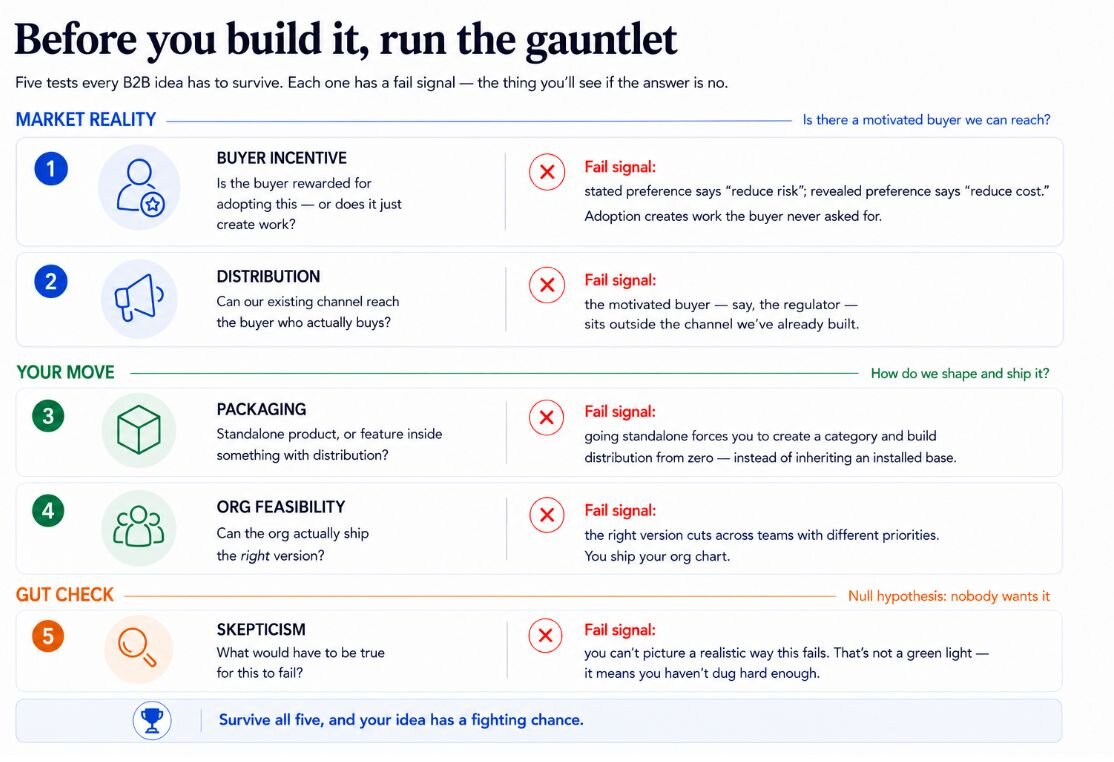
First, map buyer incentives to product capabilities before building. Stated preferences will say “reduce risk.” Revealed preferences will say “reduce cost.”
Second, ship inside an existing product with distribution before trying to create a category.
Third, treat organizational design as a constraint on what you can ship, not just on how teams are arranged.
Lastly, Internalize that the null hypothesis in B2B is that nobody wants your product. Be the harshest critic in the room, actively simulate scenarios in which the product can fail and mitigate them.
The mistake was not building something useless. The mistake was assuming that usefulness was enough. In B2B, the real test is whether the right buyer is motivated to act, has budget, can be reached through the available channel, and can adopt the product without fighting the surrounding organization and regulatory context.
 What’s changed
Sometimes an idea fails because the timing is wrong: the technology is not ready, the regulations are not favorable, or the org is not aligned. In our case, all three were at play.
We mostly built before the ChatGPT moment in late 2022. Many of the same use cases are now more straightforward to deliver with frontier LLMs.
The 2026 regulatory shift relaxed Model Risk Management guidelines and explicitly encouraged institutions to adopt AI without fear of being punished for failures. Customers are now budgeting for AI innovation specifically because of this.
Internal org changes now make the integrated solution possible — the path we should have taken five years ago.
Have I finally learned from my mistakes, or am I making new ones? Time will tell.
