
The billing experience is one of the most overlooked aspects of telecommunications products and is also one of the most frustrating customer experiences. While the billing system was initially intended to simply provide customers with their invoices, billing systems now function as customer-facing tools that significantly affect trust and customer satisfaction as well as operational effectiveness. Nevertheless, too many billing systems continue to operate in a reactive manner where problems have already affected customer experience before customers even contact the company about them.
As a technology product leader responsible for large-scale telecom billing and CRM transformation projects, I have experienced the challenges faced by customers when billing, payment, and support processes are not aligned. In this article, I will discuss how agentic artificial intelligence can help product managers rethink telecom billing as a real-time customer experience product instead of simply a backend operational system.
In this piece, I unpack
- The major gaps that exist in current billing workflows,
- How artificial intelligence-driven decision-making improves customer relationship management experiences for both agents and customers `
- Share practical examples from telecom transformation initiatives,
- Highlight important product management lessons for designing intelligent and workflow-driven billing platforms.
Drawing from real-world telecom transformation programs, this article takes a practical product management perspective rather than a purely technical one. The objective is not to replace existing billing platforms, but to demonstrate how Agentic AI can augment traditional billing and customer support processes with intelligent decision-making, proactive issue resolution, and workflow automation. By viewing billing as a customer experience capability rather than just a financial function, product managers can create more responsive, trustworthy, and customer-centric digital services.
My point of view is simple: Agentic AI should not be treated as another automation layer on top of telecom billing. Its real value comes only when it is embedded into the customer resolution workflow, especially inside CRM platforms, where agents make real-time decisions. A thoughtful skeptic may argue that AI cannot fix fragmented legacy billing systems, and that is a fair concern. My view is that AI should not replace those systems or hide their complexity. Instead, product managers should use Agentic AI to connect billing context, customer history, policy rules, and recommended actions at the moment of customer interaction. In other words, the product opportunity is not “AI for billing.” It is an AI-enabled resolution design.
The telecom billing gap: A product leadership perspective
In many telecom environments, billing systems are made up of multiple disconnected components like mediation, charging, billing, CRM, and payment platforms. While each system performs its role well, the lack of real-time integration creates operational gaps.
When a customer contacts support, agents often need to manually gather information from different systems. They may check usage logs in one tool, billing details in another, and payment status elsewhere. This fragmented experience slows down resolution and increases the chances of inconsistent answers.
Additionally, most billing errors are detected only after invoices are generated. By that time, the issue has already impacted the customer, leading to disputes and additional workload for support teams.
A well-known industry challenge can be seen when customers contact their service provider regarding unexpected roaming charges or unexplained usage fees. In many cases, support representatives must access multiple applications to review usage records, billing details, payment history, and account information before determining the cause of the issue. This fragmented process increases handling time and may result in inconsistent responses. Industry modernization initiatives have therefore focused on providing unified customer views and real-time data integration to improve resolution speed and customer experience.
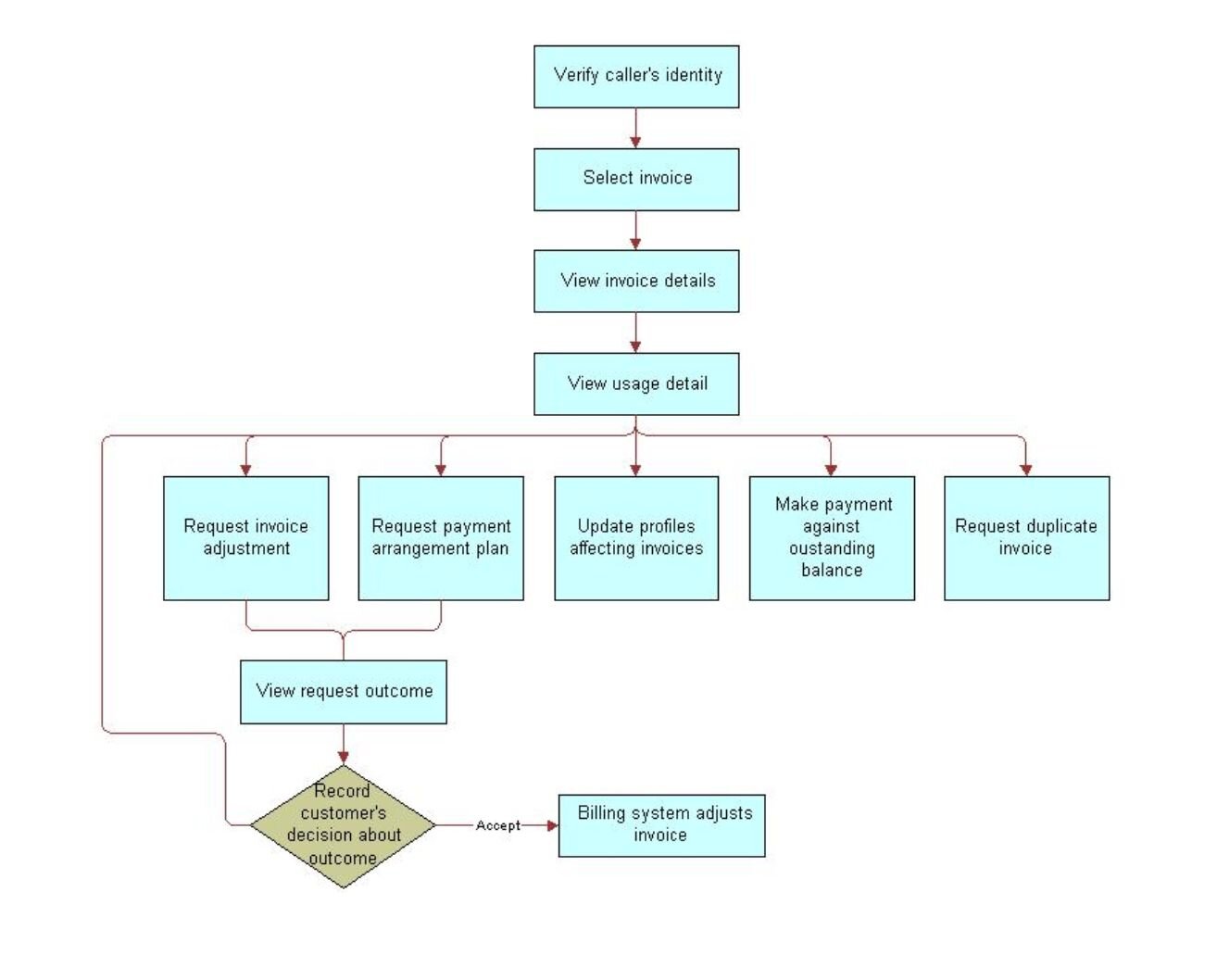
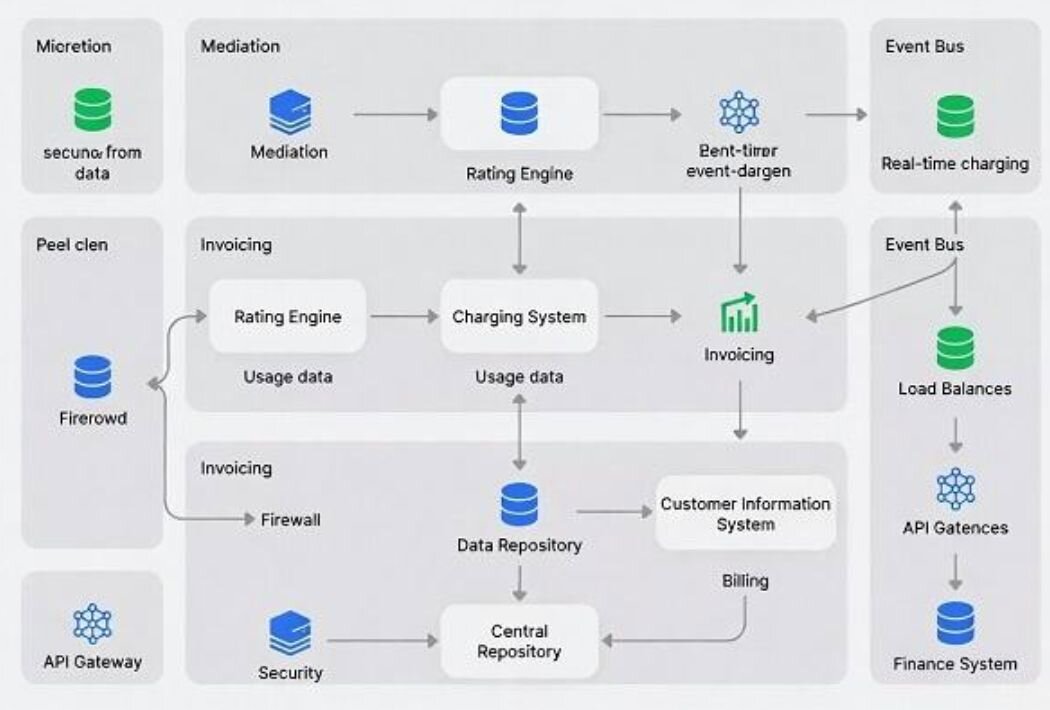
From a product perspective, the core issue is not just technical but it’s experiential. Customers expect real-time accuracy and clarity, but systems are designed for delayed processing and manual intervention.
Agentic AI: Redefining product intelligence in telecom billing
Agentic AI represents a shift from static automation to systems that can independently analyze, decide, and act.
In telecom billing, this means the system continuously evaluates usage patterns, pricing rules, and transaction flows to identify inconsistencies. For example, if a customer is charged incorrectly due to a misapplied promotion, the system can detect the issue immediately and recommend or apply a correction before the bill is finalized.
Over time, these AI agents learn from past interactions such as common dispute patterns or frequent billing errors and improve their ability to predict and prevent similar issues.
This transforms billing from a passive system into an active participant in customer experience and revenue assurance.
Building AI-driven billing platforms (from a product perspective):
Implementing Agentic Artificial Intelligence in telecom billing requires rethinking the entire product flow from data collection to decision-making and execution. For product managers, the focus shifts from managing isolated systems to designing connected customer and agent experiences.
Modern billing platforms should be designed around four core capabilities:
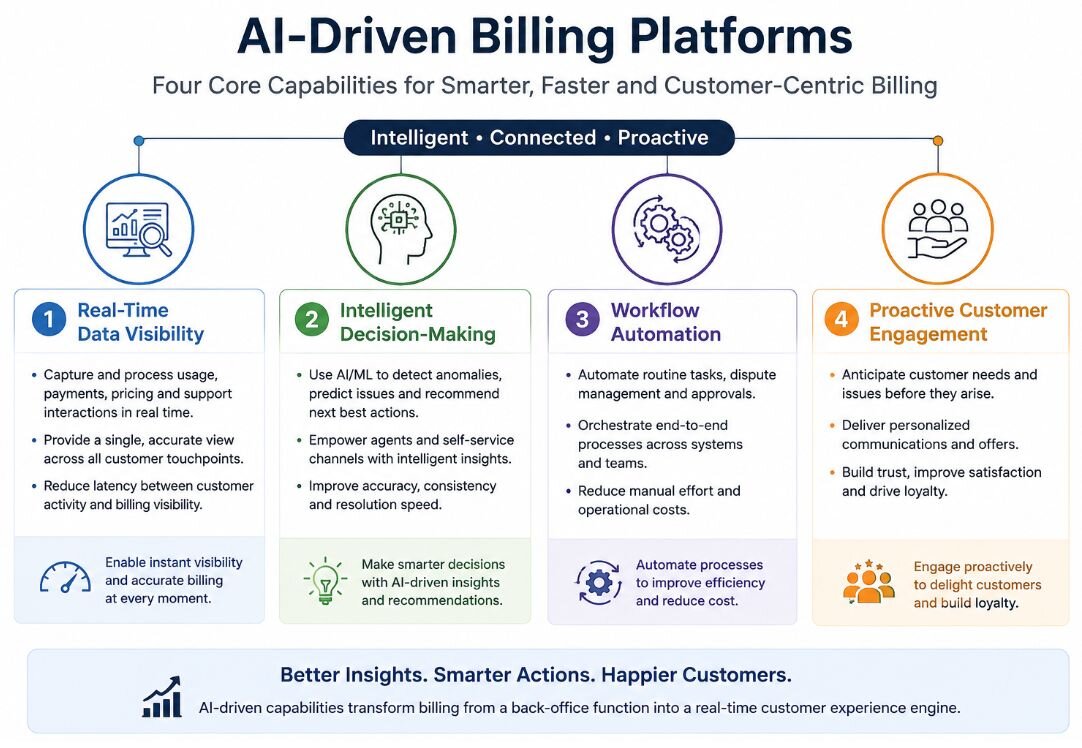
1. Real-time data visibility
Billing platforms must continuously capture and process customer usage, payment activity, pricing rules, and support interactions in real time. Product teams should prioritise platforms that reduce delays between customer activity and billing visibility.
2. Intelligent decision-making
Artificial Intelligence should proactively detect anomalies such as incorrect charges, failed promotions, duplicate billing events, or delayed usage processing. Instead of waiting for customers to report problems, the system should identify and recommend corrective actions automatically.
3. Workflow-driven execution
Insights alone do not improve customer experience. Billing, customer relationship management, and payment systems must work together so agents can execute actions such as credits, reversals, or billing corrections directly within the same workflow without relying on multiple backend teams.
4. Transparency and governance
Product managers must ensure that Artificial Intelligence-driven decisions remain explainable, auditable, and compliant. Agents and customers should clearly understand why a billing issue occurred, what action was taken, and how the resolution was determined.
From a product management perspective, success depends on how effectively these capabilities work together to create faster resolutions, simpler workflows, and more consistent customer experiences.
CRM as a product: Enabling intelligent agent decision-making
While backend intelligence is important, the real transformation happens inside the customer relationship management platform where agents interact with customers in real time. This is where billing data, Artificial Intelligence insights, and workflow automation come together to create measurable customer value.
From a product management perspective, the customer relationship management platform should not be treated only as a support tool. It should function as a core product experience layer where success is measured by how quickly and effectively agents can understand and resolve customer issues.
Instead of forcing agents to navigate multiple disconnected systems, an Artificial Intelligence-driven customer relationship management platform should provide:
- A pre-analyzed summary of the billing issue
- Root cause identification
- Impacted transactions and customer history
- Recommended next actions
- Real-time execution of billing corrections or refunds
- Clear customer-friendly explanations of the issue
This reduces agent effort, improves first-call resolution, and creates more consistent customer experiences.
Example: Artificial intelligence-assisted billing resolution
Consider a customer calling about an unexpectedly high roaming charge after international travel.
In a traditional support environment, the agent may need to manually review usage records, billing adjustments, payment systems, and promotion eligibility across multiple applications before identifying the issue. This process increases handling time and often results in escalations.
In an Artificial Intelligence-driven customer relationship management workflow, the system already identifies that the roaming package was incorrectly applied due to delayed usage synchronization. Before the agent even begins troubleshooting, the platform presents:
- The root cause of the issue
- A recommended billing correction
- The impacted billing transactions
- A suggested customer explanation
- A one-click option to apply the adjustment
The agent can resolve the issue during the same interaction while clearly explaining what happened to the customer. Over time, the system continuously learns from these interactions and improves future recommendations.
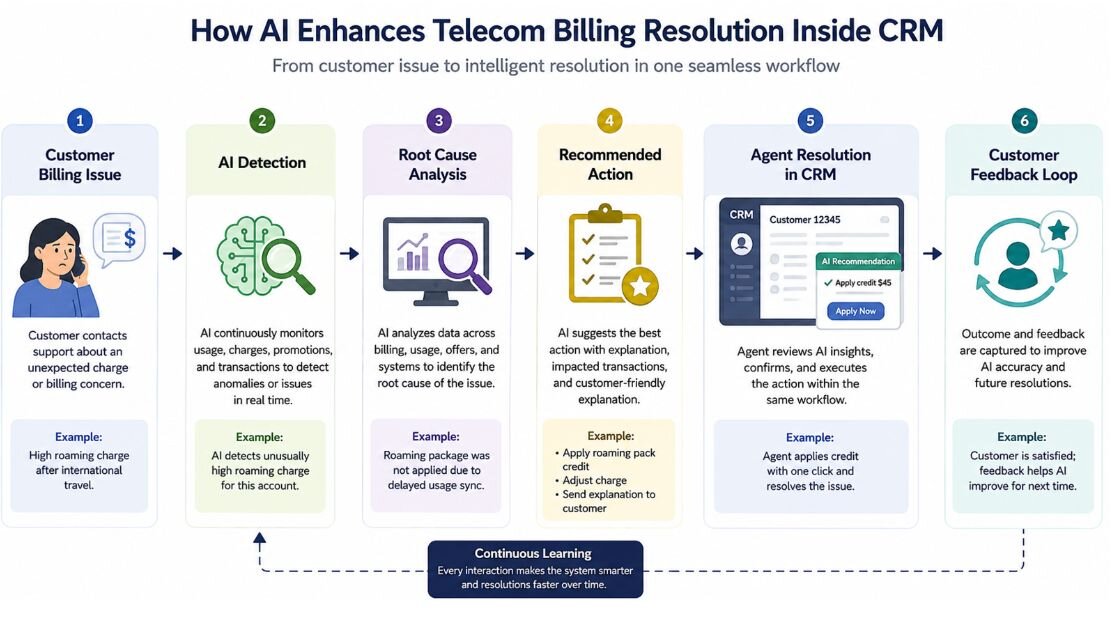
A typical AI-driven customer interaction looks very different from today’s experience.
When a customer reaches out about a billing issue, the CRM already understands the context whether it’s an unusually high charge or a delayed fee. Instead of starting from scratch, the agent is presented with a clear, pre-analyzed summary of what changed, why it happened, and what needs to be done. The system then guides the agent with recommended actions, which can be executed instantly within the same workflow, whether that’s applying a credit or correcting a charge. Just as importantly, the agent can explain the issue to the customer in simple, clear terms, building trust. Over time, every interaction feeds back into the system, continuously improving its accuracy and ability to resolve issues even faster in the future.
Real-World Application: Bringing billing intelligence into CRM
In a large telecom transformation program, the biggest product challenge was not only billing accuracy. It was the fragmented experience faced by customer care agents. Agents had to move between CRM, billing platforms, payment tools, and backend support processes to understand why a customer’s bill changed. This created long handling times, inconsistent explanations, and avoidable escalations.
One common example involved customers calling about unexpected charges, missing promotional discounts, payment reversals, or billing adjustments. Before the improved workflow, the agent often had to manually check invoice details, payment history, adjustment eligibility, promotion rules, and account notes across multiple systems. The customer experienced this as delay and uncertainty, even when the underlying issue was relatively simple.
The product improvement focused on bringing billing intelligence directly into the agent workflow. Instead of asking agents to investigate from scratch, the CRM experience was designed to surface a pre-analyzed billing summary, likely root cause, impacted transactions, recommended next action, and a customer-friendly explanation. For example, if a promotion was not applied correctly or a usage event was delayed, the agent could see the issue context and take action from the same workflow rather than waiting for a backend team.
The measurable goal was not simply to “deploy AI.” The goal was to reduce agent effort and improve resolution quality. In practical terms, this type of workflow can support roughly 20–30% improvement in handling efficiency for targeted billing scenarios, reduce repeat contacts, and improve first-call resolution because agents are no longer switching between disconnected tools. Even where exact production metrics vary by process and rollout phase, the observed product value was clear: faster diagnosis, clearer explanations, fewer handoffs, and more consistent customer outcomes.
This experience reinforced an important product lesson. Agentic AI creates value only when it is placed where decisions happen. In telecom billing, that decision point is often not the billing engine itself. It is the CRM screen where the agent decides what to explain, what to adjust, and how to restore customer trust.
Product management perspective:
From a product standpoint, the success of Agentic AI is not determined by how advanced the models are, but by how effectively they improve real-world workflows especially at the point of customer interaction.
In telecom billing, the real test of any solution is simple. Can an agent resolve the customer’s issue faster, with more clarity, and without switching systems?
Product managers should therefore judge Agentic AI not by model sophistication, but by whether it removes friction from the customer resolution journey.
If the answer is yes, the product is working. If not, even the most sophisticated AI models won’t deliver meaningful value.
From a product management perspective, these lessons translate into three key principles that help transform Agentic AI from a technology capability into a practical driver of customer experience and operational efficiency.
1. Design for workflows, not features
Customers don’t experience features they experience workflows. Instead of building isolated capabilities, product managers should focus on how quickly and seamlessly a problem moves from detection to resolution. The goal is to eliminate friction across the entire journey, not just optimize individual steps.
2. Make the agent experience a priority
In telecom billing, agents are the primary users of the system and they directly shape customer experience. A well-designed product should surface only what matters: what changed, why it changed, and what action to take. Less complexity, more clarity.
3. Embed AI into decision points
AI delivers value only when it’s part of real-time decision-making. Instead of sitting in dashboards or reports, it should guide actions directly within workflows, during issue diagnosis, resolution, and execution, helping agents act faster and with confidence.
4. Measure outcomes, not output
Shipping features is not success, improving outcomes is. Product managers should track metrics like first-call resolution, handling time, repeat calls, and customer satisfaction. If these don’t improve, the product isn’t working, regardless of how advanced the technology is.
5. Build continuous feedback loops
AI systems improve through real-world usage. Every interaction, agent decisions, customer outcomes, edge cases should feed back into the system to refine models and workflows. Treat the product as a living system that evolves over time.
Key takeaways:
The rise of Agentic Artificial Intelligence is transforming telecom billing from a backend operational process into a real-time customer experience product. For product managers, this shift requires rethinking how billing platforms are designed, measured, and continuously improved.
Product managers should consider the following six principles when building intelligent, customer-centric billing platforms.
Move from reactive to proactive operations
Modern billing platforms should proactively detect billing issues, recommend corrective actions, and reduce customer impact before disputes occur.
Design around workflows
Customers experience end-to-end workflows, not individual systems. Product managers should focus on creating connected experiences that move seamlessly from issue detection to resolution.
Embed artificial intelligence into real-time decisions
Artificial Intelligence delivers the most value when it guides agents directly within customer relationship management workflows through recommendations, explanations, and automated actions.
Measure outcomes that matter
Success should be measured through business and customer outcomes such as:
- First-call resolution
- Average handling time
- Billing accuracy
- Customer satisfaction and trust
Build continuous learning systems
Every customer interaction and resolution should improve future recommendations, workflow efficiency, and decision accuracy over time.
Make billing a trust-building experience
When implemented effectively, Artificial Intelligence transforms billing from a customer pain point into a transparent and intelligent customer experience.
