
Last week over 500 product people came together for our flagship US conference, Mind the Product Chicago. It was a day filled with amazing content, opportunities to vent network with fellow product people, and learn from the best in class from the keynote stage.
There was A LOT of content, but fear not, if you missed a talk, or didn't get an opportunity to jot a key quote or example from a keynote talk down, below you can find our notes from all of the keynote talks this year. In the coming weeks, there will be detailed write-ups and videos for each session. Be sure to subscribe to our Prioritised newsletter so you don't miss out when each video drops.
Thank you to all attendees, volunteers, and speakers who made this event special! We'll see you next year:
Advanced Positioning in the Age of AI
Speaker: April Dunford, Founder, Ambient Strategy
Positioning 101
Everything we do in marketing and sales is propped up on a foundation of positioning.
What positioning is
Positioning defines how your product is the best in the world at providing some value that a well-defined set of customers cares a lot about
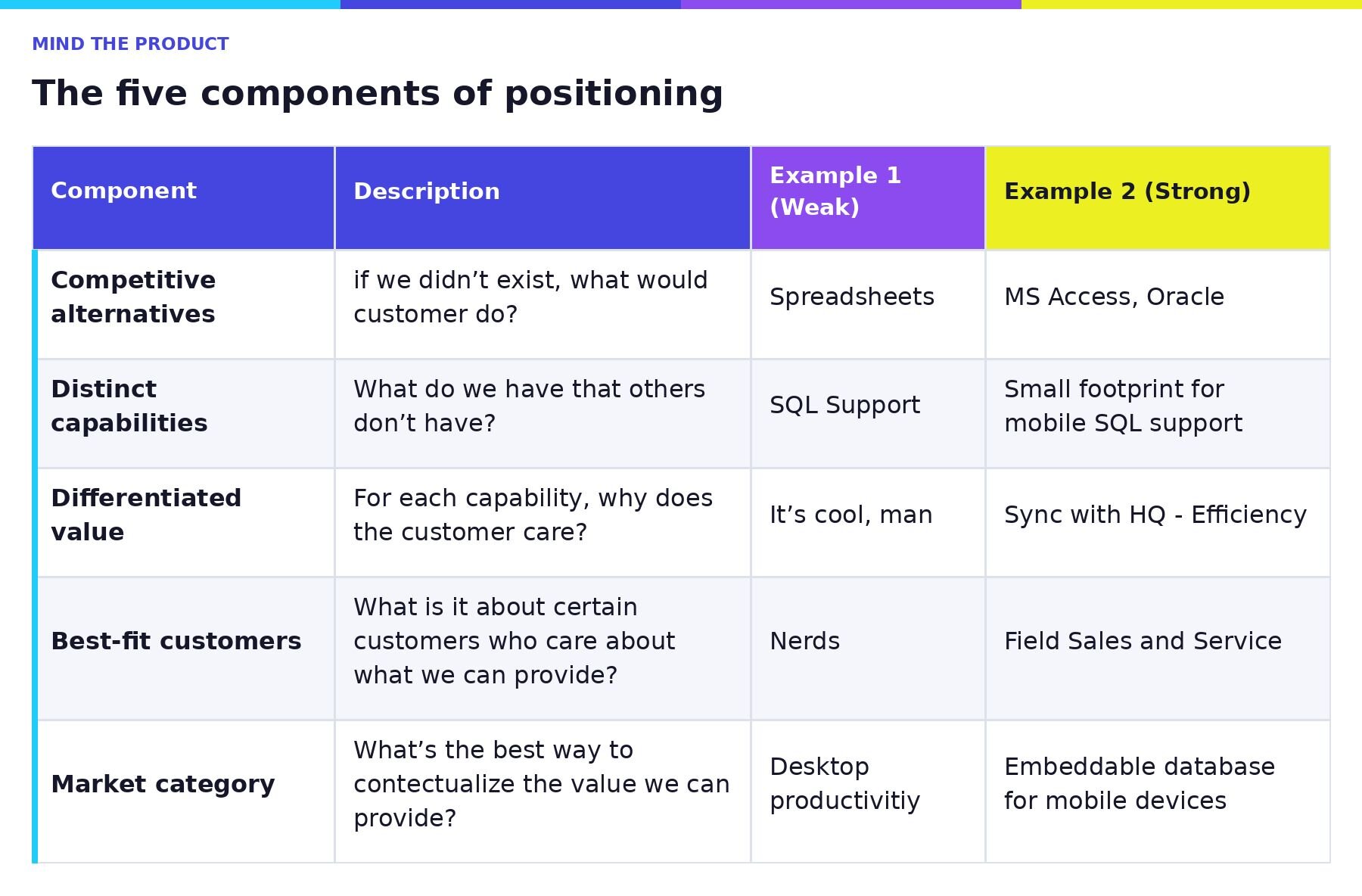
Examples were for a desktop productivity software that was a spreadsheet that ran SQL.
Example 2 comes from talking with a few of the limited number of customers who purchased it. And used that information to revise the positioning.
Example 1: 6 months 200 copies
Example 2: 1 sales person in first week, sold 3000 seats.
Does AI change everything?
Good news: AI does not change the fundamentals of positioning
Still have to position against customers, still have to differentiate against customers, still have to find best fit customers.
Bad news: There are new ways to mess it up
Rapid Change = Noisy signals
It’s hard to know what to position against
Example: What do we position against? Head of product said vibe coding, Another product leader said: Claude VP of sales said all the customers mention Excel they don’t mention claude or vibe coding. Head of Product said “Not yet”
The question comes down to do you compete against today’s competitors (Excel) or tomorrow’s competitors (Claude, Vibe coding)
Positioning evolves over time. Competitors today may not look like competitors tomorrow.
Even though your product strategy looks at the future, be careful what you talk about externally. So you need to Position for today, build for tomorrow.
Sell against today's alternatives
Today's alternatives: spreadsheets, legacy apps, manual work (vs. a vibe-coding future)
Think about what would the customer would do, not what they should do.
Respect where the customer is on their own journey
Customer maturity varies, so you need to Position your value at each stage and segment by customer maturity
Understand where your customers are on a maturity model and decide which ones you want to sell to, and which ones you want to ignore.
Example
An AI maturity model may be:
Model flows -> Agentic “Easy” -> Agentic Step 2 -> Some Orchestration -> Full Orchestration
You may find that most of your customers are at the Agentic “Easy” stage so you decide to focus on that stage and not sell to customers at the Model flows stage
Rapid Change = You need a market point of view
Is your market category going extinct? You need to have a thesis about what the market looks like in the future.
Point-of-view examples
OpenAI (Sam Altman): intelligence as a utility, bought on a meter like electricity or water.
Note: OpenAI operates primarily as a B2C business.
Anthropic (Dario Amodei): AI writes 100% of code; people specify conditions, design decisions and collaboration rules; AI acts like a smart employee who asks for clarification
Note: Anthropic operates primarily as a B2B company
Microsoft (Satya Nadella): models are becoming a commodity; context engineering is the differentiator The performance of an AI app depends on how well data is brought into context.
Note: Microsoft owns most sources of context (Word, excel, etc)
Replit (Amjad Masad): agents generate the exact tools people need on the fly, replacing expensive SaaS suites
Note: Replit is a vibe coding tool.
Salesforce (Marc Benioff): value is in the platform that encodes the business, not the UI; everyone gets their own on-the-fly UI inside tools like Slack, Claude, and Coworker
Note: This reflects Salesforce’s recent attempt to avoid “SaaSpocolypse by introducing headless Salesforce and placing emphasis on the platform.
Do you have a vision of the whole market that says what it looks like in the future.
Customer understanding has never been so important
Practices
- Executive-customer “sponsorship” Low key customer advisory board where the executive team gets asigned customers who they call once a quarter and find out what they’re up to.
- Systematized win/loss analysis, (especially the wins) Make win analysis step one after signing the contract. Include three questions about AI.
- Quarterly positioning check-in After doing the positioning workshop do a quarterly check in where you get sales, product, and marketing in a room and talk about what’s changed. If anything has changed, you may need to revise your positioning. If you’re not using a process for your positioning, you’re going to experience a lot of chaos with positioning - positioning via vibes.
Four key takeaways
- Sell against today's competitors, prepare for tomorrow's
- Understand the customer's maturity
- You need a market point of view
- Operationalize customer understanding
For More Information
Welcome to the Software Renaissance. Your Strategy Isn't Ready.
Martin Eriksson, Author, The Decision Stack
AI stole your strategy
Doomscrolling in the morning, then a client office full of people coding in Claude, an AI roadmap on the wall, and a board meeting that is all about AI
Every headline, every roadmap and every board question is a prediction (the "platform trap") Except we are terrible at predicting the future.
Radiologists and the Jevons paradox
Geoffrey Hinton, 2016 (Machine Learning and Market for Intelligence Conference): "We should stop training radiologists now"; he expected AI to replace them within 5-10 years
Hinton is the "Godfather of Deep Learning" and later won the Nobel Prize
Ten years on, what happened?
AI got very good at diagnostic imaging: about 50% faster and about 10-30x more accurate
That drove down the cost of tests but massively increased the number of tests: preventive screening at scale, more scans, more findings, more follow-up
Result in the US: 16% more radiologists, earning 44% more on average; "a renaissance in medical imaging"
The Jevons paradox
1865: economist William Stanley Jevons noticed coal use rose after Watt's steam engine made coal far more efficient
When you make something cheaper and more efficient, you do vastly more of it, not the same amount for less money
How a Nobel laureate got the future wrong
Hinton got the future wrong becuase he assumed that demand for medical imaging was finite.
AI just broke at least one assumption you've made. Do you know which one?
The Decision Stack
The five questions form the Decision Stack
- Vision: Where are we going?
- Strategy: How are we getting there?
- Objectives: What matters now?
- Opportunities: What actions do we take?
- Principles: How do we choose between actions?
Read downward as "How?" and upward as "Why?"
Each layer is a decision about what you will do and, just as importantly, what you will not do
Most organizations have a haystack of disconnected decisions (an old vision poster, a strategy in a slide deck, OKRs in a spreadsheet), and then add an "AI strategy" to the confusion
Every layer sits on assumptions
Vision: the future we describe is worth building
Strategy: this is how we win
Objectives: they measure the right outcome
Opportunities: these are the best way to solve the customer problem
Trade-offs: these are the best way to achieve our goals
AI has pulled one of these assumptions and broken your stack; do you know which one?
Why it broke now
The ground is moving fast. Today's AI is the worst AI you will ever work with
Adoption is faster than any consumer technology before it and Model costs are dropping about 10x year on year (your bill still rises because you use so much more)
The Gmail precedent
Gmail launched in 2004 with 1GB of free storage when rivals offered 2-4MB (many thought it was an April Fools' joke). Storage was about $12/GB in 2000, about $1 by 2004, under a penny today; Google bet on the future cost, not the cost of the day
Big assumptions to question
What if
- models become commodities
- the cost of a token goes to zero
- the cost of software goes to zero?
But what if models become moats, or token cost goes up 10x? (Zero-cost tokens depend on energy, chips and data centre costs)
Looking at the wrong level
Most companies only look at the opportunities layer and sprinkle AI everywhere ("AI-powered" on every product and pitch deck)
Hidden assumption: the customer's problem is a lack of AI
We're in a tech bubble
Of 8.1 billion people (as of February 2026): 84% have never used Gen AI, 16% have tried free bots, 0.3% have paid for Gen AI, 0.04% have tried Gen AI coding
Many people don't want AI: a Washington State University study found "artificial intelligence" in product descriptions reduces purchase intent
April Dunford: customers don't buy AI, they buy the elimination of a pain point
Case study: Chegg
Before AI: students Googled homework problems, found a Chegg article and paid monthly for answers; near monopoly on homework help
May 2023, CEO Dan Rosensweig: no noticeable ChatGPT impact so far; the response was CheggMate, built with OpenAI
Their assumptions: students will keep paying for answers, and CheggMate can provide better answers; they never examined whether students would continue to pay for homework ansers, which sat higher in the stack (strategy)
Stock dropped by half on the earnings call; revenue is down 75% from pre-AI highs; subscriber reporting stopped after 2024; NYSE delisting notice in July
They never asked which assumption changed: customers wanted their homework done, not Chegg and not AI
Anti-pattern 2: AI as cost-cutting (the Objectives layer)
The same assumption Hinton made
AI as cost cutting assumes demand and value are finite
The question "How do we use AI to do what we already do, cheaper?" uses a once-in-a-generation technology to shrink yourself
Thought experiment: if engineering woke up 10x more productive ten years ago, would you fire 90% of them or build 10x more?
Case study: IKEA
AI customer service resolved about 50% of tickets automatically; the obvious move was to lay off that 50%
IKEA looked at the remaining tickets and found they were design questions
Their assumption "customers only have support problems" didn't hold, but their strategy did; they retrained the helpdesk as remote interior designers
Chief People & Culture Officer Ulrika Biesert: people have been at the heart of IKEA for over 80 years and will stay there
Same humans, $1.4 billion in new revenue in the first year
AI is the biggest growth lever a business has ever had; treating it as a cost lever is a failure of imagination
Treat AI as a multiplier
Stop treating AI as a feature, stop treating it as efficiency, start treating it as a multiplier by going up the stack and rethinking strategy
Rita Gunther McGrath: in a fast-moving world strategy is more critical than ever because organizations have to make many more decisions
Anti-pattern 3: "Everyone will build their own software" (the Strategy layer)
Assumption: if the cost of software goes to zero, everyone builds their own; this comes from the builders' tech bubble
32% of enterprises are building their own software to replace at least one SaaS product (McKinsey State of AI 2026)
66% of internal builds fail to achieve their aims (MIT NANDA)
Enterprise software spend is still growing 15% from 2025 to 2026 (Gartner)
Most of the world doesn’t want to build software, they want to do the thing software enables, not build software (restaurant manager, accountant, estate agent, gym owner); even Anthropic still uses Slack, Workday and Figma
Case study: Intercom (now Fin)
2022: growth had plateaued, then ChatGPT shows up
Des Traynor: much of the product assumed humans sat in seats talking to customers when AI happened it became very clear that was not going to be true anymore.
Assumptions tested: people are how businesses do support (broken), helpdesk teams want AI features (no point), more support means more seats and ARR (broken), businesses want customers supported (holds)
ChatGPT dropped on a Thursday; by Monday they had scrapped the roadmap and gone all-in on AI
Built Fin, an AI agent resolving over a million tickets a week
Business model shift from per-seat to $0.99 per resolution: better resolution now means more revenue, so the product has to work
Fin passed $100M+ ARR in under a year; the whole company was renamed Fin
Valuation: $1.3 billion in 2018, acquired by Salesforce in 2026 for $3.6 billion; "So much for the SaaSpocalypse"
How far up the stack to go
Chegg went up zero levels
IKEA went up to strategy and found it held.
Intercom went all the way to vision, found it held, and rebuilt everything under it.
They went up until one held
How to find your assumption
Name your assumptions
IBM manual, 1979: a computer must never make a management decision; every layer is a decision and every decision (and assumption) needs someone accountable
Use Roger Martin's "What would have to be true?" to identify assumptions across the whole stack
Go up until you find the assumption that holds, then rebuild from there
Questions to start asking
Can we solve the customer problem in a completely new way (not incrementally better, fundamentally different)?
Are we still measuring the right thing (e.g., does MAU mean anything as users interact via an MCP server)?
Can our business model change completely (what does outcome-based look like in your world)?
What demand is currently locked up that AI could unlock (the Jevons question: what would customers do with your product if it were 10x cheaper, faster, more accessible)?
What can we now build that was impossible before?
Testing assumptions when the future has no data
We test assumptions well, but at one level
Product and design superpowers: research, customer interviews, prototypes, fake door tests
We obsessively test cheap decisions and pass five-year strategies on vibes
It’s time to take product superpowers up the stack. Catch: every opportunity test runs on existing data, and the future has none yet (you can't A/B test 2028)
Plan for multiple futures
A strategy that assumes one future is fragile
Plan for both token scenarios (tokens go to zero vs. tokens go up 10x)
Ask which assumptions survive different futures: "students will keep paying for answers" survives neither; "businesses will pay to resolve customer service problems" survives both
Then make a bet
Test as manty assumptions as you can, and then be comfortable moving ahead at about 70% confidence
Annie Duke, Thinking in Bets: offering a wager brings the risk out in the open, making explicit what is already implicit
Write down what would prove you wrong (kill criteria): Intercom's was resolution rate, IKEA's was revenue generated, Google's was the price of storage
Your future
Do you know which one? You will tomorrow, because tomorrow you'll go and find it
Sentence to say out loud: "I'm hearing something that contradicts our assumption about X"
We are terrible at predicting the future, and the Martin’s own talk is full of predictions
Margaret Heffernan: just because we can't predict the future doesn't mean we can't prepare for it
We're in the "DOS prompt era" of AI; at Xerox PARC, Adele Goldberg and Alan Kay challenged the assumption that computers are things you type commands into and invented the graphical interface and mouse. Alan Kay: "The best way to predict the future is to invent it"
Hinton's assumption gave radiologists 5 years; instead they got a renaissance. What will you do with yours?
For More Information
The Decision Stack: first two chapters free via thedecisionstack.kit.com/free-chapters
The PM job when building is free
Eric Simons, CEO, Bolt.new
Serial entrepreneur. Didn’t initially know what a product manager did.
Launched Bolt two years. Bolt was the first vibe coding product to hit the market. 0 to 20 Million ARR in a couple months.
Originally though it would mostly be developers using it, but found out it was mostly non developers and a lot of PMs.
As a result he talked to alot of PMs and found out they do what he did: build products.
Eric’s view of what PMs do: Talk to the customers, figure out amazing things to ship to customers. But they had crude tools to make that happen.
Julien Menard: CTO, Digital Virgo “I’m not able to take a code editor and write two lines of code.”
Before: 1 Year; 4-5 developers; 50 separate systems
After: 3-4 months, 1 architect, 1 system
A rationing protocol (how it used to be)
The product development process as described by Mary Cagan in Inspired was a way to account for the expense of developing software
Research -> Spec -> prioritise -> Hand off -> Wait -> Ship
Every step exists because engineering time was the most expensive thing in the building.
Get stoked on your idea, spend a lot of time (and money) building, get it out there and no one wanted.
AI changed that…
PMs using Bolt
38% bring in engineering earlier. The show a working prototype instead of a spec.
30% bring in engineering later. They validate the idea on their own first
First Transition: Spec-writer -> builder
What you bring into the room changes from a spec to a prototype.
Every spec is a translation. Every translation loses something.
People often don’t understand an idea as proposoed or even conveyed in a wireframe. You have to be able to try it.
Second Transition: Backlog gatekeeper -> loop-closer
What happens to an insight.
The disciplines are medling. Talking to the customers should not just be the responsibility of the PM.
The new format of a team with a melded team:
- 1 product person, no tech skills
- 1 web architect
- 1 native arcitect
The job of the PM is someone who is helping facilitate the melding of roles.
Transition 3: Execution -> context
The one that scares people.
Ideas can be stolen. But no one can steal your context. Ideas are cheap, execution is what matters.
It’s not about having a golden idea. It’s all about the conversations you have with your customers, the problem they have, the unique insights you generate based on those conversations is what’s important.
Example (owner of a logistics company)
70k a year +20K per year for API access + a specialist to run it for logistics back end
“A lot of time those people that are building that software really aren’t out there in the real world, working with these customers and working with these workflows, where we are.”
Paul Laviolette Founder, TradeWeave
Summing it Up
That’s the whole job. It always was. Now you can prove it.
What it takes to be a great PM is what it takes to build a business; Talking to customers and understanding their painpoints.
Vibe coding and AI code gen allows you to spend more time talking to customers.
Build AI Products as Systems of Trust
Alexis Zheng, Chief Product and Technology Officer, G2
Alexis walked through her career to explain how the PM job evolved with AI
Trust is the last mile of AI adoption
Legacy software vs. AI-first software
2010s: Big Data:
A massive amount of data plus a powerful neural network is the thesis behind LLMs; with more data and powerful models, the model can generalize beyond observed patterns
2020s: Big Compute:
Alexis thought she had found a mission to help enterprise customers adopt AI, then found people were running CPU workloads on expensive GPUs
2026: Trust
This revealed another gap in enterprise AI adoption that data and compute alone could not solve: trust
The economics of modern AI
The hot take: intelligence is the commodity, and tokens are the currency
Data = number of input tokens ("The internet")
Compute = number of output tokens per dollar per watt ("AI factory")
Trust = $ value per output token ("Evaluations")
Compute turns electricity into intelligence, and models get predictably better with more compute
With compute a constraint, every AI system constantly asks which tokens are worth spending compute on
Trust drives adoption and unlocks the value of tokens: new technology only pays off with intense, everyday use.
As intelligence gets cheaper and more abundant, value shifts to outputs you trust enough to act on
Token flow
An AI ecosystem is forming, organized around wherever the tokens are going; wherever tokens flow, applications eventually get built
"A chip company bought the distribution. A payments company bought the toll booth. A rocket company bought the boats."
The Powerhouse: agentic apps
The Current: NVIDIA
The Pipes: Hugging Face
The Toll: Stripe to OpenRouter
The Boats: SpaceX to Cursor
The Harbour: the trust layer
There is a race to own the token flow
Prompt -> Code -> Build -> Skills -> Trust
Prompt: about 4.5B prompts a day, about 300T tokens
Code: about 16M agent-involved PRs a month
Build: 1M new apps a week; new apps more than doubled while the average app rating went down
Skills: 110,814; access to more skills does not improve agent performance
Trust: 4.4M LLM citations a month on software questions
Multi-hundred-billion-dollar markets are converging on the same stack, with the token flow at the center; discovery becomes the bottleneck, and agents need trust signals for the same reason buyers do
What is trust?
When cars first came out, people still had horses in front of them because the cars would over break down.
The car = the AI system; the horse = humans in the loop; the engine = the models
Trust isn't about blind faith, it's about clear boundaries: knowing when to rely on the system and when a human still needs to step in
Closing trust gaps is key to adoption
Trust does not equal total autonomy
Five levels:
- Level 1 persistent human in the loop 16%
- Level 2 limited autonomy 29%
- Level 3 autonomy with guardrails 48%
- Level 4 total autonomy 7%
- Level 5 agents self-organize and deploy (coming online by 2030)
60% of software buyers use AI in the purchase process but only 9% trust the agent's decisions
45% see productivity gains consumed by oversight and rework of agents
Without trust, models get smarter but the adoption curve stays flat, and the gap between agent capability and enterprise adoption costs businesses billions of dollars which becomes the economic value of trust
Product manager market fit in the age of AI
The last generation of product leaders was trained on web and mobile craft (growth accounting, mobile-first experiences, owning an app icon on the home screen).
Every PM is an AI product manager
The user experience is the tip; deep learning broke the interface
The system underneath: models are at the centre of every application now, but the model is not the product; the product is the intelligent system you build around it
Users don't click through screens any more; they ask, or their agent uses the software for them. "If you were trained to design a product screen by screen, the job has changed."
The new product craft is designing the system.
Four design jobs
Design the system: Uber's marketplace
Uber's marketplace was an AI system a decade before agents existed
- Detect (supply and demand by block)
- Predict (conversion at this price)
- Route (network optimization)
- Act (rider and driver incentives)
You don't design the outcome. You design the system so the outcome emerges.
The PM job: the most successful product managers become the ones who can design intelligent systems with AI at the center
Design the harness: self-driving cars
Self-driving cars are agentic systems in the real world
- Perception (sensor fusion)
- Prediction (future trajectories)
- Planning (the corresponding trajectory)
- Controls (control the actuators)
Designing the harness (fault tolerance at scale): high recall, NPC reactivity, epistemic uncertainty, end-to-end latency
An agent can now reason over and control more of a system's schema, so PMs design at a higher level of abstraction.
You cannot fix a probabilistic system one failure at a time. You design the harness that keeps it safe while it's wrong.
The PM job: shift from designing every screen to building the harness that lets an agent act on the system safely, without being shown where anything is
Design the learning loop
The PM job: build the system that writes its own roadmap, and design the learning loop so the system improves continuously at scale
Continuous learning loop:
- Drive (the fleet runs, rare events arrive on their own);
- Mine (keep only the moments where prediction and reality diverged);
- Retrain (the model retrains on collected samples with no humans in the loop);
- Iterate (retrain, then gate: it ships only if it beats what it replaces)
Roadmaps used to be the bane of product existence; instead you can create a system that creates its own roadmap and iterates continuously. "The moat is the accumulated learning from every real-world encounter." Creating products is now creating loops
The catch: the autonomous loop is only as good as the verifier at each step
The PM Job: Build the system that writes its own roadmap, and designing the learning loop so your system improves continuously at scale.
Design the trust layer
"What can be verified can be automated" (Andrej Karpathy); the bottleneck is no longer model architecture, it is experience and evaluation at scale
- One scene, infinite variants: parameterise a real moment and generate thousands of versions of it with one click
- Every real failure becomes a test: anything that went wrong once is in the suite forever
- Fast enough to run on every change: if the suite takes a day, nobody runs it; cheap tests get run
- Accelerate evaluation and learning at scale: millions of miles of complexity before the first real mile
A simulator both verifies performance and accelerates learning; every buyer is asking "why should I trust you to automate my workflow", so the PM's job is to design a system that earns that trust. This is the thinking behind what G2 is building
The PM job: design how the system earns trust (what gets verified, where it gets verified, and what it takes to ship)
G2's agent evaluation systems
We built a simulated company with ground truth drawn from real enterprise operations
The question is "what if your agent could try every piece of software on your behalf, and pick the one that actually fits?"
Built agent evals with simulated companies. The simulated company has support, sales, legal and finance, each with its own data, policies and tools. Tasks and ground truth come from real enterprise operations
An agent is handed the work, every interaction is captured as a trace, and it is graded against a set of predefined rubrics, so a buyer can see how an agent behaves, whether it follows policy, and what it breaks when nobody is watching.
The most valuable skill set today: building at the frontier
There’s a new class of company, agent-native and built completely headless for the agentic age (G2 AI CX Agent Evaluations leaderboard, 9 agents)
More of us are building at the frontier: "A huge amount of software will be rewritten." (Andrej Karpathy)
Headless, agent-first experiences disrupt what we used to think software was.
The idea: stop making people use software and let agents use it for them. Established leaders are innovating too
The prize: when you ship a product that would not otherwise exist, you ship a better version of yourself
The what, the how, the proof
Product Manager Market Fit
The job used to be defining the what and figuring out the how along the way, and agents are taking the how.
Much software is now built, maintained and iterated on by agents, so PMs design at a much higher level of abstraction: the system, the harness and the loop
With agents increasingly making decisions for us, trust matters more than ever, and the last mile for every product is the proof
Spinning Up Is Easy. Shipping What's Right Is Hard Awesome.
Kathy Pham, Faculty and Senior Fellow, Product and Society, Harvard University
AI has collapsed the cost and time of much of the software and product development cycle: more code, design, prototypes, metrics, even fake test users
The hard part was never "could we build." It’s what is worth shipping, for whom, and why, and why interdisciplinary product craft matters more than ever
How much privacy will people give up for convenience?
Twenty years ago Kathy was at a large tech company working on search and health products. At that time, leading researchers talked about protecting privacy and how much of it people would trade for convenience.
Twenty years later, it's the same question.
When people give us their private information, how do we take care of it? We have to reject the “Kermit attitude” (what happens to their privacy is none of my business).
When people are willing to give up so much of their private information, it comes with great responsibility for product builders.
Examples of what we do with people’s trust
- Defense: C-130 flight simulation
- Big tech: Google Search, Google Health
- Government: U.S. Digital Service, VA health records, FTC, National AI Advisory Committee
- Nonprofit: Responsible Computing at Mozilla
- Academia: product management at Harvard
- Health startup (now): AI at Revive Health
The right pace depends on the people and the context: in government and legacy systems, move faster and bring in more technology, responsibly; in the private sector, pace yourself, sometimes
What does building the right thing mean?
- Will people use it?
- Is there market fit?
- Is it right, for people and for society?
Kim Goodwin, "How Can We Build Human-Centred Products", Mind the Product London 2018
You need to find things that are right for people, and also right for society.
Integrating ethics into the product development lifecycle was an important message at Mind The Product San Fransisco in 2019. It’s more important than ever, especially with the tools and capabilities available today.
Faster to build, faster to skip the hard questions
Then (3 years ago): multiple sprint cycles.
Now: hours or minutes
What used to take multiple sprint cycles can now take hours ot minutes. That makes ethics and responsibility easier to skip, which means you can built the wrong thing faster.
The era of fast and more
AI collapses the cost of creation: more code, designs, prototypes, metrics, and synthetic users to test against. It overwhelms the product and software cycle with more, but not necessarily right.
Everyone on the team can spin up a prototype now, but a prototype for everybody is not the same as the right thing for anybody
Any tooling that makes building the right thing cheaper makes building the wrong thing cheaper, too."
"We have seen this with agile done poorly: we can sprint our way to the wrong thing."
-Melissa Perri, "Escaping the Build Trap", Mind the Product San Francisco 2017
Historical context
Every era brought more capability: internet, personal computers, mobile, social media, cloud; now AI, with agents and loops
Every era came with a hype cycle. Capability has never been judgment. It never solved for what we should build
Shift in technology and society at the right time, and we must keep iterating on what's right for society
- 2000 links and portals (Yahoo’s link farm)
- 2002 the one-box front page (Google)
- 2022 still one box, twenty years on
- 2023 the chat interface (ChatGPT)
Timing is not the same as being right. The verdict is still out on whether ChatGPT is good for society.
We are empowered by tools. Needed more than ever to:
1 Solve the right problem
Keep laser focus on what people need or want and help the team get there; navigate the organizational pull to ship just because it's technically possible.
-Teresa Torres, "Critical Thinking for Product Teams", Mind the Product London 2017
Use AI to look backward, too. also look at the products nobody uses. What people don't use shows where we missed; AI can surface it. Example: electronic health records.
2 Make evals the new acceptance criteria
Do evals right: the right tools, and the right human domain expertise for guardrails
Turn ambiguous concepts like "responsible" and "reliable" into measurable, rigorous evaluation frameworks
Ask: "Is this right, for these people, in this context?" That judgement lives at the intersection of: anthropology, computer science, critical race and gender studies, data science, design, economics, engineering, history, human rights, law, lived experience, philosophy, policy, political science, science, technology and society studies, sociology
You don’t have to do it all yourself. Be willing to reach out to other areas to help you determine if the output of your product is right.
Product managers are the connective tissue that translates it into what is built. Honor all expertise
"What's right fills the gaps." Models learn from what already exists
3 Treat trust as a feature
No product is an island. Understand it end to end.
-Don Norman, Systems Thinking: A Product Is More Than the Product, 2009
Uunderstand everything the product connects to and depends on, because that is where trust is kept or lost; embed user trust and AI governance into the product lifecycle from day zero
4 Orchestrate the shift
Create new product and software lifecycles, redefine roles, and rethink how teams connect to turn ideas into shipped products.
Apply the "influencing without authority" muscle to manage agents while guiding cross-functional teams of designers, engineers and domain experts through the paradigm shift.
Phone a friend
Be the phone-a-friend, and have your own.
Refernece: Who Wants to Be a Millionaire. That's the PM, and our rolodex
Be the phone-a-friend: know the product, the users and the domain well enough that anyone on the team can call you for a fast, trusted, opinionated answer
Have your own: the engineer, the clinician, the designer, the community member
-Tricia Wang, "You Don't Own the Voice of the Customer", Mind the Product San Francisco 2019
The hard question was never "can we build it?"
The hard questions:
- Should we?
- Is it right for the right communities?
- What do we do if it isn't?
PMs are key here and well positioned to answer these questions for their teams
Product managers make the quick decisions across every part of the business. AI speeds up the making. The deciding is still ours.
We all already have the muscle
Manage without authority, and adjust to team needs
Bring in the right people and honor their expertise
Bring AI in at the right time
Understand the landscape you build in
Pay attention to every part of the lifecycle; shipping is just one part
Four things to take back to your team
- Solve the right problem: resist the pull to ship just because it is technically possible
- Make evals our acceptance criteria: turn "responsible" and "reliable" into something we can measure
- Treat trust as a feature: build user trust and AI governance in from day zero
- Orchestrate the shift: lead agents and teams the way we always have, through influence without authority
We know how to do this. Product managers are needed now more than ever. Let's build the right thing.
The Product Purity Trap
Emily Andrews, VP of Global Product Management, McDonald's
A lot of product leaders are still debating:
- Where should product sit
- What should product be accountable for?
- Who has the final call?
The principles of great product are compelling, but applying them inside a large, complex organization is messy
This talk is about creating impact when Product does not have the textbook conditions
The problem:
Everyone brought a truth, no one could make the decision. Several functions debate priority, each with useful information and real accountability.
- Product has customer evidence
- Marketing has the growth commitment
- Operations sees execution risk
- Engineering sees tech feasibility and what scales
The conflict is different forms of truth competing for the same decision, not smart people versus difficult stakeholders
One approach: build a RACI
Clearer letters, not a better decision
A RACI clarifies accountability but asks a governance tool to solve a culture and trust problem
Governance can clarify accountability; it cannot manufacture shared context, judgment or trust.
The exercise of the RACI hurt morale. It wasn’t practical for the situation.
Sacred Cow 1: Product should own prioritization
What if owning the decision is creating the fight?
Respect the intent behind empowered teams, but challenge the identity built around ownership
When Product treats ownership as territory, disagreement becomes a test of whether Product is doing "real Product."
That moment is the product purity trap. Don’t get stuck on this is what it’s supposed to be.
The shift: from decision owner to decision architect
Decision owners choose; decision architects create the conditions for a good choice.
Product brings customer evidence, makes tradeoffs explicit, connects economics and strategy, and defines how success is measured
The job is not to win every decision, it is to prevent an uninformed one
This is where business partners begin seeking product input and trust is built
Sacred Cow 2: Product should be the voice of the customer
What if product’s real value is translating between voices?
Product makes the whole decision visible: Customer truth, business reality, technology possibility and connects the three into one coherent choice.
This is where deep business understanding matters: how the company grows, what it costs to operate, where risk sits, what leaders are accountable for.
Product’s value is not owning one perspective. It is connecting all three.
Sacred Cow #3: "Clear decision rights solve organizational friction"
What if clarity is not enough without trust?
Decision rights matter, but they can’t make people believe in the judgment behind a decision.
A RACI can say who decides but can’t create confidence in the decision. And it can’t solve the culture or trust problem.
When trust is low, organizations compensate with more process
Trust is the operating model beneath the operating model. Results in fewer slides, less defending, more trust
Example: Emily arrived with the right data and recommendation, but leaders did not yet trust her judgment; over time she delivered, was transparent when things went wrong, and learned what they were accountable for.
Trust is built through competence, delivery, transparency, and business empathy
Business empathy means understanding what another leader is accountable for and helping solve the problem, not defending the process
Low trust means every decision needs a process; high trust means people solve problems together
Goal: become the first person people call before the problem becomes a request
The exchange: less control, more leverage
What you give up
The obsession with being the sole owner of the roadmap
Textbook dogma, in favor of pragmatic business velocity
Burning political capital on being right over being effective
What you gain
Shared accountability
Shaping corporate initiatives quarters before roadmapping begins
Mobilizing thousands of teammates beyond Product and Engineering
Business and tech sharing the burden of outcome delivery
The leadership progression
Craft earns credibility. Credibility creates influence. Influence expands impact
The role expands; the foundation (and the bar) does not change
Pragmatism is not surrender
Discovery, problem framing, quality, and execution remain non-negotiable
Protect the roadmap or protect the outcome?
Which leader does your organization need today?
- Defend the method versus adapt it to the problem
- Escalate ambiguity versus create clarity
- Seek authority versus improve the collective decision
- Measure maturity by control versus by impact
Takeaways
Hold tightly to principles, loosely to dogma
Outcomes over orthodoxy
Hold tightly to customer problems and the outcome. Stay flexible about ownership, process, and organizational purity.
Principles are not wrong; they become ineffective when treated as entitlement.
Build great products in the organization you actually have
Product leadership is proven when Product is in control, It is proven when great outcomes happen even when Product is not.
It never needed to be one function to win: someone needed to connect the truths, surface the tradeoffs, and create the conditions for a better choice
The goal is not to build the perfect Product organization, but the goal is to build great products in the organization you have.
Product Management Has Never Held Still
Alicia Dixon, Director of Product Management, Walmart
The PM Role is changing
Intuit Talent Acquisition email, September 23, 2026 (headline: "The PM role is being rewritten")
LinkedIn replaced the Associate Product Manager program with Associate Product Builder (source: Business Insider, December 2025)
If you didn't sign up to be an "AI PM," the market may be redefining parts of your job anyway.
Leadership isn't wrong to ask, but the urgency makes discovery look slow, questioning the solution look like resistance, protecting the customer look like overthinking, and asking for evidence sound like stopping momentum.
Doing product management well, feels like standing in the way of moving fast.
Good product management work is sometimes invisible
What we expect of a PM has changed every decade; the underlying responsibility has changed far less.
Most leaders care more about the outcome, the risk and the speed than whether you performed a particular product ritual.
The question was never whether the profession survives. It always does. The question is whether you spend this transition defending your job description or quietly doing the job underneath it.
How we got here: 1931 to now
1931: (Business ownership) Procter and Gamble, Neil McElroy's memo: someone should own the brand, make sure the customer is represented, and make sure you should build the product.
1950s: (Technical fluency) the accountability moves into technology at Hewlett-Packard, bridging customer needs and what engineers can build.
Late 1990s: (Customers, design, data) Agile, Lean, design thinking test and learn and move fast.
2001 to now: Discovery, outcomes; every five to seven years someone declares the old way dead
Each era stacked on the last rather than replacing it.
- 30’s - Business ownership
- 50’s - Technical fluency
- Late 90’s - Customer, design, data
- 2000’s/2010’s - Experiment and outcomes
- Now: AI enabled building
So when your VP asks where the AI is, that's not a fifth reinvention. It's just the next layer.
So here’s what to do about it when you get that ask from the VP.
1. Solve the right problem without asking permission
If leadership says "Build the AI assistant," don't ask for six weeks of discovery; nobody hears that as rigor, they hear a brake
Instead, while the team works out how to build it: talk to three real users inside forty-eight hours, look at behavioral data, find where the process breaks, test your biggest assumption with the smallest experiment
Bring what you learn into standup as a finding:
- Stop asking: "Can I do discovery?"
- Start asking: "What's the fastest way to reduce the biggest uncertainty?"
2. Tie it to the business before anyone else defines the win
Define what your outcome is going to be in advance.
Get one outcome and one baseline written down before the build becomes irreversible
If nobody defines the win, success sounds like activity: "We launched it." "We bought the licenses." "We shipped an AI feature."
Establish three things: today it's X; we believe this can move it to Y; we'll know by Z
It’s important to get out in front of defining the outcome because every function has it’s own definition of winning.
Same initiative, four scorecards:
- Legal (reduced risk exposure)
- Finance (cost per transaction)
- Operations (fewer manual touches)
- HR (faster time to competency)
Pick a primary outcome and explicit guardrails before the build starts. Otherwise, you don’t graded on succeeding. You get graded against four definitions you never agreed to, and chances are you’ll fail when judged against a couple of them.
3. Build for the human, as a habit, not a hearing
Customer centricity shouldn’t need a commitee. It should be a reflex. Before anything ships, ask what the metric means in human terms at real scale.
If the model is wrong two percent of the time, what is two percent?
Hilton example, the hallway test: a digital key failing two percent of the time looked fine on a dashboard, but what did it look like to a person? It meant a guest in a hallway at midnight with a door that won't open.
How can we make sure the customer is never disappointed.
Probabilistic systems change what "done" means. It’s no longer Does it work. It’s how well does it work, under what conditions, and what happens when it doesn't?
You don’t need permission to execise good product management.You do need good judgment.
Learning while executing a leadership call is one thing; overriding that decision is another. Whatever you learn, say it out loud. Quiet isn’t the same as invisible.
Your through line
The people who stay valuable through these shifts carry something more durable. There’s usually something you do well across very different environments. Maybe you:
- turn ambiguous problems into clear choices
- understand customers better than anyone in the
- connect technology to business economics
- build alignment where nobody has the authority
- find the real problem hiding under the requested solution.
Successfuly dealing with the next disruption won’t depend on the tools you’re certified on. It depends what you’re good at that doesn’t depend on a tool.
For example, Alicia’s through-line is catching the edge case nobody else thought to ask about.
Product management never actually replaced itself, it just kept stacking layers on what was already there. Your career works the same way. New role, same through-line.
Every role you've had didn't erase the one before it, it added to it. Your through-line isn't the one skill that survived everything else, it's the thing that's been underneath every layer you've added since you started.
Your through-line isn't a resume phrase. It's the problem people trust you to solve.
As you do that, emphasize your through-line. It’s not a personality tests. It’s who you are at your core.
The role keeps changing. The fundamentals remain.
The role started with business ownership and added additional layers up through using AI tools
But these fundamentals have stayed the same:
- Find the right problem
- Understand the human
- Connect the work to value
- Reduce uncertainty
- Make the trade-off
- Measure what happened.
"You don't have to loudly defend those principles. You can quietly practice them. Just don't let quiet become invisible."
Two things to do this week
At work: on one active initiative, name the biggest uncertainty, the primary outcome, and the human consequence
For yourself: find your through-line, in two minutes, starting now
Find your default tenet
Think of a moment when you did quietly good product work without anyone asking. Which was it?
- You went after the real problem
- You defined the win early, tied to the business
- You protected the human on the other end
- Something else, you built your own adventure
Whichever you recognized is your default instinct and a clue to your through-line
The two-question test
Use on any new role, project or opportunity
- Does this give me more room to keep using my default move?
- Am I excited by the actual problem, or by the technology or title wrapped around it?
Two yeses point to a future-facing fit; a yes to the shine of the technology or title but not the problem points to something hot but irrelevant to who you are
Summing up
The PM role will keep changing; know the fundamentals, know the value you uniquely bring, and use every new tool.
Be Curious, Not Judgmental: A Fireside Chat with Ted Lasso Co-Creator Brendan Hunt
Brendan Hunt, Co-Creator, Ted Lasso
Brendan’s background and early career
Today (October 7th) is the day the last episode of Season 4. What does it feel like to ship the final episode of a season?
Wouldn’t have thought about it until someone asks - it feels nice. It’s an invisible load of his shoulders and he can move on to the next thing.
Key points in his early days
Brendan is originally from Chicago. He initially got interested in improv during a 1984 field trip to Second City. Had not seen improv before, and it was intoxicating and he decided that’s what he wanted to do forever.
His early days during and after college at Illinois State he was doing improv or plays at a theater company he founded. He referred to it as The Grind.
In those days, an audience of 50 people felt wonderful. He was building his acting chops. There was a great air of comraderie. They all realized they were morons for doing it, but wouldn’t do anything else.
Inspiration for Coach Beard, the character.
Coach Beard came about through luck. Brendan had a beard due to the part he was playing in when the original Ted Lasso commercial was filmed. He had some lines, but there was no plan to name him. When Brendan and Jason (Sudeikis) decided to do an additional Ted Lasso commercial, they decided they needed to give the character a name.
Improv maxim: look at the scene and ask what it needs. Every entrance is fraught with terror because you can come in and mess things up. Beard doesn’t talk much because he doesn’t need to. He just has to fill in the gaps.
Building software products contrasted to creating television shows.
Advice for influencing without authority
So many departments on the show wardrobe, camer, lighting, electrical, props. No one is anyone’s boss.
As long as everyone has a sense about what they’re about, theres a good chance that things will go well
Tricks to setting the vision?
When Jason interviewed people for the writers, room he asked candidates who their mentor was. Since writing a show about a coach and leader, that set the stage.
Jason is a point guard by trade and an improv guy so he believes in sharing the ball. A bad idea supported intensely is better than a good idea not supported at all.
How did Brendan and Jason identify that viewers needed a show like Ted Lasso?
“It came to me in a dream.”
After the commercials, Jason said theres something there. So met up, didn’t know what form it would take. Decided on TV show and wrote a pilot script. It sat for a couple of years until a few others got involved.
In 2019, there was a notable toxicity of the discourse. They thought what was needed was something that pulled back from that and demonstrated leadership not submitting to worse temptations.
How did they introduce Ted Lasso at just the right time?
“Jason’s best idea was COVID.”
A common quote is Be curious, not judgmental. Does Brendan look at curiosity as something you can get better at?
Curiosity is something that it’s important to be good at as a person.
True knowledge is knowing how much you don’t know.
It’s to set yourself in the world as someone who is not going to get mad as quick. That opens a road to understanding.
What can product people learn from the blurring of roles in total football? What helped the soccer team get over the fear?
This is a situation where you have a job title and coming up on the precipice on another job. The team is into it, because they’re still serving the greater good of football. They get to play a new role, still in the service of football, and they have each other to do it with.
As long as you have a team and some defined goal, it’s easier to get past the fear of “can we do this?”
Season 1 - just coming out to do a soccer comedy, ended up really meaning alot of people. Jason while appreciating it, thought in the start of season 2, we need to right the ship, and “kill a dog”. There was a lot of argument about doing it, but everyone supported it because it was in the greater good of the show.
How can yes and lessons apply to personal and professional life?
Yes and is the central maxim that makes improv work. You agree, and then you build on it. That keeps the skit going. Improv teaches you to have a conversation not only how to talk, but how to listen.
AI and impact on Product Management world. Talk about how AI has impacted his professional and personal life.
Touchy about it in the writer side of hollywood. Don’t want to use it in the writer side. It is a valueable tool. Using it for research to write a baseball book. The baseball book is autobiographical and explains how someone can be a fan of both Cubs and Sox.
Advice for newlyweds?
Come back to yes, and.
Brendan got married over a year ago. So far appears to be working out.
Both he and his wife had been married before, so pulling from previous lessons. Big thing is communication. She’s organized, he’s “go with the flow.”
Every Sunday night, look at the week and talk about any deeper issues they need to discuss. Also, don’t bring your phones to bed.
If you were Coach Beard pulling PM aside on day one, what would you say to them?
Sorry, I have no qualifications, whatsoever. Be together, know that you are a unit. Listen to each other, Bad idea supported intensely is better than good idea not supported at other. You’re not in this alone.
Jimmies, byrons, or other?
Byrons.
In the product world we do retrospective. If you look back at your career, what would you do differently?
One thing that “was a bad choice” Left amsterdam in 2004 and went to LA. Didn’t do any research. Didn’t prepare. He was going with the flow.
Soon found out going to LA was moving to another country. Hadn’t driven a car in 5 years. Had a car accident in first week. Should’ve moved to Chicago first and go with Second City.
On the other hand, things turned out fine. It’s educational to think about what could’ve been, but then you have to consider chaos theory and what bad things could happen with the alternate choice.
All and all, he doesn’t have any regrets.
Coach Board explains the game of soccer and is using different books, with different music. Was that intentional to connect to different audiences?
The question of how do we connect with audiences was not prescribed. It was how do we best support the moment in the story. Comes down to doing the best they can, and not thinking about how to cross the broader spectrum.
Given all the time that AI has given us back, how we going to use the extra time?
Probably play with his kids more. Their living room looks like a frat house that runs a day care.
We should try to stay connected to the things that are close to us.
If coach Beard was giving parting words:
Just be you babe!
