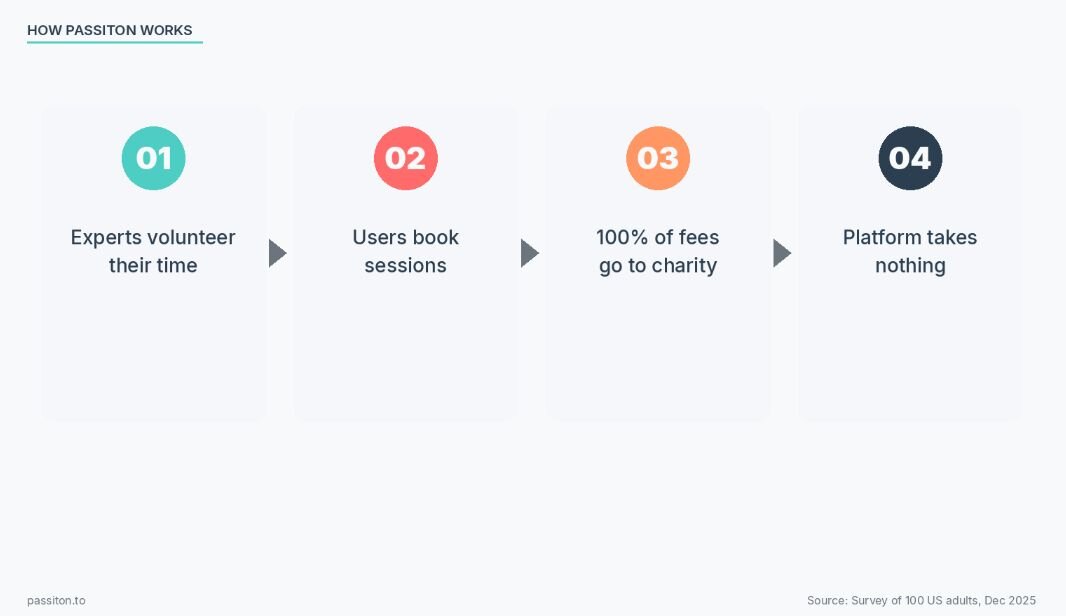
After twenty years of building products at scale -- including platforms with 50 million daily active users -- I built something purely for myself. A marketplace called PassItOn where entrepreneurs, technologists, adoption navigators, and specialists in everything from aging-in-place technology to small business launches volunteer their expertise to people who need it. Every dollar of platform fees goes to charity. The platform itself keeps nothing. I keep nothing.
It's designed, from the ground up, to generate zero revenue for me.
And it broke my brain a little. Because almost every product instinct I'd developed over two decades had to be re-examined. What I found is that removing revenue as a goal doesn't just change your business model. It changes every product decision you make. And some of those lessons are ones I wish I'd learned a lot sooner.
When the incentive structure flips
Think about how most marketplace platforms work. A coaching platform charges $70 a week. A freelance marketplace takes 20% of every transaction. The business model is simple: more sessions, more transactions, more revenue. And every product decision flows downstream from that.
Now remove it. Remove all of it.
When there's no billing-by-session, no take rate, no upsell path, the questions you ask yourself as a product person change completely. Here's what I noticed:
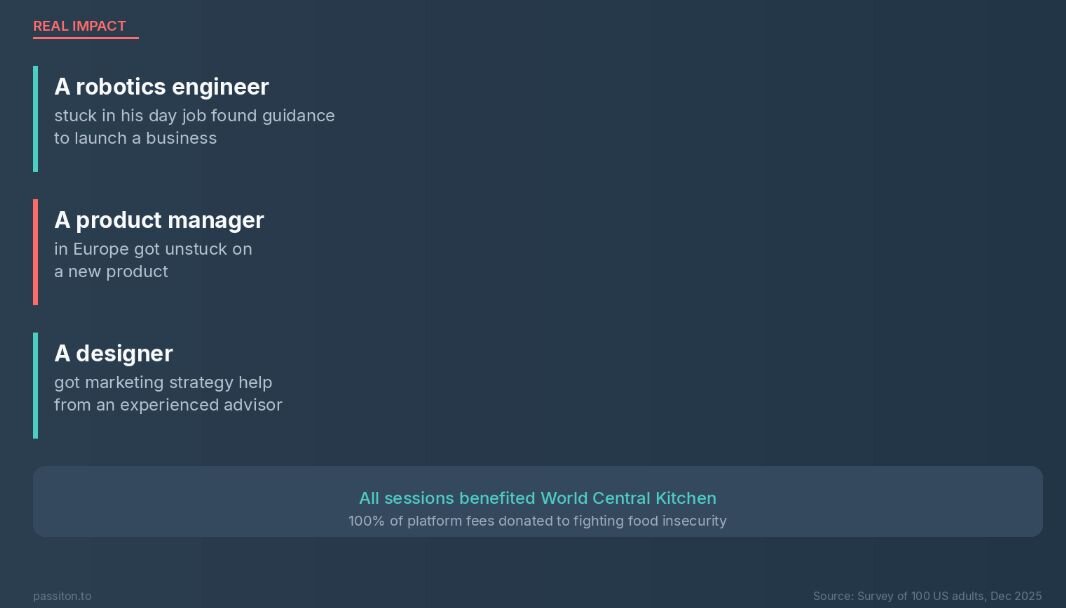
Retention becomes organic. On a paid coaching platform, retention often means lock-in -- annual plans, sunk cost psychology, "you've already invested 12 weeks." On PassItOn, people come back because the advice was honest and useful. That's it. There's no subscription to cancel, no credits expiring. A robotics engineer in San Francisco booked a session because he was stuck in his day job and wanted to launch a business. He needed someone who'd been through it. He came back for a second session on his own. After the second talk, he had a clear, prioritized list of first steps and a validated idea for his MVP. Not because we nudged him with an email sequence, but because the first conversation actually helped.
The growth engine is gratitude, not lock-in. When someone gets genuinely useful advice for free -- and knows the fees went to World Central Kitchen -- they tell people. The best growth lever I have is that the product does something people feel good about sharing. No referral codes needed.
You optimize for session quality, not session quantity. This one hit me hard. In a revenue-driven marketplace, you want more sessions. More sessions means more revenue. But when revenue is zero, you start asking different questions: Did this session actually solve the person's problem? Would one great 30-minute conversation be better than four mediocre ones? You stop trying to maximize engagement and start trying to maximize impact.
The "conversion funnel" becomes about matching, not upselling. On a traditional platform, the funnel ends at payment. On PassItOn, the funnel ends at the right expert sitting across from the right person at the right time. A product manager in Europe used her session to get unstuck on building a new product from scratch. She ended the call with a finalized product requirement document and a clear path to unblock her engineering team. A first-time founder preparing to launch an app booked a marketing strategy session. The product's job was simply to connect them with someone who could help -- not to extract maximum lifetime value from the interaction.
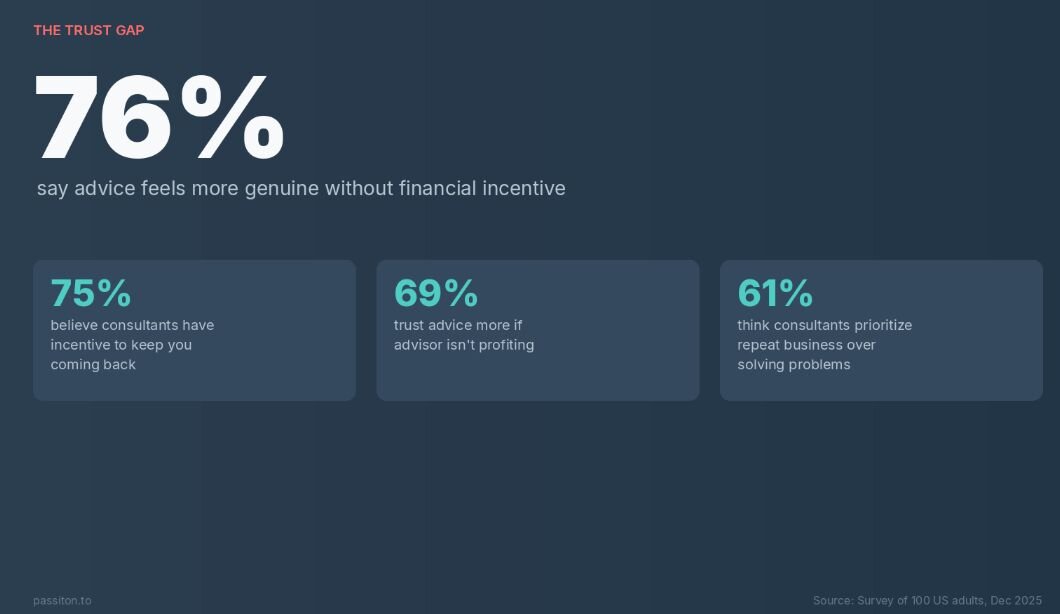
Trust is built-in. This is the subtle one -- and it turns out the data backs it up in a big way. In a consumer survey we conducted, 75% agreed that paid consultants have a financial incentive to keep you coming back. 76% said advice feels more genuine when there's no financial incentive involved. And 69% said they'd trust advice more if the person giving it wasn't profiting from it.
On platforms where experts get paid per session, there's always an underlying question: Is this person giving me honest advice, or are they keeping me engaged so I book more sessions? When the expert is volunteering their time, that question evaporates. There is literally no financial incentive to string someone along. The advice is honest because there's no reason for it not to be. The data confirms what we felt anecdotally -- people are deeply skeptical of advice when money is on the table.
The charitable model actually motivates people
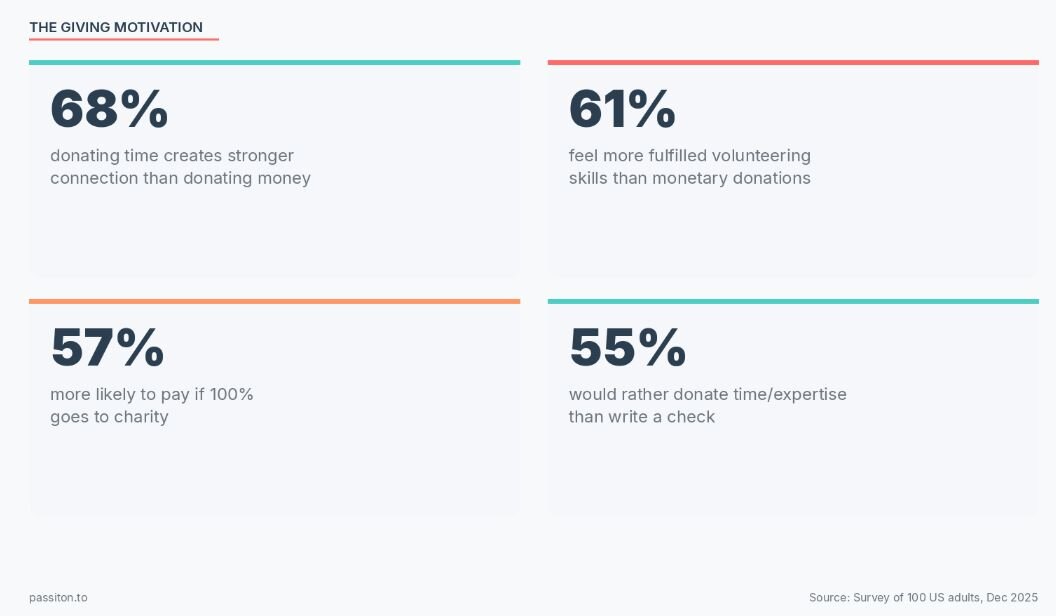
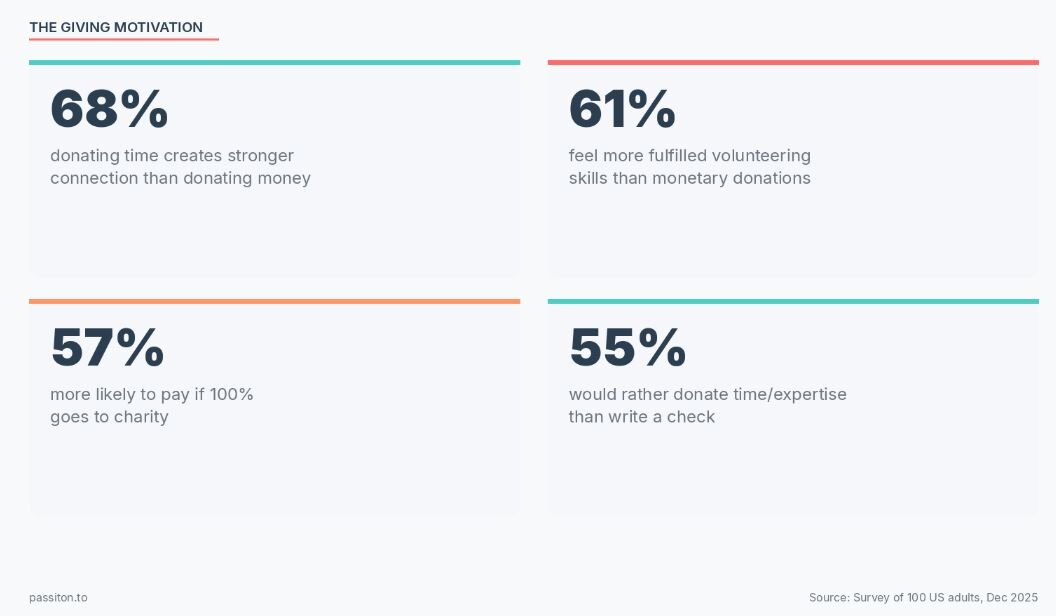
Here's something I didn't fully appreciate until we ran the numbers. In that same research, 57% of respondents said they'd be more likely to pay for advice if 100% of the fee went to a cause they care about. Only 26% said they'd pay regardless of where the money goes.
That's not a small gap. It means the charitable model isn't just a feel-good wrapper -- it's a genuine motivator. People are more willing to open their wallets when they know the money is doing something meaningful. For PassItOn, every session benefits World Central Kitchen, and that turns out to be a real driver of willingness to participate.
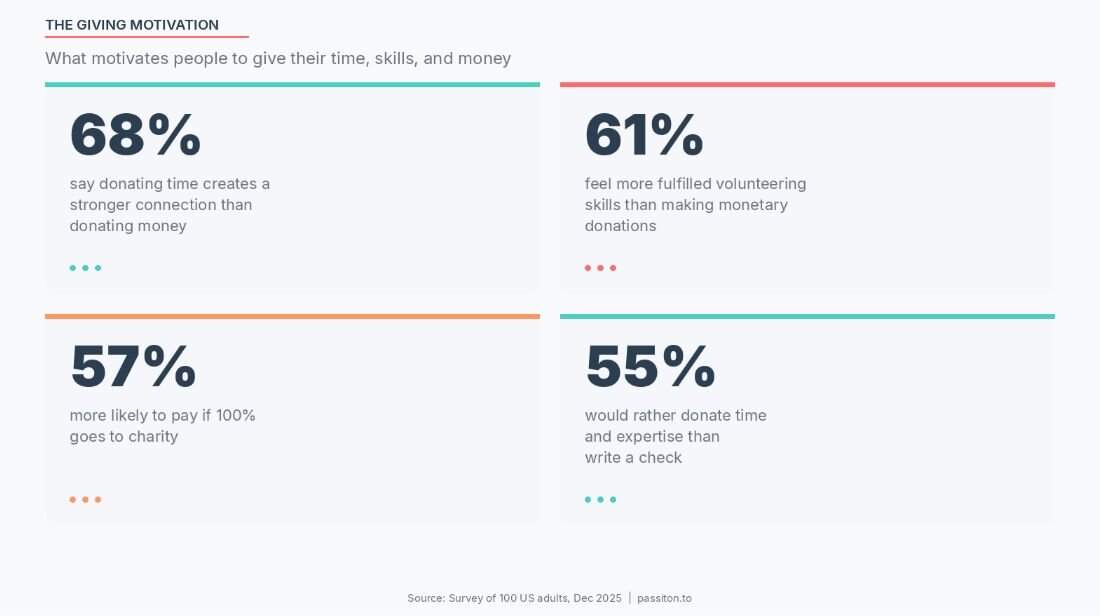
On the supply side, the numbers are equally striking. 55% of respondents said they'd rather donate their time and expertise than just write a check. 61% said they feel more fulfilled when they volunteer their skills than when they make a monetary donation. And 68% said donating time creates a stronger connection to a cause than donating money. The expert side of the marketplace -- people volunteering their knowledge -- isn't a hard sell. People genuinely want to give their time. They just need a structured way to do it.
Building the whole thing with Claude Code
Here's the part that still surprises me when I say it out loud: I built PassItOn -- auth, payments, expert matching, scheduling, the whole production stack -- using Claude Code. Solo.
I want to be clear about what this means and what it doesn't. This isn't a "vibe coding is magic" story. Building software with AI is a loop, and it's a messy one. Things break in weird ways. The AI generates code that looks perfect until you realize it's handling an edge case completely wrong. You spend time debugging things that a senior engineer would have caught by instinct.
But here's what I didn't expect: the PM mindset is actually an advantage when you're the entire team.
Twenty years of writing specs, thinking through edge cases, and arguing about user flows turns out to be surprisingly useful when you're the one directing the AI that writes the code. I know what "done" looks like. I know which corner cases matter and which ones don't. I know when a solution is over-engineered and when it's not engineered enough. My background is product, not engineering. But twenty years of shipping software means I can absolutely tell when what I'm looking at doesn't match the product I had in mind.
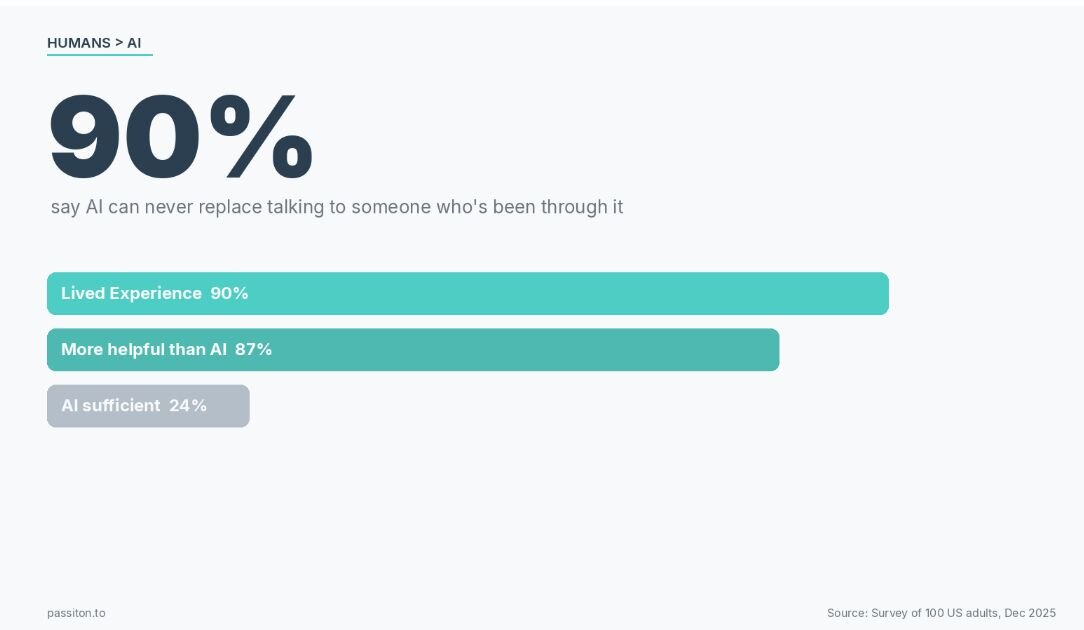
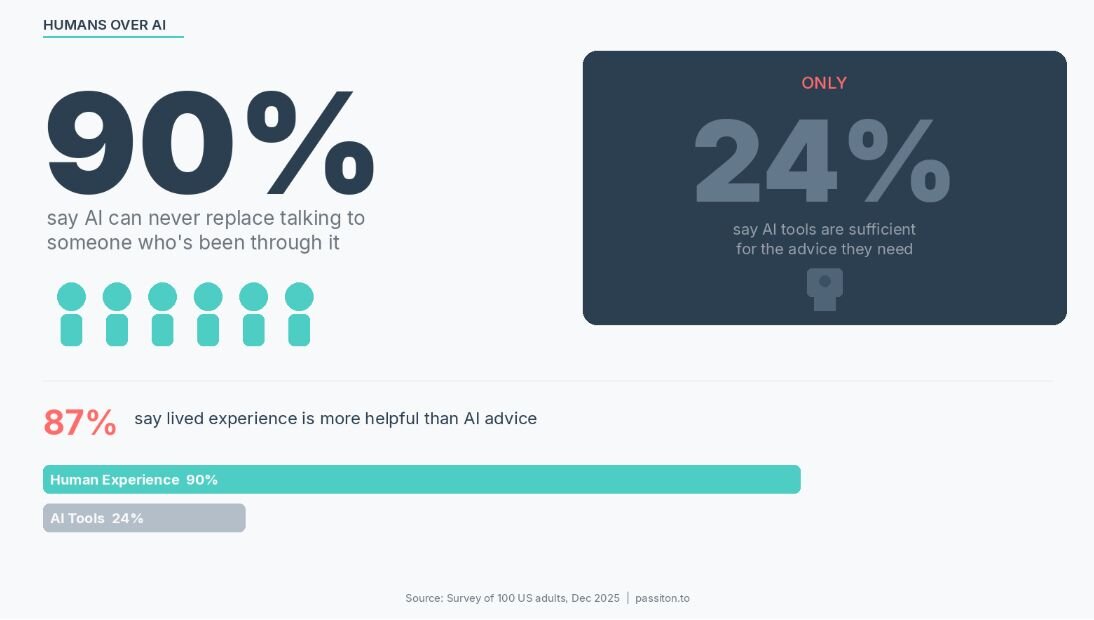
And here's the thing -- even in a world where AI can build your product, people still want humans on the other end. In our research, 90% of respondents said AI can never replace talking to someone who's actually been through it. 87% said lived experience is more helpful than AI advice. Only 24% thought AI tools alone were sufficient for the advice they need.
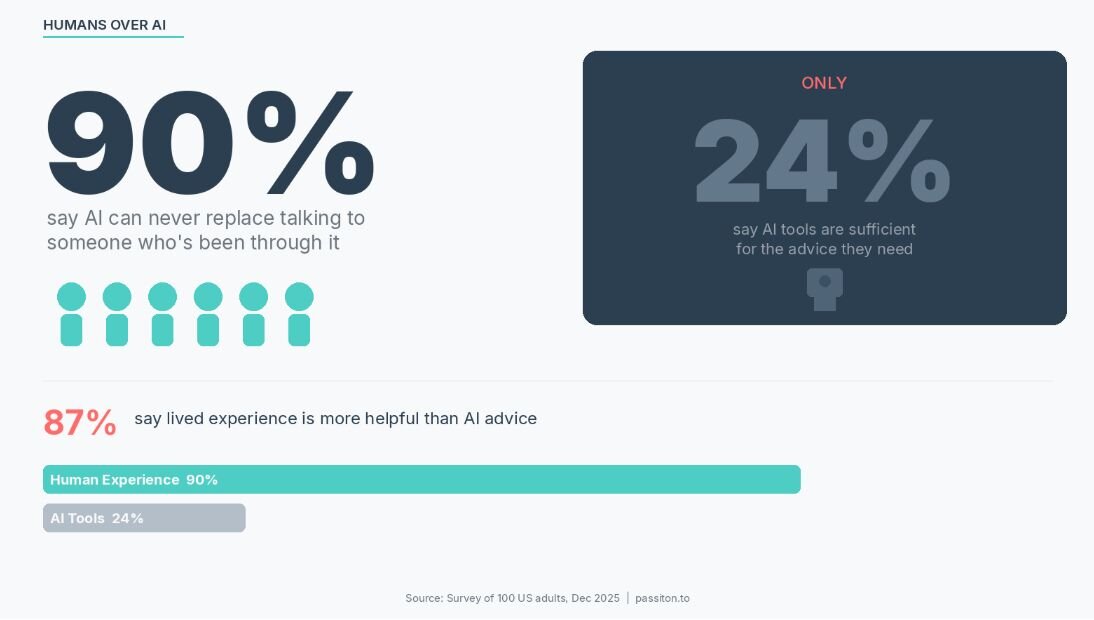
I used AI to build the platform. But the platform exists because people want to talk to other people. That tension -- AI as builder, humans as the product -- is one of the most interesting dynamics in tech right now.
The biggest lesson: AI doesn't replace product thinking. It removes the bottleneck between product thinking and a working product. The gap between "I know exactly what this should do" and "this thing exists and works" went from months to weeks. That's not magic. That's leverage.
Everyone has something to teach
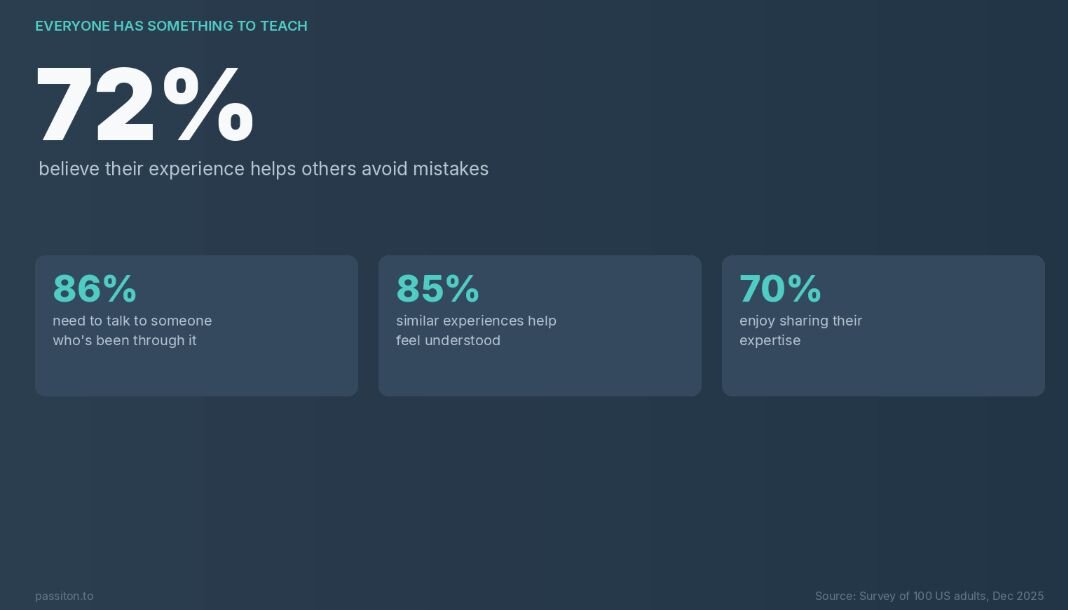
One of the bets PassItOn makes is that ordinary people have extraordinary expertise -- and they want to share it. The data supports this. 72% of respondents believe their experience can help others avoid mistakes. 70% enjoy sharing their expertise with others. And 46% said they have knowledge that took them years to learn but could teach someone in an hour.
That last stat is the one that gets me. Nearly half of all adults are walking around with hard-won knowledge they could transfer in a single conversation. The supply of expertise isn't scarce. What's scarce is a platform that connects that supply with the people who need it -- without the financial incentives that distort the advice.
Meanwhile, 86% said they sometimes just need to talk to someone who's been through what they're going through. 85% said hearing from someone with similar experiences helps them feel understood. The demand is there. The supply is there. The question is just: how do you connect them in a way that feels honest?
What this means for your products
I'm not suggesting you turn your SaaS into a charity. But I am suggesting a thought experiment that I think every PM should try at least once. Remove your primary business metric for a day. Just in your head. If your north star is revenue, or MRR, or average order value -- pretend it doesn't exist. Now look at your roadmap. Look at your backlog. Which items are there because they genuinely help users, and which are there because they move a number? The answer might be uncomfortable. Ask what your product optimizes for when you take money off the table. When I couldn't optimize for revenue, I was forced to optimize for the thing I should have been optimizing for all along: genuine user value. Am I connecting the right people? Is the experience worth someone's time? Did this actually help? These questions aren't irrelevant to revenue-generating products. They're just easy to lose sight of when the dashboard is full of financial metrics. The constraint of making $0 forced clearer thinking. This is counterintuitive, but having fewer levers made every decision sharper. I couldn't A/B test pricing tiers. I couldn't optimize checkout flows. I couldn't throw money at paid acquisition. All I could do was make the core experience as good as possible and trust that it would be enough. That constraint was clarifying in a way I didn't expect. Watch where trust breaks in your product. The biggest thing I learned from PassItOn is how much of the traditional marketplace playbook is actually about compensating for a trust deficit that the business model itself creates. When your platform takes a cut, you need reviews and ratings and guarantees and refund policies to rebuild the trust that the financial structure erodes. When nobody's taking a cut, a lot of that complexity just... disappears. The data puts a number on it: three out of four people say advice feels more genuine when money isn't involved. That's a trust tax that every paid marketplace is paying, whether they realize it or not.
The uncomfortable truth
Here's what building a zero-revenue product taught me that I keep thinking about: a lot of what we build as product people isn't for the user. It's for the business model. And that's fine -- businesses need to make money. But it's worth being honest with yourself about which decisions serve the user and which decisions serve the model. Because when you can tell the difference, you make better products either way.
Every session on PassItOn benefits World Central Kitchen. But the real benefit, for me, has been the forced clarity about what product work actually matters. After twenty years of building for growth, engagement, and revenue, building something for pure impact has made me a sharper product thinker. I didn't expect that. But I'm glad I found it.