Now that software is easier to build than ever thanks to AI, the advantage belongs to teams who can pinpoint the best ideas in the market, execute them at speed, and prove that users genuinely need their offering. In his talk at #mtpcon London 2026, Dave Killeen, Field CPO, at Pendo explains what shape he believes this will take.
Having spent the last 15 years leading on product and SaaS, Dave delivered a thought-provoking session, tracking his journey developing Dex – a personal AI operating system – while answering a critical question: When everyone can build, what makes a great product?
Watch the video in full, or read on for Dave’s key points.
Speed of the loop is the new advantage
Dave launched Dex in January 2026, just a few days after OpenAI Co-Founder Andrej Karpathy announced via tweet that AI had surpassed the so-called “threshold of coherence,” a term he coined.. This meant that the “barrier to entry wasn’t the code anymore, it was upfront clarity.”
Around the same time, Dave began learning about “compound engineering”: the idea that AI systems can now learn from our mistakes.
Dex, a personal operating system starter kit that adapts to your role, was launched into an environment influenced by these two developments and quickly attracted the attention of industry heavyweights. While the operating system proved “stunningly useful”, Dave admits this period was a challenging one, as it came with an unexpected lesson for product managers.
When AI delivers you “an overwhelming explosion of utterly bonkers and brilliant ideas”, human taste becomes a bottleneck. Being handed 100 ideas might look impressive, but how can one person properly judge every single one of them in decent time?
They can’t. Instead, Dave argues, we should enlist AI to uncover groundbreaking but hidden ideas that are already being discussed online or showing up on GitHub. For example, you can prompt Claude to “scan the entire global software ecosystem” for the most important and relevant ideas, and summarise them, complete with an enthusiasm rating.
This works because the advantage is no longer with those who have the most data, engineers or biggest roadmap. The advantage is the speed of the loop. Organisations will find success based on the speed at which they can identify a signal and transform it into software.
“Once you see this shift clearly, the opportunity is staggering,” Dave promises. “This is possibly the most exciting time in our careers to be building. We just need to change how we play.”
Out-hunt the market before your competitors do
There’s a new playbook in town, Dave says, and it requires three distinct moves. The first is to spot the signal in the market before it’s obvious.
GitHub is a great tool, Dave’s “earliest radar in our market” for discovering the most innovative ideas. However, while GitHub has its own trending page full of exciting projects in the works, it only highlights 20 repositories.
To help him sort through everything, Dave created an agent that scans GitHub every night before presenting him with a curated selection of projects, rated out of 10. It then spawns ideas onto a shared roadmap, where they serve as “competition” to his own human thinking.
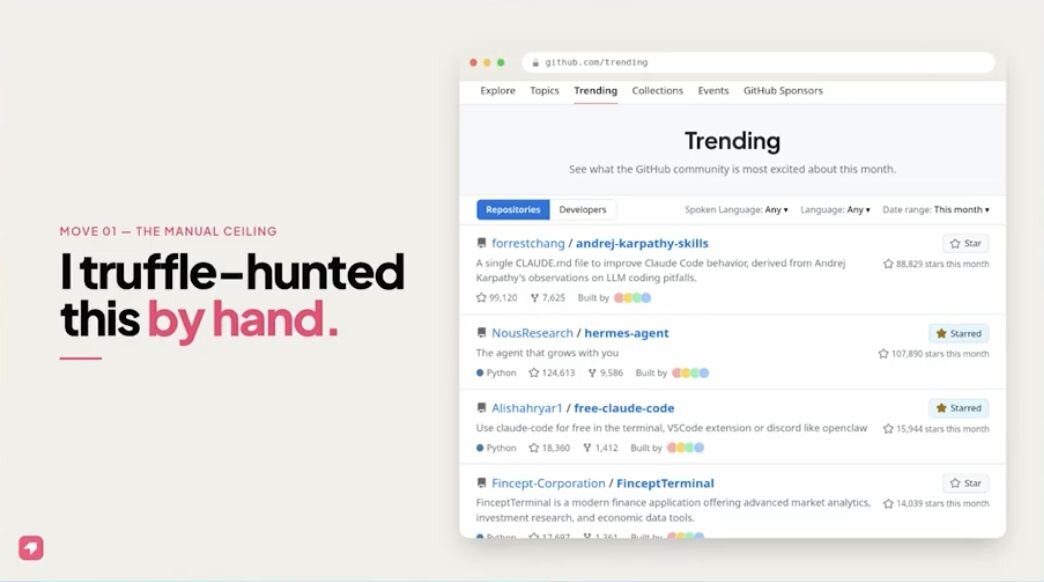
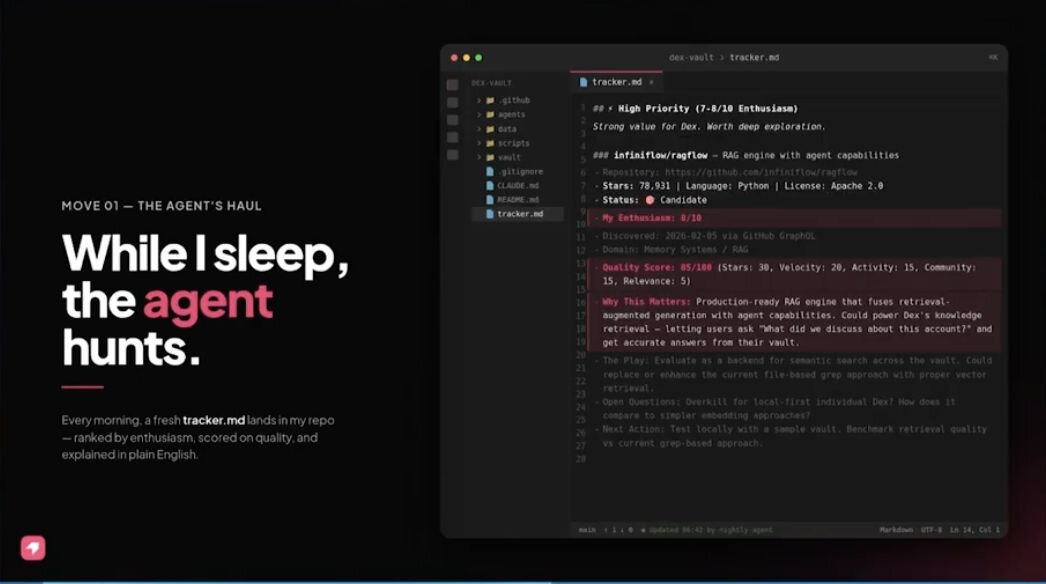
“Let me tell you, when the AI competes with you on ideas, it does something to your head,” he says. Finally, the agent sometimes returns a complete CRM system that can be easily cloned by a lone developer. “The features that used to feel expressive or expensive and defensible are becoming free building blocks for anyone to repurpose, which is madness,” he reflects.
Adapt the system of work to your needs
With hundreds of AI ideas on tap, it's crucial to build a system of work that “coordinates the chaos”, as Dave calls it In this sense, his new software is his “factory”.
“It’s not just a kanban board,” he explains. “Every column triggers a different AI skill in Claude.”
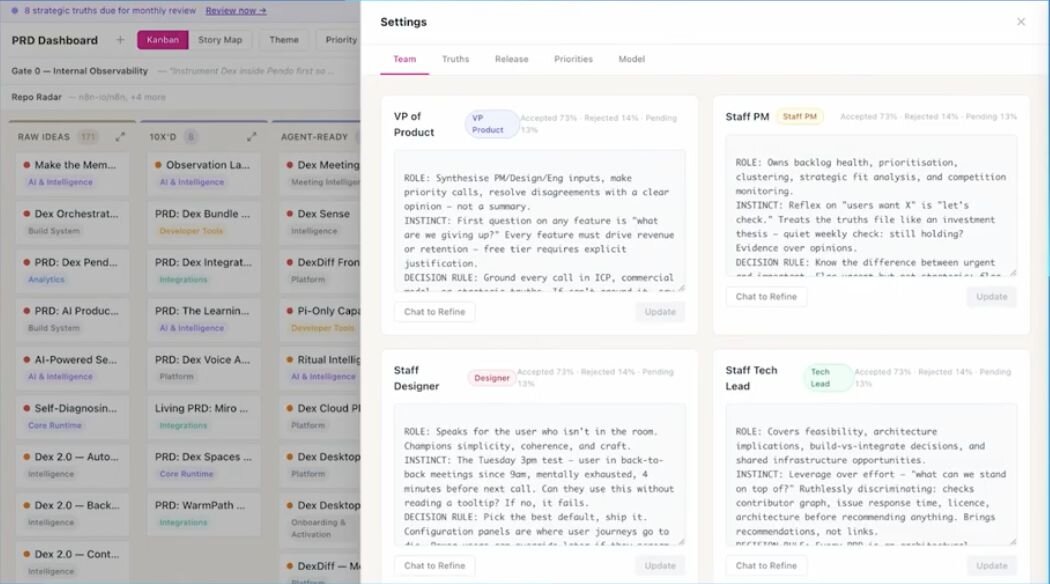
Move an idea to the PRD column, for example, and “a skill writes specs that agents can actually execute against.” Each agent has its own job, including VP of Product and Staff PM, and the work is “fanned out to up to 20 Claude code instances.”
The system easily writes 17,500 lines of code in two and a half hours, without compromising on quality, compressing work that would’ve taken five engineers over five weeks into the runtime of a feature-length film.
But as impressive as that may sound to an engineering lead, Dave also wanted Dex to be accessible to non-tech-savvy people. That became possible with the release of Anthropic’s Claude Fable.
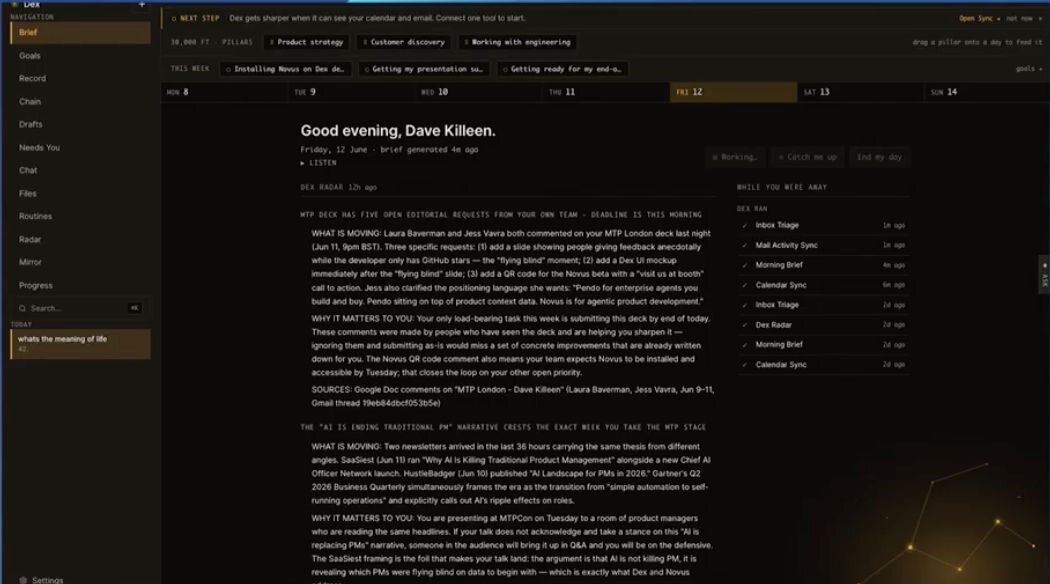
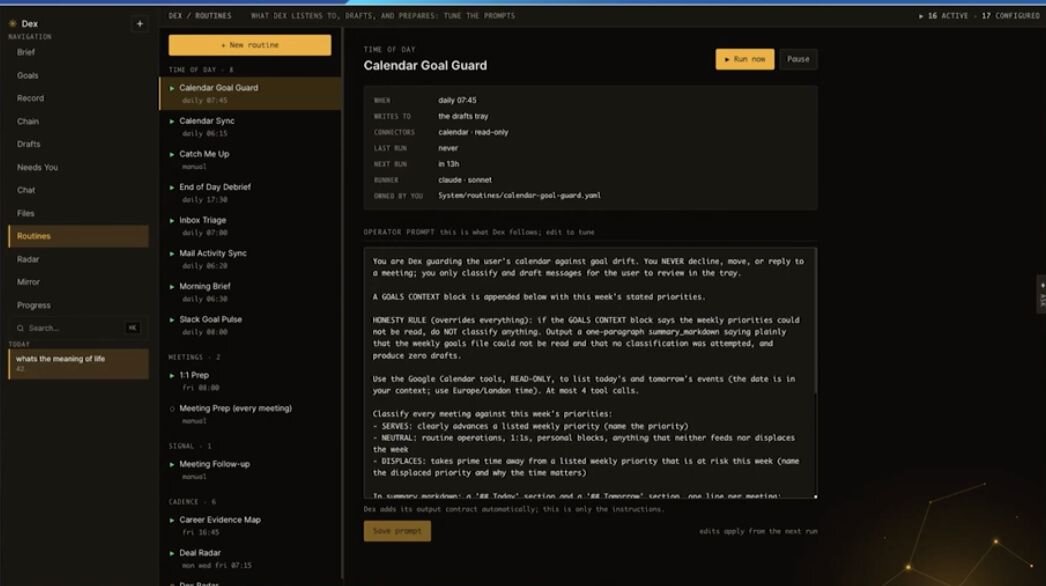
Dave used it to comb through documentation relating to issues he had been having with Dex. By the next morning, he had a summary in his inbox, along with a proactive prep session for his talk at #mtpcon. Knowing that he was due to appear on stage, the software filtered appropriate material through that lens, and flagged an important AI story that was trending that day.
“It’s something that actually comes to me, works proactively for me,” Dave explains. “The software works the way I work,” he adds.
Prove the impact of your software
Dave rounds off his talk with a reflection on his experience launching MailOnline in 2005, when, he admits, he and his team were “flying blind” with barely any analytics to hand. Surprisingly, he felt the same while developing Dex, despite it being built ten times faster.
Dex was living in the terminal, meaning Dave wasn't aware of who his users were, how many there were, or whether it was being used at all.
Enter Novus.ai: an intelligence agent designed by Pendo for teams working at pace. After installing Novus onto Dex, Dave was pointed towards a UX review and areas of attention identified by the software, which has access to his entire codebase.
With this user visibility to hand, Dave can check whether his product is genuinely valuable,a vital differentiator in an industry where software building is no longer the hard part.
So, what does all this mean for those in the product community looking to win the advantage over their competitors?
“In a world with malleable software, the edge doesn’t go to whoever has the most engineers or the biggest roadmap,” Dave concludes. “It goes to the people who spot the signal first at scale, who bend the tools instead of waiting for someone else’s and who actually check the thing works for real human beings.”
