
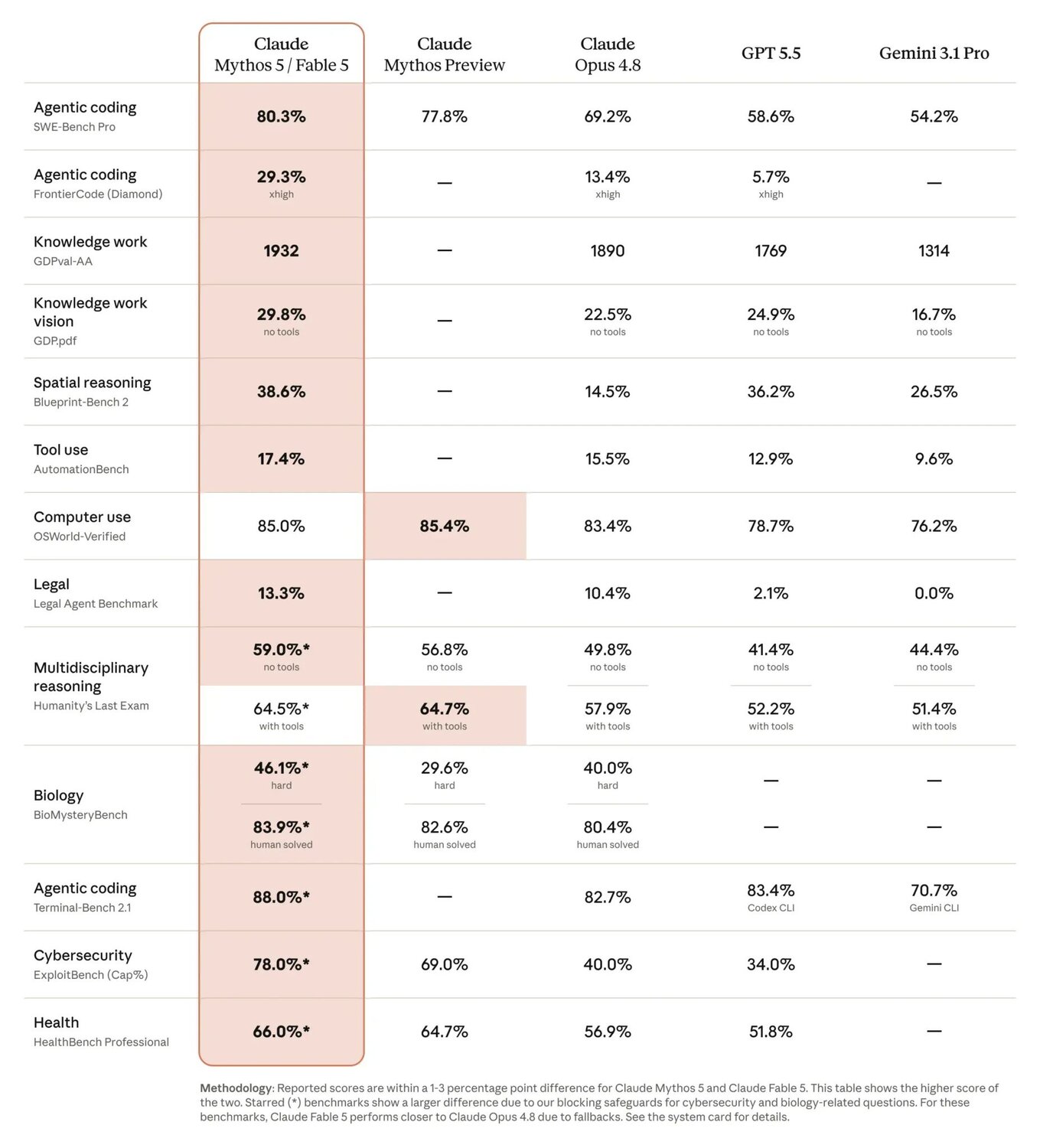
When Claude’s Fable 5 hit the news this week, I was excited. A safe version of Mythos, Anthropic's most capable model ever. Fable 5 is that same model, now open to everyone. Mythos was so powerful, able to find and exploit software vulnerabilities on its own, that Anthropic first gave it to a small group of cyberdefenders through a program called Project Glasswing.
Then I read the fine print: it refuses the hardest questions we have, in chemistry, biology, cybersecurity, the jailbreak edge cases, routing them to a weaker model instead of answering.
That got me thinking. Like a lot of people building in the coding and agent space, I've half-turned into an addict. I spend hours configuring models and wiring them into my workflow to automate my own tasks, and I've stopped being sure whether they're making me more capable at my hardest problems or less.
My own agent, built on Hermes and Claude, is starting to deskill me. It does the work; I type a few keys and point it around. Am I sharpening my judgment, or becoming a keyboard-punching monkey?
The promise of AI was that humans and models would solve the hardest problems sooner, together. What I'm watching instead is a split: an addictive loop that keeps us using, and a erosion that leaves us less able. This article proposes a different model, with Fable 5 and Hermes as the test cases.
What Hooked actually says
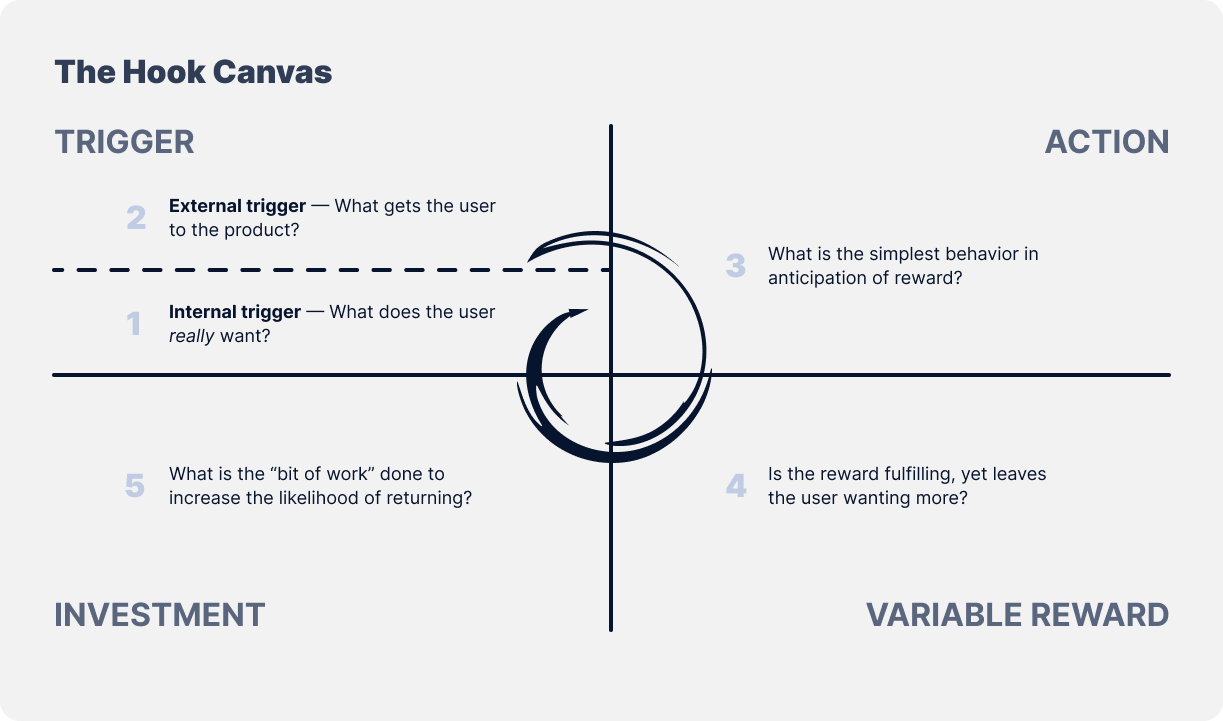
Hooked, Nir Eyal's 2014 playbook, models habit-forming products as a four-phase loop, and the phase that does the work is the third.
It starts with a trigger. Early on that's external, a notification or a badge, but the goal is to graft the product onto an internal trigger, an emotion you already carry, so that idleness alone sends you back. The trigger produces an action, the smallest thing you can do in expectation of a reward: the thumb-flick of a scroll.
Then comes the variable reward, and this is the engine. Eyal borrows from slot-machine research: a payoff you can't predict pulls far harder than a reliable one. Refresh the feed and you might get nothing, or you might get the post that makes your day. That uncertainty is the hook. He sorts these rewards three ways, rewards of the tribe (social validation), of the hunt (information or resources), and of the self, the intrinsic satisfaction of mastery and completion. That last one matters for what follows, because it's where Hooked comes closest to building competence, and it's the obvious rebuttal to anyone who calls the model pure manipulation.
The loop closes with investment: you put in data, effort, a follower count, and that stored value both raises your switching cost and loads the next trigger.
The detail to carry forward: at the center of Hooked sits a reward engineered to be variable and intermittent. The product works precisely because you cannot predict what you will get.
3. Why it breaks for AI tools
An AI tool is supposed to be about utility. The point of automation is to take work off my plate so I can spend my attention on strategy and judgment. The tool is a companion you offload to, so that you compound yourself. The point was never to keep me coming back.
Hooked's reward is variable and intermittent by design. The trap with AI tools is that you don't need a product manager to bolt that on. Agentic tools generate it for free. The automation nails the task one run and face-plants the next, and that intermittent success is the slot machine. The tinkering itself is satisfying, Eyal's reward of the self, the pull of getting the thing to work exactly how you want. Nobody has to engineer the addiction; it's latent in the medium.
I feel it every time I'm in Claude Code, and I've felt it on Opus and on Fable 5. You get pulled into the reasoning, into building the best possible setup, and the process is so engaging you look up and you've spent twelve hours getting the agent to work the way you intended. What you should have done is offload the task and go spend those hours on the work that actually needs your judgment, the work that upskills you and compounds you.
Gerlich's 2025 work found that the more people lean on AI tools, the weaker their critical thinking gets, mediated by exactly this offloading. He calls it cognitive laziness. So when a team reaches for the Hooked playbook and pulls those levers harder, a utility tool tips one of two ways. Either it becomes a useless toy that never really takes work off your plate, or a crutch that takes your judgment too. Hooked's mastery reward sounds like competence, but handed out intermittently it trains dependence instead. Neither serves the one thing the tool was for.
An alternative approach: The Compounding Model
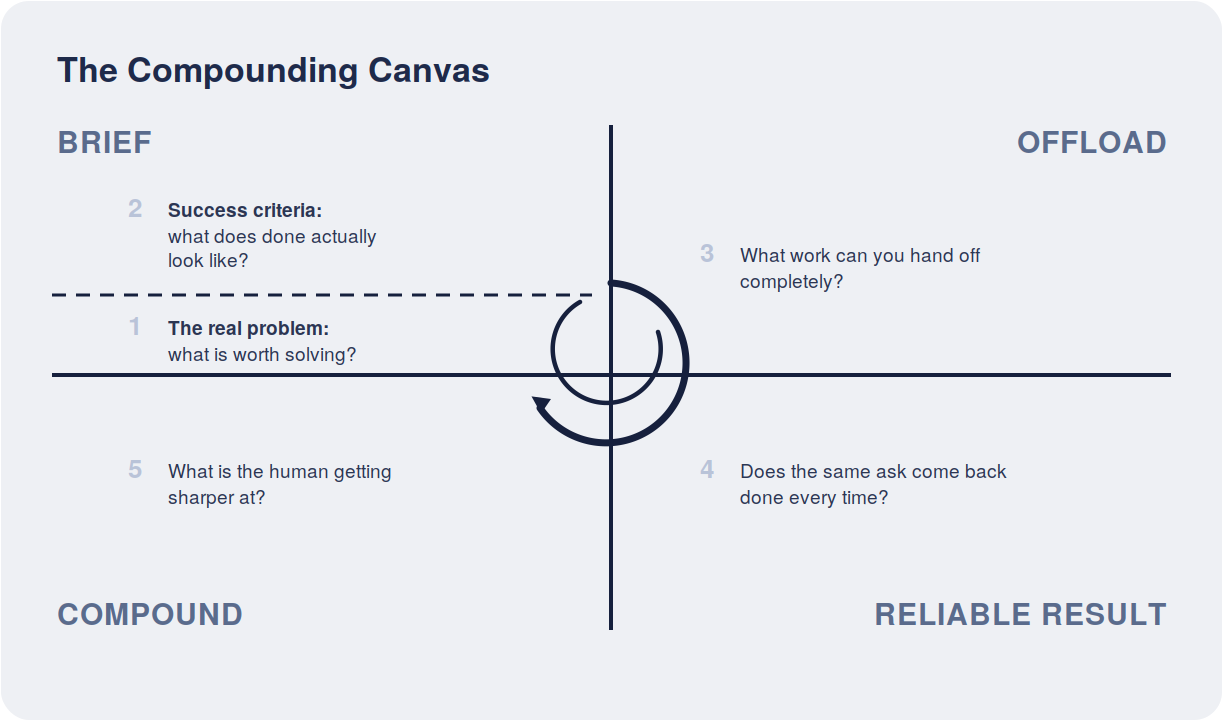
Here's the model I'd put in Hooked's place. I call it the Compounding model, and it starts from what an AI tool is actually for. It exists to take work off your plate so your attention rises to the work worth your judgment. The execution is what should leave your hands. The framing, deciding what problem is even worth solving and asking the questions that get you to the core, is the human part. A good tool can think alongside you there, but it must not do it for you. That's the line: offload the execution, protect the judgment.
Get that line right and the tool keeps you where Csikszentmihalyi said growth happens, at the edge of your own skill, on the hard problem. Get it wrong and it drags you below your frontier into babysitting the build, which is where skill quietly atrophies.
Now watch how today's tools actually behave. They keep you in the loop through a stream of approvals and intermittent decisions: continue, looks right, approve this step, approve the next. The industry sells that as keeping you in control. It is the same variable reward wearing a safety vest. Each little approval is a pull of the lever, and it keeps you tangled in the exact execution you were trying to hand off. The thing marketed as responsible design is the hook.
The fix is not fewer check-ins everywhere. It's check-ins on the right thing. Keep me in the loop for judgment, should we ship this, does this match what I actually want, and out of the loop for execution. A great employee doesn't ping the boss to approve every function. They spend an hour understanding the problem, then go solve it.
That's the Compounding model in a sentence: brief it like a great employee, then get out of the way.
It inverts Hooked term for term. Hooked's reward is variable; this one is reliable, the work comes back done. Hooked's investment compounds in the product and raises your switching cost; this one compounds in you, because the hour you spent framing sharpened the one skill the machine can't take. The trigger isn't a manufactured craving, it's a real task. You brief, it builds, you come back more capable than you started.
That is the difference between a tool that hooks you and a tool that compounds you.
Hermes, hands-on
So I tested the Compounding model on myself, using the most mundane task I had: logging what I eat.
I built the agent on Hermes, running a Claude model, and wired it to a WhatsApp number so I could log from my phone (Figure 1). Standing it up was not frictionless, which is its own small lesson about self-hosted agents, but it was simple once it ran the loop. I text what I ate (Figure 2), and the agent estimates the macros, flags where I'm short, and suggests what to add (Figure 3). (The food data here is illustrative, not my real log.)
Two things made this a real test of the model rather than a gadget. First, after a few days it distilled the repeated task into a reusable skill on its own, with no prompting from me (Figure 4). That's the learning loop, the part meant to make it more useful the longer it runs. Second, it built and kept a file modeling who I am, my patterns and preferences, capped at roughly 1,375 characters (Figure 5). That file is the offloading made literal: the things I handed the agent to remember so I don't have to.
Which sets up the only question that matters here. When the loop fires and the agent hands me "here's your gap, eat this tomorrow," is it making me more capable of understanding my own intake, the way briefing a great employee leaves me sharper, or is it just handing me orders I follow without thinking, one more pull of the lever?
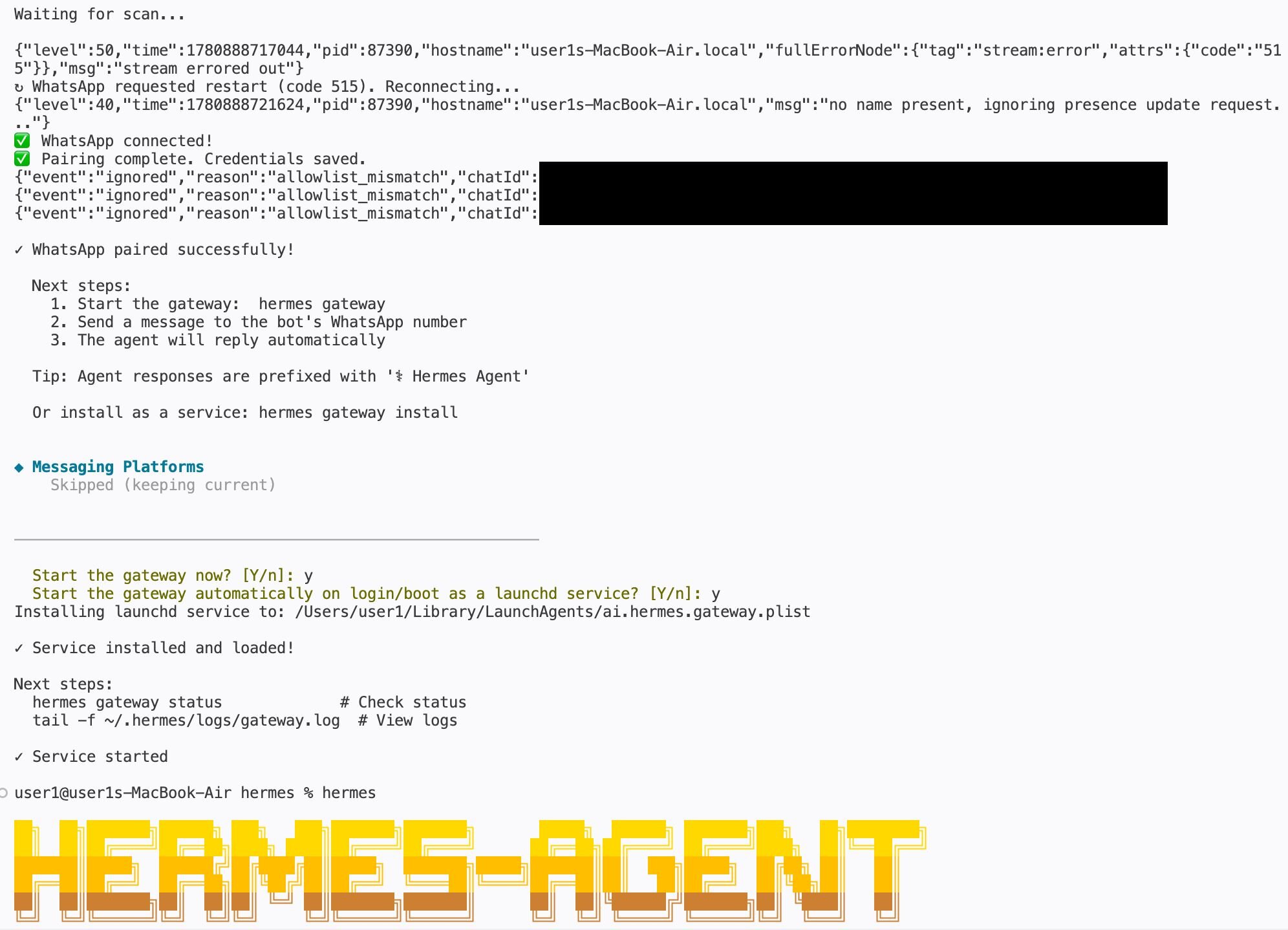
Setting up Hermes Agent and Whatsapp Gateway
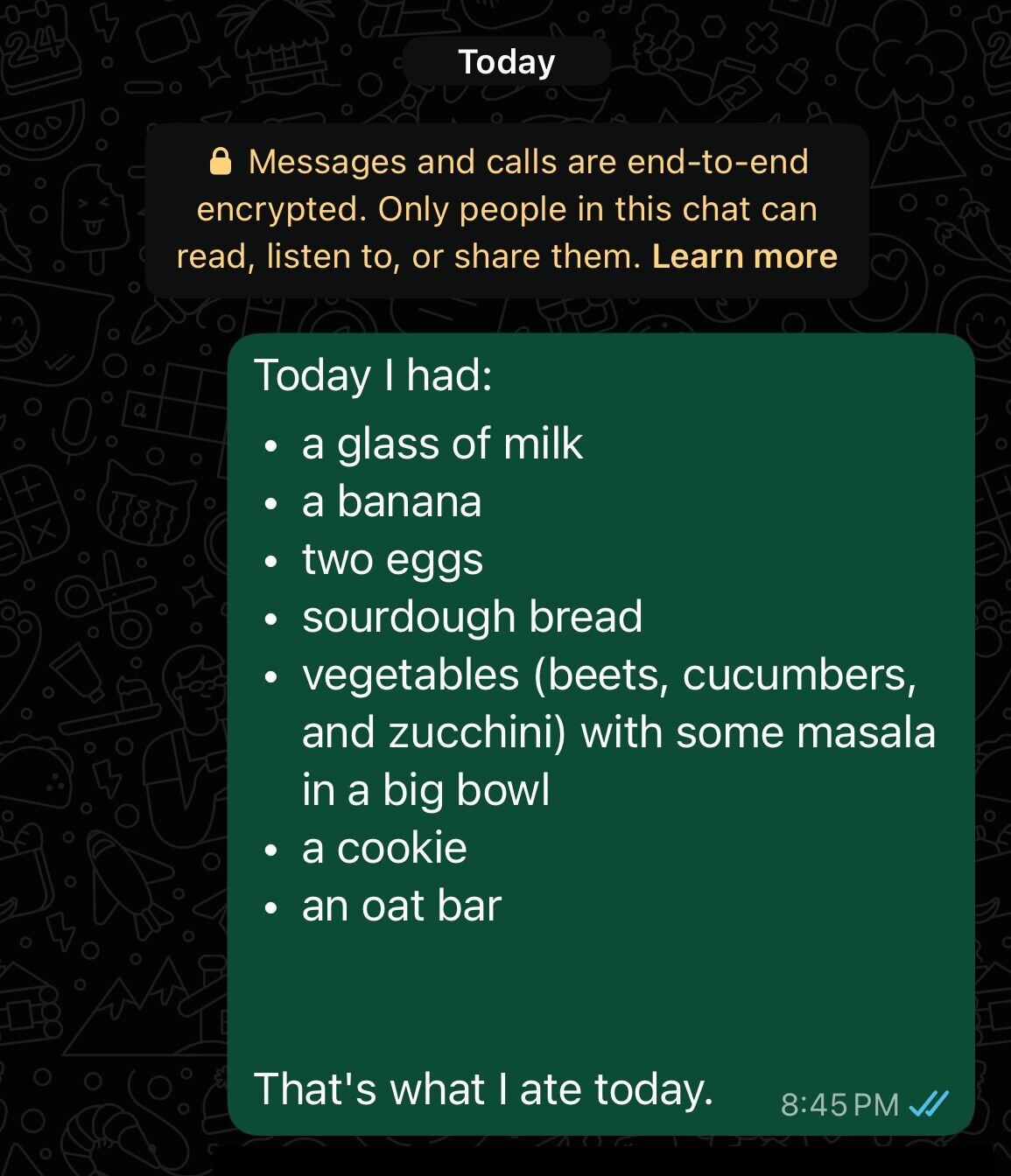
Figure 2. I text my food log to Hermes over WhatsApp
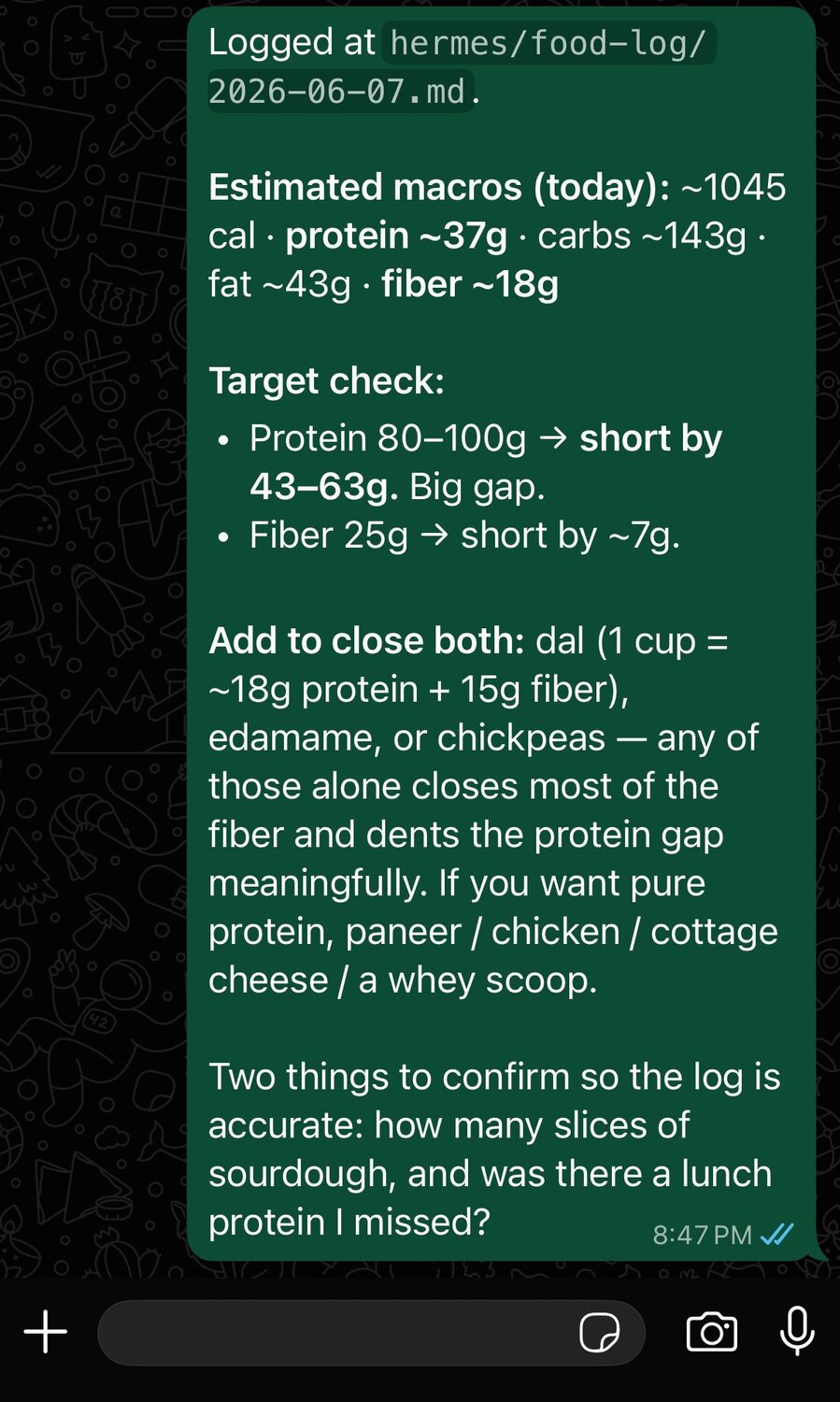
Figure 3. Hermes (via Claude Opus 4.7) estimates macros, flags the gap, suggests what to add.

Figure 4. The skill-creation loop turning a solved task into a reusable skill
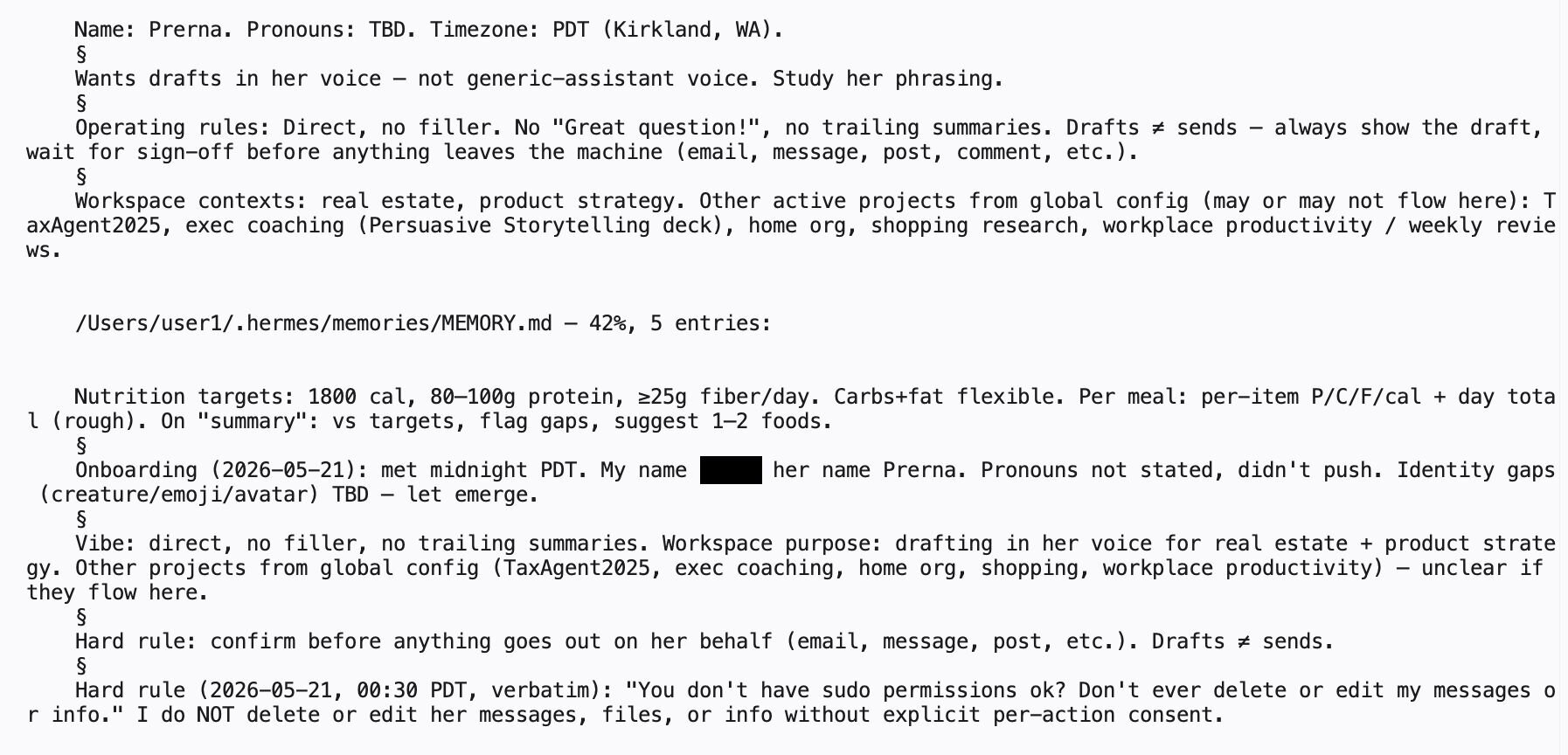
Figure 5. This is the file Hermes keeps on me, its model of who I am, capped at roughly 1,375 characters. Redacted.
So what happened? The tool was easy. Logging took seconds, and it reliably flagged my gaps and told me what to change. That part was useful. But I had almost no agency in it. I was following its calls. ‘Easy and useful’ slid straight into just do what it says.
Could it have been a real thinking partner instead? Probably. But only if I'd poured in the hours I described at the start, the tinkering I'd called the hook. That's the lesson I didn't expect. The order-following version is the one you get for free. The version that makes you sharper, you have to build on purpose, against the grain. Left to default, even the person who designed the model reached for the easy orders.
What I'd tell a PM building an AI product today
If you're a product manager building one of these tools, the work shifts, and most of it moves earlier than you'd think.
- Spend your effort on the framing. What matters is helping the user root-cause the problem, understand what they're actually trying to solve, and dig in until the question is sharp. That's the human work, and it's where your craft belongs, not in one more clever way to keep someone in the app. Get the tenets right and the rest follows.
- Which means not optimizing for the wrong thing. Stop counting time-in-product and session length. Count whether the user got the artifact they came for and left. A tool that does its job sends people away satisfied. If your metrics reward stickiness, you'll build the hook whether you mean to or not.
- And treat a surprise as a bug. In a utility tool the reward is reliability, the same result every time you ask. Variability is the slot machine, and you don't want it in something people depend on.
If you remember one line from this article, keep this: brief it like a great employee, then get out of the way.
There's a tell in how Fable 5 launched. Anthropic shipped its most capable model ever and deliberately built it to hold back on the questions it shouldn't answer. The instinct worth stealing isn't the raw capability, it's the restraint, the willingness to design for when a tool should hand control back instead of grabbing for more of your attention.
That's the real choice in front of every team building with AI. We can build tools that grow the people who use them, or tools that hollow them out. One compounds you. The other turns you into a keyboard-punching monkey. We get to decide which.
