
Sahil Jain has always been in a technology wave in one way or another. Writing platform code at Yahoo! at 17 when the first iPhone shipped, evaluating startups at AOL at 19 during Y Combinator's second batch, and co-founding AdStage at 21, just when Facebook, LinkedIn, and Twitter advertising were all arriving at once.
Samepage.ai, available today on Product Hunt, is his latest project that he's been building during this new world where things are moving tens of times faster than they have before. We caught up with Sahil to learn more about what it's like building a product today, and what non-technical product professionals should do to get started with AI tools.
A background in building from the ground up
Sahil has spent the better part of two decades building software products at moments of technological transition. After a career-changing interaction with a young founder named Darian Shirazi, now an investor, he left AOL and, after a period as a business co-founder at one of the early YC companies building developer tools, he started AdStage in 2012 alongside CTO, Jason Wu.
AdStage addressed a problem that was straightforward in its origins: managing advertising campaigns across Google, Facebook, LinkedIn, and Twitter from a single platform. The company raised over $17 million, built a customer base of more than a thousand agencies and in-house teams, and was acquired by Tapclicks in March 2020 after eight years of operation. After a stint as CPO of Tapclicks, he moved on, took some time away from the technology space, and returned with a new problem to solve.
The idea for Samepage grew out of a frustration he kept running into during the COVID era of back-to-back calls. "We were in literally thirty to forty meetings a week," he says. "And in almost every one, we'd spend the first few minutes catching people up on the very topic of the meeting — even when we'd sent an agenda, even when people had read the email." He'd noticed the same dynamic at AdStage for years: organisations had more communication tools than ever, and people were still routinely not on the same page.
He started keeping a document called "I Got 99 Problems," logging every workplace friction he encountered. It had fifty-four entries by the time he counted. Several of them pointed at the same root: information asymmetry. "You and I may have different information about and understanding of Project A," he says. "That's the core problem. How can technology help solve that?" He'd sit on any idea for a year, and if it kept surfacing, he'd write it up in more detail. Samepage was the one that wouldn't go away.
What building Samepage.ai looks like
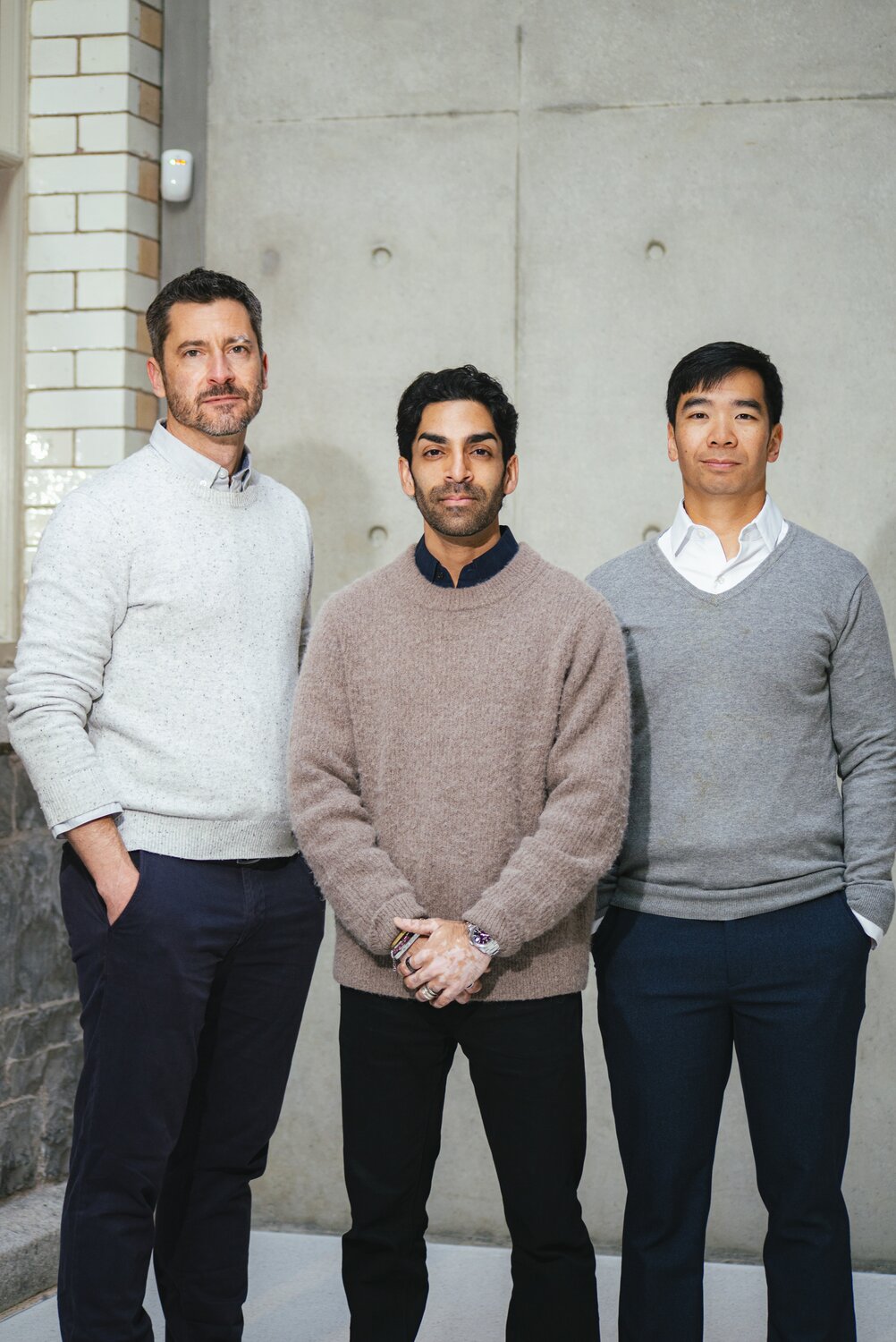
The founding team of Samepage is three people: Sahil, Jason, and Paul. They also have a designer and a web developer on contract. No full-time hires beyond the founders.
On the question of team composition, Jain doesn't think the functions change dramatically, it’s just the headcount that is the biggest change. "You're still going to need the same roles," he says. "You'll probably hire fewer of them, and lean toward people who are more senior in their function rather than building out layers." For Samepage's own next hires, they’re prioritizing customer success first, then sales. Engineering resource is Jason's call. "I've been asking him for two and a half years if he wants to hire another engineer. The answer is always no, not until he's nearing capacity."
The key purpose for Samepage is for a product person to simply connect their data sources — Jira, Notion, Slack, Gong, and let the platform build what Jain calls a second brain: a constantly updated repository of everything relevant to that person's work. On top of that, Signals are automated cards that monitor specific data sources, run a set of instructions, and surface insights and information on a schedule. "Every morning our agent goes through your data and surfaces signals automatically," Jain says. "You don't even have to build them." To pull this off effectively, the product automatically builds out a profile of the user that changes as the user changes.
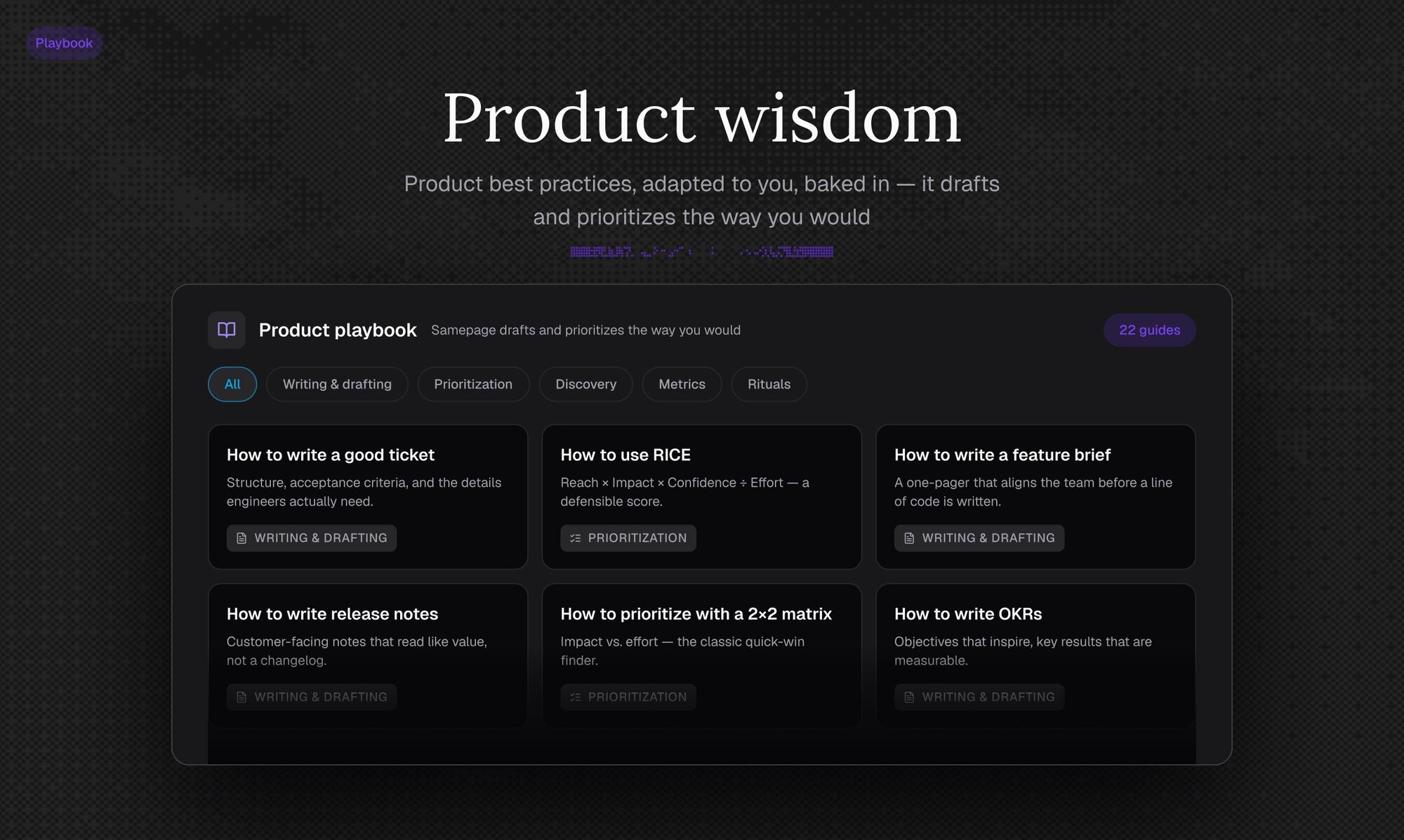
The thesis for this product is that the relationship between people and information is about to change. "Today, information is a pull," Jain says. "You go to Google, to Notion, to Confluence and you look for something. I think that's going to be a thing of the past. Information in the future is going to travel to you automatically." Samepage is built around that bet.
How the team are adapting to new ways of working
The team encountered some instant challenges themselves from building during this new age. Paul, the product lead, ran out of backlog. Jason was building faster than product could specify what to build next. The PM challenges of getting engineering to build more things faster inverted entirely. "Paul had to dramatically change the way he works," Jain says, "because it's not about how hard something is to build anymore. It's about what to build."
They now run on one fixed meeting a week (Mondays) and an almost daily sprint cadence.
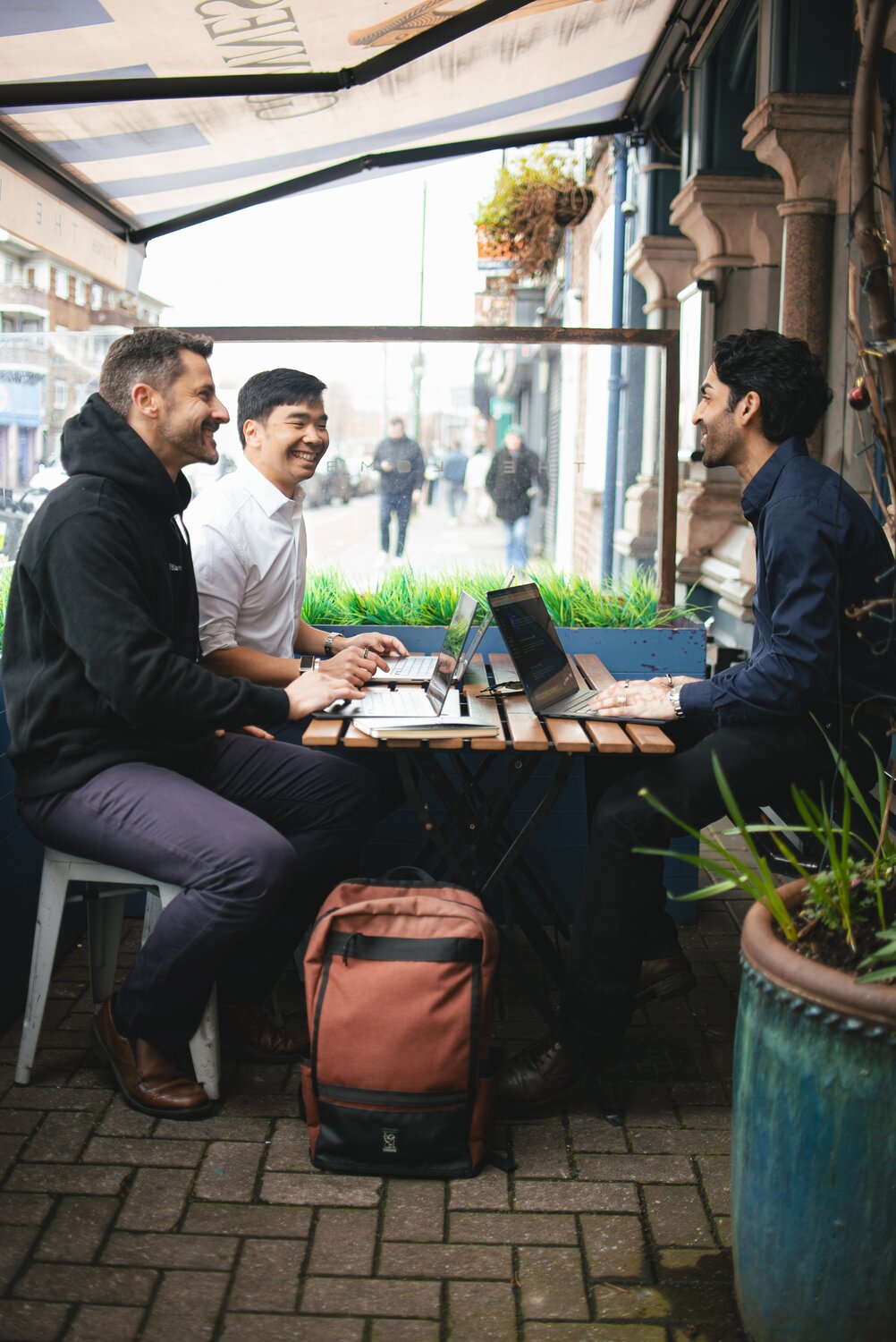
A recent feature that they were working on was scoped by Paul in a day or two, built by Jason the same day, staged the next morning, and shipped to production that evening. Paul and the designer both run the full application locally and ship front-end changes themselves; Jason reviews the code, sometimes with an AI agent, before it goes live.
Jain's advice to product leaders navigating AI's speed is to just "send it." He uses the traditional skateboard-to-car analogy. “If the cost for building the car has collapsed dramatically, just build car one, then car two, then car three," he says. "Be less methodical, build that extra feature instead of weeks of validation. We can always cut it."
Jain keeps returning to what he sees as the product person's edge in all of this. "Judgment and discernment, are very human, and AI has not proven it can do them well." When building costs collapse, the hardest question is whether to build it at all.
For anyone looking to build in an AI era: start smaller than you think
Jain relates to the anxiety product managers feel, especially amidst the industry's fear-mongering about being left behind on AI.
He offers four tips:
- First, prioritise community forums. Platforms like the PM subreddit reflect the industry's messy reality better than LinkedIn. Even seasoned professionals are navigating uncertainty together.
- Second, Jain emphasises that while AI accelerates production, human judgment and discernment remain irreplaceable. Success in this era comes from staying "in the game" and building muscle through consistent "reps," a philosophy that drives his small, highly efficient team.
- Third, he advises starting small to get to grips with the new technology. Starting with Claude for personal life if that's what it takes. Plan a trip, cook a meal, then move it to work. When you do, scope it to the tasks that are most tedious and information-heavy. Start with LLMs, as they perform well on knowledge work. Don't try to rebuild a process from scratch. "Any good product person knows you need to scope the problem to something really manageable," he says.
- Finally, expand your surface area. Just as he scheduled regular calls with founders and investors to stay connected, constantly experimenting with AI tools keeps you positioned to collide with opportunity.
Building when things won't stop moving
Jain compares the current AI era to the iPhone era, the only difference being that mobile was a massive shift, but it took a decade to catch on. "I worked on the first iPhone. It took ten years before mobile really caught on the way it did today. We don't even think about that now." AI, he believes, is already well beyond that pace.
He is honest about what that does to product builders. "Every morning we wake up facing a perceived or real existential threat," he says. "Is what we're building going to be useless in three months? If that existential reality occurs, we're all screwed. All we can do is punch our card, be in the game, build muscle, stay ready."
Jain thinks the most interesting things that will be built with AI are things nobody can conceive of yet. The longer-term question he keeps returning to is the impact this will have on our purpose as humans. He uses the Pixar film WALL-E as a reference, where automation has removed so much friction from daily life that people have drifted into passivity. "That is a possibility," he says. "If cost of goods goes down and things are automated, maybe we have more leisure time. And if and when we get to that, the question will be: how do you live with yourself when you have less purpose derived from your work?"
He dealt with a version of it after moving on from AdStage, the version where time expands and the structure disappears. "People saw me travelling around the world and thought my life was great. I woke up every day, went to the gym, cooked, and had ten hours of nothing to do. It sucked. People need purpose. Whatever AI makes easier or obsolete, that part doesn't change."
