
At 4 AM, I am a genius.
Lying in the dark before a product strategy workshop, my brain produces roughly 657 ideas. An entire reframe of the problem space that I am certain will land.
By 10 AM I am in a room with twelve people and a long list of someone else's ideas on a whiteboard, and I have become an empty space.
Someone says my name and everyone turns. And what comes out of my mouth — after a pause long enough to be noticed — is a lot of uhs and ums, one incoherent sentence built with grammar rules last used in the 1960s, and a rehash of the previous person's point in slightly worse words.
I had the ideas. I want to be very clear about that. I had them. Some also seemed excellent, however they could not be extracted by the instrument being used to extract them.
You have read the other version of this article. The one where ADHD turns out to be a secret superpower and the conclusion is that we are uniquely gifted, if only we could sort out our calendars. This is not that article.
On a bad Tuesday afternoon in a noisy office with ongoing construction right out the window across my desk, ADHD is a tax. The superpower version sells better however it just leaves out the days that actually need help.
But I also don't want to write the other version with the kanban boards and the capture systems and the 4-by-4 breathing, where the environment is a fixed law of physics and the only variable available for adjustment is me. Because here is what I've come to think after several years of being the person who finds this job harder than it looks:
I am detecting a badly designed system
Like any product, the way we work is full of design decisions. The difference is that we rarely recognise them as design decisions anymore. Some examples I’ve experienced are as follows:
- Full of defaults that nobody has audited.
- Meetings are the correct interface for making decisions.
- Responsiveness is a reasonable proxy for value.
- Memory is a personal virtue rather than shared infrastructure.
- The ability to improvise aloud, under time pressure, in front of an audience, is a meaningful measure of product thinking.
All of these are choices: someone made them by accident a long time ago.
Diagnostic one: the meeting is a badly designed interface
Product teams spend enormous amounts of time improving user interface while rarely questioning the interface they themselves use most: the meeting.
We critique onboarding flows, optimise dashboards, redesign navigation and obsess over reducing friction for our users. Yet the way we make our own decisions is often treated as untouchable, as though meetings arrived fully formed rather than being another system somebody designed.
So let's look at one like a product with unclear purpose and no stated user goal. Context is delivered verbally, once, at speed, and then lost forever. And if you were distracted for two seconds by your colleague’s gorgeous furry friend climbing onto your lap looking for attention, then that’s that. There is no async path for users who can't or don't want to engage in real time. Success is undefined, so it ends when the calendar says so rather than when the job is done.

If a PM brought me this spec I would send it back. And yet the strategy workshop is the room where ideas are supposed to happen. Twelve people improvising. It is optimised for people who think while talking. It systematically loses people who think before talking, or after, or in writing, or at 4 AM in the dark. People like me, and possibly many of you are reading this.
The fix is a pre-read. It's asking for contributions in writing before the room, so the ideas that arrive at 4 AM, or during the long shower after gym have somewhere to go. It's stating the decision that needs making, who owns it, and what information it requires. These are three questions any competent PM would ask about a feature and almost nobody asks about a meeting.
Do this and you get better ideas because you stopped selecting for the fastest talker in the room and started selecting for the best thinker.
Diagnostic two: we optimised for collision and destroyed focus
Ask me about my last day in the office and I can tell you one thing about it: the sales team.
Their laughing, their music, the specific pitch of a deal being closed loudly, thirty feet away, across an open-plan office floor that somebody once described in a deck as "designed for serendipitous (or whatever fancy word they could come up with to show off) collaboration."
I built a workaround by listening to one Spotify song on loop for hours. I decided against a playlist because it would eventually serve me a song I don't like, and then I will spend forty minutes finding a replacement instead of doing the Q4 roadmap. Crucially, it has to be a song whose tone I know but whose lyrics I don't, because if I know the words my brain will grab a line and start singing along and the whole thing collapses. This is a bespoke, self-engineered, single-track noise-cancelling system that I built, unpaid, because the environment I was given was hostile to the thing I was hired to do.
Every open-plan office is a bet. It's a bet whose benefits are easy to notice and whose costs are much harder to measure, and the cost lands unevenly — silently, on the people least able to absorb it, who then look like they're underperforming.
Diagnostic three: responsiveness is masquerading as value

The Slack notification pings and I look, of course, the notification is designed by professionals to make me look, and I am not better than that.
And in the two seconds that takes, someone in the meeting says my name. There is a specific chill that comes with the certainty that everyone has just seen you not be there, and that they will now file this away under something about you.
I know what happens next, because it has happened many times. I will spend the following ten minutes not listening to the meeting at all, but running an internal review of the previous four seconds. So the cost of that ping is twelve minutes.
Somewhere along the way we decided that being reachable was the same as being useful. It isn't. It is the cheapest possible proxy for it, and we adopted it because it's easy to see. Product managers know the danger of choosing proxy metrics over outcomes. We warn teams about it all the time. Yet we've done exactly that to ourselves.
Deep work is invisible until it produces something. Availability is visible immediately. Guess which one gets rewarded.
Diagnostic four: the room does not reward the best idea
I am afraid to speak in meetings with my own team. I know them, I like them (at least some of them – especially the ones with the cute dogs), they have never once been anything but decent to me, and I still feel my heart go when it's my turn to talk.
That's rejection sensitivity, which travels with ADHD like a shadow, and it doesn't respond to logic. Knowing that nobody in the room is judging me does absolutely nothing to the physical sensation that all of them are.
So, what does the meeting actually select for?
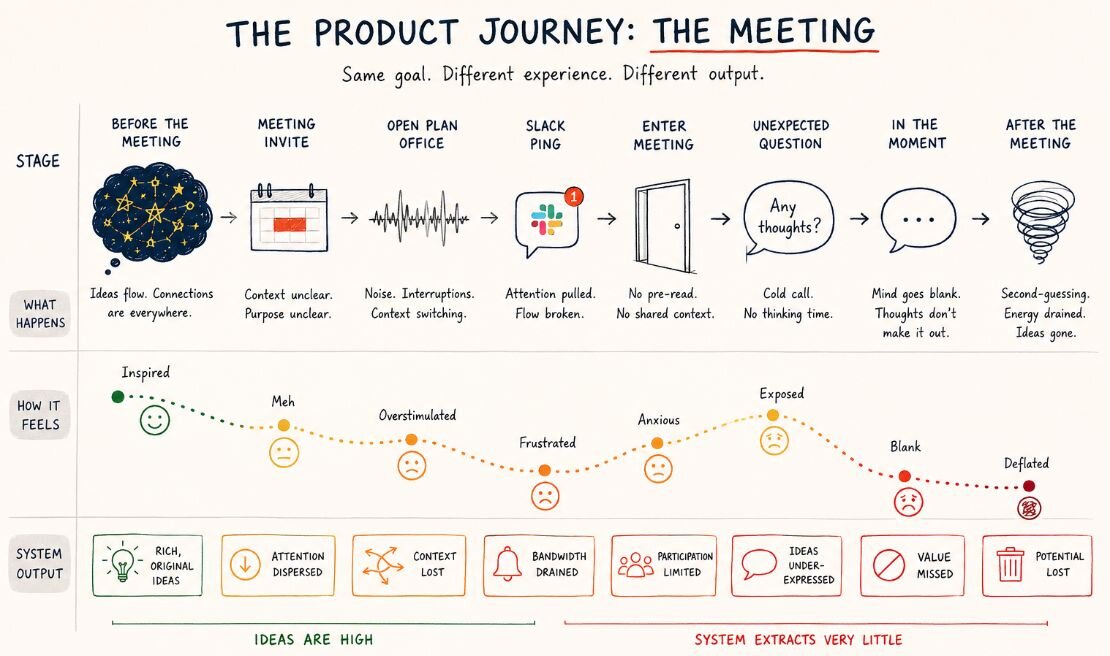
It selects for the person most comfortable being looked at. It selects for confidence, fluency, and a nervous system that stays quiet under observation. Those are real traits and I know some top class PMs who have them. However, they are not the same trait as having good product judgment, and there is no correlation. But we seem to have built an entire profession on the assumption that they're correlated.
Look around your last strategy session and ask who spoke, and who didn't, and whether you'd bet your roadmap on the difference between them being about the quality of their thinking. The fix is the same shape as the others: give people a way to contribute that isn't live improvisation. Let ideas arrive in writing, before or after the room. Judge the thinking, not the performance of delivering it.
The part where this stops being just about ADHD
Every single fix I have ever needed turned out to be a better way to work.
Write the decision down, and you help me — and also the person who was on leave, and the new joiner in six months, and the future version of yourself who cannot remember why you shipped the thing.
Send the pre-read, and you help me — and also the analyst who needs to look at the numbers before she can say anything intelligent about them.
Kill the meeting that has no owner and no decision, and you help me — and also everyone else in the building who was praying you would and looking for an excuse unused in the last three months to skip it.
Protect focus time, and you get better product thinking — from me, and from everybody, because nobody does their best strategic work in the fourteen-minute gaps between calls while a deal closes behind them.
These changes are just examples of something product managers already know. When a particular group struggles with your product, you investigate what their experience is revealing about the design.
So why don't we apply that thinking to the way product teams work?
We spend our careers questioning assumptions, challenging default behaviours and redesigning systems that don't work as well as they could. We should be just as curious about the systems we build around ourselves.
So if you're leading a product team this week, start by auditing the defaults. Ask which of your meetings actually need to happen live, and who on your team is expected to think and speak in the same breath. Ask what you're really rewarding, responsiveness, or good work, and what you've started measuring just because it was easy to count. Those questions won't only help the person with ADHD. They'll make the whole team better.
