
The regulatory maturity framework for product teams.
If compliance only appears in your roadmap during legal review, you are already late.
Most teams only realise this when it is already too late.
In many regulated environments, this pattern is more common than teams expect. Product teams move quickly at the beginning of an initiative. Discovery moves forward, roadmaps fill up, and features start moving through delivery. On the surface everything looks like healthy momentum. Progress is visible, teams feel productive, and stakeholders see activity.
I have seen this play out multiple times. What starts as confident execution gradually slows down when regulation finally enters the conversation and changes the pace of everything.
Architecture needs to be revisited, scope begins to shrink, and launches move further down the timeline. What originally looked like a straightforward feature now involves discussions between product, engineering, legal, and commercial teams. The tension that follows often leads organisations to blame regulation for slowing innovation.
In reality, regulation is rarely the real problem. In most cases, the real issue is that it was never treated as part of product design in the first place.
Over time I have come to see this pattern as a leadership maturity issue. I call it the regulatory maturity gap. Some teams treat compliance as an interruption that appears late in delivery. Others design their products with regulatory constraints in mind from the very beginning. The difference between the two is rarely the industry they operate in or the complexity of the rules they face. More often, the difference comes down to leadership discipline and how early regulatory thinking is integrated into product decision.
The hidden cost of late compliance
Most teams do not struggle with regulation because they lack intelligence, talent, or good intentions. They struggle because compliance is structurally separated from product thinking.
Discovery is typically driven by user value and growth opportunity. Engineering focuses on speed and reliability of delivery. Legal teams validate alignment once decisions have already started to feel committed. Compliance exists in the organisation, but it does not meaningfully influence the early trade‑offs that shape architecture and product capabilities.
At first, this separation creates the illusion of speed. Decisions move quickly because risk remains invisible. Roadmaps appear confident because constraints have not yet surfaced.
The friction, however, does not disappear. It simply accumulates beneath the surface.
Eventually, regulation enters the process through a legal review, a new customer requirement, or a market expansion. At that point, the cost of earlier assumptions becomes visible. What originally looked like fast progress turns out to be deferred complexity.
The maturity gap is therefore not defined by how many regulations a company faces. It is defined by whether regulatory constraints influence architecture early enough to avoid expensive redesign later.
Designing products with regulatory constraints in mind
Strong product leaders do not wait for compliance validation to begin thinking about regulatory implications. Instead, they design with constraint deliberately.
This approach does not mean slowing discovery or adding unnecessary bureaucracy to delivery. It means asking better questions earlier in the process.
In one of the teams I worked with, skipping this step meant we only realised the impact later, when changes were already expensive to make.
For example, which regulatory boundaries shape this capability? Which markets introduce variation in requirements? What obligations around traceability, auditability, consent, or reporting must be supported from the beginning? Where could rigid design decisions create long‑term cost if regulation evolves?
These questions are often treated as legal concerns, but in practice, they are architectural decisions. The moment regulatory thinking enters discovery, trade‑offs become clearer. Engineering choices become more durable, and legal teams can contribute as design partners rather than acting as a final approval gate.
When this shift happens, execution does not slow down. Instead, teams build products that can survive scrutiny, expansion, and regulatory change without constant redesign.
Making regulatory impact visible in product decisions
Teams that treat compliance as an afterthought experience regulatory change as disruption. Each update appears as an unexpected constraint that forces delivery to pause and adjust.
More mature organisations operate differently. They expect regulatory change and make it visible inside their product systems.
In these environments, regulation is mapped directly to product capabilities. Leaders understand which features carry regulatory weight, which markets introduce constraints, and where flexibility must be preserved in the architecture. This visibility changes the way prioritisation happens.
Instead of treating regulation as external pressure, teams incorporate it as a strategic input.
In practice, I’ve seen this happen when teams only discover regulatory impact after delivery is already in motion. Trade‑offs are discussed openly and earlier in the process. When new requirements appear, the organisation can adapt without destabilising the roadmap.
The result is not a rigid organisation. It is one that manages complexity with greater clarity.
The role of product leadership
Compliance cannot sit entirely with legal teams, and product leaders should not attempt to replace legal expertise. However, product leadership must own the integration between regulatory thinking and product design.
In practice, this means ensuring that regulatory considerations influence roadmap commitments, architecture reviews, and commercial positioning. When leadership consistently reinforces this integration, the internal dynamic begins to change.
Legal teams are no longer perceived as blockers who appear late in the process. Instead, they help safeguard market access and customer trust. Product teams are no longer defending speed at all costs; they are designing systems that remain resilient over time.
This shift does not happen automatically. It requires leadership to treat regulatory thinking as part of the product operating model rather than a downstream validation step.
The regulatory maturity framework in practice
To make this more practical, I often use a simple model that product teams can apply immediately. A framework is only useful if it changes how a team works in the near term, not just how it thinks about a problem in theory.
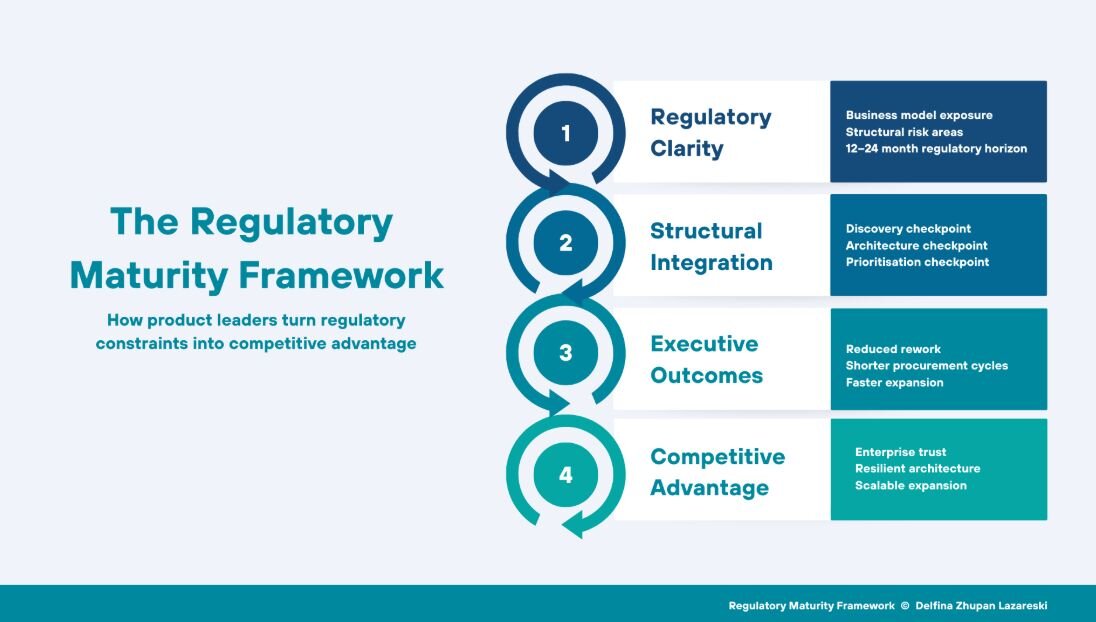
The regulatory maturity framework focuses on four stages: clarity, integration, outcomes, and advantage.
 Stage 1: Regulatory clarity
Before annual planning begins and before major roadmap commitments are made, leadership should be able to answer three questions clearly.
- Which regulations materially limit or enable our business model?
- Where in our product are we structurally exposed (data, AI decisions, reporting, cross‑border flows)?
- Which upcoming regulatory shifts could affect the next 12 - 24 months?
If these questions cannot be answered with confidence, compliance will almost always appear tactical and reactive. Regulatory clarity provides the starting point for mature product decision‑making.
Stage 2: Structural integration
Once clarity exists, regulation must become embedded directly in the way product teams operate. In practice this integration typically happens through three checkpoints.
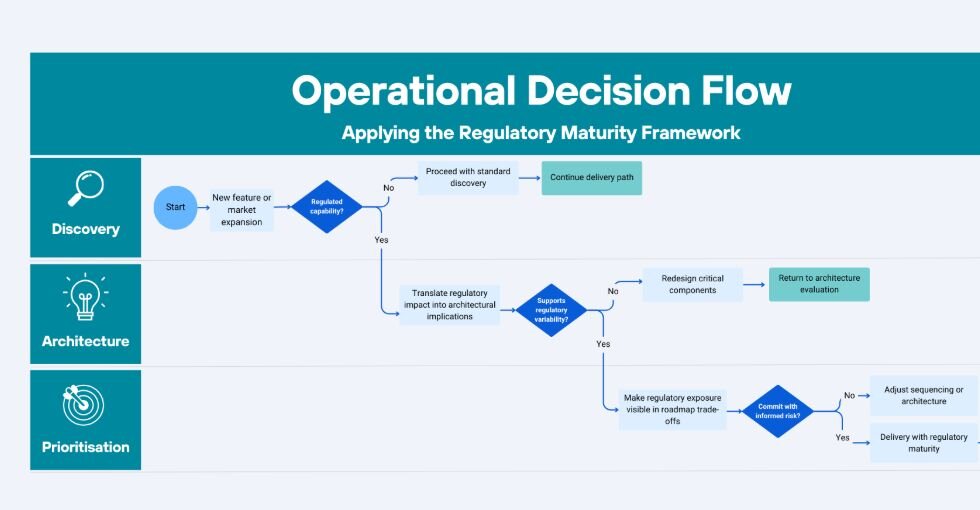
The discovery checkpoint ensures that no major capability moves forward without translating regulatory impact into product implications.
The architecture checkpoint ensures that core components carrying regulatory weight, such as data models, policy engines, or audit layers, are designed with enough flexibility to accommodate regulatory variation across markets.
The prioritisation checkpoint ensures that regulatory exposure becomes visible when roadmap trade‑offs are debated. Discussions about speed versus risk happen explicitly rather than surfacing unexpectedly later.
This approach is not about adding bureaucracy. It is about sequencing decisions in a disciplined way so that constraints shape architecture before they become expensive to change.
Stage 3: Measurable outcomes
When regulatory clarity and structural integration are applied consistently, organisations begin to see measurable outcomes.
Late‑stage rework decreases because compliance gaps are addressed earlier in the design process. In practical terms, this often means fewer last-minute changes and more predictable delivery timelines. Procurement cycles in regulated enterprise markets become shorter because trust and transparency are built into the product. Audit conversations become smoother, and expansion into new jurisdictions becomes easier.
Internally, leadership teams gain greater confidence in roadmap commitments because the underlying architecture was designed to accommodate regulatory variability.
This is what regulatory maturity looks like in practice. It is not documentation, and it is not reactive legal review. It is a repeatable operating system that converts constraint into advantage.
Stage 4: Competitive advantage
Over time a deeper shift begins to appear. Regulatory discipline becomes part of the organisation's strategic positioning.
Enterprise customers start trusting the platform faster because risk has been designed out of the system rather than managed reactively. Expansion into new markets becomes smoother because architectural flexibility was planned early. Compliance reviews and audits become less disruptive because regulatory logic is embedded directly into the product.
What begins as regulatory awareness can gradually turn into competitive advantage.
Constraint becomes capability.
How to recognise regulatory maturity
You can usually tell that the regulatory maturity gap is closing when several signals begin to appear inside the organisation:
- Compliance discussions happen before architecture is final
- Regulatory risk appears naturally in roadmap debates
- Legal teams influence design decisions rather than reviewing them afterward
- Enterprise customers mention trust and resilience as reasons for choosing the product
At that point regulation is no longer experienced as an interruption. It becomes an embedded capability, and embedded capabilities are difficult for competitors to replicate.
What this looks like in practice
In one product environment I worked in, we had planned on the roadmap the implementation of the EUDR regulation, which requires companies to prove that products are not linked to deforestation through traceability, supplier data, and geolocation of origin. The initiative was scoped, prioritised, and already moving through delivery. Confidence was high, timelines were aligned, and we genuinely believed the work was close to done. At that point, the implementation itself looked like something that could be completed within a single sprint.
What we realised later was that not all regulatory requirements were fully understood or translated into product implications. Some expectations around supplier verification, data granularity, and auditability only became clear once we were already deep in development. What initially looked like a contained sprint-level effort quickly expanded into a much larger scope.
In our case, everything moved quickly through discovery and delivery, confidence built as features took shape, and everything felt on track until regulatory considerations surfaced late in the process.
At that point, nothing in our system was technically broken, but key assumptions no longer held. Requirements around data retention, auditability, and cross-market reporting introduced constraints that had not been fully accounted for earlier. What initially looked like a contained feature quickly expanded into a broader architectural discussion. In practice, this meant revisiting parts of the data model, supplier flows, and audit logic that we had already considered stable.
The impact was not dramatic in isolation, but it was very real. It translated into weeks of additional alignment, rework, and shifting expectations across teams that could have been avoided with earlier visibility.
The adjustment we made afterwards was simple but structural. Before moving forward, we started translating regulatory impact into product and architectural implications much earlier in discovery. Conversations became clearer, trade-offs more explicit, and decisions more durable.
Over time, something more important changed. Regulatory thinking stopped being a late-stage correction and became part of how we designed and positioned the product. Customers were not only evaluating functionality, but also how resilient the system was to regulatory change.
The leadership shift behind it
In regulated industries compliance is often framed as a cost of doing business. However, when it is intentionally embedded into product design, it becomes a capability.
It sharpens architecture, disciplines prioritisation, reduces hidden exposure, and builds customer trust. Trust compounds over time, and that accumulated trust eventually becomes advantage.
Less disciplined competitors often struggle with rework, reactive adaptation, and credibility gaps. Teams that design with constraint early tend to scale with far greater predictability.
Regulation is unlikely to disappear. If anything, it will intensify, particularly around AI governance, data protection, and global digital expansion.
The real question therefore is not whether regulation slows innovation. The real question is whether product leadership is mature enough to treat constraint as architecture.
In regulated markets leadership is not measured by speed alone. It is measured by how well products are designed to withstand change, scrutiny, and growth over time.
