
As the lines between product and engineering continue to blur, organisations are making structural changes to adjust to the new way of collaboration. Consequently a conversation that has grown over the past few years is the CPTO role. Based on conversations ranging from CPTOs and Product Professionals working in the field, along with community and recruitment data, we explore the role on the CPTO, and what impact it has on product and engineering teams.
Here's what we'll be covering in this piece:
- Where did the CPTO role come from?
- What the data says
- Where the CPTO operates best
- The skills gap from both sides
- How teams are structuring around the CPTO
- How AI is impacting Product Leadership
- The CPO is rising, and that complicates everything
First let’s start with what is currently happening in product teams, we asked product leaders in the community where the budget for product development tools lived in their organisations three years ago compared to today. Three years ago, 68% said the majority of that budget sat on the engineering side. Today, that figure is 51%. Design and engineering are both in net decline as more respondents report less investment than more.

Community data reveals more budget is being allocated to the product side.
Interestingly, the one function seeing clear growth is the all-around builder, the generalist who handles both disciplines.

If budgets are moving toward product and the hybrid generalist is rising, the natural conclusion might be that the org chart is shifting to match that. But the picture is more complicated than that. Because at the same moment that demand for the combined Chief Product and Technology Officer is growing, demand for the standalone CPO is also at its highest in years, according to Stephen Rosenthal, Partner at Founders Keepers.
Where did the CPTO role come from?
Before the Chief Product Officer became a recognised role in business, product managers reported into the CTO. As the recognition of product began to grow, so did the business case for a product leader at the C-suite level. Dave Martin, COO at Turtl and a former CPO, pointed out in a LinkedIn post: “This organisational design has come full circle back to a single c-suite role with engineering and product management and design reporting to them. Before the Chief Product Officer became a job, the product managers often reported to the CTO.”
Reflecting on his career as a Product Leader, Dave added: “I remember first presenting a roadmap to the executive team as a their first CPO, it went well, but in the elevator the CTO commented, “that felt like a CTO presentation”. I asked why, as I had focused on the value creation of the customer's problem and stayed clear of solution details. His reply “it justified my budget, until you arrived I had to do that.”
By the late 2010s, product management had matured into a discipline, become a key part of the business, and the craft therefore developed its own methodologies and frameworks. “What is new about the CPTO compared to a CTO who has product responsibility is the P is explicit. In leadership, words matter, and stating clearly Product is a core part of the leader’s responsibility might set a different tone and expectation.”
From a recruitment standpoint, Stephen believes that historically, hiring managers who who don’t really understand the role of product would go, ‘Just put it under technology. It’s on that side of the table,’”
On the other hand, a smaller group of organisations made the move to address the notorious tension between product and engineering. “I always felt there was a tension,” says Jo Wickremasinghe, Chief Product & Technology Officer at BPP, who came to the role after 25 years working in digital products. “The desire to build features and add value versus dealing with technical debt, having the perfect architecture. The job of a CPTO was made to resolve that tension and make those decisions.”
What background do CPTOs usually come from?
Data from over 4,500 CPTO profiles through Live Data Technologies reveals that the most common path runs through engineering first. Across every role these leaders have ever held, engineering accounts for 59% of all career job-slots, against.
Education follows the same pattern. The dominant degree path is a CS or engineering undergraduate, followed by an MBA. Computer Science alone is five times more common as a field of study than the next-ranked discipline. The business qualification matters, but it sits on top of a technical foundation. That bears out in the conversations for this piece: despite Prerna Singh, Jo Wickremasinghe, and Dave Martin each spending the majority of their careers in product, all three hold engineering degrees, from Computer Science to Aerospace Engineering.
What the data says about where the CPTO role is going
To understand where the CPTO role is going, we looked to Alex Hamilton from Live Data Technologies data to understand any trends. According to him, the CPTO title accounted for approximately 4.7% of new appointments in 2018, rising to around 7.5% by 2025, never topping 8% in any single year.

Natalia Williams, a fractional CPO with over 25 years of experience across startups, Macy’s, and Mailchimp, believes that there a clear demographic lean regarding how companies approach hiring at the C-suite level. “I see more of the CPTO role in Europe, than in North America,” she says. “In North America, Silicon Valley had a lot to do with how product evolved, product evolved into a kind of purist role. Whereas in Europe and the UK, it kind of evolved from project managers and product owners, so the role has been more ambiguous.”
She believes that’s what makes the CPTO easier to justify in European contexts: “It’s easier to make a distinction between CPTO and CPO+CTO here because the role hasn’t followed the same trajectory as it has in North America.” and the numbers back this up, data from Live Data Technologies find that the ratio of CPTOs in the US vs Europe weighs more towards Europe.

Where the CPTO operates best
Speaking to leaders across different organisations, it’s clear that the CPTO role depends far more on company type and stage over anything else.
The CPTO model tends to make most sense when technology is the delivery mechanism rather than the product itself. In a SaaS business for example, the technology is what you’re selling demands two expert leaders. In an education company, or a nonprofit mobilising global campaigns, the digital product exists in service of something else. In those cases, separation of product and technology leadership can create more problems than it solves.
"When I came in and said I'm the Chief Product and Technology Officer, they said, you don't own the product, that's the faculty, that's the university, so it was really confusing, but I did educate people that I'm talking about digital products, and the reason we call them products is because they have a lifecycle, and we need to iterate and grow them," Jo Wickremasinghe, CPTO at Education firm BPP, explained, reflecting on her entry into her leadership position.
She added, "The challenge for me in a product leadership role is I think it's quite rare to have true product ownership unless you are in a tech first company. I've always been in a company where tech is part of the business, but it's not a tech business."
Prerna Singh, CPTO at non-for-profit organisation Avaaz, thinks the same. “Where I’ve seen the role really succeed is when the technical and product decisions are so intertwined that splitting them up actually creates more chaos and creates almost a translation loss than a healthy tension.” For example sunsetting a legacy product and moving over to a new platform requires input from both engineering and product teams. “A lot of the thinking I’ve had to do is not just, ‘What should we do about this technology stack?’ But where is it that we’re trying to go as a product?”
The CPTO role can also work well at startup and growth stage — when teams are small enough for one leader to hold context across both domains, and the organisation is agile enough to absorb the occasional bottleneck. At enterprise scale, the same structure risks becoming a liability: one person managing too many contexts, with the organisation gradually building around their blind spots.
On the flipside, Stephen believes that those who hire CPTOs are setting them up to fail, especially in SaaS companies, “In most businesses, the engineering team is four to five times the headcount of the product team,” says Rosenthal. “So if you’re saying you’re the CPTO, but everyone on the engineering side is working deeper in technology than you, it can be challenging for the CPTO to work effectively with that team.”
Natalia believes that if the economic centre around outcomes lives outside of product, such as the P&L, market strategy, and go-to-market decisions sit with a GM or CEO, then she feels it makes sense for a CPTO to exist in that organisation. “In those cases, the CPTO is a builder rather than a business owner, and the scope is survivable,” she explains.
The danger lies in assuming the opposite is also true: “To say that you could combine all the decision rights of a CPO and all the decision rights of a CTO into one person is unfair to that person. It is two whole jobs being represented as one job, and there’s not enough time in the day for one person to do all that work. If you just want a builder, have a CPTO. If you’re focusing on how you grow revenue — pricing, market strategy, P&L, portfolio allocation, customer experience — then you need someone focused on that. And that’s a CPO.”
Prerna adds that the background of the person matters just as much as the org type. "CPTOs will come in all sorts of shapes and sizes,” she says. “The way that it fits and slots into a specific company given its needs is what makes that role extremely useful. When there's a mismatch, that's when there's friction."
For her position as CPTO at Avaas, she explains that her CEO wanted a single point of contact rather than having to triangulate between a CPO and a CTO. “From his perspective, he wanted to go to one person to get a full picture of what what's actually happening, versus trying to then, you know, especially for someone I think who comes from a non-technical background.”
The skills gap
Every conversation about the CPTO role eventually arrives at the same question: does the person have the skills depth and experience to handle both product and engineering teams?
Rosenthal says, “If one of those letters was to go away, could you justifiably be the CTO or the CPO? There are a lot of people who start in tech and think, ‘I really love the product side.’”
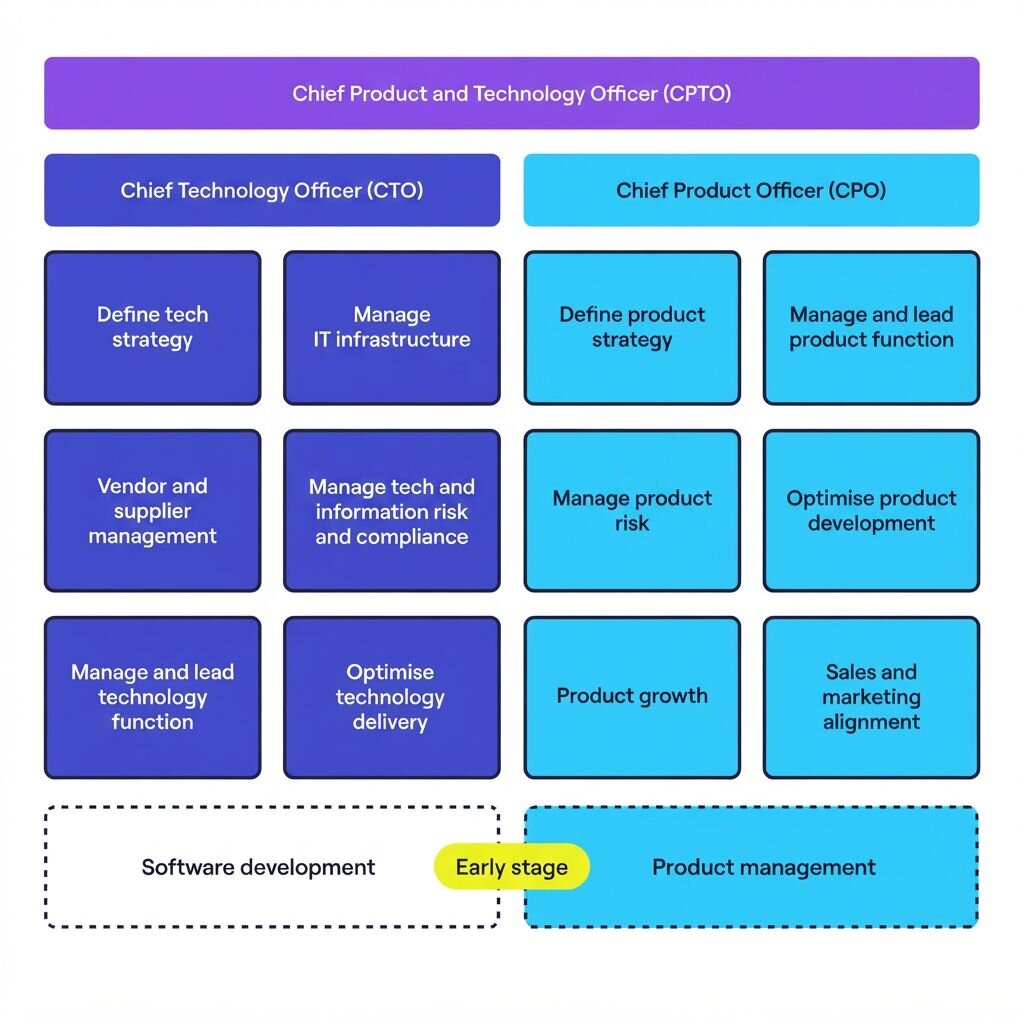
A product leader who moves into a CPTO role brings commercial instinct, customer empathy, and prioritisation judgment, however the gap between that and the depth required to hold the confidence of a senior engineering team is significant if you don’t have technical knowledge. “If things go wrong such as a cyberattack, you’re responsible. Someone who’s been building customer requirements and shipping product is not qualified for those moments,” he adds.
On the flipside, Shir Inbal, Product Lead at Pendo, who has worked under CPOs, CTOs, and COOs, believes that those product leadership skills are incredibly hard to grow if you pivot from a technology leadership role into a product leadership role. “Most of the conversations are very technical if you’re working for a CTO as a product person. I’ve found that a lot of CTOs are very tunnel focused on how to get there, not how the market sees your product.” In practice, she found herself seeking peer communities, mentors, external networks to fill what her reporting line wasn’t providing.
Regardless of whether an engineering leader or a product leader takes that role, there’s always a risk that they naturally lean towards one side. Singh acknowledges the shift — “I used to get that resolution, and now I have to generate it” — and describes finding herself reviewing architecture diagrams and security postures with a different level of scrutiny than she ever had as a VP of product. “The criteria I use to make decisions has fundamentally changed.” What helps, she argues, is intellectual honesty about where your gaps are, and engineering leaders underneath you who trust you enough to fill them. “You need all of that, and the ability to personally evaluate technical trade-offs well enough that the engineering leaders that report to you treat you as a peer.”
Wickremasinghe who started her career as an aeronautical engineer before moving into product looks for the same balance in the people she hires. “A product person who understands tech and a tech person who understands product is so important in the CPTO role. I’m looking for pragmatism on both sides.” She’s also clear about where even she has limits. “I've had to become a better storyteller, because I'm communicating to two vastly different groups of people.”
Moving from engineering into a product and engineering leadership role, or vice versa, is hard. Deep technical experience, like that of Prerna and Wickremasinghe, is a real asset in these roles. But so is balance. Every decision you make benefits from holding both perspectives at once.
How teams are structured
Structure is where the philosophy of the CPTO becomes concrete. There were three models that emerged based on the conversations we had with leaders in these roles.
The first is what Wickremasinghe calls the “amigos model.” A director of product, a director of engineering, a director of design, and a director of data sit as peers, each line-managing their own discipline but working daily within cross-functional product teams organised around domains. “They are all accountable for the same outcome, and then they have to figure out the technology choices and the feature choices and the priorities and the tech debt together. It’s a joint accountability,” she says. When everyone on the team shares a goal, the usual blame patterns become harder to sustain.

An example of Amigos model.
The second model, closer to what Singh describes at Avaaz, puts the CPTO at the top with VPs of product and engineering translating the vision downward. The advantage here is speed. “If you’re having to spend more time adding meetings to the calendar to sort out tensions between a CPO and a CTO, those are all cycles that slow you down,” she says.

An example of how Prerna's team operates
Both models share the similar logic that decisions that previously escalated to the CEO now resolve one level below. “I’ve seen it where if they were not laddering up to the same person, it’d go to the CEO to resolve,” she says. “And now you have to explain trade-offs to a person who has even less context.”
Natalia Williams, now a Fractional CPO, who began her career as a product designer and engineer before moving into CPO roles, believes the quality of collaboration depends on when engineers enter the conversation. “The best engineers I’ve worked with are the ones that challenged me from a product perspective and said, ‘I hear what you’re trying to accomplish, but I feel like there’s a better way.’” For that to happen, leads need context early. The Single Threaded Leader model, pioneered at Amazon, is the most prominent precedent for this kind of accountability.
Sean O’Neill, now CPTO at Syncron, saw it operate firsthand: “The key insight for Amazon was to have a Single Threaded Leader driving the vision, the proposition, the validation, the development, and to have all the resources necessary to succeed or fail in the role. This resulted in the tightest alignment between product and tech with the fastest cycle time to innovate or pivot.” Amazon’s unit leaders rose from either engineering or product backgrounds, the path of their roles mattered less than the single point of accountability.

An example of the STO model
In younger organisations, particularly those where the CEO comes from a non-technical background, the CPTO often exists because the CEO needs a single person to give them a coherent picture.
What AI is doing to the role
Every conversation eventually turns to AI. Leigh Newsome, partner at Hoola Hoop and executive advisor to CPOs, CTOs, and CPTOs, names agentic AI adoption as the number one topic hitting leadership plates right now. “For companies that have been around for quite some time and are not AI-native — how do they adopt agentic product development processes into their organisations? That train is running quickly.”
AI has also raised a harder question of ownership. When a company deploys a large language model as a core product feature, who owns it? The CPO, because it faces the user? The CTO, because it sits on the technical stack? Neither answer is sufficient. The CPTO, sitting across both worlds, may be the only executive who can hold both sides of that question at once.
His advice after a roundtable on exactly this question: “Bring prototypes, not code.” Product leaders can use AI to see something come to life, to test ideas and communicate direction. But the lower-level mechanics of scalable, secure, production systems still require engineering depth. The assumption that AI can substitute for technical depth — and by extension justify a product leader stepping into a CPTO role, is one Shir Inbal is sceptical about. “A lot of companies believe it’s easier to bridge that technical gap with AI, which is why CPOs are falling into the CPTO role,” she says. “But you still need that technical expertise regardless of AI. You still need to have that deep knowledge.” At scale, the arithmetic doesn’t hold: “Think about the size of an 800-person company — do you know how much information and decisions and time it takes for one person to be up on everything? There’s only so many places you can be as a person.”
The Mind the Product Community Survey for Product Leaders mirrors these thoughts. Product managers doing more building, and engineering shifting toward smaller mixed teams covering more ground. “I see the engineer/PM roles becoming more intertwined,” said one VP of product. “Hybrid roles, with pure engineering focusing more on architecture, testing, and developing harnesses for generalist product/design/engineers,” said another CPO.
The caveat raised by multiple respondents is that speed alone is not the point. “There’s a bit of a trend to rush straight to solution because you can so quickly,” noted one VP of product.
The CPO is rising, and that complicates everything
At the same time the CPTO role is gaining momentum, the standalone CPO role is also seeing its highest demand in years, Rosenthal says. “We’ve never had as many product roles on simultaneously.” He believes that when technology becomes increasingly commoditised, when you buy AI rather than build it, the scarce skill is knowing what to build. “If you take away the heavy lift for engineers, which we know is going with AI, then actually you realise the value is coming from the product people who understand how to make something customers want to purchase.”

Data from Live Data Technologies reveals that both the CPTO and CPO role are growing
It’s an argument MTP has been making for years. Writing in 2018, Simon Cast observed that “technology is ubiquitous and on its own is no longer a competitive advantage. Product management, however, is a force multiplier for business.”
Based on his conversations with executives across the US, Leigh believes that teams are looking to consolidate, he says: "I looked across a lot of the companies we have worked with and work with, and I would say the number of a CPTO type role is much higher than I expected. I saw in some cases two-thirds of the organisations actually having something pretty close to a CPTO. They may call it something different—sometimes they leave a CPO title and, you know, engineering may report into that CPO alongside product."
To add more options into the mix, Rosenthal is seeing early signs of a new title emerging in digital-native businesses: GM of Product. This role is vertically integrated, owning the P&L, the marketing team, the engineering team, and the full journey from product vision to revenue realisation. “It only makes sense. You’re not just waiting for requirements and then hoping someone codes it for you and someone else sells it. You own the whole thing.”
Whether that’s the future or a niche experiment in a few progressive organisations remains to be seen. But it signals something real, the debate about how to structure product and technology leadership is far from settled.
Our take
It would be tidier to end with a clean answer, like a checklist: if your company is X size, in Y industry, with Z revenue model, hire a CPTO. But you would be the first to tell us that it’s a bit more complicated than that.
What the evidence does suggest is that the CPTO works when it’s a strategic choice for the right individual, instead of a structural shortcut to cut costs. When the person in the chair has genuine experience and skill on both sides, enough to be trusted by engineers, and enough to hold the commercial and customer-insight that makes product decisions meaningful, and also the management skill to communicate effectively with a VP of Product and VP of Engineering to help manage that load.
Additionally, the CPTO position is likely to be more effective when the organisation’s product is not primarily a technology product, such that the role isn’t being asked to produce two exceptional specialisms from one person.
Jon Horvath, who comes down on the side of keeping CPO and CTO separate, argues that the friction between them is a feature of the natural dynamic between the two teams: “There’s an inherent friction that’s really healthy between the two organisations. Being able to have each other’s interests at heart, but also push on the customer side is really healthy.”
Shir Inbal keeps it simple: “Product and engineering always work in unison. But they can’t be one and the same, there’s a difference.”
“It devalues both their contributions,” argues Rosenthal. He’d rather see a CPO and a CTO working in constructive tension.
On the other hand, Wickremasinghe, Singh, and Newsome, would rather have one decision-maker and no translation loss.
Prerna says, "I think that blend of CPTO is more likely to be more important than ever because you can't really just justify a product expert when so many engineers can come up with products themselves. Equally, you can't just justify just a tech person when the product blends in so much to the business. You need to be able to be really driving value with the tech."
Leigh adds, “Historically, some companies made this move as a cost-cutting measure, saying, ‘We can't afford to have two executives, let's just pick one. And have both departments report into a leader. However, I think the real opportunity comes down to companies intentionally defining CPTO roles and recognizing that for a genuine strategic advantage.” Leigh recommends to really look at the combination of product and technology, and how the two are really intertwined. Get the right leader that understands both and can lead both and use that as a secret weapon for the company to really help differentiate the product and user experience they deliver to the user.
He closes, "The most effective CTO-CPO pairs operate with overlapping rather than sequential thinking. Product direction and technical feasibility are discussed in the same room, at the same time, early. The goal is to eliminate the delay between them." which is what the CPTO could solve.
The right answer depends on what your organisation actually needs. And the first step, as ever, is being honest about that.
Mind the Product spoke with Jo Wickremasinghe (CPTO, BPP), Prerna Singh (CPTO, Avaaz), Leigh Newsome (Partner, Hoola Hoop), Stephen Rosenthal (Founders Keepers), Jon Horvath (Former Head of Product, BibliU), Shir Inbal (Product Lead, Pendo), and Natalia Williams (Fractional CPO) for this piece.
Community survey data was collected anonymously by the Mind the Product Leadership community, and Live Data Technology data was collected by public data from over 4,500 CPTOs.
