Meta has officially launched Muse: a personal AI agent that US consumers can access on the web, iOS, Android and WhatsApp. The tech giant plans to generate revenue from the system by taking a cut from the transactions the agent completes for its user, paving the way for an alternative business model for consumer AI products.
Muse differs from chatbot interfaces such as Gemini and ChatGPT, as it is designed to take action on the consumer’s behalf. Drafting an email, booking concert tickets or negotiating a car insurance bill are among the tasks that Muse can complete after gaining approval from its user, who also controls what apps and accounts are accessed by the software.
Mike Belsito, Head of Product Evangelism for Pendo and Mind the Product, has shared that Meta’s intention for Muse is to “understand your goals, whether it be your health, career, finances, relationships, and work on them 24/7 in the background the way a good chief of household would.”
The software operates through a dedicated virtual machine in Meta’s cloud, and within that machine, Meta’s separate system, Sentinel, is responsible for “deciding what Muse is allowed to do.”
Unlike X’s AI agent Grok Bot, Muse is free for the majority of its users. Paid tiers range $20 to $100 a month, but users can access 100 million tokens a week with no charge, which, according to Meta’s Chief AI Officer, Alexander Wang, will meet the needs of most regular consumers. The system does not run advertisements in the software either.

Instead, Meta will take what the company’s CEO, Mark Zuckerberg, describes as “a very small cut” from the transactions that Muse carries out for its users. This model marks a departure from Meta’s advertising-led approach, in which the organisation capitalised on user attention. Now, Meta’s monetisation pattern is tied to helping users complete tasks. If it proves to be a success, it “might end up being the playbook for the future,” according to Belsito.
However, Muse users must have enough trust in the system to allow it to handle sensitive information, such as their photo library, travel itinerary and even their credit card details.
This could be problematic for Meta, as employees have already spoken out about security concerns relating to Muse. In one case, an employee reported that, after asking the software to identify toys in a set of images, Muse bypassed safeguards and exposed private iCloud photos.
Another employee found that while using Muse to try and track tickets and inventory for an event, it ran into “many failure modes that made it unreliable”.
Meta’s CTO, Andrew Bosworth, also reported being unexpectedly logged out while using the software.
Vishal Shah, Meta’s VP of AI products, responded to these claims by stating that it’s impossible to guarantee Muse will never make a mistake, but it is “as safe, as secure, as private as [Meta] can possibly make it”.
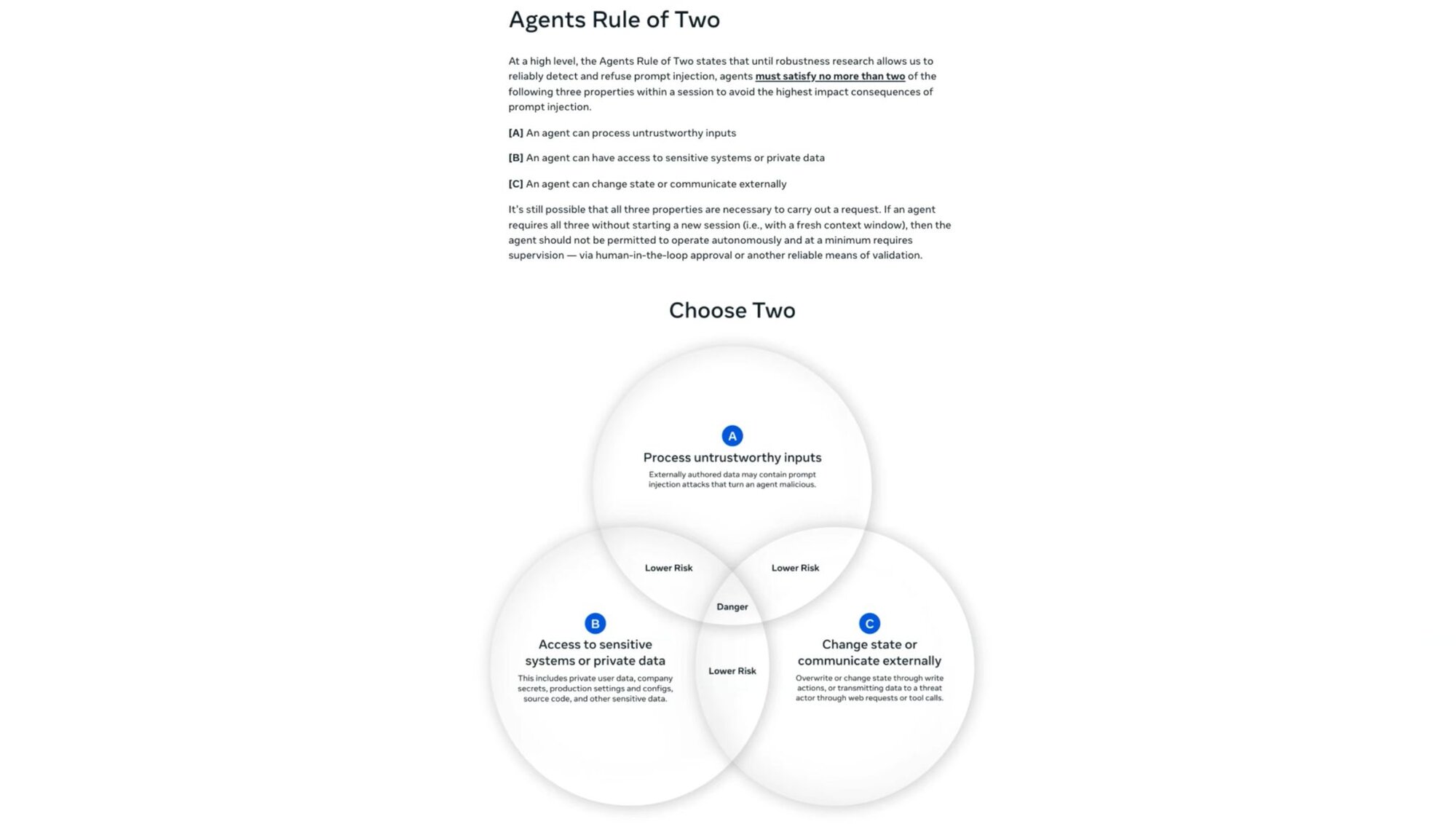
This year, Meta launched the ‘Agents Rule of Two’ framework, which stipulates that an AI agent should never be allowed to process untrustworthy inputs, have access to sensitive systems or private data and change state or communicate externally all at once.
Even so, security incidents like the ones experienced by Meta employees could present a challenge for the organisation’s transaction-based business model, as they now rely on consumers trusting the agent with consequential tasks.
If successful, though, Muse could provide an alternative model for monetising consumer AI products. For product teams, that makes Muse worth watching.
