At #mtpcon London 2026, Vonny Laing, UCD Lead at Student Loans Company, made the case that most product teams are building things with far more impact on people's lives than they realise. Therefore, the growth playbook they were trained on no longer works.
Drawing on 20 years across public and private sector, she introduced a different approach: design from the edges outward, distinguish what users want from what they need, and get out of the building to understand both. When your product becomes something people genuinely rely on, you inherit a duty of care, whether you chose it or not.
Watch the video in full, or read on for Vonny's key points.
The line between product and service is blurring
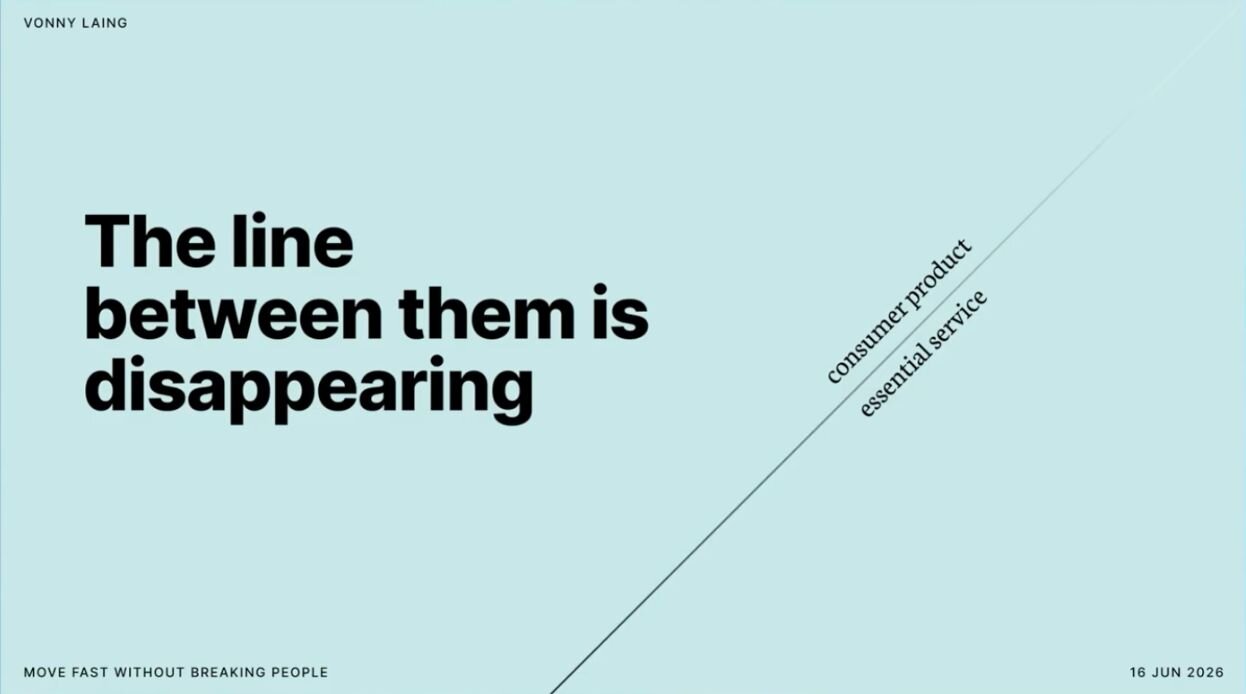
Laing opens by explaining that over the course of her career, she has noticed that the line between a product someone chooses to use and a service someone genuinely relies on is disappearing. Most product teams are now building things that have a far bigger impact on users' lives than they realise. She argues that the optimisation and growth playbook they were trained on doesn’t work anymore. "If we are designing things that people really need, we need a new playbook," she says.
In her career, she approaches product work through three lenses. As a public servant, she designs for everyone regardless of whether they shout the loudest or pay the most. As a designer, she has come to see the role as inherently political; what you decide to include, deprioritise, or ship first determines who gets to use something. As a researcher, she doesn't trust anything until she has tested it in front of real people.

Designing for the edge cases
Reflecting on her time working for a supermarket bank, the business had both a supermarket and a banking arm that served entirely different demographics. It came to Vonny and her team with a new customer strategy that requested them to target the customers who had the least money. That meant a family demographic earning under £25,000 between two parents, likely in persistent debt, for whom the points and vouchers at the end of the month were a necessity.
To bring her experience to life whilst protecting anonymity of the user, she introduces a composite user drawn from her research: a young single mother, studying and working, with two children, who had too much month at the end of the money. Despite all of this, Laing explains how she was extremely good with money. The user ran an envelope system, one for food, one for fuel, one for school dinners, one for clothing, and could tell you without looking how much was in any envelope at any given moment. She knew which supermarkets reduced food at what time on which day. She took her children to beaches, forests, and museums. When she wanted to treat them, she took them to a Pizza Hut buffet and ate the salad her kids wouldn't finish so she didn't have to buy herself an extra meal.
"When I started to meet users like this, it really opened my eyes,” Vonny explains. “There was an assumption that someone who is struggling financially is bad with money, and that absolutely was not the case. She was one of the most sophisticated money managers I've ever met."
Following on from her findings, her team flipped the design process. Instead of starting with the core or typical user and then working outward, they started with the most challenging use-cases. Vonny argues that when you make something easy for your most challenging users, instead of your core and typical users, those benefits flow up to everyone. The clarity that helps a single mother track her overdraft to the penny also helps a millionaire, she adds.

She spent the remainder of her talk breaking down principles to build impactful products for users who rely on your service.
Eat your greens
Vonny’s first practical principle is what she calls eating your greens. She explains how user wants and user needs are not the same thing:
- The want gets someone into your product.
- The need, including the need they don't know they have yet, is what keeps them there.
Your user's needs change over time. Personas, mindsets, demographic data, they’re a snapshot. She shares an example of a user who moved city, watched their husband be made redundant, became the primary earner, and then went through a cancer scare, all within a few years. The person who needed your product in chapter one of their life is a different person in chapter nine.
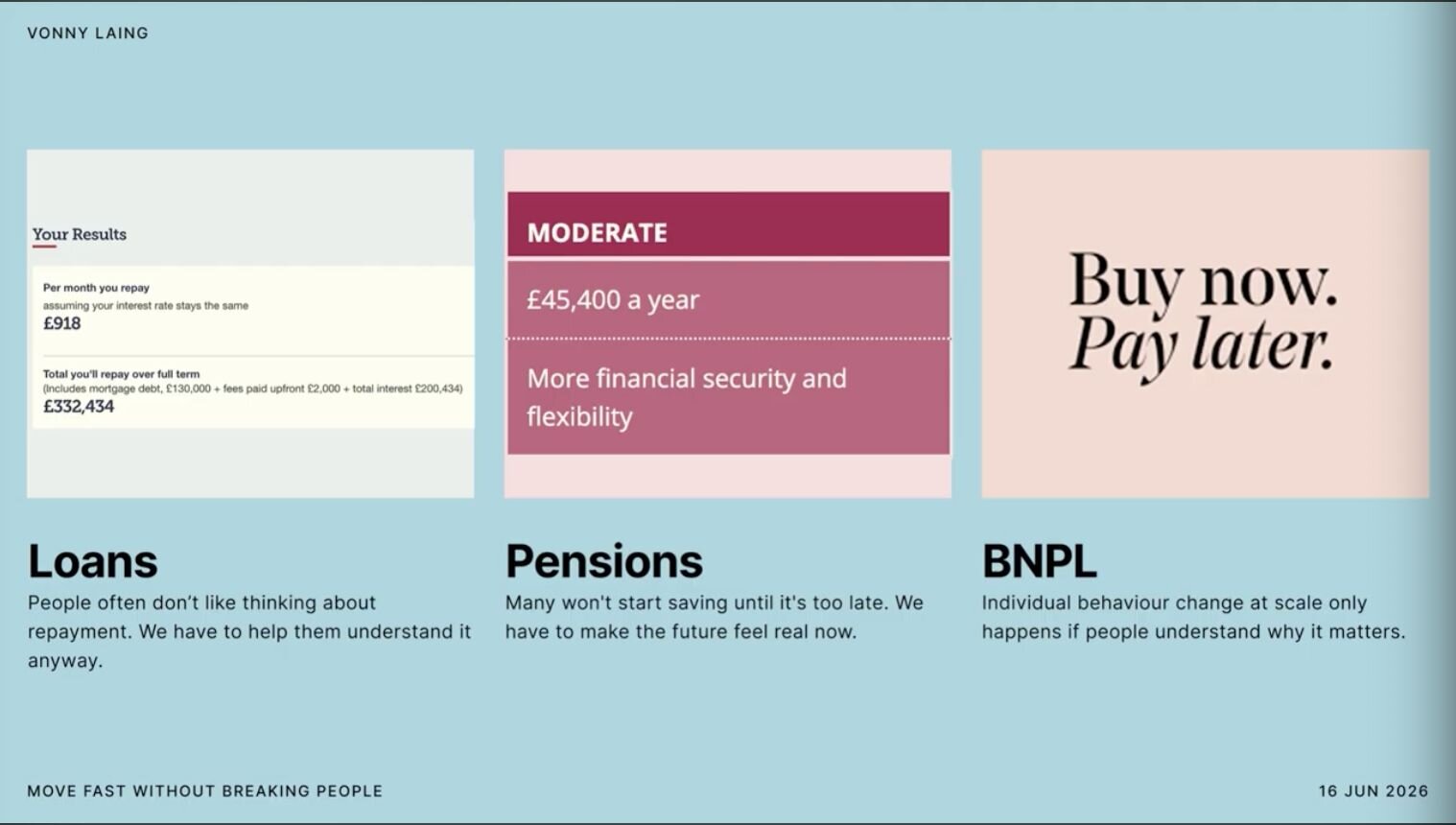
She points to three domains where this matters most for her role specifically:
- Loan repayments, where people make decisions they'll live with for decades.
- Pensions, where a 25-year-old cannot meaningfully conceptualise their future self.
- Buy now, pay later, which was made so frictionless that people could commit without thinking.
"We get really good at selling people the chocolate, but future them is the one who has to pay for the dentist," she explains.
Follow your product decisions forward, Vonny explains. What happens if they get exactly what they’re asking for, and nothing else? Who is on the other end in six months? In three years? In five? In a room full of product people, only one hand went up when she asked who had ever been asked that question in a meeting.
Leave the building
Vonny is adamant that nothing replaces in-person research, and equally unequivocal that the most common excuses for not doing it, such as no budget and no time, aren't good enough.
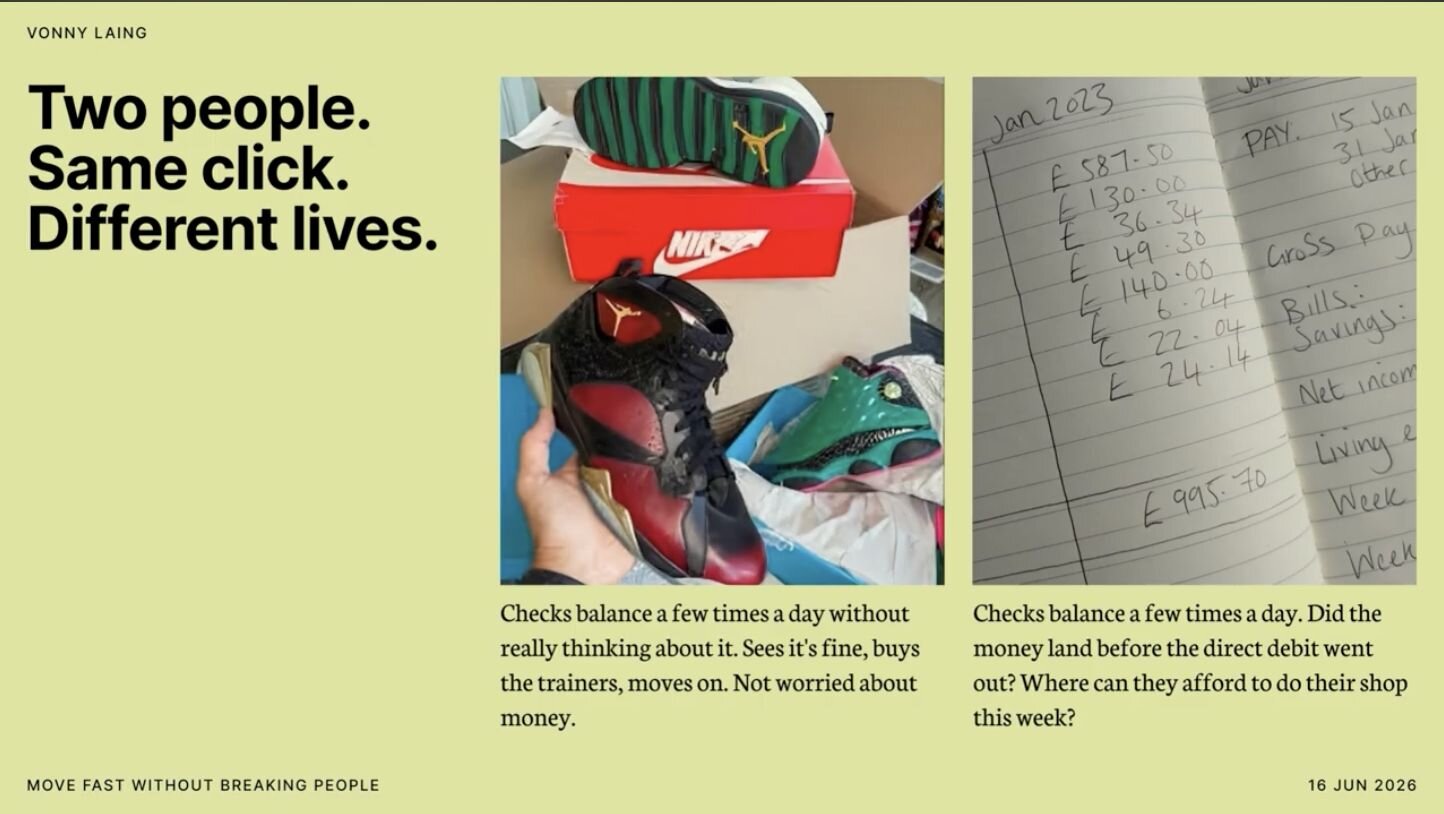
Two users can click in and out of a banking app five times a day and generate identical behavioural data with entirely different emotional experiences, she explains. One is checking whether there's enough in the account before buying a new pair of trainers, while the other is running mental arithmetic: did the direct debit come out, will there be enough for groceries, is an unarranged overdraft charge about to wipe out her food budget? You cannot see that difference in a completion rate. You can only see it by spending time with people.
"Nothing we build lives in isolation. So it's really, really important that you understand what your user needs, not just what they want, and you get out and see what people are doing so you can understand what they need from you now and in the future," she adds.
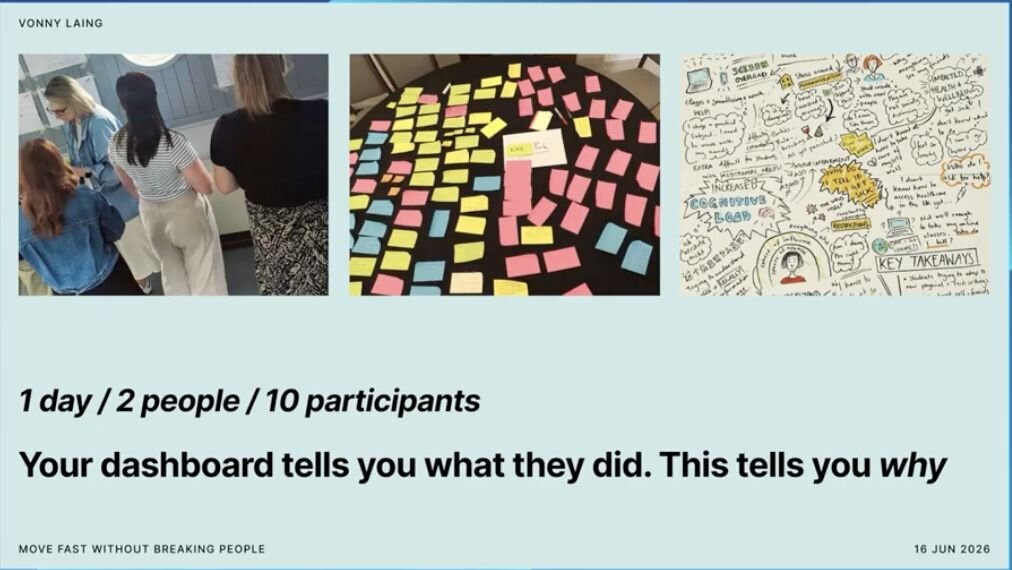
It doesn’t have to be expensive, Vonny stresses, "Give me two people, their train fare, a box of Celebrations, and an excusal from their meetings and they’ll come back with some insights.” That doesn’t require an expensive research programme. "Go out, touch grass, and talk to people," she says.
When you do that, you find out more about them and build rapport.
Don't stop caring
Most people who work in product started because they cared, about building the right things, about doing right by users, Vonny explains. That level of care gradually gets designed out through deadlines, dashboards, shareholders, KPIs.
"Don't let that happen. You can still move fast, it's really important that you do, but make sure you know who is on the other end. And don't break them. It doesn't take much. I promise."
