At #mtpcon London 2026, John Moriarty, Product Design Director at Fin, formerly known as Intercom, shared what happened when the company went all-in on AI-assisted development.
Within a year, productivity across R&D had tripled, 94% of pull requests were authored by Claude Code, and nine major products launched in two months. Drawing on the past twelve months inside Fin, he explained where product people's value now sits when agents manage the middle.
Watch the video in full, or read on for John's key points.
Going all-in on AI
Fin started life as Intercom about a decade ago, helping its customers talk to their customers online. In 2022 it made a bet that AI would be the future of customer service.
Twelve months earlier, Fin's CTO had set a goal to double productivity across R&D using AI within a year. People thought it was ambitious and progress was flat for the first few months. Then a new batch of models arrived in December and everything accelerated.
Over the full year, Moriarty explains that the company has tripled productivity, measured by pull requests per person per month across the whole business.

Moriarty adds that 94% of Fin's pull requests are authored by Claude Code, and 19% are auto-approved with no human reviewer in the loop. That has meant twice the number of product changes, shipping 39% faster, he cites. But the number that matters, he argues, is nine major product launches in two months.
Agents own the middle
To understand what's shifting, Moriarty explains what the process used to look like. The volume of work was large and execution was expensive. You needed dedicated roles just to keep pace.

AI changed all of that. Everyone else's focus moves to the edges when agents own the middle of the product development process. In practice, this means:
- PMs shift further upstream to the most strategic customer conversations.
- Design moves upstream to contribute to the roadmap and downstream to contribute to the front end.
- Engineering goes end-to-end on more ambitious projects while building the technical foundations the entire system runs on.
The same steps of designing, building, and reviewing still happen, but in much tighter loops. What used to take weeks now takes days, and the same team can run multiple streams in parallel. That, he says, is how you get to nine tier-one launches in two months.

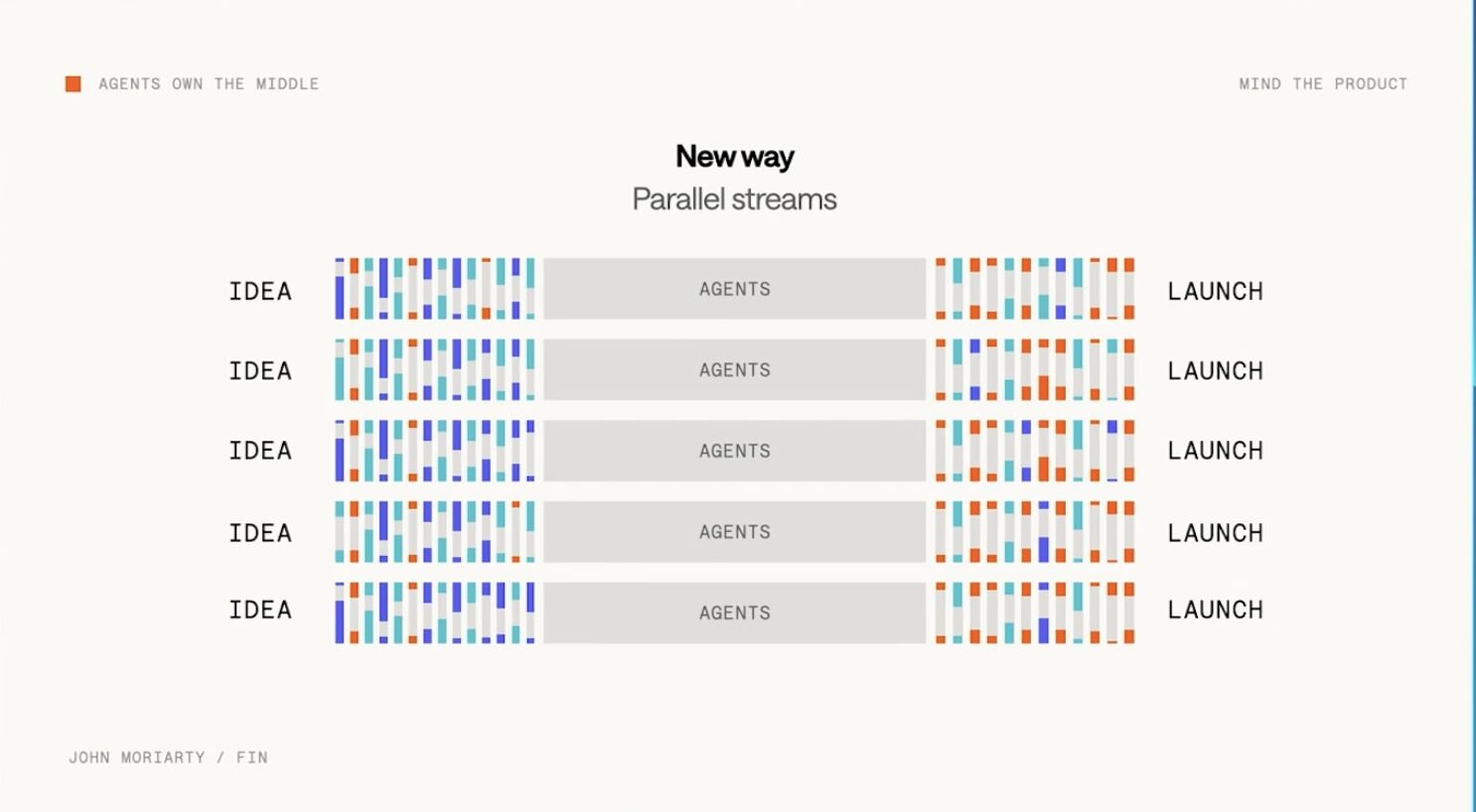
When the slow part is no longer the build, Moriarty explains that problem framing, decision-making, quality, and cohesion makes things more difficult. These are the challenges that land on product people.
Boundaries are blurring
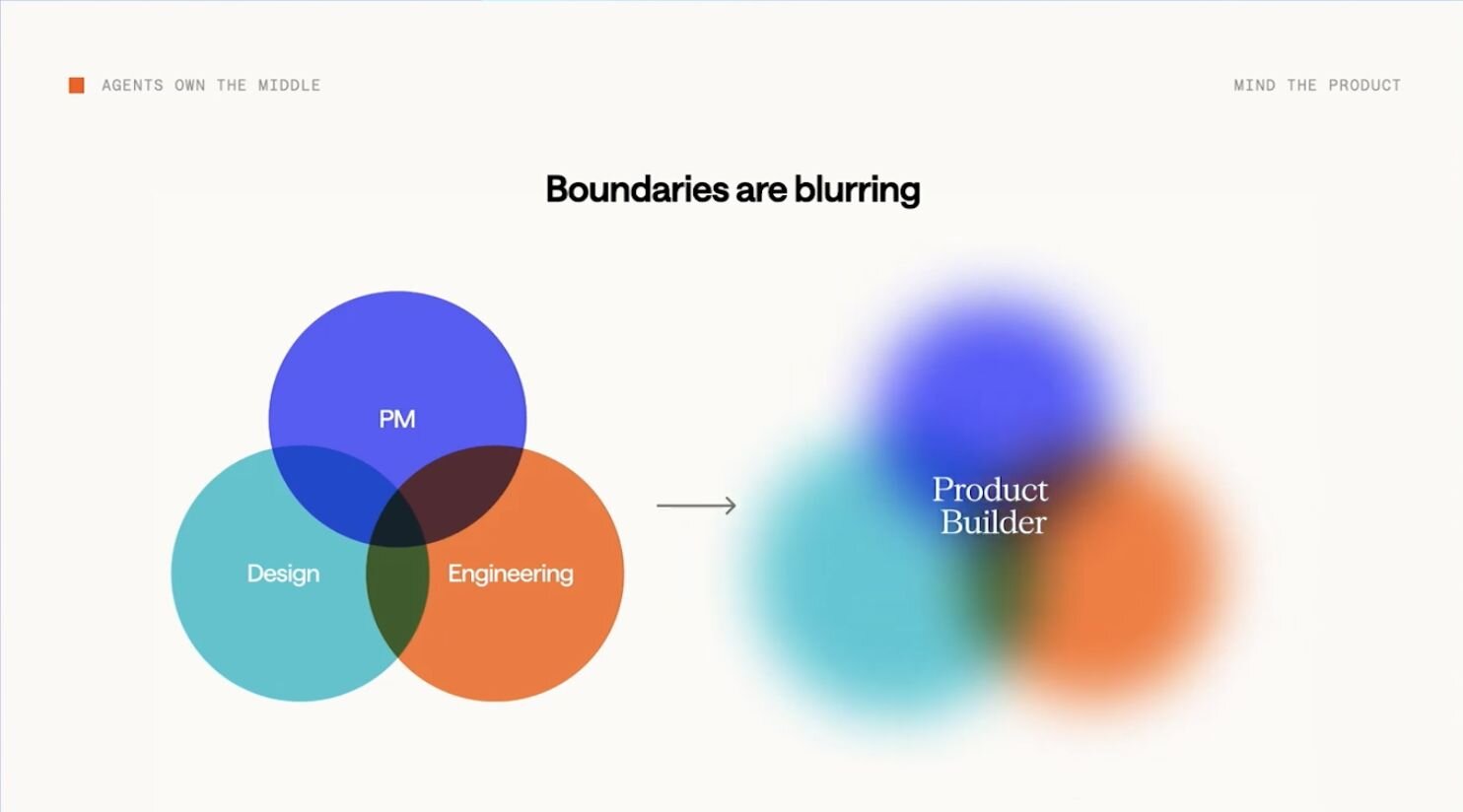
That shift has been uncomfortable, particularly for designers, he adds. Moriarty's team has had to let go of what they used to define as craft. "Craft used to mean controlling every detail, but now it means setting the conditions that shape quality," he says.
Fin's design team is deliberately letting go of ownership of the UI, with a vision that everyone across R&D has the tools and knowledge to ship high-quality product.
The designer's role shifts from gatekeeper to orchestrator. The value of the product designer now comes from setting the standard that holds the quality bar across the organisation.
Moriarty breaks down three areas of focus for the product design team at Fin:
- Defining what to build: Execution is faster than ever, which makes direction more important; the leverage sits in choosing the right thing. He shares the example of Procedures, a product that began as a concept from a designer, who partnered with an engineer, coded a prototype using real customer data, and iterated in front of customers in real time. "In a previous world, we would have written PRDs and discussed this repeatedly."
- Building the infrastructure: Without shared standards, speed becomes a liability, Moriarty explains. Fin's design system, Surge, and its companion, Surge Intelligence, codify components, patterns, and design and engineering decisions in a format AI can consume.
- Ensuring quality at scale: Moriarty explains that getting a product to 80% is almost instant now, and anyone can create something credible, so the risk is quality decreasing as volume accelerates. "The way we define the product design craft has changed."
The UI is no longer the product
Moriarty explains how interfaces are thinning and agents are displacing UI. "The thing that we as designers learn to build — the screen, the UI — is increasingly not the product." He leaves the audience with the question every product team is going to face: "What's left of your product when AI handles the jobs it was designed to do?"
Five principals to live by as a Product Builder
Moriarty closes with five specific asks to thrive in this new way of building:
- Get hands on. You cannot direct something you don't understand, so get inside these systems beyond the quick demo and the vibe-coded prototype, and learn where they fall short.
- Raise the floor. The teams seeing the biggest gains are the ones that built the infrastructure so that when one person gets better, the whole organisation does. It takes leadership buy-in and deliberate investment, and it's the difference between teams experimenting and teams compounding.
- Speed needs direction. "Vague briefs produce vague outcomes at speed, in every direction at once." Get obsessively clear about what you're trying to achieve, and design in deliberate pauses to ask whether you're still solving the right problem.
- Understand what good looks like. Taste has to be in the systems, criteria, skills, and guardrails that agents and teams build against. "If your bar for good only exists in a few people's heads, it won't survive the pace."
- Redefine what done looks like. Shipping is now the easy part. The harder question isn't whether a feature is good, but whether it should exist, because "done" now means something at a product level, coherent and intentional, and someone has to own that.
Agents owning the middle isn't a threat, Moriarty concludes, it's a fact. The question is what you do at the edges. He closes, “It's the best thing that's ever happened to us."
