Simonetta Batteiger is a co-active coach who works closely with product leaders. At mtpcon London 2026, she opened with a provocation: sure, tech products are having an impact in the world right now, but not all of it feels like something to be proud of. Hence the slightly transgressive title of her talk.
Her main point centred on what it means to build trustworthy product experiences and why, in an age of agentic AI, product teams can no longer afford to leave that to chance.
Watch the video in full, or read on for our key takeaways from her session.
What do you not want to stand for?
That was Simonetta’s first question to her audience. It’s also a heuristic she uses regularly when coaching product leaders through difficult decisions, exploring beyond just what matters to them, and into what they actively want to stand against.
She adds that, right now, the list of things worth saying no to is long: AI slop, hallucinations, psychophancy, enshittification, AI systems that flatten diversity by returning an average of all possible answers. She concludes these are all products and ways of operating with real-world negative impact, from environmental costs to documented cases of AI-induced psychological harm.
It’s hard to reconcile the inherent promise of building products with the reality of what some of those products are doing to the world. But, she notes, when asked why they enjoy their roles despite the difficulty and uncertainty, product leaders consistently give the same answer: having a positive impact in the world. That shared motivation is precisely why the question of what we say yes to matters so much.
Trust is the foundation
Simonetta frames trustworthiness using the metaphor of a house: trust is the foundation and without it, nothing else can stand.
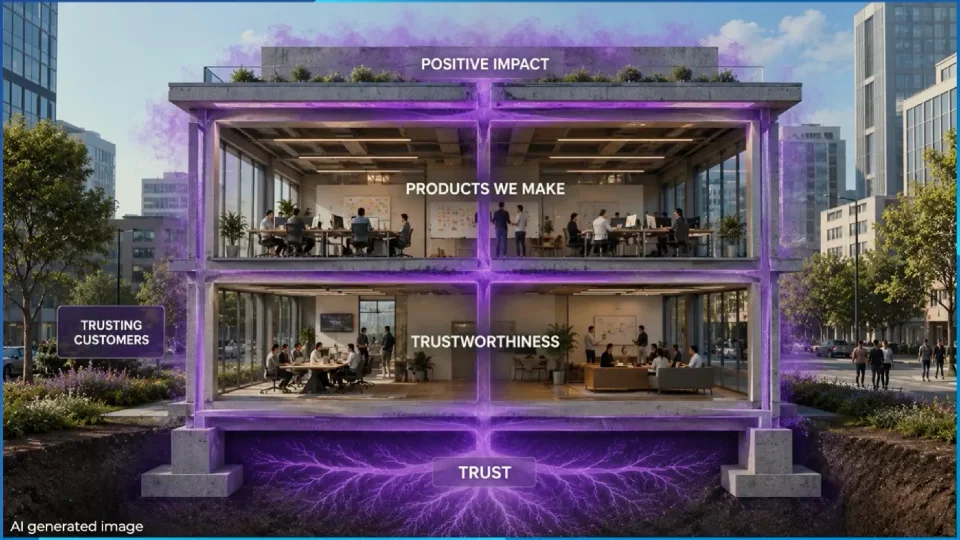
She draws on Stephen Covey's The Speed of Trust, which examines trust across two dimensions: character (your integrity, your intent, your honesty and congruence) and capability (meaning here the results you're actually creating in the world). As product builders, you can influence and design for both of these to suit your values.
And, Simonetta argues, in a world where agentic AI systems are making decisions on your product's behalf, that’s a significant risk. It’s your duty to ensure both dimensions are in place in order to create a trustworthy product.
When trust breaks down
To make the business case concrete, Simonetta shares a recent example. A Starbucks marketing campaign in South Korea—its third-largest market—was created using AI and went live without adequate human oversight. The campaign referenced Tank Day, a painful episode in South Korean history in which military forces suppressed the country's early democracy movement, resulting in 150 deaths and thousands of hospitalisations. To make things worse, the campaign used a slogan tied to a police cover-up of how some of those people died.
The mistake cost Starbucks a 26% loss in credit card revenue over a single week. Extrapolated to annual revenue, Simonetta estimates this would have been worth roughly $580 million. The company had to apologise publicly to the president, close stores for a full day of employee re-education, and deal with customers destroying their merchandise in the streets.
The point of this painful example is that, when no one in the loop has a clear sense of what “good” looks like and what they must avoid, costly mistakes can happen.
You have to specify the good
Avoiding harm is necessary, but it’s only the bare minimum. It doesn't constitute a positive vision, and it's not enough to guide an AI system.
Agents without clear context will default to the average, not to the product builder’s unspecified values. That means you have to be explicit about what trustworthiness looks like in your specific product context. That should cover both what's forbidden and what counts as a good outcome.
Simonetta points to Martin Ericson's decision stack as a useful mental model for specifying this across layers: vision, strategy, goals, and foundational principles, adding a non-negotiable of her own—trust over short-term gain.
Another useful diagnostic tool, and one she says has aged very well, is Akshay Core's 2018 thesis that a system which isn't trustworthy isn't useful. Core's framework breaks trustworthiness into five qualities: explicability, transparency, lack of bias, privacy-centredness, and benefit to society.
Finally, Simonetta points to a paper that forms the basis of the EU AI Act, which covers trustworthiness aspects including human autonomy, prevention of harm, fairness, and explicability, with practical examples of how to govern for each.
Designing trustworthiness by design: Practical examples
Moving on to practical examples of build-in trustworthiness by design, here are some that Simonetta highlights.
Preventing skill atrophy in medical AI. A radiologist she spoke to described how their imaging system is set up so that doctors still make the diagnosis themselves first, speaking it into the system before the AI weighs in at all. The AI is then only for flagging disagreements, which prompt the doctor to take a second look. This keeps the human in the loop and the system is just an additional safety layer without replacing clinical judgement.
Building non-bias as a core feature. A product leader in Simonetta’s working group is building a hiring system for government use, with the specific requirement that the system be provably non-biased. Rather than treating this as a constraint, she treats it as the product—because if she can't demonstrate that the system decides fairly, she won't be able to sell it. This means things like zip codes, commute time, or gaps in a CV are explicitly excluded from what the model can see.
Preserving human agency as a competitive differentiator. Ecosia, a European search engine, recently gained 40% more users in the US in part because it gave users the choice to search without AI summaries at the top. Meanwhile, Google did not explicitly have this option. Designing for human agency, Simonetta says, can be a genuine source of growth.
Trusting agentic buyers. As AI purchasing agents become more prevalent, products need to expose specific signals—such as rate limiting and supply chain information—so those agents can make informed decisions about whether to keep buying.
Where to start this week
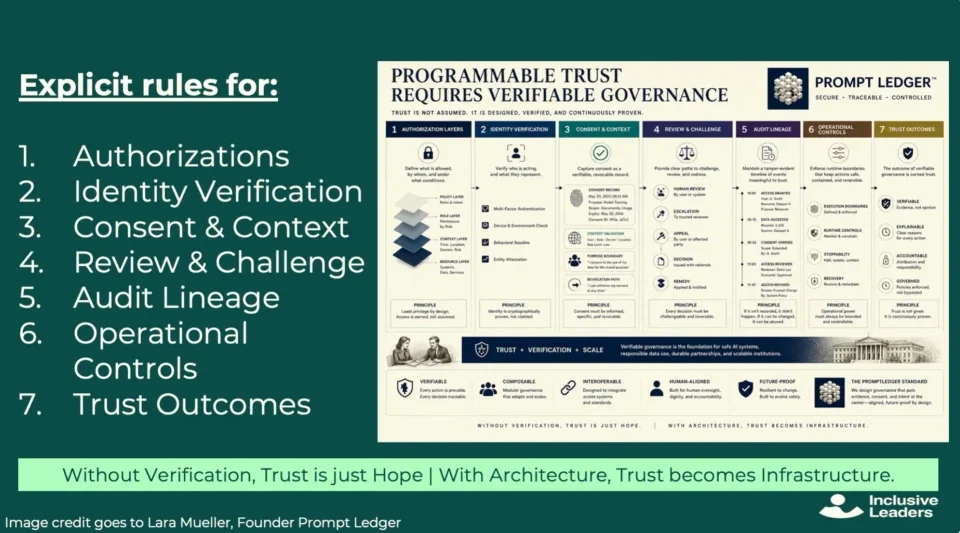
Before closing her talk, Simonetta covers what build-in trust can look like: authorisation, identity verification, consent and context, fallback mechanisms and kill switches, explicability and logging (input, output, and what happened in between), and operational controls.
Finally, a practical call to action that PMs can apply this week:
- Get clear on what trustworthiness means for your specific product. Simonetta recommends pages 32 onwards of the EU AI Act's underlying paper as a checklist of trustworthiness principles to design against. We’ve linked the whole document above.
- Make your vision, strategy, and principles explicit, not just for your human team, but for the agents that co-create with you.
- Hold the principle of trust over short-term gain when making difficult decisions.
- Think about human agency: where in your product can you preserve the user's choice and control?
Every bullet point is significant, she concludes, because you cannot build a useful product if it isn't trustworthy. In a world where agentic systems are increasingly co-creating your product experiences, trustworthiness by design is the job.
