
The real problem is letting AI pressure override your product judgement.
The alarm on your phone goes off, but you’ve already been awake for a while, scrolling. Your LinkedIn feed suggests that every product person has become an AI builder overnight: researching, prototyping, creating agents, shipping features, and posting the results before you’ve finished reading the latest AI summary.
I recognise that fear of falling behind. But the real risk for product managers is not that we are failing to use AI fast enough. It is that the pressure to keep up is making us forget the core of the job: what to build and why.
I have seen two distinct patterns of response, two distinct camps: “AI introverts” and “AI extroverts”. These are not personality types, but coping strategies. And I’ve used both.
AI introverts respond to the pressure by going quiet. Maybe they’re experimenting with AI, but doing it cautiously and in private. Maybe they’re still learning and don’t have much to share, or perhaps they are sceptical. Either way, AI introverts don’t talk about AI much. And when they compare their personal experience to what they see on LinkedIn, it’s easy to conclude that they’ve fallen behind. This makes them even more quiet than usual.
AI extroverts respond to the pressure in the opposite way. Keen not to be left behind, they actively participate in every AI conversation, sharing their experiences and thoughts. They explore the latest developments quickly and are vocal about it. They might use language that expects AI fluency from the reader and often express strong opinions.

The same mistake in opposite directions
Both camps, AI introverts and AI extroverts, are doing their best to face a very real challenge. The extrovert fully engages; the introvert retreats.
But the more I watch these two camps, the more I think they make the same underlying mistake: both respond to pressure instead of applying product thinking.
AI extroverts over-correct. They react to the pressure of the moment by moving faster, building more and perhaps outsourcing some of their product thinking to the tools that make product work easy. AI introverts under-correct. Their response is to go quieter than usual, compare themselves to the distorted reality of social media, and distrust their own judgement because they think everyone else has it all figured out.
I’ve made the same mistake in both directions.
When the AI boom started, I was slow to catch up and embarrassed about it - I expected myself to be much further along. So I went into my shell, not sharing much about what I was doing but also not learning from anyone else: what tools they used, what problems they were solving, what issues they encountered. I was missing out on exactly the kind of intel that would have helped me move faster. That was the AI introvert mistake, and the embarrassment that caused it made it worse.
Then, to fight off the imposter feeling, I went the other way. I started building and building. At home, I prototyped Briefing, a little tool to manage day-to-day communication with my partner about mundane household stuff. I fell in love with how easy it was to make, and made the most basic product mistake there is. I never spoke to my customer. I was running on assumptions and never validated any of them. Looking back, part of me knew all along it wasn’t something my partner would ever use consistently. But I built it anyway and ended up with something that solved nobody’s problem, including mine!
I’d like to say I’ve grown out of it but I still fight the temptation at work. When a new exciting capability appears, it is so tempting to say yes to it without asking if it solves anything, whether it brings us closer to the vision, or whether perhaps it’s just a solution searching for a problem it could solve.
An answer from 2,500 years ago
Most people know the Greek philosopher Heraclitus for one idea: that you cannot step into the same river twice. The line from 2,500 years ago gets quoted so often that it overshadows the philosopher’s other argument—that underpinning constant change is logos, a Greek word translated as reason or rule. Heraclitus believed that everything happened according to logos, but that most people failed to recognise it, which in turn affected the quality of their decisions and actions.
Let’s apply this lens to the product context. The AI extrovert is focusing on the surface of the change. The introvert is hesitant to engage. Neither of them pays attention to the logos, which in these terms is product judgement. It’s the underlying question of which problems are actually worth solving, with or without AI.
So how can we pay attention to the logos?
#1 Break the silence
Instead of letting the LinkedIn feed give you a distorted view of reality, reach out to a few product people from your community and beyond to find out about their actual experience with AI. If you are still on a learning curve, be honest about that and ask for support..
If you suspect you are behind, treat that as an insight and lean into it: start to explore. But understand that your caution and your scepticism are an asset, not a flaw. The questions you have been quietly asking—“Does this help anyone?”, “Would the customers care?”—are the foundations of your product judgement. That is the logos, and not how many times you say the word “AI” at work.
 #2 Stay focused on your customers
AI-generated personas are so good now they seem like a great substitute for conversations. And let’s face it, talking to people takes time. It is so tempting to skip this step entirely and just talk to an LLM instead.
The single most important thing any product manager can do is resist that temptation and continue with customer interviews. Sure, use AI for initial orientation, to design your research or to analyse it but don’t make important product decisions without talking to customers.
Nothing will replace real contact with the people you’re building your product for. This is what helps you develop empathy and build a deep understanding of your audience. It’s a prerequisite for sound product judgement and decision making. (Teresa Torres and her Continuous Discovery are a great reminder!)
#3 Just because you can build it…
Yes, AI has dramatically democratised product development. It’s not only easy to build regardless of engineering experience, there’s also an expectation that you will build, and fast. But launching more features nobody needs just because it’s possible or because others are doing it won’t make the product any better. This is where your product judgement comes into play. Saying no is even more valuable today than it was in the past.
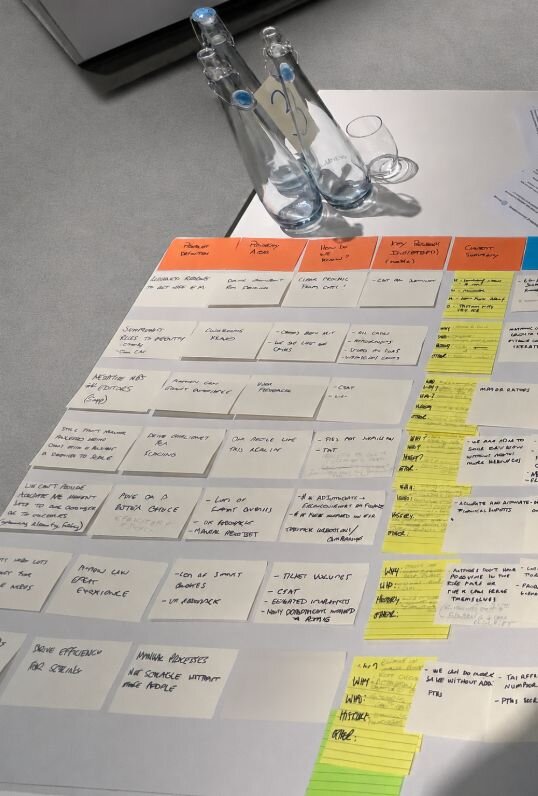
The growing speed and ease of development will elevate the importance of deciding what not to build. You will need to apply productjudgement and make decisions significantly more often. Should we build this new capability, or would it clash with the vision and overcomplicate the product? Does it make sense to add expensive AI assistance to this part of the customer journey, or is the value limited? Your ability to make those calls is your asset.
So the next time you wake up before your alarm, forget the scroll. Reach out to another product person. Prepare for the customer conversation you have been avoiding. Revisit the last feature request you said yes to, and the one you said no to. While everything around product management is changing, the core of the job is the same: to decide what problems are worth solving.
Images:
- Credit: Photo by Adrian Swancar on Unsplash [worried person looking down at the phone]
- Calendar mock-up [owned]
- Brainstorming - post-its [owned]
