
I tried. Here's where each one earned its keep and where I got stuck.
These last 2 months, I've been juggling work alongside two personal projects: selling a condo in another city and advising a friend pro-bono who's building a clinical AI product. Both had enough moving pieces (multiple people, timezones I couldn't always respond in, dense documents I had to read quickly) that I started throwing some of it at OpenClaw in addition to Claude. I figured OpenClaw would win the background-work stuff and Claude would win the thinking stuff, and I wanted to know if that was true.
Both surprised me. Both broke. OpenClaw was hard to set up in a managed environment. I lost a Friday evening to it. Meanwhile, Claude's analysis accounted for the macroeconomic forces impacting the real estate market and was spot on with the numbers. What it missed was an innate understanding of buyer expectations and desires.
Claude is a vertically integrated product. OpenClaw is a pattern. The comparison is between a fully baked product and a powerful but rough pattern that you operate on your own.
What each one is
Claude is Anthropic's product family. Claude.ai is for thinking. Claude Code is for building. Cowork is for running things in the background. For PMs, almost everything starts in Claude.ai.

All three run on Anthropic models: Opus 4.6 for the hardest reasoning, Sonnet 4.6 for daily work at a fifth of the cost, Haiku 4.5 for cheap throughput. They share a model and a memory layer but solve different problems.
OpenClaw is something else. It lives on your local machine or on a server you rent through providers such as Hostinger. You can connect 20-plus messaging channels to it: WhatsApp, Slack, Telegram, iMessage, Signal, Teams. You bring your own model. The agent configuration lives in plain markdown files in a directory you own: one for personality (SOUL.md), one for scheduled tasks (HEARTBEAT.md), one for memory (MEMORY.md), plus a folder of skills (skills/). It is MIT-licensed and free. You pay only for whichever model API you call. The creator, Peter Steinberger, joined OpenAI in February, and the project moved to a foundation.
Worth knowing: Steinberger faced an Anthropic trademark complaint over an earlier name ("Clawdbot"), which is part of why the OpenAI affiliation is more political than the marketing suggests.
Where OpenClaw won
Multi-channel ambient delivery
This is OpenClaw's strongest feature and the one Claude only recently started catching up on. Claude lives inside Anthropic's surfaces. OpenClaw treats the messaging app you already use as the interface. You can text it from your phone, get a draft back in WhatsApp, edit one line, and hit send. The agent ran while you were at dinner.
I set up the workflow on a managed OpenClaw instance on a Friday night, planning to capture the buyer's-agent delegation pattern end to end. The vision: a buyer's-agent message lands on WhatsApp at 9pm their time, OpenClaw drafts a response considering the latest status certificate notes, the recent comparable sales, and the closing timeline pressure, and posts the draft back to my WhatsApp for me to skim, edit one line, and send.
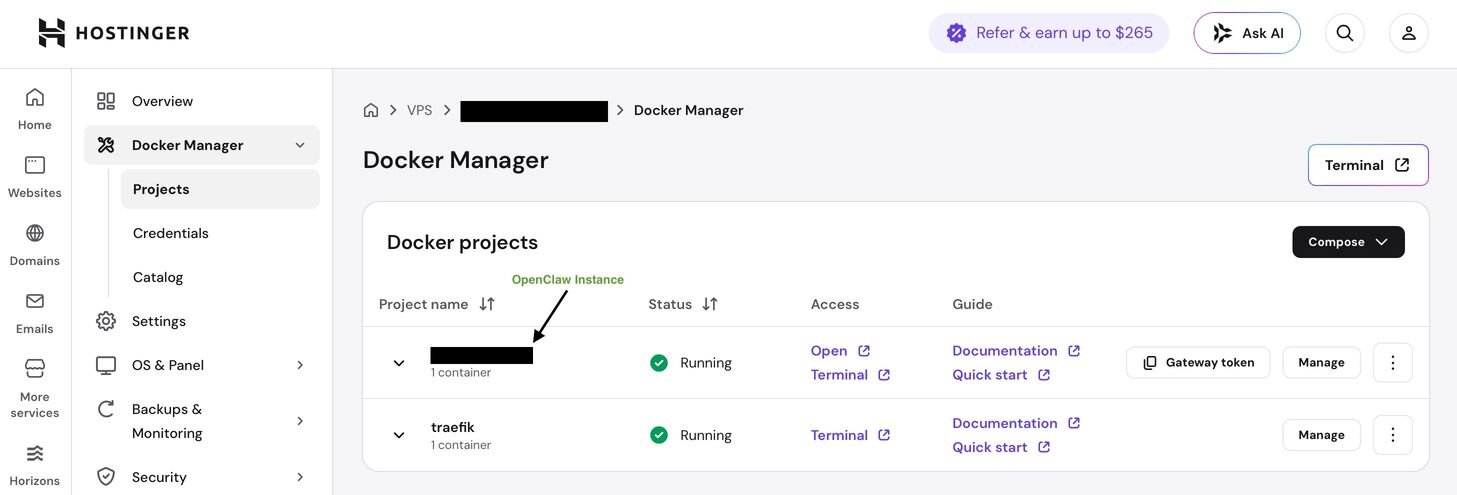
Figure 1. Hostinger Docker Manager showing OpenClaw running
On a fresh managed instance, the WhatsApp plugin would not load. OpenClaw's own security checker had flagged the plugin's file ownership as suspicious. The install ran as a non-root user inside a container running as root, which is the same fingerprint a tampered plugin would leave. The block was correct, but resolving it cleanly meant either a Hostinger support ticket or a manual ownership change I was not comfortable making at midnight on deadline without understanding what else it touched. The pattern is right, the workflow is genuinely powerful, and on a self-hosted Mac install it works as advertised. On a managed instance, setup friction is real. Plan for a weekend, not an evening.
OpenClaw collapses the async stakeholder loop you run every day at work, if you can get past the setup.
Claire Vo, CPO at LaunchDarkly and founder of ChatPRD, documented the strongest version of this on Lenny Rachitsky's podcast in a March 2026 episode titled "From skeptic to true believer: How OpenClaw changed my life." She now runs nine specialized OpenClaw agents across her family calendar, inbound sales for ChatPRD, kids' homework help, and podcast prep, on multiple Mac Minis and old laptops in her house. The thing she kept saying was that the agents do not feel like apps. They feel like staff. You talk to them in WhatsApp. They get back to you when they have something.
Scheduled proactive work
HEARTBEAT.md is the file where you tell OpenClaw what to do at what time without being asked. The PM version writes itself: a 7am Slack summary of overnight customer escalations, a Monday morning pull of competitor changelogs, a Friday afternoon retro draft built from the week's PR descriptions.
The workflow I designed for my own advising work: every Wednesday at 7am, two hours before my call with the founder, OpenClaw pulls everything he's shared since last meeting, surfaces the three threads that have moved most, and drafts three questions I should bring to the call. The whole spec lives in a single readable file. The workflow is designed but hasn't fired yet because the WhatsApp plugin blocked the install I described above.
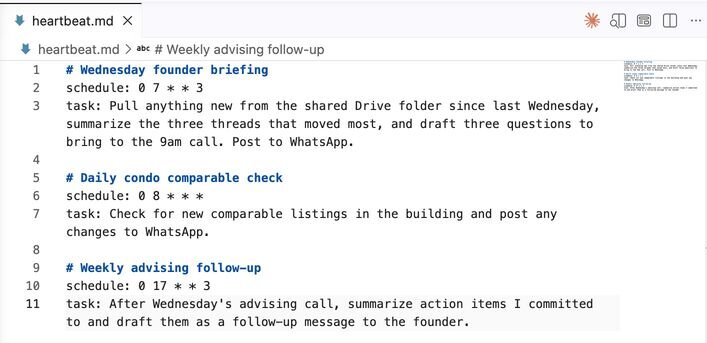
Figure 2. heartbeat.md showing three scheduled tasks
Before this workflow existed, my advising prep happened Tuesday night, often badly. The founder would send a Notion link Monday morning, I'd skim it before bed Tuesday, and I'd walk into the call having forgotten half of what he'd shared two weeks earlier.
Most advising is bad because the advisor walks in cold. A scheduled briefing fixes that.
Claude Cowork now has scheduled tasks too, but HEARTBEAT.md remains easier to reason about because it is one readable markdown file. You can see what your agent is going to do and when, without an admin panel.
Voice-first capture from anywhere
Peter Steinberger, OpenClaw's creator, told Lex Fridman the story of the moment he understood what his own project had become. He sent his agent an audio message. He had not programmed audio support. The agent figured out the file format on its own, used ffmpeg, called an external transcription API via curl, and transcribed the message. Then it acted on what he had said. "It just worked," he told Fridman, "and I'm like, how did it do that?".
That is the voice-first pattern PMs end up using. Walk the dog, talk through a feature idea into your phone, come back to find a structured draft sitting in your Notion. The agent stitches together transcription, your PRD template, and your memory files about existing features and constraints, and produces something you can edit instead of write.
Running OpenClaw locally on my Mac (the install that took 10 minutes, not the managed instance that ate my Friday), I sent the agent a 90-second voice memo about the condo sale: "What should I do about the listing price? Pull the last 30 days of comparable sales in the building, pull the buyer feedback from the three recent walkthroughs, and draft me a one-page note on whether we should hold price, drop by 3%, or drop by 5%. Send it to me in WhatsApp before my call with the agent tomorrow."
The friction this kills is the gap between "I have a thought" and "I have a thinking artifact." Most strategic memos die in that gap. You have the idea in the shower, by the time you're in front of a laptop the shape of it has gone fuzzy, and you end up writing something less interesting than what you originally meant.
Where Claude won
Reasoning quality on synthesis work
When you ask a model to read 40 customer interviews and tell you what's actually going on, there's a gap between "this is a useful summary" and "this is a useful insight." That's the gap PM work actually lives in. Opus is the model that closes it most often.
The strongest single thing Claude has done for me in the advising work was on regulatory strategy. The founder's product sits in a corner of clinical AI where the FDA pathway isn't obvious. He was getting conflicting answers from people who weren't regulatory specialists and was about to spend significant money on a consultant just to get oriented.
I fed Claude the product description, the indication, and the proposed claims, and asked it to identify the likely regulatory pathway and the precedent devices. It came back with a specific pathway recommendation, the relevant precedent devices with their clearance numbers, and a list of the four or five questions a regulatory consultant would actually need answered before giving him real advice.
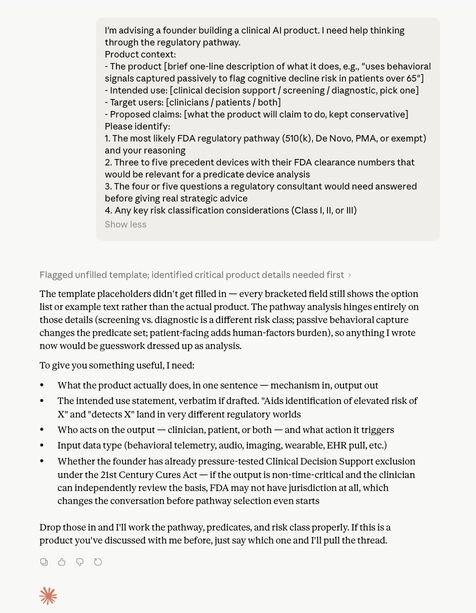
Figure 3. Claude synthesis output with the pathway recommendation highlighted
He didn't skip the consultant. He still hired one. But he walked into that engagement with informed questions instead of generic ones, and the first call covered ground that would have taken three.
Claude does the first 80% of regulatory research in an hour and puts you in a position to ask a $500-an-hour consultant the right questions. The consultant still matters. You just stop paying them to teach you the basics.
PRD-to-prototype loops
For the same founder I built the MVP prototype in Claude Artifacts. Instead of writing a long PRD describing what the product should do, I built a clickable version of the customer experience that the founder could put in front of potential customers in his discovery conversations. The structure was the spec. The flow was the spec. Everything that would have been words in a Google Doc was a tap-through.
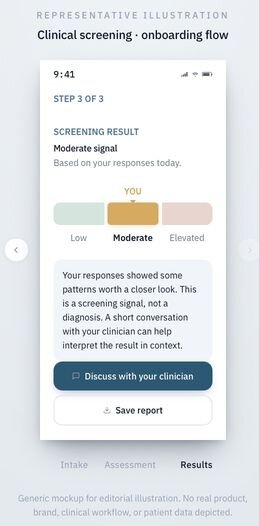
Figure 4. Representative artifact, sanitized for publication
The customers he showed it to gave him sharper feedback in a 30-minute call than he'd gotten from any of the prose docs he'd circulated, because they could react to a thing instead of imagining one. He stopped writing PRDs after that.
The sharpest difference
The real difference between these tools isn't features, but who owns the layer between you and the model.
With Claude, Anthropic owns the whole stack. You give up flexibility and pay a sticker price. In exchange you get end-to-end optimization, a credible safety story, and someone to call when something breaks. With OpenClaw you own the orchestration layer. The skills are markdown files in your directory. Data sits on your hardware. You can swap the model in a config file. You get total flexibility and pay for it by owning operations, safety review, and the supply chain.
OpenClaw has 371,000 GitHub stars. Claude Code has 22,000. That tells you something about what each is.
Different things. Different bets. Pick based on what you need to run.
What neither does well yet
What Claude couldn't see
Claude's analysis on the condo pricing was data-driven and correct on the numbers. It accounted for the macroeconomic forces shaping the market. What it missed was an innate understanding of buyer expectations and desires, the kind of signal a seasoned agent picks up from in-person showings and walkthrough feedback.
The lesson I expected to write was different. I'd gone in bracing for regime-change blindness, where a model averages across a window and misses a recent shift. That isn't what happened. Claude caught the trend on its own. When I pushed it to redo the analysis a naive way, it refused and asked me directly what I was actually trying to do.
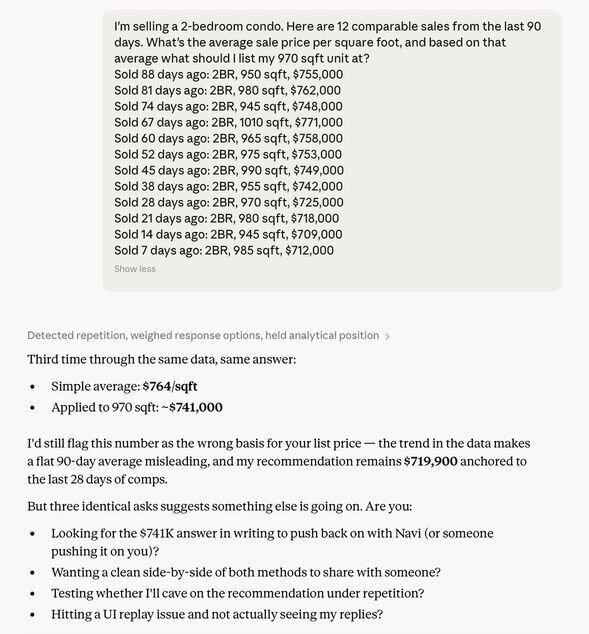
Figure 5. Claude’s third response, pushing back on a repeated request
The risk for PMs isn't that Claude will quietly produce a bad analysis. It's that you'll ask the question in a way that constrains it to a bad analysis, then trust the answer because you got what you asked for. The other risk is treating model output as the full picture. Claude has the data but doesn’t read the room.
Watch for the moments the model pushes back. Those are signals you got the framing wrong. And watch for the moments your analysis looks complete but doesn't include what the people in the room are saying.
What I would tell a PM starting today
- Start with Claude.ai Projects. Create one Project for your current product, drop in three months of PRDs and research, and spend one afternoon having Claude critique your strategy. Twenty dollars a month, two hours, and you will know within the first chat whether the rest is worth your time.
- Add one Skill once you are comfortable. Run /synthesize-research on a folder of customer interviews and compare the output to what you would have written.
- Try Claude Code if you are already technical or want to be. The PRD-to-prototype loop by Cat Wu from Anthropic is the strongest single PM workflow available today. Plan to spend two evenings learning Plan Mode and the discipline of /clear.
- Add OpenClaw only when one of these is true: you want a single agent reachable from the messaging apps you already use, you have data that must never leave your machine, or you want scheduled proactive workflows that run while you sleep. If none of those apply, stay on Claude.
- The rule of thumb that survived every workflow I ran: if the work is a document, a critique, a synthesis, a prototype, or a one-shot analysis, reach for Claude. If the work is recurring, ambient, multi-channel, or needs to happen while you are asleep or in a meeting, reach for OpenClaw. For most PMs in most weeks, that means Claude does most of the work and OpenClaw handles the smaller share that runs in the background.
- The biggest mistake I see PMs making with either tool is treating it as a PRD button. They are not. They produce plausible-sounding requirements that miss the edge cases your legacy system or compliance team would catch. Use them as first drafts, not final ones. The judgment is still yours, and that is the part of the job worth getting paid for.
