
This week, #mtpcon London returned to the Barbican Centre once again, and boy was it a day full of great product goodness.
From the talks on the mainstage and ProductTank stage, to the Speed Networking and Roundtable Discussions — there was a lot going on.
Themes of resilience, AI, and human judgment ran through almost every session, and we came away with plenty to think about.
Read on for our key learnings from product leaders including Christian Idiodi from SVPG, Jonathan Evens from Google DeepMind, April Dunford, Best-selling author, Charity Ibhadon from WPP, and so many more!
Invest in the product skills that matter
First up to the mainstage was Christian Idiodi, Partner at Silicon Valley Product Group, who opened the day by saying "Product management has drifted from invention into administration."
Through the story of "Jim" a PM so consumed by stand-ups, status updates, and stakeholder emails that he never actually builds anything, Christian stressed that using AI to go faster in the wrong direction is just a faster way to miss the point.
He said, "AI is meant to help us become better thinkers, to amplify our creativity, to increase our productivity in creation. That is the highest use of AI for our discipline." The product people who thrive in this era will be the ones who invest in product sense, business acumen, and the human judgment no model can replicate.
Launching AI products looks very different at $100M vs $100K budget
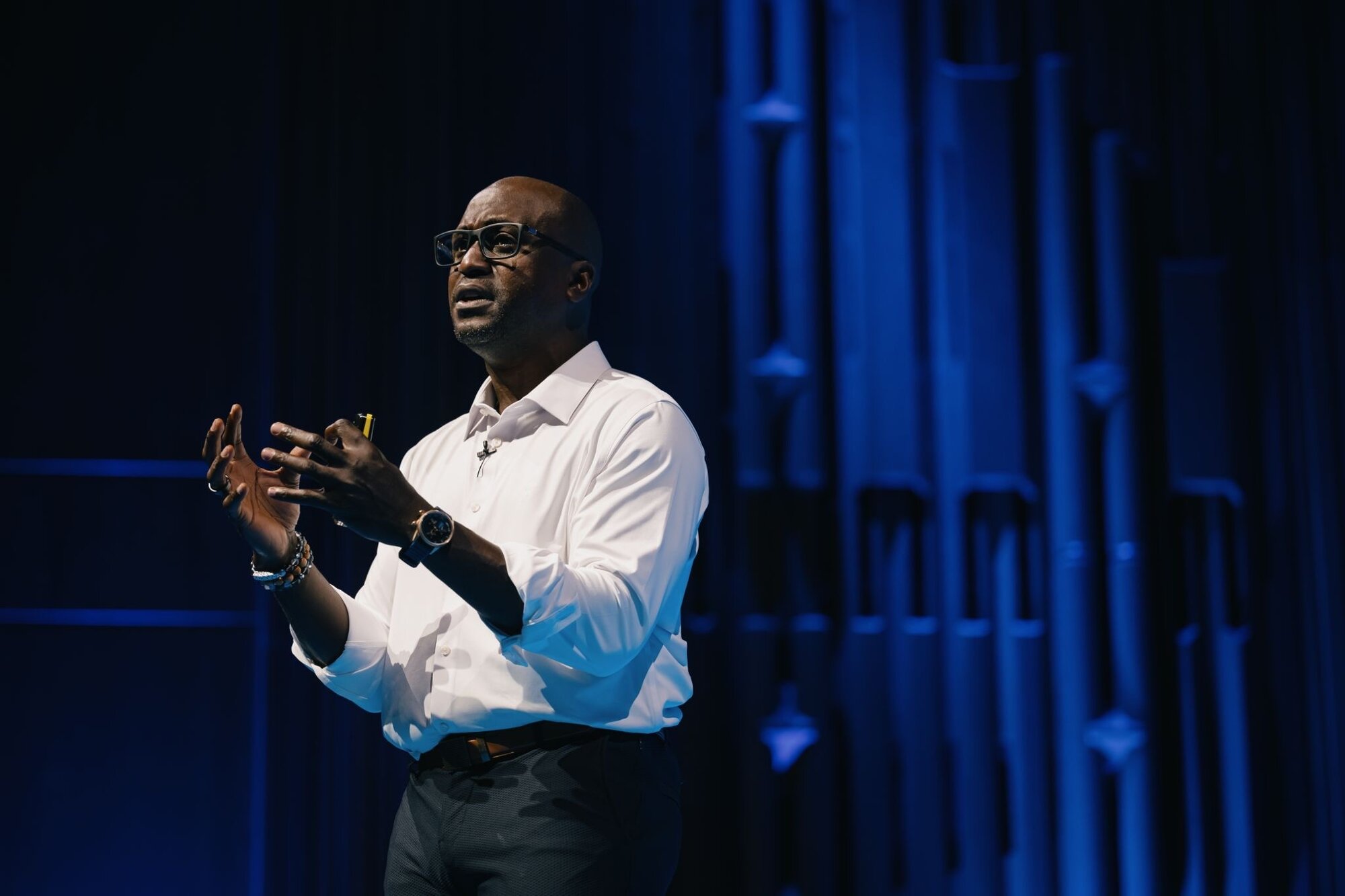
Next up on the mainstage was Jonathan Evens, AI Product Lead at Google DeepMind. He drew on two contrasting case studies to unpack what building with AI actually requires: launching personalisation inside Google Search, and then building an MVP from scratch at the Evens Foundation.
Working at Google on its new personalisation feature involved competing against a world-class existing product with billions of users, while the latter involved working with a team of under ten with no full-time developer, and an entirely novel AI research problem.
The lesson across both: at scale, you're evolving a product that users already trust. If you break that trust and you're done. On the flipside, at early stage, you're leaning 100% on the technology's capabilities. "If there's no technology, there's no product." In both cases, Jonathan noted that evaluations are non-negotiable, and spotting technical difficulties early is the difference between a demo and a real feature.
Product is hard. It should still be fun…sort of
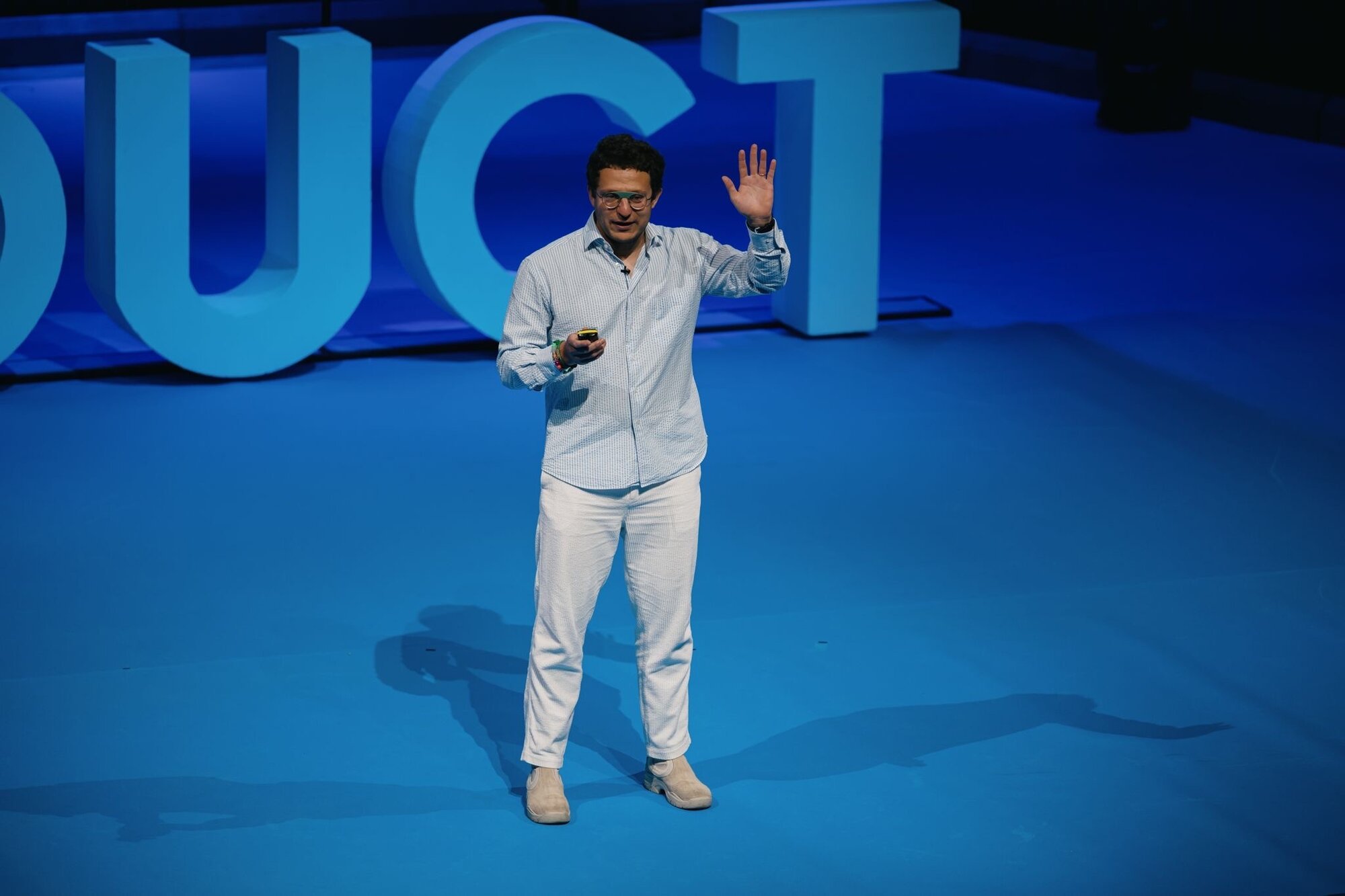
Charity Ibhadon, Global Product Director at WPP, delivered one of the most personally honest talks of the day, a tour through the structural chaos of the product role and offered an argument for why it's still worth showing up for. She pushed back on the "PM as CEO" framing and the ecosystem of fear-driven content that monetises insecurity rather than building capability. "Resilience is energy, perspective, and recovery. If any one of those breaks, everything will feel harder."
Her practical advice for Monday was as follows:
- Remove one unnecessary meeting
- Talk to one customer
- Unfollow one source of noise, and create one moment of genuine enjoyment in your week
"Product won't get easier…sorry. But the goal isn't to make things easy — it's to get better at enjoying something difficult."
Don't be an a**hole
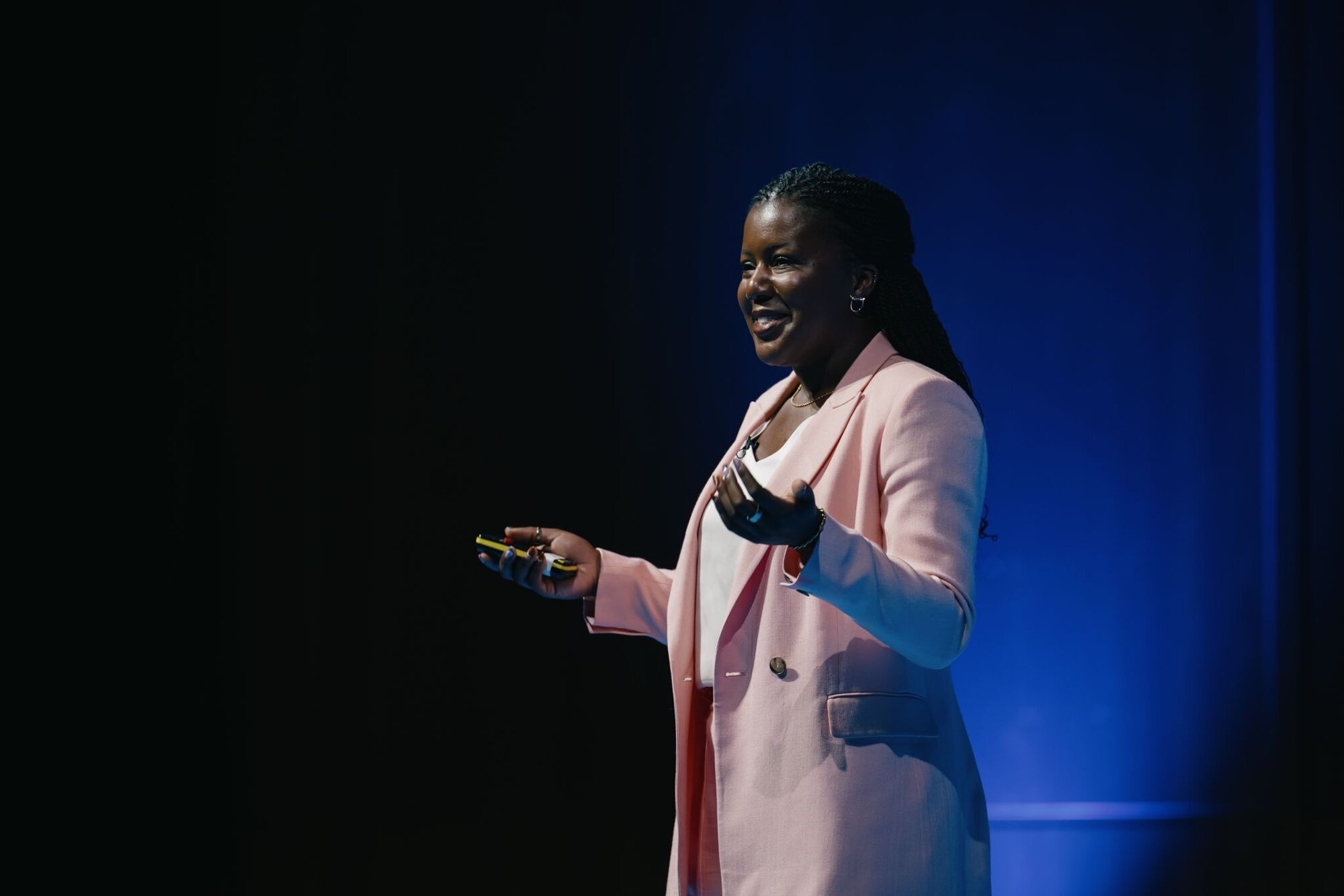
Simonetta Batteiger, Product Leadership Coach at Inclusive Leaders, brought another bold point of view over at the ProductTank stage. Amid slop, hallucinations, and prompt injections, she argued that the product community has been too focused on what to say no to, and not nearly specific enough about what it actually wants to build toward.
She shared with the audience a practical framework to help navigate the mess: trustworthiness needs to be explicitly codified. That means building in human autonomy, fairness, explicability, and harm prevention from the start.
Innovation in heritage organisations is possible. But you have to think big enough to match them
Ben Cook, Deputy Director of Product at NHS England, closed the mornings talks with ann inside look into building the NHS App, a product that’s used by 30% of England every month, with commitments to eradicate cervical cancer and reduce HIV transmission to zero by 2040.
When it comes to innovating in large insitutations, Ben explains that most product people approach them with the wrong frame.
He gave us two lessons that he carries everywhere: learn everyone's definition of value before trying to align it, because in fragmented organisations stakeholders have radically different views of success; and shift feasibility and viability testing left, because in constrained environments those are what will actually sink your product. "Think big, think radical, and go after the biggest opportunities you can, because it genuinely makes a difference." he closed.

Agents own the middle at Fin
John Moriarty, Director of Design at Fin (formerly Intercom), gave the most data-rich talk of the afternoon. At Fin, John explained how 94% of pull requests are now authored by Claude Code, the team tripled R&D productivity over the year, and nine major product launches shipped in two months. The bottlenecks have shifted from execution to problem framing, decision making, and quality judgment.
His urged attendees to get hands-on with new technology, because you can’t direct something you don't understand; make AI capability a shared standard, and start asking harder questions about what survives.
"Entire categories of product are becoming unnecessary. This is the question every product team is going to face: what's left of your product when AI handles the jobs it was designed to do?"
Rethink the broken product system
Dan Dalton, Director of Product Management at Sage, opened his ProductTank session with a forensic history of the profession — from product as a business function pre-2010, through the rise of Agile, the unicorn era, the cult of frameworks, and the mass layoffs of 2021–2024. His argument: the forces eroding the PM role aren't new, and AI isn't the real culprit.
What's actually hollowing out the discipline, Dan argued, is the system that elevated it: framework fundamentalism, thought leaders with under three years' experience dominating search results, and strategy theatre where PMs mistake documentation for thinking.
To escape this, Dan urges us to hone in on intuition (the bet), taste (the bar), and scars (the reason you trust either).
We're all learning
Faith Forster, founder of Discoveree, shared the most candid account of what actually happens when you build an AI-native product from scratch, including the moment an agent error triggered 100,000 failed LLM calls over a long weekend and drained her bank account. Her product went from idea to launch in under six months, built solo without a full-time engineer.
She said to the room “By the time you do your next quarterly roadmap planning, a product that doesn't exist today could be your biggest threat. When you're building with AI, the definition of "done" changes too.” She urged attendees to continue iterating until the product is well-adopted.
When your product becomes essential, you inherit a duty of care
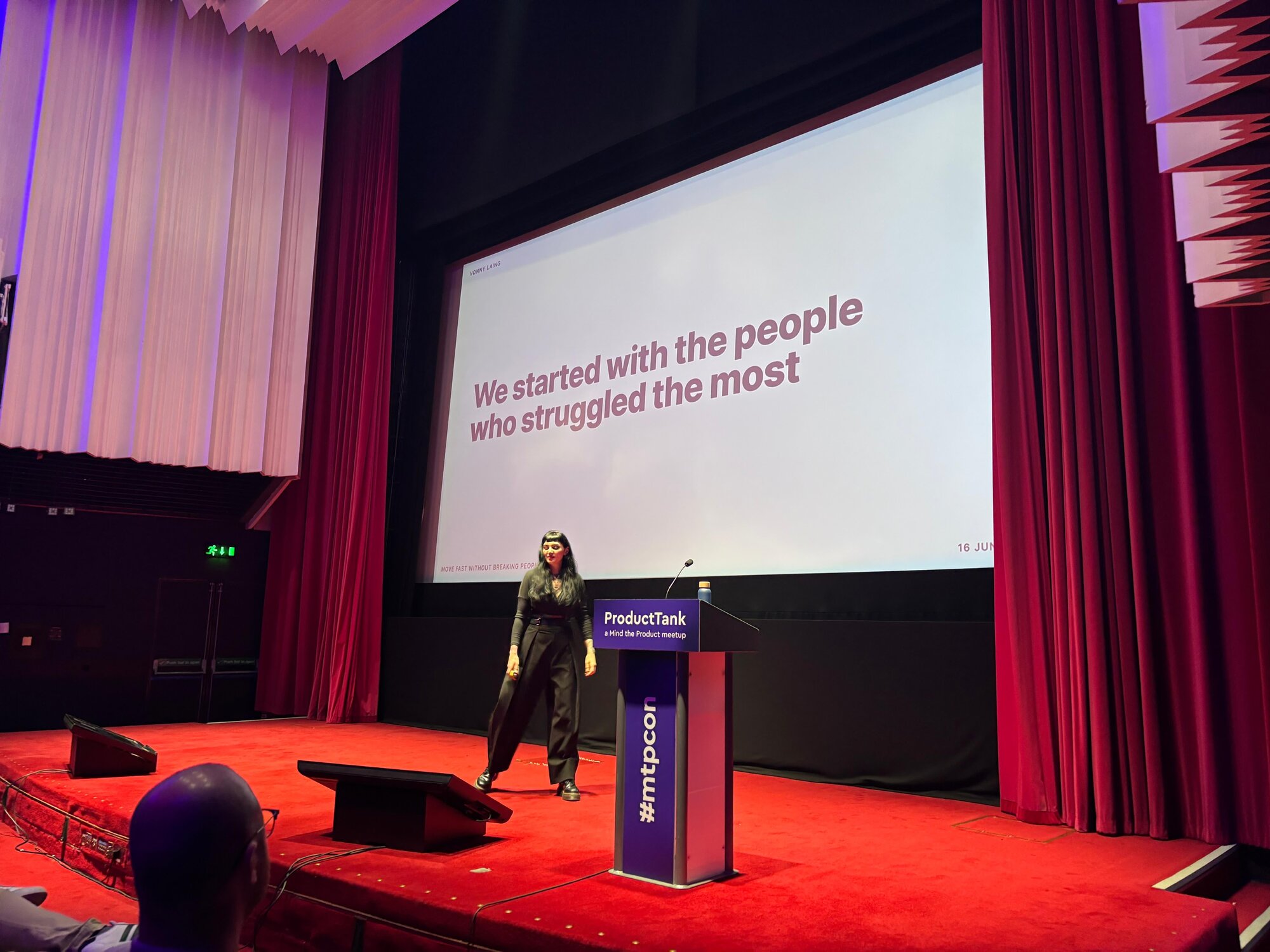
Vonny Laing, UX Lead at Student Loans Company, opened with a choice made at Tesco Bank. Instead of building for the core, mainstream user, the team at Tesco started at the edge, with families on the lowest incomes, managing persistent debt, stretching Clubcard vouchers to feed their kids. The insight was that designing for the hardest constraint makes the product better for everyone. Start at the margins, and the middle takes care of itself, she said.
Once a product becomes part of how someone manages rent, council tax, and groceries, the line between consumer product and essential service disappears. "You don't get a duty of care because you chose one, you inherited it when your product became essential." She shared two practices for acting on that:
- Design for who your users are becoming, not just who they are today
- Leave the building and go talk to your customers, because dashboards tell you what happened but they rarely tell you why
In the age of AI, you still need a point of view about your product
April Dunford, author of Obviously Awesome and Sales Pitch, brought product positioning into the AI era. She argued that the fundamentals haven't changed, but there are a hundred new ways to mess it up. The most important new requirement is having a clear point of view about where your market is heading. Customers are genuinely confused and they need someone to help them make sense of it.
Her second big argument was about timing: position for today's alternatives are not the ones you expect to face in two years. "I can only sell what's on the truck right now. If you try to sell too far into the future, the customer says come back when it's ready." Compete with who you're competing with now, but build for what's coming next.
Over the next few weeks, we'll be publishing full write-ups of all of the talks which will also include speaker slides, and videos. Stay tuned to the Mind the Product website for that!
Did we miss a lesson from this year's #mtpcon London that landed for you? Let us know at editor@mindtheproduct.com.
Until next time!
