
Fintech, e-commerce, and charitable giving are treated as distinct product domains, each with its own user motivations, but in terms of conversion, they face many of the same problems: building trust, reducing friction, communicating costs, offering the right payment methods, and bringing users back when they leave before completing a transaction.
A supporter on a nonprofit's website often has no account or saved payment relationship with the organisation, and may even have no established relationship with it at all. They're making a payment and a trust decision at the exact same time, often for the first time. Friction, an unexpected fee, or a missing payment method can be enough to lose the transaction, with no guarantee that person will return.
At Fundraise Up, an online donation platform used by nonprofits like UNICEF, Rainforest Trust, WHO Foundation, and many more, we ran experiments to address these conversion challenges. The results revealed lessons that extend beyond fundraising, offering learnings on checkout and conversion optimisations that other teams can adapt to their own products.
🧪 Metrics mentioned in the experiments passed the threshold for statistical significance (p-value < 0.05), confirming that these results are reliable.
🛒 The impact of e-commerce strategies on conversions
Experiment 1: Abandoned donations recovery
An abandoned donation doesn’t necessarily mean a lost conversion. People who abandoned the payment process had already shown an intent to give, so a timely reminder (for example an email) could potentially bring them back to complete their payment. E-commerce researchers have been studying this pattern for years, and the data revealed that abandoned-cart emails are most effective when sent promptly, while the purchase is still fresh in the customer’s mind. That’s why 98% of retailers reportedly send their first follow-up within 24 hours of abandonment. We decided to test whether the same logic applies to donations.
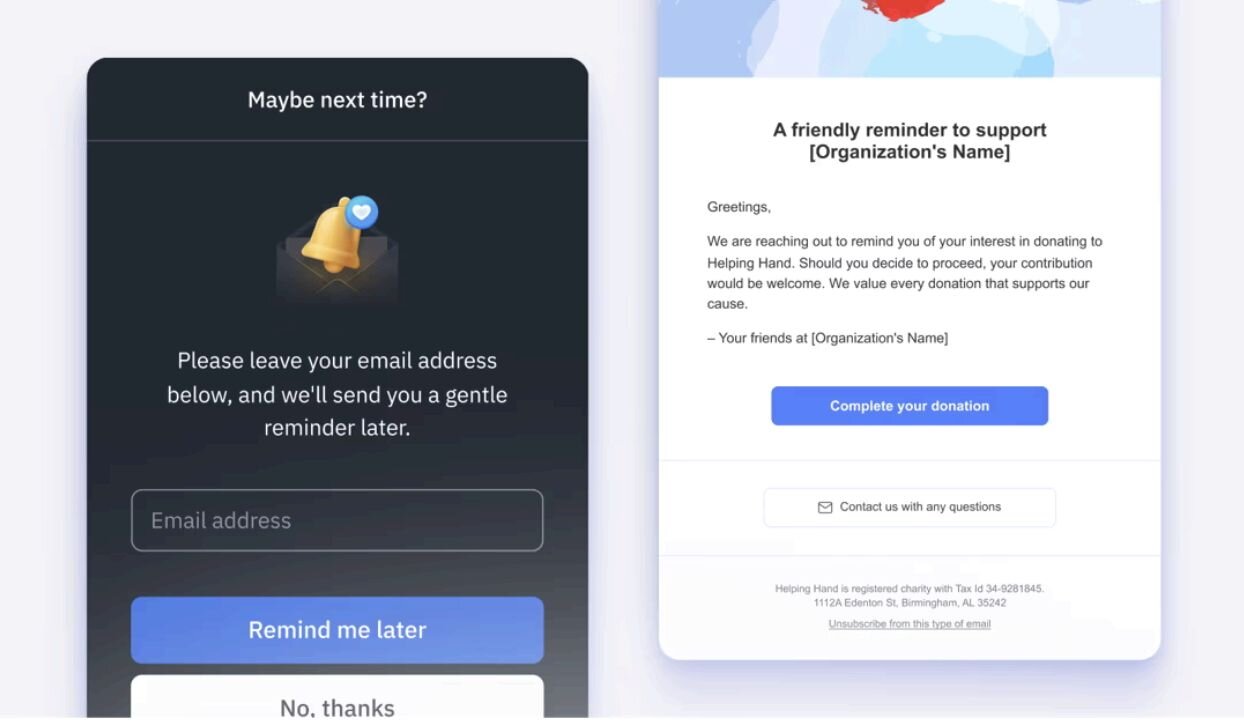
We ran an experiment in which we asked supporters entering the donation flow to provide their personal details, select a payment method or choose a campaign. If they attempted to leave the checkout at this point, they saw a gentle prompt: “Want a reminder later?”. Those who opted in were automatically enrolled in an email sequence, with their email address pre-filled. The emails reminded them of their initial intention to donate, with the option to unsubscribe at any time.
Test setup
Duration: 52 days
Audience: 100,000+ visitors
Goal: Convert at least 5% of email-opted-in abandoners into completed donations without reducing average ARPU (Average Revenue Per User).
Group split:
- 50%: Test (group with prompt displayed and activated email sequence after 1, 3, and 7 days after abandonment)
- 50%: Control (group without a reminder prompt)
Key metrics:
- Donation conversion rate (the percentage of visitors who completed a donation after receiving an abandoned donation email)
- ARPU
Results
- 10% of users who received emails ended up making a donation.
- ARPU remained strong
Learning
Timely reminders help reconnect donors with the initial motivation that prompted them to complete the transaction, before the emotional momentum fades. In this experiment, the abandoned donation sequence recovered 10% of incomplete donations without reducing ARPU, suggesting that donors who returned to complete their gifts contributed at a similar level to those who donated on their first visit.
The initial 1/3/7-day reminder cadence established a baseline for further optimisation, creating opportunities to test first-touch timing, sequence length, and segmentation based on how far supporters progressed through checkout.
Experiment 2: Adding an upsell to the one-time receipt email
Receipt emails are one of the most frequently opened communications from nonprofits, making them a valuable post-transaction opportunity to encourage supporters to take the next step in their giving journey.
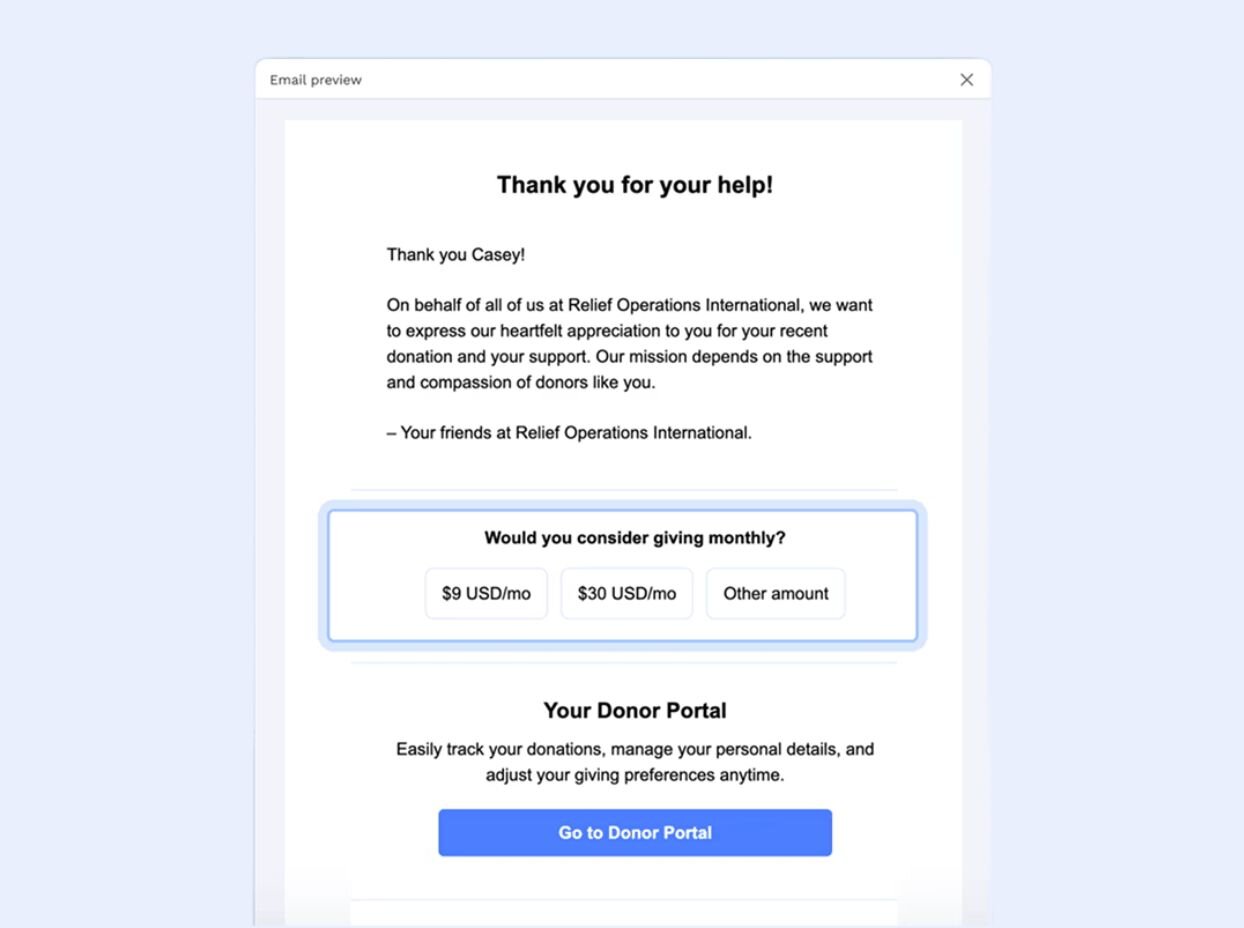
We wanted to test whether introducing a recurring giving prompt into one-time donation receipts could convert more supporters into monthly supporters. We added an upsell option directing donors to a one-click Recurring Confirmation Page, where they could set up a recurring donation through a pre-saved payment method, without logging in or entering their payment details again.
The goal was to enhance an existing touchpoint, turning a transactional email into an opportunity to increase recurring donations and build longer-term donor relationships.
Test setup
Duration: 44 days
Audience: ~200,000+ one-time English-speaking supporters
Goal: Adding a recurring-giving upsell to the one-time receipt email to increase recurring conversion by at least 1.5%.
Group split:
- Three preset amounts
- Two preset amounts + ability to enter custom amount option
- Single button linking directly to the Recurring Confirmation Page
Metrics
- Recurring conversion rate
- Email-to-donation conversion rate
- Average one-time gift (ARPPU)
Results
Although recurring conversion remained unchanged, the upsell option had a measurable impact on donation behavior:
| Metric | Result |
| Average donation amount | +6.19% with the two-preset + custom amount variation. |
| Upsell CR | −44.36% with direct, single-button variation. |
| Recurring conversion across any variation. | No statistically significant change |
| Email-to-donation CR | No statistically significant change |
Learning
The findings suggest that offering donors a choice of suggested amounts, alongside a custom option, is more effective at increasing donation value than presenting a single generic call to action. However, this did not translate into higher recurring conversions overall.
💳 The impact of payment methods on conversion
Integrating a variety of relevant payment methods in checkout help improve conversion. In fact, having limited payment options is a common direct abandonment trigger: 13% of shoppers in Baymard’s survey said they abandoned because they could not use their preferred payment method, and 10% cited limited payment options as a reason for abandonment.
Our donation data from 2021 proved the importance of offering multiple payment options. While credit cards remained the dominant method, accounting for 65% of donations, other payment methods also contributed meaningfully:
- Credit cards: 65%
- PayPal: 25%
- Apple Pay: 6%
- Google Pay: 3%
- Other: 1%
But optimising checkout around credit cards alone risks overlooking a substantial share of users’ preferences and creating extra friction for those with preferred alternative methods. This is particularly relevant on mobile, where manually entering card details on a small touchscreen takes time and effort, especially when users need to switch between apps or retrieve their card details.
We hypothesised that digital wallets could reduce this friction by allowing supporters to pay securely without having to manually enter their payment details or additional contact information.
We tested the integration of Google Pay and Apple Pay, with results that highlighted the importance of making payment options relevant to the user's parameters, such as device and browsing context:
- Google Pay availability increased conversion by 2.6%.
- Apple Pay availability increased conversion by 2%.
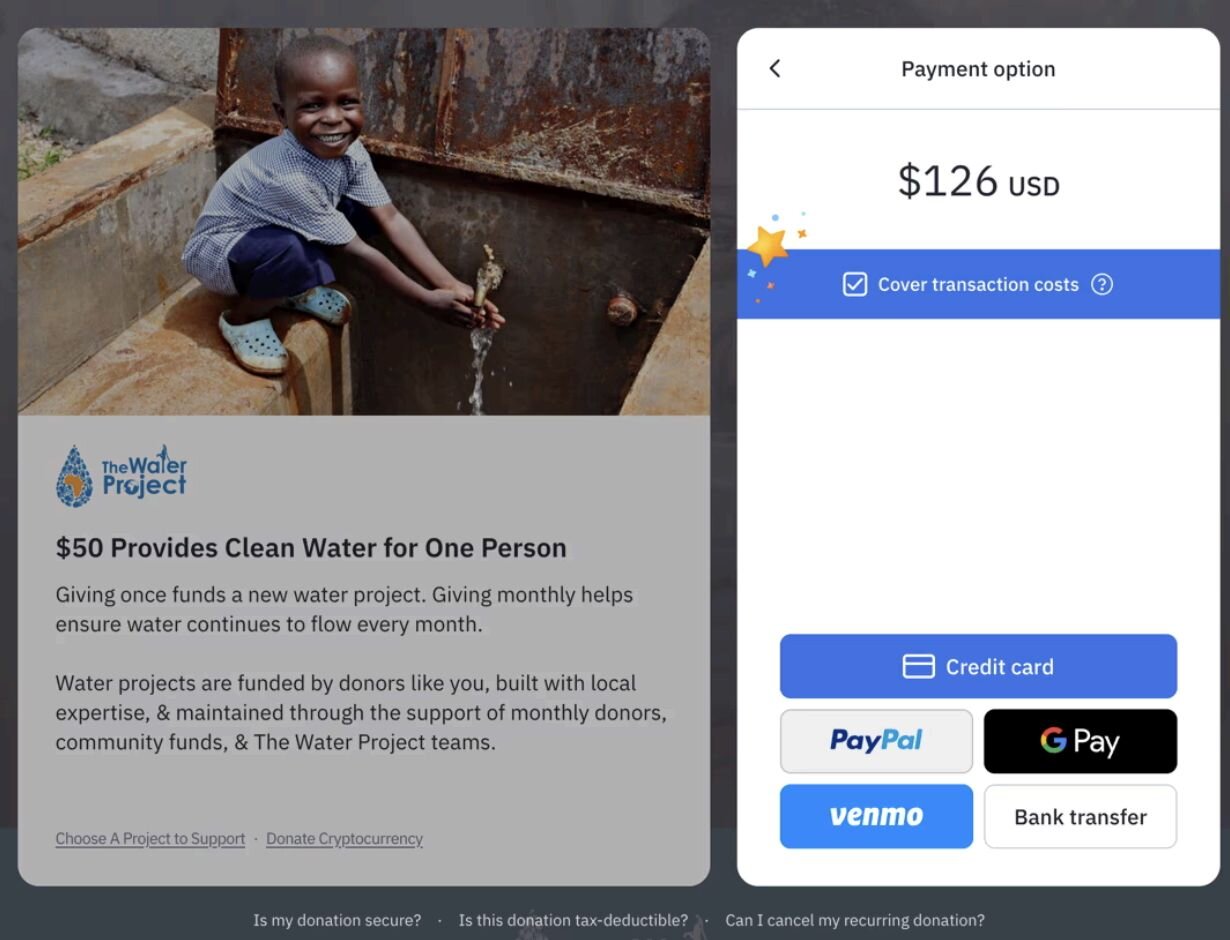
Then we examined how browser context affected the results, focusing on Google Pay among Chrome users and Apple Pay among Safari users. The findings revealed further opportunities to optimise the checkout experience for users’ browsing environments:
- Google Pay availability increased overall conversion among Chrome users by 4%.
- Apple availability increased overall conversion among Chrome users by 3.5%.
Offering more payment methods is only part of the solution. Payment options also need to be presented in ways that fit the user's context.
By making the relevant digital wallet easy to access based on users’ preferences, we reduced friction at the point of payment and improved checkout conversion.
Stock donations: More options doesn’t lead to more conversions
Beyond traditional payment methods, alternative options can help increase donation conversion, but their effectiveness depends on the audience and the context in which they're giving.
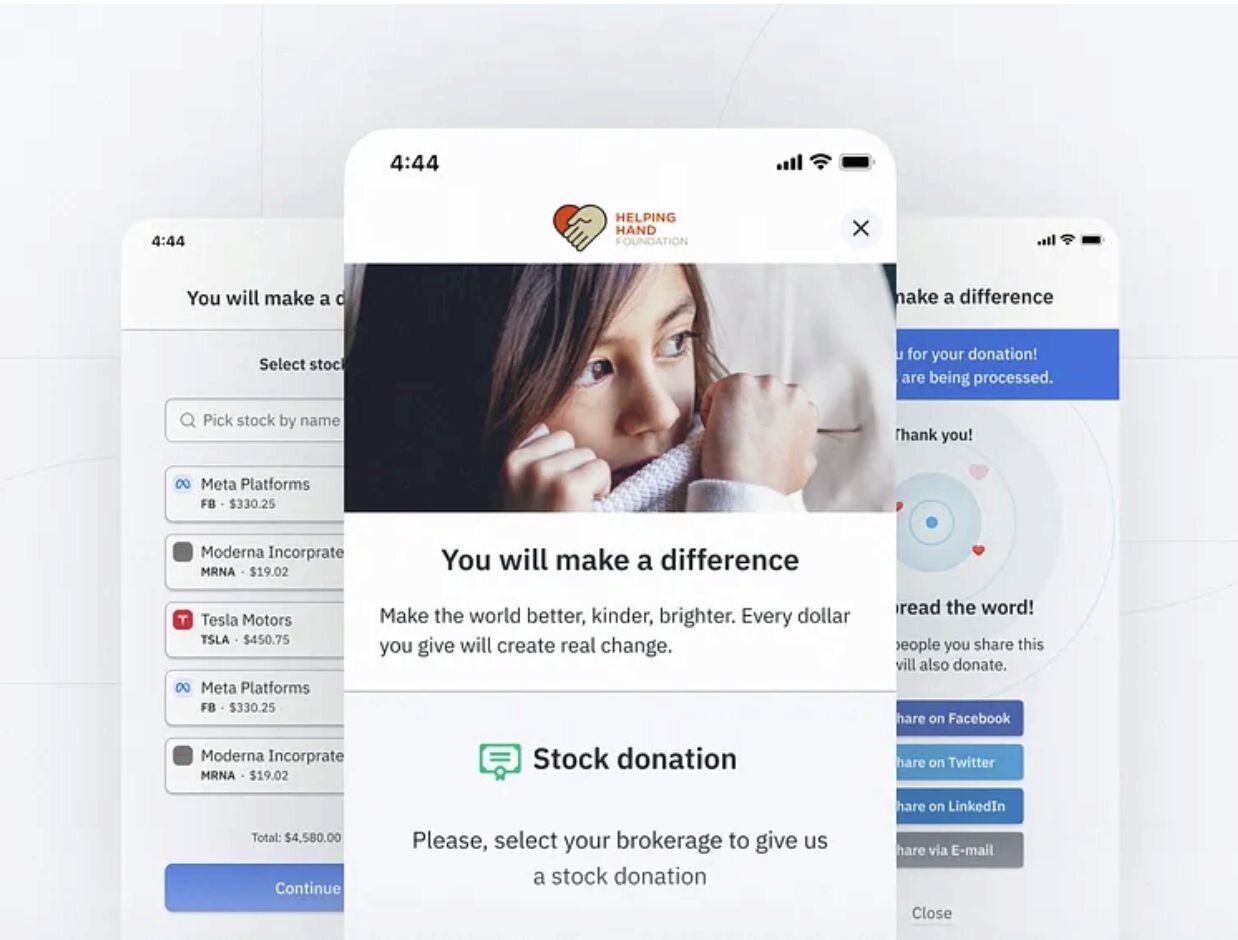
One of the alternative methods we tested was enabling direct stock donations through a third-party provider to potentially unlock additional charitable giving. The hypothesis behind this experiment was that eligible U.S. donors could give appreciated publicly traded stock directly to a qualified nonprofit, potentially avoiding capital gains tax on the appreciation while claiming an itemised charitable deduction based on the stock’s fair market value. In simple terms, donors could give more to a nonprofit without necessarily spending more out of pocket, making stock donations a potentially more tax-efficient way to support charitable causes.
Opportunity looked promising as the average one-time online donation was around $150, compared with approximately $5,000 for a stock donation. That meant even a relatively small number of stock donations could generate as much revenue as hundreds of traditional online gifts, making this an opportunity worth investigating.
Experiment
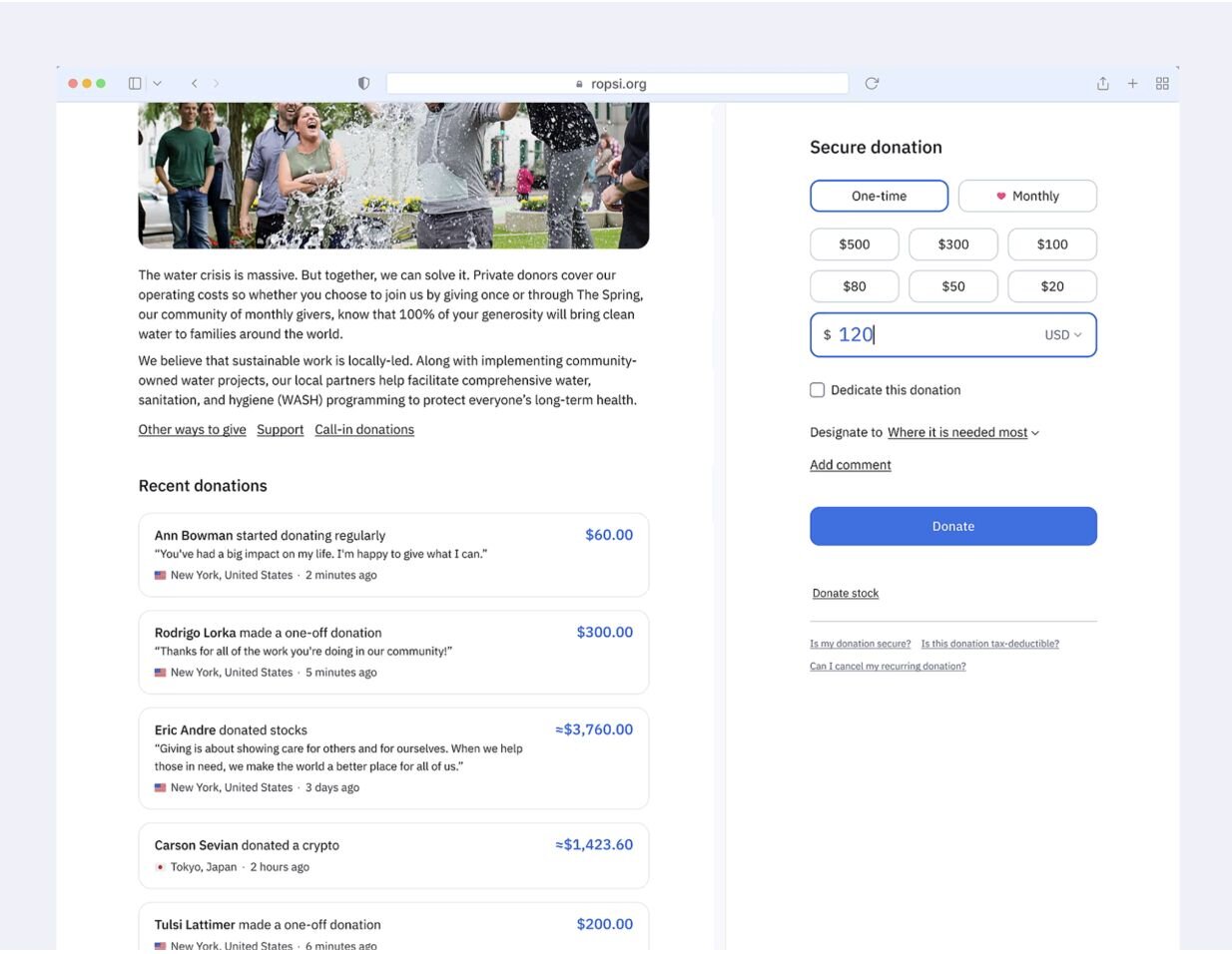
Donors accessing the checkout modal could select “Donate stock” through a link placed beneath the primary Donate button.
Test setup
Duration: 36 days
Audience: 50,000+ U.S.-based unique visitors in the test group who saw this alternative option.
Goal: 2–4% increase in overall donations.
Group split:
- 80%: Test (Stocks option enable)
- 20%: Control (Stocks option hidden)
Key metrics:
- Stock donation click-through rate (% of checkout visitors who clicked “Donate stock”)
- Stock donation share (% of donation of share made through stocks vs other types of donations)
- Stock donation revenue share
Results
| Metric | Result |
| Stocks CTR | 0.45% of visitors clicked the link |
| Donations through stocks | 0.15% of total donations came through stocks |
| Revenue attributed to stocks | 0.7% of the total donation amount |
Learning
The number of users who chose to donate stocks during the test was lower than expected, at less than 1% of all supporters. Most actually ignored the stocks option when it was presented in the checkout. “Donate stock” also added steps and time to the donation flow, as supporters had to choose suitable brokerage, find and select the specific stocks they wanted to give, which created friction that a standard donation doesn’t have.
Summary
These experiments highlight three things:
- A strong hypothesis forces you to think through the experiment before building it: what behavior you're trying to change, why you expect it to change, and what different outcomes would tell you. That way, even when the results don't match your expectations, you know what you've learned and what to do next.
- Users’ preferences matter just as much as functionality, and small differences in how people want to pay, give or engage have a measurable impact on conversion and donation value.
- Good product ideas don't have to come from within your own industry. The example of applying e-commerce practices like abandoned-cart recovery shows a surprising overlap between fintech and donations, provided the underlying user behavior and context are similar. The key is to understand why a practice works before applying it elsewhere.
For PMs, the practical move is to treat other industries as a source of testable hypotheses: map where your own funnel has a trust gap, a conversion friction point, or a drop-off, then borrow one tactic and test it with a clear hypothesis and success metric. The stronger that understanding of your audience’s behavior and context, the better the hypotheses you’ll generate and the more you’ll learn even when the results don’t go the way you expected.
Fintech, e-commerce, and charitable giving are treated as distinct product domains, each with its own user motivations, but in terms of conversion, they face many of the same problems: building trust, reducing friction, communicating costs, offering the right payment methods, and bringing users back when they leave before completing a transaction.
A supporter on a nonprofit's website often has no account or saved payment relationship with the organisation, and may even have no established relationship with it at all. They're making a payment and a trust decision at the exact same time, often for the first time. Friction, an unexpected fee, or a missing payment method can be enough to lose the transaction, with no guarantee that person will return.
At Fundraise Up, an online donation platform used by nonprofits like UNICEF, Rainforest Trust, WHO Foundation, and many more, we ran experiments to address these conversion challenges. The results revealed lessons that extend beyond fundraising, offering learnings on checkout and conversion optimisations that other teams can adapt to their own products.
🧪 Metrics mentioned in the experiments passed the threshold for statistical significance (p-value < 0.05), confirming that these results are reliable.
🛒 The impact of e-commerce strategies on conversions
Experiment 1: Abandoned donations recovery
An abandoned donation doesn’t necessarily mean a lost conversion. People who abandoned the payment process had already shown an intent to give, so a timely reminder (for example an email) could potentially bring them back to complete their payment. E-commerce researchers have been studying this pattern for years, and the data revealed that abandoned-cart emails are most effective when sent promptly, while the purchase is still fresh in the customer’s mind. That’s why 98% of retailers reportedly send their first follow-up within 24 hours of abandonment. We decided to test whether the same logic applies to donations.
We ran an experiment in which we asked supporters entering the donation flow to provide their personal details, select a payment method or choose a campaign. If they attempted to leave the checkout at this point, they saw a gentle prompt: “Want a reminder later?”. Those who opted in were automatically enrolled in an email sequence, with their email address pre-filled. The emails reminded them of their initial intention to donate, with the option to unsubscribe at any time.
Test setup
Duration: 52 days
Audience: 100,000+ visitors
Goal: Convert at least 5% of email-opted-in abandoners into completed donations without reducing average ARPU (Average Revenue Per User).
Group split:
- 50%: Test (group with prompt displayed and activated email sequence after 1, 3, and 7 days after abandonment)
- 50%: Control (group without a reminder prompt)
Key metrics:
- Donation conversion rate (the percentage of visitors who completed a donation after receiving an abandoned donation email)
- ARPU
Results
- 10% of users who received emails ended up making a donation.
- ARPU remained strong
Learning
Timely reminders help reconnect donors with the initial motivation that prompted them to complete the transaction, before the emotional momentum fades. In this experiment, the abandoned donation sequence recovered 10% of incomplete donations without reducing ARPU, suggesting that donors who returned to complete their gifts contributed at a similar level to those who donated on their first visit.
The initial 1/3/7-day reminder cadence established a baseline for further optimisation, creating opportunities to test first-touch timing, sequence length, and segmentation based on how far supporters progressed through checkout.
Experiment 2: Adding an upsell to the one-time receipt email
Receipt emails are one of the most frequently opened communications from nonprofits, making them a valuable post-transaction opportunity to encourage supporters to take the next step in their giving journey.
We wanted to test whether introducing a recurring giving prompt into one-time donation receipts could convert more supporters into monthly supporters. We added an upsell option directing donors to a one-click Recurring Confirmation Page, where they could set up a recurring donation through a pre-saved payment method, without logging in or entering their payment details again.
The goal was to enhance an existing touchpoint, turning a transactional email into an opportunity to increase recurring donations and build longer-term donor relationships.
Test setup
Duration: 44 days
Audience: ~200,000+ one-time English-speaking supporters
Goal: Adding a recurring-giving upsell to the one-time receipt email to increase recurring conversion by at least 1.5%.
Group split:
- Three preset amounts
- Two preset amounts + ability to enter custom amount option
- Single button linking directly to the Recurring Confirmation Page
Metrics
- Recurring conversion rate
- Email-to-donation conversion rate
- Average one-time gift (ARPPU)
Results
Although recurring conversion remained unchanged, the upsell option had a measurable impact on donation behavior:
| Metric | Result |
| Average donation amount | +6.19% with the two-preset + custom amount variation. |
| Upsell CR | −44.36% with direct, single-button variation. |
| Recurring conversion across any variation. | No statistically significant change |
| Email-to-donation CR | No statistically significant change |
Learning
The findings suggest that offering donors a choice of suggested amounts, alongside a custom option, is more effective at increasing donation value than presenting a single generic call to action. However, this did not translate into higher recurring conversions overall.
💳 The impact of payment methods on conversion
Integrating a variety of relevant payment methods in checkout help improve conversion. In fact, having limited payment options is a common direct abandonment trigger: 13% of shoppers in Baymard’s survey said they abandoned because they could not use their preferred payment method, and 10% cited limited payment options as a reason for abandonment.
Our donation data from 2021 proved the importance of offering multiple payment options. While credit cards remained the dominant method, accounting for 65% of donations, other payment methods also contributed meaningfully:
- Credit cards: 65%
- PayPal: 25%
- Apple Pay: 6%
- Google Pay: 3%
- Other: 1%
But optimising checkout around credit cards alone risks overlooking a substantial share of users’ preferences and creating extra friction for those with preferred alternative methods. This is particularly relevant on mobile, where manually entering card details on a small touchscreen takes time and effort, especially when users need to switch between apps or retrieve their card details.
We hypothesised that digital wallets could reduce this friction by allowing supporters to pay securely without having to manually enter their payment details or additional contact information.
We tested the integration of Google Pay and Apple Pay, with results that highlighted the importance of making payment options relevant to the user's parameters, such as device and browsing context:
- Google Pay availability increased conversion by 2.6%.
- Apple Pay availability increased conversion by 2%.
Then we examined how browser context affected the results, focusing on Google Pay among Chrome users and Apple Pay among Safari users. The findings revealed further opportunities to optimise the checkout experience for users’ browsing environments:
- Google Pay availability increased overall conversion among Chrome users by 4%.
- Apple availability increased overall conversion among Chrome users by 3.5%.
Offering more payment methods is only part of the solution. Payment options also need to be presented in ways that fit the user's context.
By making the relevant digital wallet easy to access based on users’ preferences, we reduced friction at the point of payment and improved checkout conversion.
Stock donations: More options doesn’t lead to more conversions
Beyond traditional payment methods, alternative options can help increase donation conversion, but their effectiveness depends on the audience and the context in which they're giving.
One of the alternative methods we tested was enabling direct stock donations through a third-party provider to potentially unlock additional charitable giving. The hypothesis behind this experiment was that eligible U.S. donors could give appreciated publicly traded stock directly to a qualified nonprofit, potentially avoiding capital gains tax on the appreciation while claiming an itemised charitable deduction based on the stock’s fair market value. In simple terms, donors could give more to a nonprofit without necessarily spending more out of pocket, making stock donations a potentially more tax-efficient way to support charitable causes.
Opportunity looked promising as the average one-time online donation was around $150, compared with approximately $5,000 for a stock donation. That meant even a relatively small number of stock donations could generate as much revenue as hundreds of traditional online gifts, making this an opportunity worth investigating.
Experiment
Donors accessing the checkout modal could select “Donate stock” through a link placed beneath the primary Donate button.
Test setup
Duration: 36 days
Audience: 50,000+ U.S.-based unique visitors in the test group who saw this alternative option.
Goal: 2–4% increase in overall donations.
Group split:
- 80%: Test (Stocks option enable)
- 20%: Control (Stocks option hidden)
Key metrics:
- Stock donation click-through rate (% of checkout visitors who clicked “Donate stock”)
- Stock donation share (% of donation of share made through stocks vs other types of donations)
- Stock donation revenue share
Results
| Metric | Result |
| Stocks CTR | 0.45% of visitors clicked the link |
| Donations through stocks | 0.15% of total donations came through stocks |
| Revenue attributed to stocks | 0.7% of the total donation amount |
Learning
The number of users who chose to donate stocks during the test was lower than expected, at less than 1% of all supporters. Most actually ignored the stocks option when it was presented in the checkout. “Donate stock” also added steps and time to the donation flow, as supporters had to choose suitable brokerage, find and select the specific stocks they wanted to give, which created friction that a standard donation doesn’t have.
Summary
These experiments highlight three things:
- A strong hypothesis forces you to think through the experiment before building it: what behavior you're trying to change, why you expect it to change, and what different outcomes would tell you. That way, even when the results don't match your expectations, you know what you've learned and what to do next.
- Users’ preferences matter just as much as functionality, and small differences in how people want to pay, give or engage have a measurable impact on conversion and donation value.
- Good product ideas don't have to come from within your own industry. The example of applying e-commerce practices like abandoned-cart recovery shows a surprising overlap between fintech and donations, provided the underlying user behavior and context are similar. The key is to understand why a practice works before applying it elsewhere.
For PMs, the practical move is to treat other industries as a source of testable hypotheses: map where your own funnel has a trust gap, a conversion friction point, or a drop-off, then borrow one tactic and test it with a clear hypothesis and success metric. The stronger that understanding of your audience’s behavior and context, the better the hypotheses you’ll generate and the more you’ll learn even when the results don’t go the way you expected.


